![How to Write a CV for Teaching Applications [2026 Guide]](/thumbnails/cv-for-teaching-applications.webp)
PDF or DOCX · up to 2MB
Learn how to write a teaching CV that gets interviews. Real template analysis, what principals look for, and common mistakes to avoid.
![PhD CV vs Resume: Which One to Send [2026]](/thumbnails/phd-cv-vs-resume.webp)
When a PhD needs an academic CV and when a one-page resume wins, what changes between them, and how to convert one into the other without starting again.
![Postdoc CV: Structure, Template and Example [2026]](/thumbnails/postdoc-cv.webp)
What a postdoctoral CV needs that a doctoral one does not: independence, funding, and a publication list a panel can audit. With a full worked example.
![Research CV: UK Format, Structure and Examples [2026]](/thumbnails/research-cv-uk.webp)
How to write a research CV for UK universities and institutes. The section order panels expect, how to list publications and funding, and how long it should actually be.
Short answer: Lead with qualified teacher status and the subjects and key stages or grades you are licensed for, then experience written as student outcomes, then curriculum, pastoral and extracurricular responsibility. Two pages in the UK, one to two in the US. Name the exam boards and the safeguarding training explicitly.
Writing a CV for teaching applications requires demonstrating two things: that you are credentialed to teach and that your students learn. Principals and hiring committees look for specific certifications first, then evidence of student outcomes.
Teaching remains one of the largest professions. According to the U.S. Bureau of Labor Statistics, there are over 1 million high school teachers in the United States, with projected growth as retirements create openings. STEM teachers are particularly in demand.
This guide breaks down exactly what education hiring committees look for, with a detailed example.
Education hiring is credential-driven but outcome-focused. Based on guidance from National Education Association resources and district hiring practices, here is what gets evaluated:
Credentials are non-negotiable. Without them, your CV will not be considered:
A principal needs to know you can legally walk into a classroom tomorrow. Put credentials first.
This is where most teaching CVs fail. Principals read dozens of CVs from people who "created engaging lesson plans." They want to see what worked:
"78% AP pass rate (school average 62%, state average 58%)" tells a principal exactly what you can deliver.
Experience matters, but context matters more:
A principal hiring for an AP Biology position wants to know you have taught AP Biology, not just "science."
Teaching extends beyond the classroom:
A robotics coach or debate advisor shows commitment to students beyond required hours.
Principals want teachers who continue developing:
Teaching CVs follow a specific structure. Here is what the template demonstrates:
Contact Information
Teaching Credentials (certifications first)
Education
Professional Experience
Awards
Volunteering
SkillsCredentials come first. Without a valid teaching license, nothing else matters. Put your certifications at the top where principals can immediately verify you are qualified.
Education follows credentials. Your degrees support your credentials. Include relevant coursework, thesis topics, and academic honours.
Experience shows impact. Each teaching role should include student outcomes, not just job duties.
Extracurriculars demonstrate commitment. Coaching, club advising, and volunteer work show you invest in students beyond the classroom.
Skills are organised by function. Teaching skills span curriculum, classroom management, and technology. Group them logically.
Let us analyse a high school teacher CV that demonstrates every principle discussed above.
Teaching CVs need to establish two things: credentials and impact. This one puts the teaching license first because without it, nothing else matters. The Single Subject credential in Biology tells an administrator you can walk into a classroom tomorrow.
The experience section focuses on outcomes, not activities. "78% AP pass rate" and "14% improvement on state standardised tests" are the metrics that matter. Principals read dozens of CVs from people who "created engaging lesson plans." Show them what worked.
The robotics coach role does double duty. It shows STEM depth and demonstrates commitment beyond contract hours. Schools want teachers who build community.
Notice this CV does not oversell. It is honest about being entry-level. The experience is substantial but not padded. An administrator can see exactly what they are getting.
Credentials appear first with full details:
TEACHING CREDENTIALS

Texas Standard Teaching Certificate | Texas SBEC | June 2022
- Secondary Science (Grades 7-12): Biology and Chemistry endorsements

ESL Supplemental Certification | Texas SBEC | August 2023

Gifted and Talented Certification | Texas SBEC | January 2024

AP Biology Certified | College Board | July 2022
Note the specificity: state, issuing body, date, and exact endorsements. A principal can immediately verify you are qualified for the position.
Education supports the credentials:
EDUCATION

MA Education, Science Teaching
University of Texas at Austin | Austin, TX | 2020-2022

- Graduate Teaching Fellowship recipient. GPA: 3.9/4.0.
- Thesis: 'Implementing Inquiry-Based Learning in High School Biology:
  Effects on Student Engagement and Scientific Reasoning Skills' (Distinction).
- Relevant coursework: Science Pedagogy, Curriculum Design, Assessment Methods,
  Educational Psychology, Learning Technologies.

BS Biology, Cum Laude
Texas A&M University | College Station, TX | 2016-2020

- Minor in Chemistry. GPA: 3.75/4.0. Dean's List 6 semesters.
- Undergraduate research assistant in molecular biology lab.
- Pre-Med Society, Peer Tutoring Program volunteer.
The education section includes thesis topic (relevant to teaching methodology), relevant coursework, and evidence of academic excellence. For teachers, this level of detail is appropriate.
Each role includes student outcomes:
Biology Teacher | Lake Travis High School | Austin, TX | 2022-Present

- Teach AP Biology, Biology, and Environmental Science to 145 students
  across 5 sections. Design and deliver curriculum aligned with TEKS standards.

- AP Biology results: 78% pass rate (school average 62%, state average 58%).
  23 students scored 5 in 2024, up from 14 in 2023. Mean score improved
  from 3.1 to 3.6.

- Developed hands-on lab curriculum using local Texas Hill Country ecosystems.
  Students conduct authentic field research including water quality monitoring
  and biodiversity surveys.

- Achieved 14% improvement on STAAR Biology EOC compared to prior year cohort.
  Implemented targeted intervention program for struggling students with
  85% success rate.
The bullets follow the pattern: Scope + Action + Measurable Outcome
Notice the comparison to benchmarks: "school average 62%, state average 58%." This context shows the achievement is meaningful, not just a number.
Beyond-classroom commitment is highlighted:
Robotics Coach | Lake Travis High School | Austin, TX | 2023-Present

- Lead advisor for 18-member FIRST Robotics Competition team.
  Regional finalists in 2024 and 2025. Qualified for State Championship in 2025.

- Secured $12,500 in grants and corporate sponsorships from Dell,
  National Instruments, and Austin Energy.

- Coordinate with engineering mentors from local tech companies.
  4 team alumni now studying engineering at UT Austin, Texas A&M, and Rice.
This shows STEM depth, fundraising ability, and student outcomes beyond the classroom.
A training placement is real classroom experience, so give it an entry in the experience section. The mistake is labelling it in a way that makes it sound like coursework.
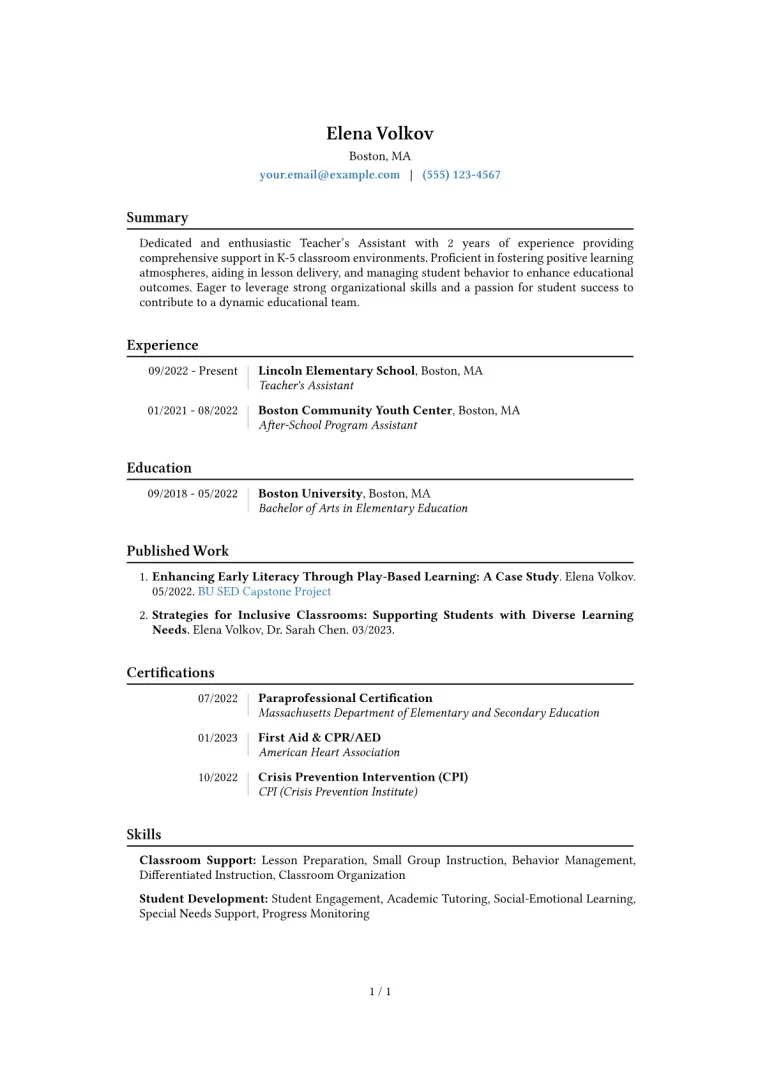
Once you have a post, the same entries stay and simply move down the page. A teacher's assistant CV shows how classroom experience is written up when a supporting role is the strongest thing you have.
Weak: Starting with education or experience
Strong: Teaching credentials at the top, immediately visible
Without valid credentials, your CV will not be considered. Make them impossible to miss.
Weak: "Created engaging lesson plans and differentiated instruction."
Strong: "78% AP pass rate (school average 62%, state average 58%). 14% improvement on state standardised tests."
Every teacher creates lesson plans. What matters is whether students learned.
Weak: "Responsible for teaching Biology to high school students."
Strong: "Teach AP Biology, Biology, and Environmental Science to 145 students across 5 sections. Design curriculum aligned with TEKS standards."
Specificity matters. Which courses? How many students? What standards?
Weak: Only listing classroom teaching
Strong: Including coaching, club advising, committee work, and volunteer activities
Schools want teachers who contribute to the community beyond their contracted hours.
Weak: Not listing ESL, Gifted and Talented, or other supplemental certifications
Strong: All certifications listed with issuing body and date
Supplemental certifications make you more versatile and valuable.
Different subjects have different expectations:
STEM Teachers:
English/Humanities Teachers:
Special Education:
New teachers should emphasise:
Experienced teachers should emphasise:
Public schools:
Private schools:
If you came to teaching through alternative certification:
JobSprout is designed to help you create professional CVs that meet education hiring standards. Here is how our tools can help with your teaching application:
Browse our template gallery to find templates designed for teaching applications. Every template uses the traditional formatting that principals and hiring committees expect.
Struggling to articulate your student outcomes? JobSprout's AI Writer helps you:
Our templates give teaching credentials appropriate prominence. The AI can help you format certifications correctly with issuing bodies and dates.
Our AI Cover Letter Writer creates personalised letters for each school. The Deep Research feature pulls real information about the school's programmes and priorities, so your cover letter demonstrates genuine knowledge of their community.
Many school districts use applicant tracking systems. JobSprout's templates are tested to parse correctly, ensuring your credentials and experience reach human reviewers.
Create and download your CV for free. No watermarks, no paywall when you are ready to apply. Export as PDF for consistent formatting.
One to two pages maximum. New teachers should fit on one page. Experienced teachers with extensive professional development and leadership roles may use two pages.
Include it if it is strong (3.5+ or equivalent) and you graduated within the last 5 years. For teaching, academic performance in your subject area and education courses matters.
Not required for initial certification in most states, but increasingly expected for career advancement. Many states require a master's degree within a certain number of years of initial certification.
Be prepared to explain briefly. If you used the time for professional development, childcare, or other productive activities, mention it. Focus on what you accomplished when you were teaching.
Include it if it is relevant to your subject area or demonstrates transferable skills. A former engineer teaching physics should include that background. Unrelated work experience can be brief or omitted.
You now know what principals look for: valid credentials, quantified student outcomes, and commitment to the school community.
Next steps:
No credit card required. No watermarks. Your CV, ready in minutes.