PDF or DOCX · up to 2MB
Upgrade your CV with powerful action verbs. Organised by skill type: leadership, teamwork, communication, analysis, creativity, and more. Stop using 'responsible for' and start getting interviews.

Whether to put a photo on your CV depends on the country. Where it is expected, where to leave it off, the usual sizes, and what makes a good one.

Your LinkedIn About holds 2,600 characters, but desktop shows about four lines before "see more". Where LinkedIn folds each section, and what to put first.

How to take a professional headshot at home with your phone: the lens, the light, the distance and the crop, plus when an AI headshot does a better job.
Every bullet point on your CV starts with a verb. The difference between a forgettable application and one that gets interviews often comes down to word choice.
"Responsible for managing a team" tells the recruiter nothing. "Led a team of 8 engineers to deliver a £2M project 3 weeks ahead of schedule" tells them everything they need to know.
This guide gives you 200+ action verbs organised by category, so you can find the perfect word for every achievement on your CV.
Recruiters spend an average of 6-7 seconds scanning a CV. In that time, they're looking for evidence that you can do the job.
Action verbs do three things:
Show ownership. "Managed" is stronger than "was responsible for." "Created" beats "helped with."
Demonstrate impact. Strong verbs suggest measurable results. "Increased," "reduced," "accelerated" all imply quantifiable outcomes.
Pass ATS filters. Many Applicant Tracking Systems scan for specific verbs. Using varied, industry-appropriate action words increases your chances of making it through.
Weak:
Strong:
The content is similar. The impact is completely different.
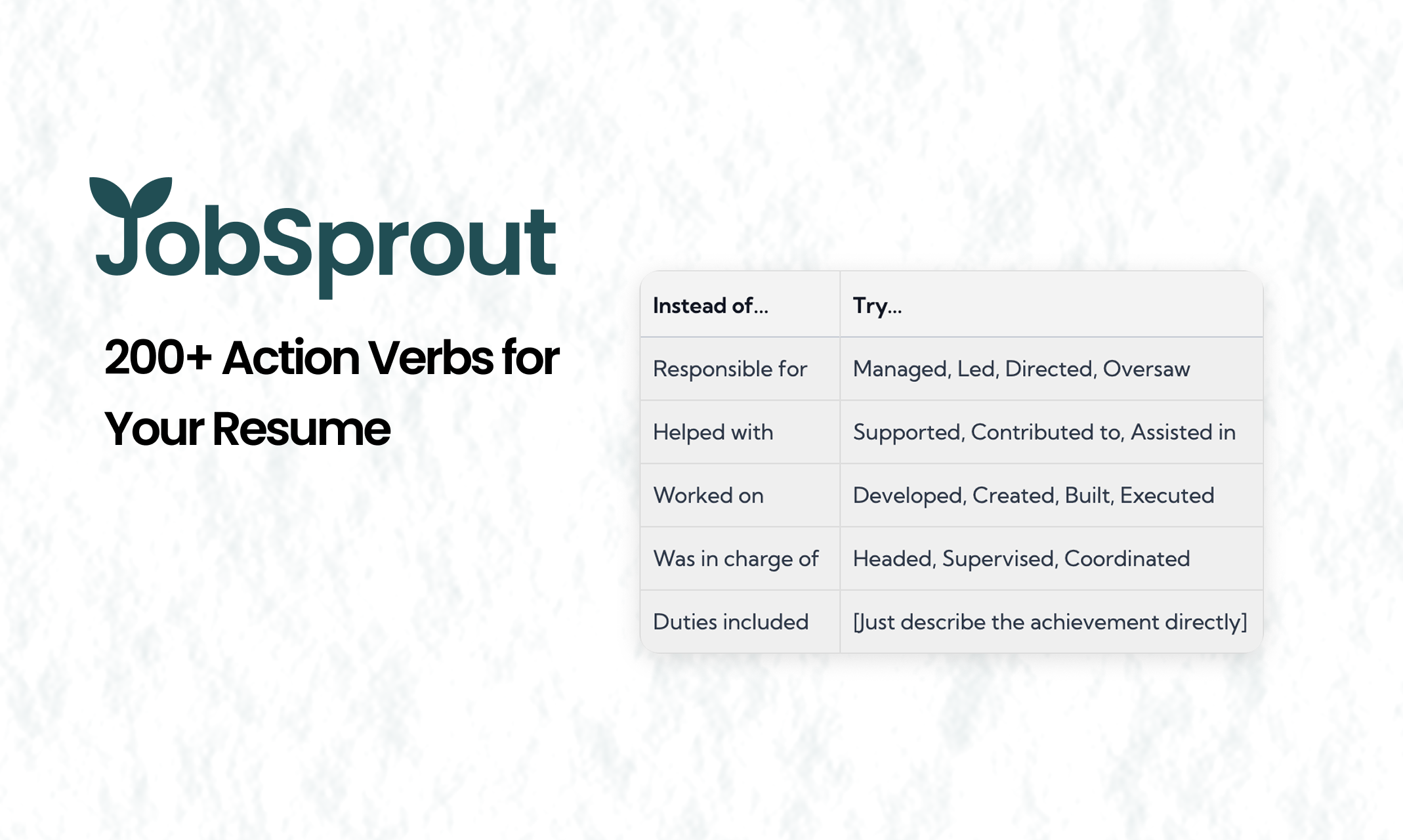
Before we get to the good stuff, here are words and phrases to cut from your CV immediately:
| Instead of... | Try... |
|---|---|
| Responsible for | Managed, Led, Directed, Oversaw |
| Helped with | Supported, Contributed to, Assisted in |
| Worked on | Developed, Created, Built, Executed |
| Was in charge of | Headed, Supervised, Coordinated |
| Duties included | [Just describe the achievement directly] |
These verbs are too vague to convey impact:
Use these when describing roles where you guided others, made decisions, or drove initiatives.
For Leading Teams:
For Strategic Leadership:
Example bullet points:
Use these when highlighting how you work with others.
For Team Contributions:
For Cross-Functional Work:
Example bullet points:
Use these for roles involving writing, speaking, or conveying information.
For Written Communication:
For Verbal Communication:
For Training & Teaching:
Example bullet points:
Use these when highlighting measurable accomplishments.
For Delivering Results:
For Improving Performance:
For Reducing/Saving:
Example bullet points:
Use these for roles involving data, investigation, or strategic thinking.
For Research:
For Problem-Solving:
Example bullet points:
Use these for roles involving design, ideation, or building new things.
For Creating:
For Innovating:
Example bullet points:
Use these for hands-on, technical, or operational roles.
For Technical Work:
For Project Execution:
Example bullet points:
Use these for revenue-generating and market-facing roles.
For Sales:
For Marketing:
Example bullet points:
Use these for roles involving money, planning, or organisational management.
For Financial Work:
For Administrative Work:
Example bullet points:
Don't just pick impressive-sounding words. Choose verbs that accurately reflect what you did.
If you were the decision-maker: Led, Directed, Decided, Authorised
If you contributed to a team effort: Collaborated, Supported, Contributed, Assisted
If you created something new: Built, Designed, Developed, Launched
Using "managed" 10 times makes your CV repetitive. Use different verbs for similar achievements:
The best CV bullets combine strong verbs with quantifiable results:
Verb + What + Result
For previous positions, use past tense (managed, led, created).
For your current role, you can use present tense (manage, lead, create) for ongoing responsibilities.
Many companies use Applicant Tracking Systems that scan for specific terms. Review job descriptions and incorporate relevant action verbs that appear in the posting.
Architected, Automated, Built, Coded, Debugged, Deployed, Developed, Engineered, Implemented, Integrated, Migrated, Optimised, Programmed, Refactored, Scaled, Tested
Analysed, Branded, Campaigned, Converted, Created, Drove, Engaged, Generated, Grew, Launched, Measured, Optimised, Positioned, Promoted, Targeted
Aligned, Budgeted, Coordinated, Delivered, Directed, Executed, Facilitated, Led, Managed, Monitored, Organised, Planned, Prioritised, Scheduled, Tracked
Acquired, Closed, Converted, Cultivated, Generated, Grew, Negotiated, Penetrated, Prospected, Retained, Secured, Sold, Upsold, Won
Conceptualised, Created, Designed, Developed, Illustrated, Innovated, Prototyped, Redesigned, Reimagined, Visualised
Analysed, Audited, Balanced, Budgeted, Calculated, Forecast, Managed, Projected, Reconciled, Reported
Coached, Coordinated, Developed, Facilitated, Hired, Implemented, Managed, Mediated, Mentored, Onboarded, Recruited, Trained
Yes, when appropriate. If the job description says they want someone who can "drive results" and "collaborate with stakeholders," use those exact verbs (with evidence to back them up).
Yes, this is best practice. Starting with an action verb immediately shows what you did, rather than burying your achievement in passive language.
Not inherently, but some are more specific. "Spearheaded" tells you more than "did." "Slashed costs by 30%" tells you more than "reduced costs." Choose verbs that convey the nature and scale of your work.
As many as you need to avoid repetition. If you have 15 bullet points, try to use at least 10-12 different verbs. Your CV should read like a varied professional story, not a repetitive list.
Not entirely. If you genuinely supported someone else's work rather than leading it, "assisted" or "supported" is honest and appropriate. But make sure you're not underselling contributions where you had more ownership.
Now that you have the right words, put them to work.
Create your CV with JobSprout and our AI will help you craft compelling bullet points with the right action verbs for your industry and experience level.
Last updated: January 2026