![How to Write a CV That Shows Startup Experience [2026 Guide]](/thumbnails/cv-for-startup-engineers.webp)
PDF or DOCX · up to 2MB
Learn how to write a CV that showcases founding engineer and startup experience. Real example from JobSprout's creator, what hiring managers look for, and how to position breadth as a strength.
![PhD CV vs Resume: Which One to Send [2026]](/thumbnails/phd-cv-vs-resume.webp)
When a PhD needs an academic CV and when a one-page resume wins, what changes between them, and how to convert one into the other without starting again.
![Postdoc CV: Structure, Template and Example [2026]](/thumbnails/postdoc-cv.webp)
What a postdoctoral CV needs that a doctoral one does not: independence, funding, and a publication list a panel can audit. With a full worked example.
![Research CV: UK Format, Structure and Examples [2026]](/thumbnails/research-cv-uk.webp)
How to write a research CV for UK universities and institutes. The section order panels expect, how to list publications and funding, and how long it should actually be.
Startup engineers face a unique CV challenge. You have built entire products from scratch, worn every hat imaginable, and shipped features that directly moved business metrics. But when you try to write it all down, it can look unfocused - like you could not decide what you wanted to do.
This guide is different from our general tech CV guide. That guide covers backend engineering with a focus on system scale and specialisation. This one is specifically for engineers who have worked at early-stage startups and need to translate that experience for their next role - whether at another startup or a larger company.
The example in this guide is my own CV. It landed me my current role at Lawhive after working as a founding engineer at a cleantech startup and then at Darktrace. I built JobSprout partly because I was frustrated with how hard it was to create a CV that properly represented startup experience.
At a startup, your job title rarely captures what you actually do. "Founding Engineer" might mean:
This breadth is valuable. But on a CV, it can read as "jack of all trades, master of none" if you present it wrong.
The key insight: you need to tell a story of intentional breadth, not accidental chaos.
I have been on both sides of the hiring table. Here is what hiring managers at different company types are looking for:
Startup hiring managers love startup experience. They want to see:
The risk they are evaluating: "Will this person need too much structure to be effective here?"
Larger company hiring managers are more cautious about startup experience. They want to see:
The risk they are evaluating: "Will this person struggle with our processes and team dynamics?"
Both want to see impact. The difference is how you frame it:
Here is the structure that works for startup experience:
Contact Information (including GitHub/Portfolio/LinkedIn)
Education
Professional Experience (reverse chronological)
Skills (grouped by category)
Projects (side projects that show initiative)Education early. Controversial take: for startup engineers applying to larger companies, education provides credibility that your startup experience might not. A Cambridge MPhil or Berkeley CS degree signals "this person can learn complex things" even if your startup failed.
Experience section carries the weight. This is where you translate startup chaos into structured achievements. More on this below.
Skills grouped by domain. Startup engineers often have broader skill sets. Grouping by domain (Frontend, Backend, Infrastructure) shows intentional breadth rather than random exposure.
Projects section matters. Side projects demonstrate that you build things because you want to, not just because someone pays you. For startup engineers, this signals the ownership mentality that made you effective at a startup.
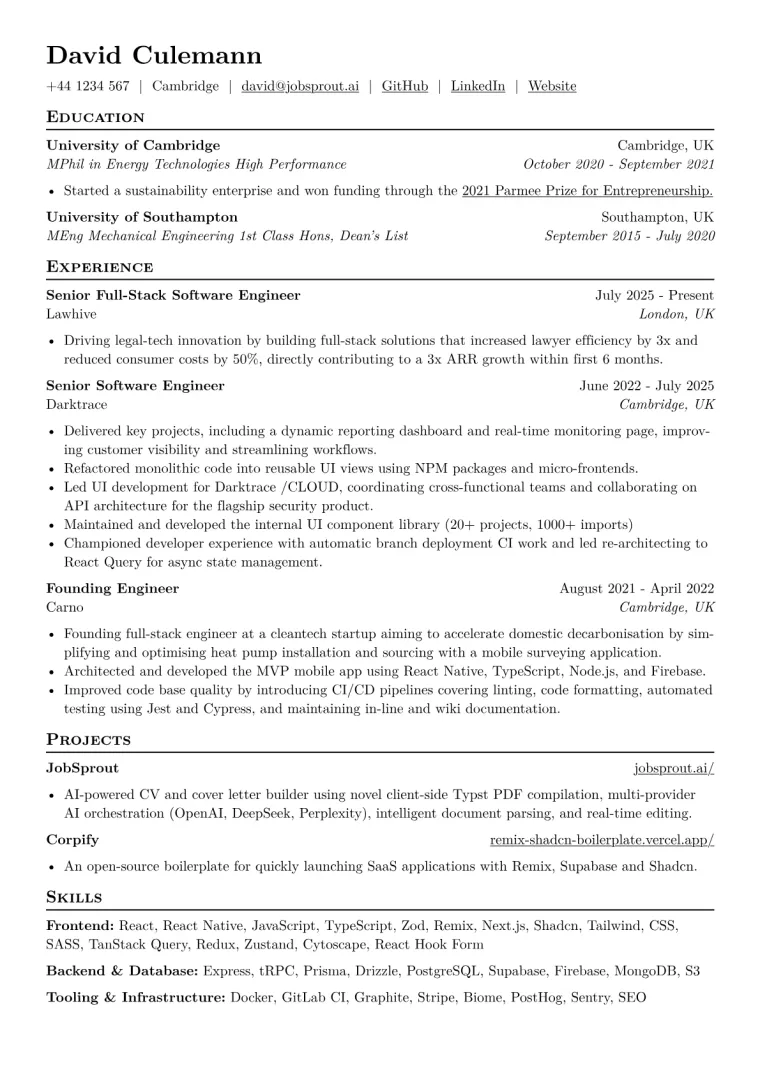
This is my actual CV. It got me hired at Lawhive after working as a founding engineer at Carno (a cleantech startup) and then at Darktrace.
The most important thing about this CV is what is not on it. Everything that does not directly support the target role has been cut. Many people think additional content cannot hurt - it can. Padding signals that you do not know what matters. A focused one-page CV shows confidence and clarity of thought.
Notice the header: name, contact, and three relevant links (GitHub, LinkedIn, personal site). Recruiters who want to dig deeper have clear paths to explore. This is strategic - it keeps the CV scannable while giving curious readers more to find.
The experience section tells a clear story: founding engineer at a startup, then senior role at a scale-up, then senior role at a fast-growing legal tech company. Each step shows progression and increasing scope.
Here is how I presented my founding engineer experience:
Founding Engineer | Carno | 2021-2022
Cambridge, UK

- Founding full-stack engineer at a cleantech startup aiming to
  accelerate domestic decarbonisation by simplifying and optimising
  heat pump installation and sourcing with a mobile surveying application.
- Architected and developed the MVP mobile app using React Native,
  TypeScript, Node.js, and Firebase.
- Improved code base quality by introducing CI/CD pipelines covering
  linting, code formatting, automated testing using Jest and Cypress,
  and maintaining in-line and wiki documentation.
What this does right:
Context first. The first bullet explains what the company does and why it matters. This is crucial for startups that hiring managers have never heard of.
Technical specificity. "React Native, TypeScript, Node.js, Firebase" tells a hiring manager exactly what stack I worked with. No guessing.
Process maturity. The CI/CD bullet shows I understand engineering best practices, not just hacking things together. This is important when applying to larger companies.
What is deliberately omitted:
The Darktrace section shows I can work in a larger organisation:
Senior Software Engineer | Darktrace | 2022-2025
Cambridge, UK

- Delivered key projects, including a dynamic reporting dashboard
  and real-time monitoring page, improving customer visibility and
  streamlining workflows.
- Refactored monolithic code into reusable UI views using NPM
  packages and micro-frontends.
- Led UI development for Darktrace /CLOUD, coordinating cross-functional
  teams and collaborating on API architecture for the flagship security product.
- Maintained and developed the internal UI component library
  (20+ projects, 1000+ imports)
- Championed developer experience with automatic branch deployment
  CI work and led re-architecting to React Query for async state management.
What this does right:
Scale indicators. "20+ projects, 1000+ imports" shows the component library had real adoption.
Leadership signals. "Led UI development" and "coordinating cross-functional teams" shows I can work with others, not just solo.
Technical depth. The React Query and micro-frontends bullets show I can make architectural decisions, not just implement features.
My skills are grouped by domain:
Frontend: React, React Native, JavaScript, TypeScript, Zod, Remix,
          Next.js, Shadcn, Tailwind, CSS, SASS, TanStack Query,
          Redux, Zustand, Cytoscape, React Hook Form

Backend & Database: Express, tRPC, Prisma, Drizzle, PostgreSQL,
                    Supabase, Firebase, MongoDB, S3

Tooling & Infrastructure: Docker, GitLab CI, Graphite, Stripe,
                          Biome, PostHog, Sentry, SEO
Why this grouping works:
The projects section shows initiative:
JobSprout
AI-powered CV and cover letter builder using novel client-side
Typst PDF compilation, multi-provider AI orchestration (OpenAI,
DeepSeek, Perplexity), intelligent document parsing, and real-time editing.

Corpify
An open-source boilerplate for quickly launching SaaS applications
with Remix, Supabase and Shadcn.
Why include side projects:
Weak: "Handled frontend, backend, DevOps, hiring, customer support, and office management."
Strong: "Architected and shipped the MVP mobile app using React Native and Firebase, establishing the technical foundation for the product."
Pick the 2-3 most impressive things you did. The rest can come up in interviews.
Weak: "Founding Engineer at Carno"
Strong: "Founding Engineer at Carno, a cleantech startup simplifying heat pump installation"
Hiring managers have not heard of your startup. Give them one sentence of context.
Weak: "Built the mobile app"
Strong: "Built the mobile app from scratch, now used by 500+ installers across the UK"
If your startup had any traction, mention it. Even small numbers are better than no numbers.
Weak: "Thrived in a fast-paced, ambiguous environment with constantly changing priorities"
Strong: (Just show it through your achievements, do not say it)
Everyone claims they can handle ambiguity. Your achievements should demonstrate it.
A CV for another startup should emphasise different things than a CV for Google. Tailor your framing:
Startups fail. This is normal. Here is how to handle it:
Startup titles are often inflated or meaningless. Here is how to translate:
Honesty builds trust. Inflated titles get caught in reference checks.
Startup engineers often understand business context better than engineers at larger companies. Show this:
Connect your technical work to business outcomes.
The "jack of all trades" concern is real. Counter it by showing depth in at least one area:
I built JobSprout because I was frustrated with how hard it was to create a CV that properly represented my startup experience. Here is how it helps:
Browse our template gallery to find templates that work for startup engineers. Every template is ATS-optimised and professionally typeset - no formatting headaches.
Struggling to translate "I did everything" into structured achievements? JobSprout's AI Writer helps you:
Applying to both startups and larger companies? Create multiple versions of your CV, each tailored to what that type of company values. JobSprout's one-click job tailoring makes this easy: paste the job description and our AI creates a tailored version in seconds, with a word-level diff showing every change.
Our AI Cover Letter Writer creates personalised letters that explain your startup background in context. The Deep Research feature pulls real information about the company, so your letter addresses their specific concerns.
JobSprout uses Typst for professional typesetting. Your CV will look polished without you adjusting margins, fonts, or spacing manually.
Create and download your CV for free. No watermarks, no paywall when you are ready to apply.
Yes. Hiring managers understand that startups fail. What matters is what you built and learned. Hiding it creates suspicious gaps.
Be honest and brief:
Do not badmouth founders or investors.
It depends on the role and team. Some teams specifically seek startup experience for its ownership mentality. Others prefer candidates with experience in large codebases and processes.
Research the team you are applying to. If they are building something new within the company, startup experience is often valued.
There is no magic number. What matters is what you accomplished. Two years at a startup where you shipped a product is more valuable than four years at a startup that never launched.
No. Equity is private financial information and irrelevant to your qualifications.
You now know how to translate startup experience into a CV that works for your next role - whether that is another startup or a larger company.
Next steps:
No credit card required. No watermarks. Your CV, ready in minutes.