![How to Write a CV for Tech Applications [2026 Guide]](/thumbnails/cv-for-tech-applications.webp)
PDF or DOCX · up to 2MB
Learn how to write a software engineering CV that gets interviews. Real template analysis, what hiring managers look for, and common mistakes to avoid.
![PhD CV vs Resume: Which One to Send [2026]](/thumbnails/phd-cv-vs-resume.webp)
When a PhD needs an academic CV and when a one-page resume wins, what changes between them, and how to convert one into the other without starting again.
![Postdoc CV: Structure, Template and Example [2026]](/thumbnails/postdoc-cv.webp)
What a postdoctoral CV needs that a doctoral one does not: independence, funding, and a publication list a panel can audit. With a full worked example.
![Research CV: UK Format, Structure and Examples [2026]](/thumbnails/research-cv-uk.webp)
How to write a research CV for UK universities and institutes. The section order panels expect, how to list publications and funding, and how long it should actually be.
Writing a CV for tech applications requires a different approach than other industries. Software engineering hiring managers are looking for specific signals - technical depth, quantified impact, and evidence that you can ship code that works at scale.
The good news: according to the U.S. Bureau of Labor Statistics, software developer roles are projected to grow 17% between 2023 and 2033. The competition is real, but so is the demand. A well-structured CV can be the difference between landing interviews and getting filtered out.
This guide breaks down exactly what tech recruiters look for, with a detailed example.
According to Tech Interview Handbook and insights from Stack Overflow's hiring manager research, here is what gets evaluated in those crucial first seconds:
The skills section on a tech CV functions differently than in other industries. Hiring managers scan for specific technologies that match their stack. They are looking for:
A hiring manager at a Go shop will scan for "Go" or "Golang" before reading anything else. If it is not there, your CV might not get a second look regardless of how transferable your skills are.
This is where most tech CVs fail. According to Resumatic's analysis, "Writing 'Implemented Redis caching' means nothing without explaining the performance improvements it delivered."
Strong tech CVs answer: "What got better because you were there?"
Senior roles especially require evidence that you have worked on non-trivial systems. Hiring managers look for:
Your career progression tells a story. Moving from junior to senior responsibilities, taking on technical leadership, expanding your scope - these patterns signal someone who is still growing.
Unlike other industries, tech hiring managers can often verify your work. GitHub profiles, open source contributions, and portfolio links give them confidence that your CV claims are real.
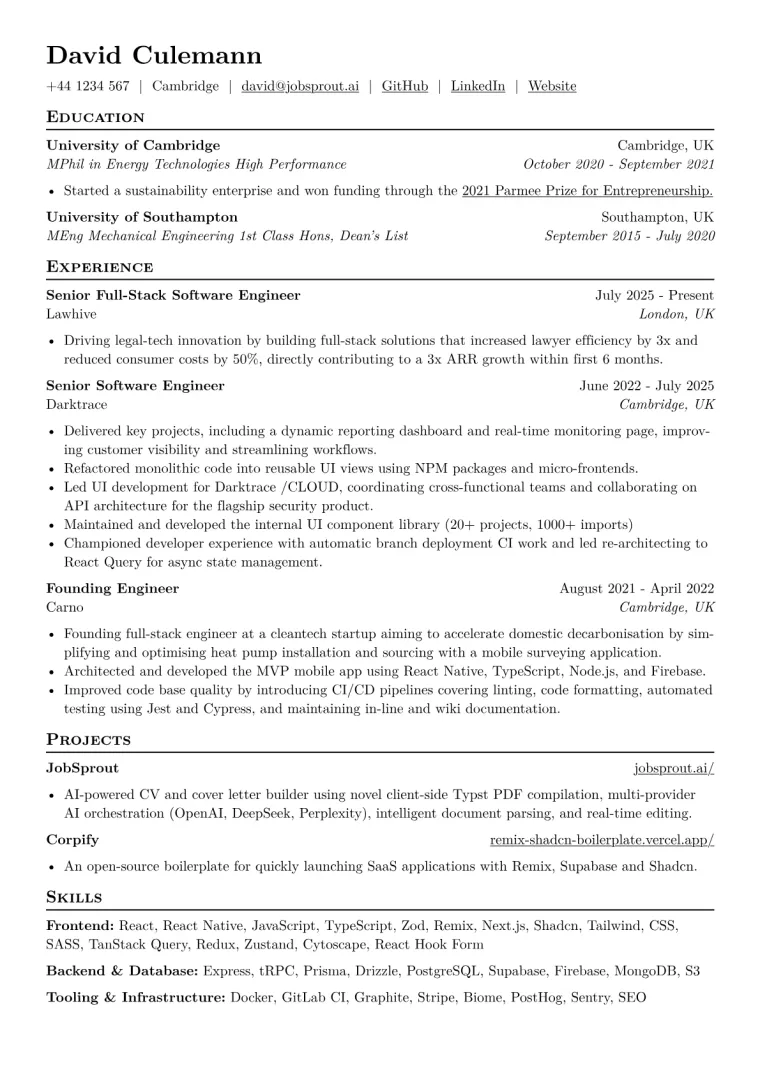
Tech CVs follow a specific structure. Here is what the template demonstrates:
Contact Information (including GitHub/Portfolio/LinkedIn)
Education
Professional Experience (reverse chronological)
Skills (grouped by category)
Projects (optional but valuable for juniors)Education comes early. For most tech roles, especially at top companies, your educational background establishes baseline credibility. The template puts it right after contact information.
GitHub and Portfolio links in the header. These are not optional extras - they are expected. The template includes GitHub, LinkedIn, and personal website links alongside phone and email.
Experience before skills. Your work history demonstrates how you apply your skills in practice. The skills section then provides a quick-reference summary of your technical capabilities.
Projects section has real weight. For entry-level candidates especially, personal or open source projects can carry as much weight as work experience.
One page is usually enough. Unless you have 15+ years of experience, a focused one-page CV shows confidence and clarity. Padding signals that you do not know what matters.
Let us analyse a backend engineer CV that demonstrates every principle discussed above.
This CV works because it leads with what matters most in backend engineering: systems that run reliably at scale. The summary is one sentence that tells you exactly what this person does and at what level.
Every bullet point has a number. Not vague claims like "improved performance" but specific outcomes: "reduced p99 latency from 340ms to 45ms" or "handles 12,000 requests per second." Backend hiring managers scan for this. If you built something, say how big it got.
The skills section groups technologies by purpose rather than listing them alphabetically. A hiring manager can immediately see this person knows Go, works with PostgreSQL, and has production Kubernetes experience. That is a complete picture in three lines.
Notice there is no objective statement, no list of soft skills, no "passionate about technology" filler. Just the work and the results.
The skills are organised by category, not listed alphabetically:
Languages: Go, Python, TypeScript, SQL
Backend: gRPC, REST, PostgreSQL, Redis, Kafka
Infrastructure: Kubernetes, Docker, Terraform, AWS
Observability: Prometheus, Grafana, DataDog
This organisation shows systems thinking. A hiring manager can see at a glance: "This person works in Go, uses PostgreSQL and Kafka for data, deploys on Kubernetes, and knows how to monitor what they build."
Each role follows the same pattern:
The bullets follow the formula: Action + Technology + Result + Scale
Notice how each bullet could stand alone on a recruiter's notes. They are complete stories, not fragments.
Education comes early in this CV - right after contact information. For tech roles at competitive companies, a strong educational background (Berkeley CS, Magna Cum Laude) establishes credibility immediately.
The entry is concise but includes key signals: university name, degree, honours designation, and one bullet noting research experience and honour society membership. No GPA listed - after a few years of experience, your work speaks louder.
For recent graduates, this section would include more detail: relevant coursework, GPA if strong, and academic projects.
Weak: "Used React, Node.js, PostgreSQL, AWS, Docker, Kubernetes..."
Strong: "Built React frontend and Node.js API serving 100K daily users, deployed on AWS ECS with Docker."
A list of technologies tells hiring managers nothing about your depth with each one. Context shows you actually used them to build something real.
Weak: "Improved system performance."
Strong: "Reduced API latency by 60% through query optimisation and Redis caching, improving user retention by 15%."
If you cannot quantify something directly, quantify adjacent metrics. How many users? How much data? How many team members? Numbers give credibility.
Weak: "Responsible for developing features and fixing bugs."
Strong: "Shipped 20+ features including search functionality that increased user engagement by 25%."
Job descriptions list responsibilities. CVs should list what you accomplished in those responsibilities.
Modern tech companies use Applicant Tracking Systems. Your CV needs to:
For more details, see our ATS-Friendly Resume Guide.
Entry-level: 1 page maximum Mid-level: 1 page strongly preferred, 2 pages acceptable Senior/Staff+: 2 pages maximum
A one-page CV forces you to prioritise. If everything is important, nothing is.
Your GitHub profile is an extension of your CV. Before applying:
A hiring manager who clicks through and sees clean, documented code will weight your application higher.
A React frontend developer CV should look different from a Go backend engineer CV. Review the job description and reorder your skills section to match their priorities.
If they list "Python, Django, PostgreSQL" and you know all three, put them first in your skills section - even if you have used other technologies more recently.
If you are applying for remote roles, signal that you work well remotely:
Even small contributions to well-known projects carry weight:
"Contributed bug fixes to React Query (2 merged PRs)" shows you can work in existing codebases and collaborate with maintainers.
Most tech certifications are not necessary, but some carry weight:
Worth including:
Skip unless directly relevant:
JobSprout is designed to help you create professional, ATS-friendly CVs without the usual friction. Here is how our tools can help with your software engineering application:
Browse our template gallery to find templates designed for tech roles. Every template uses professional typesetting and is optimised for Applicant Tracking Systems - no formatting breaks, no parsing errors that get your application filtered out.
Struggling to articulate your achievements? JobSprout's AI Writer helps you:
With one-click job tailoring, paste a job description and our AI extracts the role details, rewrites your CV to match, and shows you a word-level diff of every change. Skills are reordered, keywords are naturally integrated, and your summary is adjusted to align with what the employer is looking for. This is critical for passing ATS screening at companies like Google, Meta, and Stripe.
Our AI Cover Letter Writer creates personalised letters in seconds. The Deep Research feature pulls real information about the company you are applying to, so your cover letter references their actual products and tech stack - not generic filler.
JobSprout uses Typst for professional typesetting - the same technology used in academic publishing. Your CV will look polished without you adjusting margins, fonts, or spacing manually.
Create and download your CV for free. No watermarks, no paywall when you are ready to apply. Export as PDF for consistent formatting across all ATS systems.
Only if it is strong (3.5+ or First Class) and you graduated within the last 2-3 years. After that, experience speaks louder than academic performance.
Less important than it used to be. Many successful engineers have degrees in other fields, boot camp backgrounds, or are self-taught. What matters is demonstrating you can code through your experience, projects, and portfolio.
No. Tech hiring managers expect clean, scannable CVs. Unusual layouts, graphics, and colours can:
The classic template or modern template from JobSprout's template gallery works for virtually all tech applications.
Be honest but brief. If you used the time productively (learning, contributing to open source, personal projects), mention it. Unexplained gaps raise questions that honesty resolves.
Many tech companies do not require them, but a good cover letter can help - especially at smaller companies where hiring managers read applications more carefully. Keep it brief and specific about why you want this role at this company.
You now know what tech hiring managers look for: quantified impact, relevant technical skills, and clean formatting that passes ATS screening.
Next steps:
No credit card required. No watermarks. Your CV, ready in minutes.