PDF or DOCX · up to 2MB
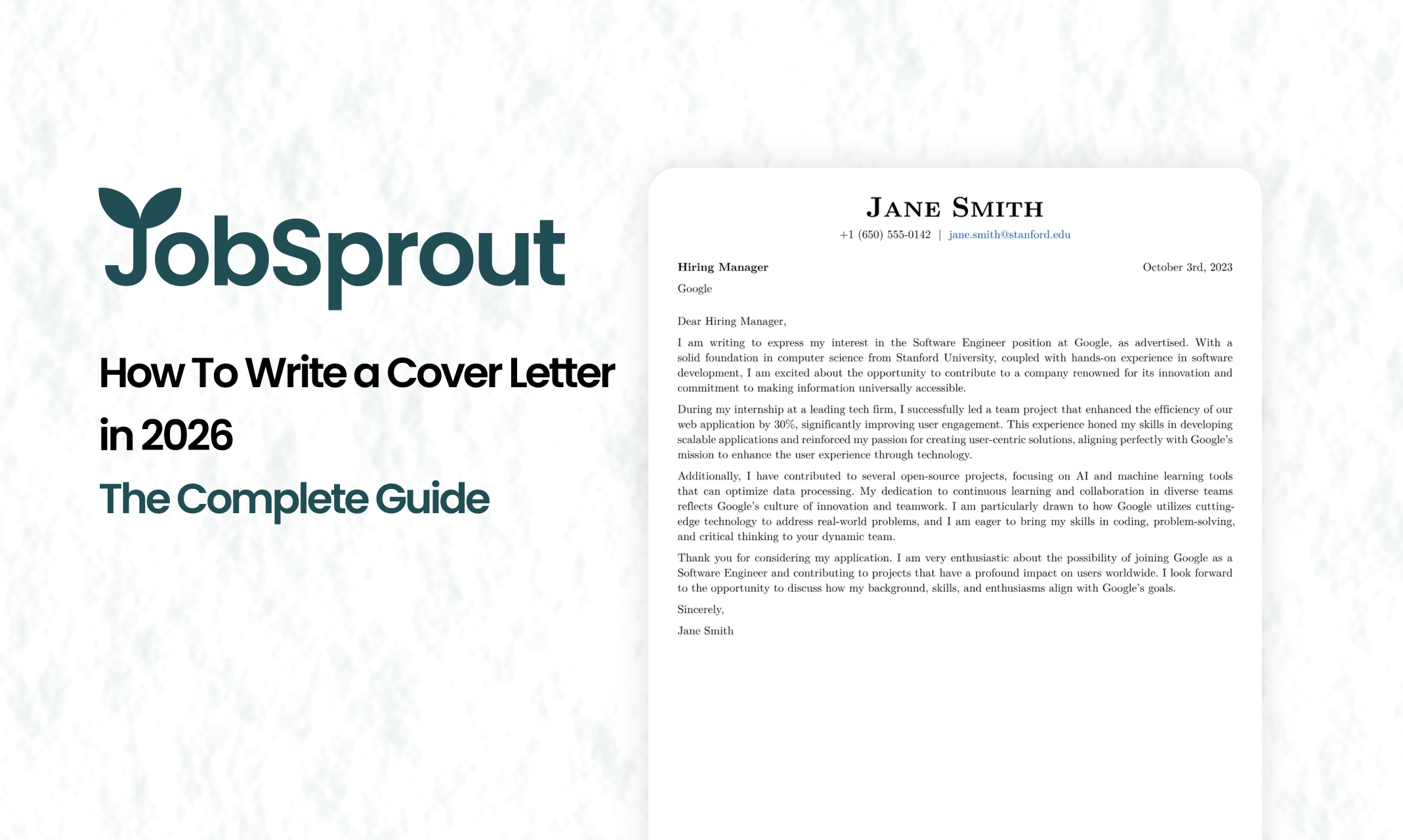
Learn how to write a cover letter that gets interviews. Step-by-step guide with templates, examples, and expert tips for standing out to hiring managers.
Learn the best way to list languages on your resume, including proficiency level frameworks, formatting options, and industry-specific advice. Complete guide with examples.
Learn how to write a resume for a part-time job. Includes tailored examples for students, parents, retirees, and side-job seekers, plus templates for retail, food service, tutoring, and more.
Struggling with the first sentence of your cover letter? Discover 20+ proven opening lines, 5 formulas that work, and the mistakes that get your application binned.
You've found a job you're excited about. You've polished your CV. You're ready to apply.
Then you see it: "Please attach a cover letter."
Your heart sinks. You start typing something generic, or worse, you close the tab entirely and move on to the next listing.
If this sounds familiar, you're not alone. Cover letters are the most dreaded part of job applications. Yet skipping them is a costly mistake.
According to a survey of 625 hiring managers, 83% read the majority of cover letters they receive, and 94% say cover letters influence their interview decisions. Nearly half (45%) actually read the cover letter before the CV.
The cover letter isn't dead. It's just misunderstood.
This guide will show you how to write cover letters that get results: a clear structure, practical examples, and strategies that work whether you're applying in London, Sydney, or New York.
A cover letter is a short document (typically 200-400 words) that accompanies your CV when applying for jobs. While your CV lists your qualifications and experience, the cover letter explains why you're interested in this specific role and how your background makes you the right fit.
Think of it this way:
A good cover letter doesn't repeat your CV. It complements it by:
| Aspect | CV/Resume | Cover Letter |
|---|---|---|
| Format | Structured sections | Flowing paragraphs |
| Tone | Factual, concise | Conversational, persuasive |
| Content | Complete work history | Tailored highlights |
| Length | 1-2 pages | 200-400 words |
| Purpose | Document qualifications | Make a case for fit |
| Customisation | Moderate | High (per application) |
Short answer: Yes, almost always.
Longer answer: The data overwhelmingly supports including one, even when it's optional.
A Resume Genius survey of 625 US hiring managers found:
The numbers are consistent across other studies:
There are rare situations where a cover letter isn't needed:
In virtually every other case, include one. The downside of submitting a cover letter when it wasn't expected is... nothing. The downside of not submitting one when it was expected is rejection.
A common objection: "Recruiters are too busy. They'll never read it."
The data says otherwise. 45% of hiring managers read your cover letter before your CV. That means for nearly half of applications, your cover letter is your actual first impression.
And here's what's at stake:
Your cover letter can either rescue a borderline application or sink a promising one. That's not a document you want to phone in.
Every effective cover letter follows the same basic structure:
| Element | Recommendation |
|---|---|
| Length | 250-400 words (3-4 paragraphs) |
| Pages | Never more than one page |
| Font | Professional fonts (Arial, Calibri, Georgia) at 10-12pt |
| Margins | 2.5cm (1 inch) on all sides |
| Spacing | Single-spaced with a blank line between paragraphs |
| File format | PDF preferred (preserves formatting) |
Hiring managers spend an average of 30 seconds to 2 minutes reading a cover letter. Some spend even less. Your cover letter needs to make its case quickly and clearly.
Start with your contact details at the top of the letter. Keep it clean and professional.
If your email is unprofessional, create a new one. Something like firstname.lastname@gmail.com works perfectly. Hiring managers do notice, and roughly 3 in 10 applications are dismissed due to unprofessional email addresses.
Example header:
Sarah Mitchell
Digital Marketing Manager
+44 7700 900123 | sarah.mitchell@email.com
Manchester, UK | linkedin.com/in/sarahmitchellBelow your details, include:
If you're applying via email, some of this information will be in the email itself, but including it in the document looks more professional.
The greeting sets the tone. Get it right.
Always try to find the hiring manager's name. Check:
Once you have their name:
Formal settings (finance, law, government):
Less formal settings (tech, creative, startups):
When unsure of gender:
Despite your research, sometimes you genuinely can't find who's hiring. In that case:
Acceptable alternatives:
Avoid these:
UK: "Dear" followed by first name is increasingly common even in formal industries. Use your judgement based on the company culture.
US: More likely to use "Mr./Ms. Surname" in initial contact.
Germany: Formal greetings are expected ("Sehr geehrte Frau/Herr [Surname]").
Australia: Generally more casual; first names are common.
Research the company culture before deciding on formality level.
Your opening paragraph needs to grab attention immediately. Hiring managers read hundreds of applications. Generic openings get generic results.
I am writing to apply for the Marketing Manager position at XYZ Company. I believe I would be a good fit for this role as I have five years of experience in marketing.
This tells the hiring manager nothing they don't already know from your CV. It's forgettable.
Your recent brand refresh for [Product Name] caught my attention. The shift toward sustainability messaging while maintaining your playful voice was masterfully executed. As a Marketing Manager who led a similar repositioning at [Previous Company], resulting in a 40% increase in engagement, I'd be excited to bring that strategic thinking to [Company Name].
This opening:
Lead with a relevant achievement:
In my current role at [Company], I reduced customer acquisition costs by 35% while increasing conversion rates. That's exactly the kind of growth-focused approach I'd bring to the Head of Growth position at [Target Company].
Reference a mutual connection:
When James Chen mentioned you were expanding the product team, I immediately thought of how my experience launching three B2B SaaS products could support [Company]'s ambitious roadmap.
Show specific company knowledge:
[Company]'s commitment to making financial services accessible to underserved communities aligns perfectly with why I moved into fintech. As a Product Manager who specialises in inclusive design, I'd love to contribute to that mission.
Address a specific need from the job description:
Your job posting mentions you need someone who can "bridge the gap between engineering and business stakeholders." That's precisely what I did at [Previous Company], where I translated technical roadmaps into board presentations that secured £2M in additional funding.
The body of your cover letter is where you make your case. You typically have 1-2 paragraphs to demonstrate two things:
Match your experience to the job requirements. Study the job description and identify the top 2-3 requirements, then provide evidence you meet them.
The job description says:
"Experience managing a budget of £100K+ and a team of 3-5 people"
Your cover letter responds:
In my current role as Marketing Lead at [Company], I manage an annual budget of £180,000 and a team of four specialists covering content, paid media, and design. Over the past two years, we've increased qualified leads by 65% while reducing cost per acquisition by 28%.
Key principles:
This is where you demonstrate genuine interest and cultural fit. Hiring managers want to know:
Research before writing:
Then write something specific:
What draws me to [Company] is your approach to sustainable manufacturing. I've followed your zero-waste initiative since 2023, and the recent B Corp certification confirms you're genuinely committed, not just greenwashing. As someone who chose to specialise in sustainable supply chain management specifically to work with companies making real impact, this role feels like the opportunity I've been looking for.
Avoid:
Your cover letter is the place to explain context your CV can't convey:
Career change:
While my background is in journalism, the core skills transfer directly: synthesising complex information, meeting tight deadlines, and communicating clearly to diverse audiences. My transition into content marketing has been intentional. I've completed Google's Digital Marketing certification and led content strategy for my current employer's most successful product launch.
Employment gap:
You'll notice a gap in my employment history from 2022-2023. During this time, I took leave to care for a family member. I've remained current with industry developments through professional reading and online courses, and I returned to freelance consulting six months ago to ensure my skills were sharp.
Relocation:
I'm currently based in Manchester but will be relocating to London in March, which is why I'm specifically targeting opportunities in the Greater London area. I'm prepared to start any time after the 15th.
Your closing paragraph should:
Confident and action-oriented:
I'm confident my combination of technical SEO expertise and content strategy experience would help [Company] achieve its ambitious organic growth targets. I'd welcome the opportunity to discuss how I could contribute. Please don't hesitate to reach out at your convenience.
Enthusiastic but professional:
I'm genuinely excited about the possibility of joining [Company]'s product team at such a pivotal growth stage. I'm available for an interview at your earliest convenience and look forward to discussing how my experience could support your roadmap.
For senior roles:
Based on my track record of building high-performing teams and my passion for [Company]'s mission, I believe I could make a meaningful contribution as your VP of Engineering. I'd welcome the chance to explore this further.
Safe choices for any context:
Slightly warmer (for less formal companies):
Avoid:
After your sign-off: Your name (and optionally your phone number or email again for easy reference).
Dear Ms. Thompson,
Your graduate programme's focus on rotations across different business units is exactly what I've been looking for: the chance to develop broad commercial understanding before specialising.
At university, I took every opportunity to gain practical experience. As Vice President of the Business Society, I led a team of 12 to organise our largest-ever careers fair, securing participation from 35 employers (up from 22 the previous year). My dissertation on consumer behaviour in subscription services received distinction and has since been cited in industry publications.
What attracts me to [Company] specifically is your reputation for developing future leaders. I spoke with two of your alumni at a recent careers event, and their enthusiasm for the mentorship they received was evident. I want to learn from the best, and [Company]'s track record suggests I would.
I'm available for interviews throughout March and would be delighted to discuss how I could contribute to your graduate cohort.
Kind regards, James Park
Dear Rachel,
When I saw [Company] was hiring a Senior Product Manager for the payments team, I knew I had to apply. I've watched your expansion into European markets with interest, and the technical challenges of cross-border payments are exactly where I want to focus my career.
In my current role at [Fintech Company], I've led the product team responsible for our core payment processing platform. Over three years, we've reduced transaction failures by 60%, launched support for 12 additional currencies, and processed over £2B in annual volume. I've worked closely with engineering, compliance, and operations to navigate PSD2 requirements and build systems that scale.
What excites me about [Company] is your approach to solving complexity through elegant design. Your recent checkout redesign, reducing steps from five to two while maintaining conversion, showed real product thinking. I want to contribute to that kind of work.
I'd welcome the chance to discuss how my payments experience could support [Company]'s European growth. I'm available for a call at your convenience.
Best regards, Emma Richardson
Dear Hiring Manager,
After eight years as a secondary school teacher, I'm transitioning into Learning & Development, and your L&D Specialist role at [Company] aligns perfectly with where I want to take my career.
Teaching gave me exactly the skills corporate training requires: designing engaging content for diverse audiences, adapting delivery based on feedback, and measuring learning outcomes. In my most recent role, I developed a new A-Level curriculum that increased pass rates from 72% to 89% over two years. I've also created and delivered professional development workshops for colleagues on topics including classroom technology and differentiated instruction.
To prepare for this transition, I've completed the CIPD Level 3 Certificate in Learning and Development Practice and have been consulting part-time for a startup, helping them build their onboarding programme from scratch.
I understand that career changers require evidence, not just enthusiasm. I'd welcome the opportunity to demonstrate how teaching skills translate, and to learn about [Company]'s approach to employee development.
Kind regards, Michael Okonkwo
Dear Dr. Patel,
I'm writing to apply for the Research Associate position in your computational biology lab. After a two-year career break to raise my children, I'm ready to return to research, and your work on protein folding algorithms is precisely where I want to contribute.
Before my break, I spent four years at [Research Institute] analysing genomic data and co-authored three peer-reviewed papers, including one in Nature Methods. During my time away, I've maintained my skills through online courses in machine learning and contributed to an open-source bioinformatics tool that now has over 500 GitHub stars.
I've followed your lab's recent preprints with great interest, particularly the work on applying transformer architectures to sequence analysis. My background in both wet lab biology and computational methods would allow me to bridge those worlds, something I noticed your job description specifically mentions.
I'm available to start immediately and am happy to discuss flexible arrangements as I transition back into full-time work. Thank you for considering my application.
Best regards, Sarah Williams, PhD
The problem: Your cover letter could be sent to any company with minimal changes.
The fix: Include specific details about the company that prove you've done research. Mention recent news, their products, their culture, or their mission, and explain why it matters to you.
The problem: Your cover letter is just a prose version of your CV.
The fix: Select 2-3 most relevant experiences and expand on them with context and outcomes. Your cover letter should complement your CV, not duplicate it.
The problem: Every sentence starts with "I" and focuses on what you want from the role.
The fix: Frame your experience in terms of what you can offer the employer. Instead of "I want to develop my leadership skills," try "My experience leading cross-functional teams would help [Company] coordinate the upcoming product launch."
The problem: Your cover letter sprawls across two pages with extensive detail.
The fix: Keep it to 250-400 words. Hiring managers won't read beyond one page. Every sentence should earn its place.
The problem: Spelling mistakes, grammatical errors, or (worst of all) the wrong company name.
The fix: Proofread multiple times. Read it aloud. Have someone else check it. Use grammar-checking tools. Triple-check company names and hiring manager names.
The problem: Your cover letter reads like a legal document from 1950.
The fix: Write like a professional, not a robot. "I would like to express my interest in the position" can become "I'm excited to apply for the role." Be professional, but be human.
The problem: Your cover letter just... ends, without suggesting next steps.
The fix: Always include a call to action: "I'd welcome the chance to discuss this further" or "I'm available for an interview at your convenience."
The problem: Your cover letter doesn't address the specific requirements listed.
The fix: Study the job description and explicitly address the key requirements with relevant examples from your experience.
AI tools have transformed how many people approach cover letters. Used correctly, they can save time and improve quality. Used poorly, they can sink your application.
Hiring managers are increasingly adept at spotting AI-generated content. Generic, overly polished language that lacks specific details is a red flag. When every applicant's cover letter sounds the same, nobody stands out.
The worst approach is prompting an AI to "write a cover letter for [job title] at [company]" and submitting the output unchanged. This produces exactly the kind of generic, forgettable content you're trying to avoid.
AI works best when it enhances your authentic voice rather than replacing it:
Draft first, then refine. Write your own first draft, then use AI to improve specific phrases or sections.
Provide context. The more specific information you give the AI about your experience and the target company, the better the output.
Stay in control. Use AI to reword awkward sentences or suggest stronger action verbs, but keep the core content genuinely yours.
Maintain specificity. Generic AI outputs need your specific achievements, numbers, and company research to become effective.
With JobSprout, you can use AI without losing authenticity:
Job Role Tailoring: Paste a job description and JobSprout extracts the role details. The same extracted job role feeds into both CV tailoring and cover letter generation, so your application tells a consistent story aligned to the role.
The AI Writer lets you select specific text (a word, a phrase, or a paragraph) and tell it exactly what you want: "make this more confident," "shorten this," or "add a specific metric." You stay in control of your story.
Deep Research automatically gathers real information about the company and role from the web, so your cover letter can reference specific company initiatives, recent news, or cultural values without hours of manual research.
The AI Assistant understands your CV and target role. Ask it "how can I make this opening stronger?" or "what achievement should I highlight for this role?" and get genuinely useful suggestions.
The goal isn't to automate your cover letter. It's to remove the friction so you can create something genuinely good.
250-400 words, or roughly 3-4 paragraphs. Never exceed one page. Hiring managers spend an average of 30 seconds to 2 minutes on cover letters, so every word needs to count.
Yes, unless the application explicitly says not to. 72% of hiring managers expect one even when it's "optional", and 77% of recruiters give preference to candidates who submit one.
"Dear Hiring Manager" is perfectly acceptable. You can also try "Dear [Department] Team" or "Dear Recruitment Team." Avoid dated phrases like "To Whom It May Concern."
Ideally, yes. Consistent formatting (fonts, colours, header style) creates a professional, cohesive application package. Tools like JobSprout automatically match your cover letter to your CV template. Browse our template gallery to see professionally designed CV and cover letter pairs.
Yes. At minimum, you need to customise:
A generic cover letter is almost worse than no cover letter.
Focus on:
PDF preserves your formatting across devices and operating systems. Only use Word (.docx) if the application specifically requests it.
Only if the job posting explicitly asks. Otherwise, save this for the interview stage.
Briefly and honestly. Focus on what you did during the gap (caregiving, education, health, travel) and how you've stayed current with your field. Don't apologise or over-explain.
You can have a base template, but you must customise it for each application. At minimum, change company-specific references and ensure your highlighted experiences match that role's requirements.
A cover letter is your chance to be more than a list of qualifications. It's where you make a human connection, demonstrate genuine interest, and explain why you, specifically you, are the right choice for this role.
The hiring managers who read cover letters aren't looking for perfection. They're looking for:
Get those right, and your cover letter will do its job: get you an interview.
If you want to create personalised cover letters without the frustration of starting from scratch each time:
Try JobSprout - Generate cover letters with AI that actually understands your experience, uses Deep Research to pull in real company insights, and keeps you in control of your story. Free to create and download.
Questions about your specific situation? Email david@jobsprout.ai or connect on LinkedIn.