PDF or DOCX · up to 2MB
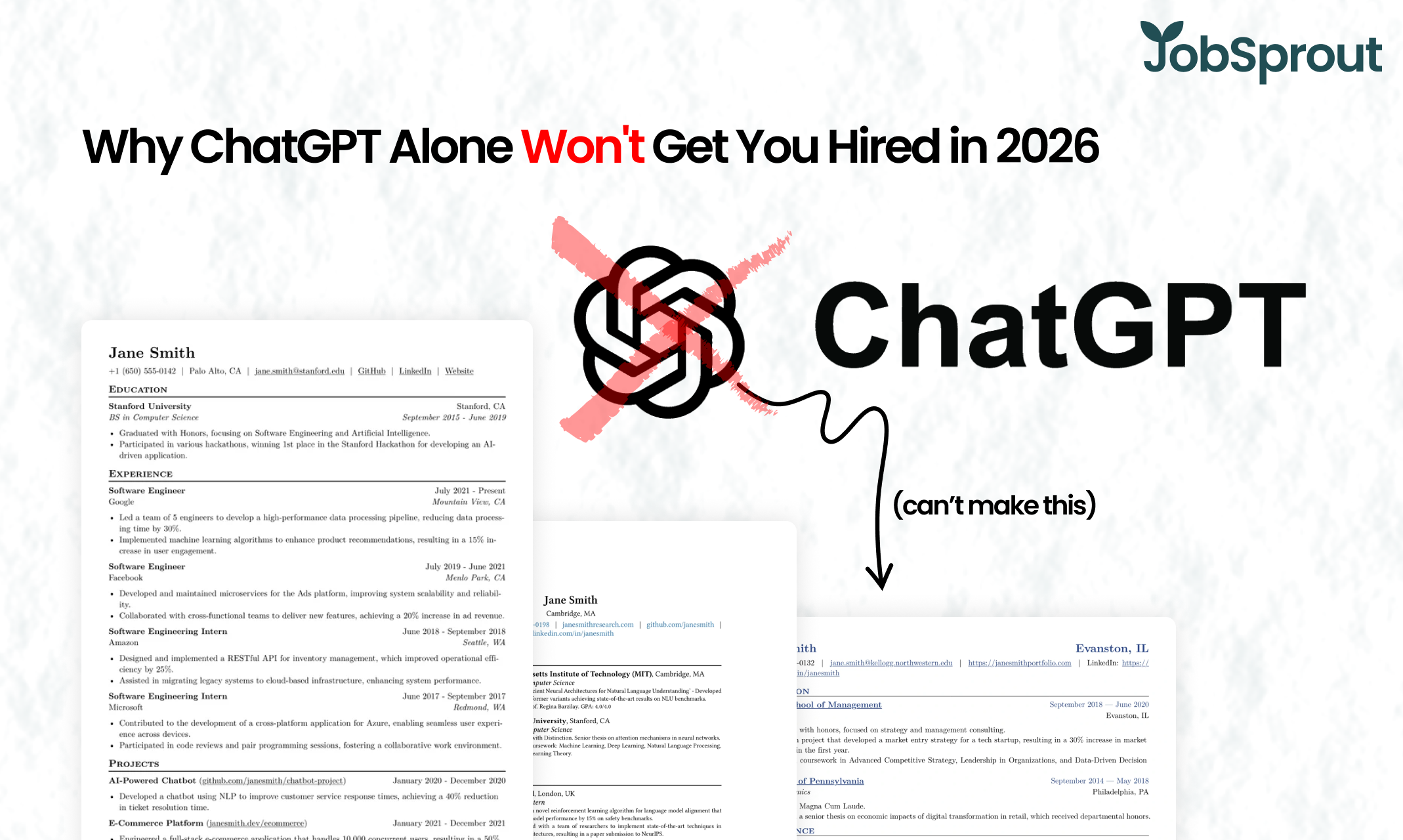
ChatGPT is free and brilliant. So why are specialised resume tools still thriving? Here's what everyone gets wrong about using AI to write your CV.
Whether to put a photo on your CV depends on the country. Where it is expected, where to leave it off, the usual sizes, and what makes a good one.
Your LinkedIn About holds 2,600 characters, but desktop shows about four lines before "see more". Where LinkedIn folds each section, and what to put first.
How to take a professional headshot at home with your phone: the lens, the light, the distance and the crop, plus when an AI headshot does a better job.
ChatGPT can write a resume. Whether it's a good resume is another question.
Paste in your work history and ask for help. You'll get something back quickly. It'll sound polished. It'll have action verbs. And it'll probably be full of generic fluff, vague claims, and occasionally details you never actually told it - confidently stated as fact.
"Results-driven professional with a proven track record of delivering value." Sound familiar? That's ChatGPT filling gaps with filler. It doesn't know what makes your experience compelling. It doesn't know what recruiters in your industry look for. It doesn't know the difference between a bullet point that gets interviews and one that gets skimmed.
And then what? You copy the output into Word. You wrestle with margins, fonts, spacing. You end up with a document that looks like... a Word document. Which is exactly what 90% of the resumes I reviewed looked like - and not in a good way.
So why would anyone pay for a resume tool when ChatGPT is free?
After spending years reviewing CVs as part of hiring teams - and then building a resume tool anyway - I think the answer is worth exploring properly.
The short version: The problems go deeper than most people realise. The writing has gaps. The formatting is on you. And the system you're trying to navigate has rules ChatGPT doesn't know.
Here's what happens when most people use ChatGPT for their resume:
The output sounds polished. It might even impress you. But it often fails at the thing that actually matters: getting you past the gatekeepers.
Those gatekeepers are:
ChatGPT doesn't know the rules of this game. It knows language patterns. That's not the same thing.
ChatGPT's output is only as good as your prompt. The problem? Most job seekers don't know what makes a good resume prompt.
Try this experiment: ask ChatGPT to "write a resume for a marketing manager." You'll get something generic, probably with phrases like "results-driven professional" and "passionate about delivering value."
Now try: "Write a resume for a marketing manager with 6 years of B2B SaaS experience, emphasising demand generation metrics, specifically pipeline contribution and CAC reduction, formatted for ATS parsing with keywords from this job description: [paste description]. Use the X-Y-Z formula for achievements and avoid cliches like 'team player' or 'self-starter'."
Better, right? But how many job seekers know to do this?
The gap between "can write a resume" and "can write a resume that gets interviews" is a prompt engineering gap that most people don't know exists.
Specialised tools close this gap. They've already encoded the best practices, the keyword strategies, the formatting rules. You don't need to be a prompt expert. You just need to provide your information.
Yes, ChatGPT has memory features now. It can remember things you've told it across conversations. But here's the problem: that memory is incomplete, unstructured, and prone to hallucination.
ChatGPT might remember you mentioned working at a tech company. But does it remember:
Probably not. And when it fills gaps, it guesses. You might get confident-sounding details that are slightly (or completely) wrong. In a resume, where accuracy matters and recruiters verify claims, this is dangerous.
Even with memory enabled, you'll find yourself re-explaining context, correcting mistakes, and double-checking outputs against your actual history. The cognitive overhead doesn't disappear.
Purpose-built tools work differently. Your profile is structured data, not fuzzy memories. Your entire CV, your career goals, your application history - all stored reliably in one place. When you ask for help, the AI works from your actual information, not its best guess.
With JobSprout, you build your profile once. The AI Assistant knows your CV, your work history, and your target role - accurately. Ask it "make this more relevant for a startup" or "tailor my summary for this job description," and it works from facts, not fragments.
I recently tested a dozen resume builders that advertise AI features. Here's what most of them actually do:
That's it. There's no special sauce. No proprietary technology. No unique approach to resumes. Just a middleman between you and the same AI you could access directly.
How do you spot these tools? Their AI sounds exactly like ChatGPT because it is ChatGPT. They add a pretty interface but no real intelligence about what makes resumes work.
The genuine resume tools do something different. They understand ATS parsing. They know what recruiters look for. They've built systems that encode expertise, not just relay prompts. The AI is a component, not the entire product.
When evaluating any "AI resume builder," ask: what does this tool know that ChatGPT doesn't? If the answer is nothing, you're paying for a UI.
The most common gimmick these tools use? Fake ATS scores.
Many tools offer an "ATS score" claiming to predict how your resume will perform with Applicant Tracking Systems.
The uncomfortable truth? Most of these scores tell you very little.
Real ATS systems (Greenhouse, Workday, Lever, iCIMS) are proprietary. Third-party tools can't actually tell you how a specific ATS will parse or rank your resume. They can make educated guesses based on keyword matching and formatting, but the confidence they project is often unwarranted.
Some tools use what appears to be arbitrary scoring. Get an 85% score, change nothing, run it again, get a 72%. The score exists to create anxiety and drive purchases, not to help you get hired.
What actually matters:
You don't need a magic number. You need a resume that follows established rules.
ChatGPT can write great content. It cannot format a document.
Copy ChatGPT's output into Word, and you're responsible for:
Most people aren't designers. The result is resumes that look... thrown together. Inconsistent spacing. Fonts that don't quite work. Layouts that feel cramped or amateur.
Visual quality is a signal. When recruiters spend 7 seconds on initial screening, your resume's appearance creates an immediate impression. Polished typography signals attention to detail. Sloppy formatting signals the opposite.
According to our experience reviewing hundreds of CVs in hiring processes, less than 10% look professionally typeset. The rest are clearly Word documents with default templates and minimal effort.
There's a reason academic papers, books, and professional documents use typesetting systems like LaTeX and Typst. They produce objectively better-looking output:
JobSprout uses Typst, the modern successor to LaTeX. You get the visual quality of professionally typeset documents without the learning curve. The difference is visible at a glance, and in a 7-second scan, that matters.
Here's a frustration I hear constantly: you write a bullet point that's 90% perfect, but one phrase feels weak.
You ask the AI to improve it. Instead of fixing that one phrase, it rewrites everything. Now it sounds like the AI, not you. Your voice is gone.
Most AI resume tools work this way. Rezi rewrites entire bullets. Kickresume generates whole sections. You either accept everything or reject everything. There's no middle ground.
This matters because your resume should sound like you. Generic AI-speak is increasingly obvious to recruiters. They've seen the same "results-driven professional" and "passionate about delivering value" phrases a thousand times.
What you actually need is targeted help: make this phrase shorter, make that sentence more confident, align this bullet with a specific job description. Keep everything else exactly as you wrote it.
With JobSprout's AI Writer, that's how it works. Select a word, a phrase, or a sentence. Tell it what you need. It executes your instruction without touching anything else. You stay in control of your voice while getting help with the phrasing.
ChatGPT is genuinely useful for certain resume tasks.
ChatGPT is good for:
If you're comfortable with the copy-paste workflow and don't mind spending 15-20 minutes per session re-establishing context, ChatGPT can definitely help.
ChatGPT falls short for:
The question isn't "can ChatGPT help with my resume?" It can. The question is whether the overhead of prompt engineering, context management, and formatting is worth your time compared to tools built specifically for the job.
When a resume builder is more than a ChatGPT wrapper, it provides:
Your profile lives in the system. The AI knows your entire work history, your skills, your career goals. You don't re-explain yourself every time.
Templates designed for ATS compatibility and visual quality. Single-column layouts that parse correctly. Professional typography that impresses humans.
Select exactly what you want to change. Specify exactly how you want it changed. Keep control over your voice.
Multiple CVs and cover letters, all using the same underlying profile. Toggle sections on and off for different applications. See real-time previews as you edit.
JobSprout's Deep Research feature searches the web for real information about companies and roles, then uses that context to help write genuinely personalised cover letters. Not generic slop, actual tailoring based on what the company cares about.
Paste a job description and your CV is rewritten to match the role in seconds. You see every change in a word-level diff preview and accept or reject before saving. Try doing that in ChatGPT without copy-pasting your entire CV back and forth.
JobSprout can also publish your CV as a hosted personal website in minutes, no code. It's built straight from the CV you already have, lives at a jobsprout.me link you can share, and stays in sync as you edit. ChatGPT can draft the words, but it can't host a page for you.
This is the fundamental insight that ChatGPT optimists miss: hiring is a system with specific rules.
ATS systems parse resumes in predictable ways. Recruiters scan for specific patterns. Keywords matter. Formatting matters. Visual first impressions matter.
A generalist AI understands language. It doesn't understand the hiring system.
Specialised tools encode the rules. They know what works and what doesn't. They've been built to navigate this specific system, not to write poetry or explain quantum physics.
If you're applying to a handful of jobs and have time to spare, ChatGPT can work. Accept the overhead. Master the prompts. Handle the formatting yourself.
If you're serious about your job search, a specialised tool will save time and produce better results:
The cost of specialised tools is minimal compared to the cost of staying unemployed for an extra month because your resume looked amateur or got filtered by ATS.
We built JobSprout because the alternatives were disappointing. Wrapper apps charging money for ChatGPT with a UI. "AI tools" that take over instead of assisting. Fake ATS scores designed to create anxiety.
Our approach:
Is ChatGPT free? Yes. Can it help with your resume? Absolutely.
But if you want to actually get hired, you need more than raw intelligence. You need a tool that understands the system.
Yes, you can. ChatGPT is genuinely useful for brainstorming, rephrasing awkward sentences, and generating first drafts. The question is whether the overhead is worth it. You'll need to re-explain your situation every session, craft effective prompts, and handle all formatting yourself. If you're applying to a few jobs and have time, it can work. If you're in an active job search, specialised tools save significant time.
Nothing, if the wrapper adds real value. The problem is that many don't. They charge money to put a UI on the same AI you can access for free, without adding meaningful features like context persistence, professional formatting, or precision editing. You're paying for convenience that doesn't exist.
Some tools offer genuine value by checking formatting and keyword matching. The problem is when scores are presented as definitive predictions of ATS performance. Real ATS systems are proprietary, and third-party tools can only make educated guesses. A "92% ATS score" sounds precise but may be arbitrary. Focus on following established formatting rules rather than chasing a number.
It's not strictly necessary, but it helps. When recruiters spend 7 seconds on initial screening, visual quality creates an immediate impression. A professionally typeset CV signals attention to detail before they've read a word. In competitive markets, small advantages compound. That said, content always matters more than formatting. A well-typeset CV with weak content won't get you hired.
They don't have insider access to proprietary ATS code. What they do is follow established best practices: simple single-column layouts, standard section headings, clean formatting, proper file types. These principles come from years of testing and feedback from recruiters. It's not magic, it's accumulated knowledge of what works.
You can. Some people use ChatGPT for initial brainstorming, then move to a purpose-built tool for formatting and refinement. The key is using each tool for what it does best. ChatGPT excels at generating ideas. Resume builders excel at structure, formatting, and document management.
Three main things: typesetting (we use Typst for professional output, not HTML/CSS), precision (select exactly what to edit instead of accepting full rewrites), and no fake ATS scores or download hostage-taking. We built what we wanted to exist as job seekers ourselves.
Generic AI content is often obvious: vague language, overused phrases, content that sounds polished but says nothing specific. The solution isn't to avoid AI, but to use it as a starting point rather than an endpoint. Provide specific details about your actual achievements, then use AI to refine the phrasing. Your unique experiences make the content authentic.
ChatGPT is a remarkable tool. It can help with your resume. But it can't navigate the hiring system for you.
That system has specific rules: ATS compatibility, visual first impressions, keyword matching, formatting standards. A generalist AI knows language patterns. It doesn't know these rules.
Purpose-built tools encode this knowledge. They handle the complexity so you can focus on substance.
The question isn't whether ChatGPT is good. It is. The question is whether it's the right tool for this specific job.
For most job seekers, the answer is: ChatGPT is a useful supplement, but not a complete solution.
Try it: jobsprout.ai
Free to create and download. No paywall when you're ready to export.
Questions? Email david@jobsprout.ai or connect on LinkedIn.