Sign Language Interpreter Resume Example
 Example by JobSprout
Free to use. No download fee.
Market Insights
Sign Language Interpreter
Salary Range
Salary Trend
Sep 2025 – Aug 2026
12-Month Trend
Based on advertised Education & Teaching roles.
US market data · Source: Adzuna · Updated Sep 2026
How useful was this template?
Sign Language Interpreter resume samples
Three complete resumes, each in a different design.

Free to use. No download fee.
What makes a strong Sign Language Interpreter resume?
US median salary $85,944 ·
For a mid-level Sign Language Interpreter in Education, hiring managers require practical experience navigating the unique dynamics of school environments. Strong resumes highlight relevant certifications such as RID NIC or a high EIPA score, reflecting expertise in educational settings. Achievements should focus on facilitating student access to curriculum, adapting interpreting styles for different age groups, and familiarity with IEP meetings. Mentioning collaboration with educators and understanding child development stages shows a comprehensive approach crucial for this specialized role.
Why this example works
This example CV effectively showcases these elements by clearly segmenting experience to emphasize specific educational interpreting responsibilities. Achievements are quantified, for instance, by detailing the number of students supported or the variety of academic subjects interpreted. Key certifications are prominently displayed, assuring recruiters of immediate qualifications. The skills section is well-grouped, distinguishing between ASL proficiency levels, technical interpreting tools, and professional soft skills vital for classroom integration.
Sign Language Interpreter resume example (text version)
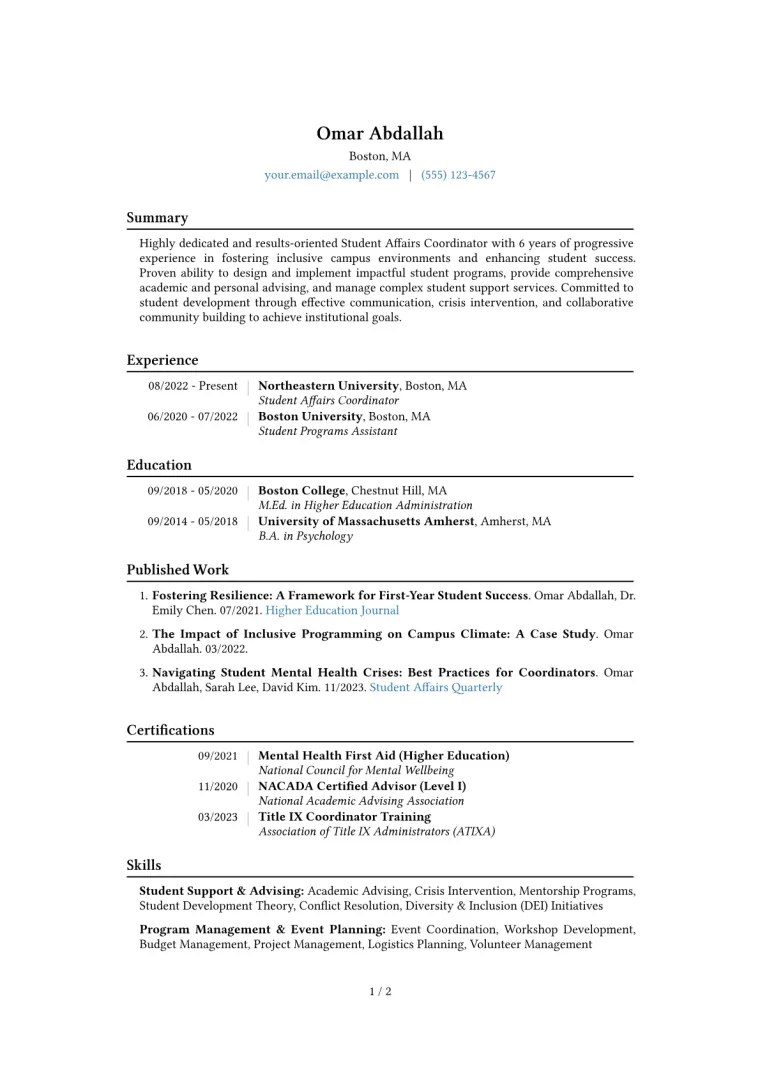
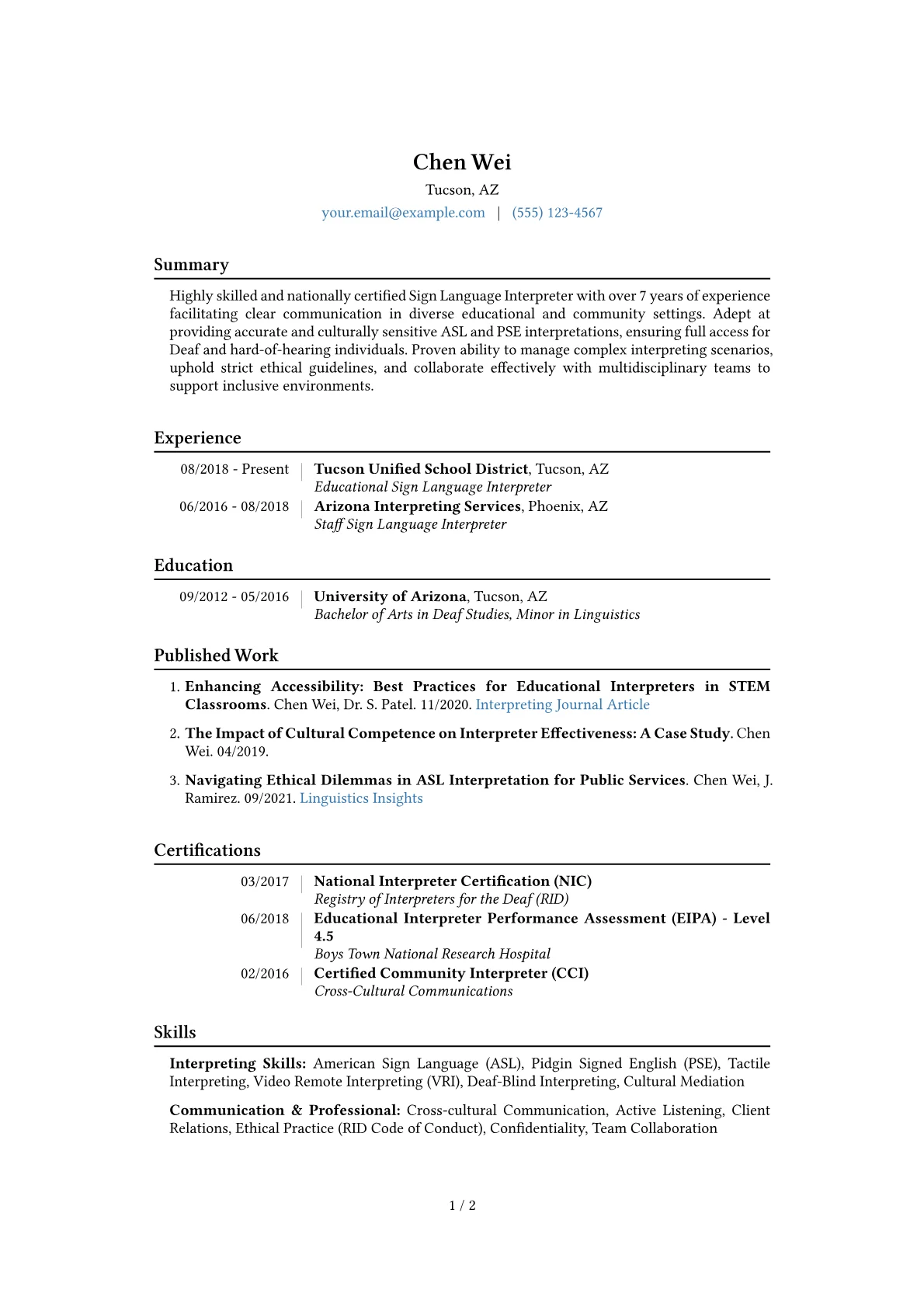
Chen Wei · Sign Language Interpreter
Summary
Highly skilled and nationally certified Sign Language Interpreter with over 7 years of experience facilitating clear communication in diverse educational and community settings. Adept at providing accurate and culturally sensitive ASL and PSE interpretations, ensuring full access for Deaf and hard-of-hearing individuals. Proven ability to manage complex interpreting scenarios, uphold strict ethical guidelines, and collaborate effectively with multidisciplinary teams to support inclusive environments.
Experience
Educational Sign Language Interpreter · Tucson Unified School District
Tucson, AZ · 2018 - Present
- Provided daily ASL interpretation for 8-12 Deaf and hard-of-hearing students across K-12 classrooms, facilitating access to curriculum and social interactions.
- Collaborated with 15+ teachers and support staff to adapt interpreting strategies for diverse subjects, resulting in a 15% improvement in student comprehension scores.
- Interpreted for over 50 parent-teacher conferences and IEP meetings annually, ensuring effective communication of student progress and educational plans.
- Mentored two new interpreters on district policies and classroom interpreting best practices, contributing to a 100% successful onboarding rate for new hires.
- Managed scheduling and logistical coordination for 3-5 interpreting assignments per week, maintaining a 98% on-time arrival rate.
Staff Sign Language Interpreter · Arizona Interpreting Services
Phoenix, AZ · 2016 - 2018
- Delivered over 1,500 hours of professional interpreting services across various settings including medical, legal, business, and community events for a diverse client base.
- Maintained a client satisfaction rating of 95% by consistently providing accurate and culturally appropriate interpretations.
- Managed a caseload of 20-30 appointments per month, demonstrating strong organizational skills and adaptability to dynamic schedules.
- Participated in monthly professional development workshops, acquiring new skills in VRI (Video Remote Interpreting) and expanding proficiency in specialized terminology.
- Successfully facilitated critical communications in emergency room settings on more than 30 occasions, ensuring patient understanding and care.
Education
Bachelor of Arts in Deaf Studies, Minor in Linguistics · University of Arizona
Tucson, AZ · 2012 - 2016
- Graduated Cum Laude with a GPA of 3.7/4.0, demonstrating strong academic achievement in specialized fields.
- Completed a capstone project on 'Bilingualism in the Deaf Community,' interviewing 10+ community members and presenting findings to faculty.
- Recipient of the Departmental Scholarship for Academic Excellence in Deaf Studies for two consecutive years.
Skills
Sign Language Interpreter resume example: Medical Interpreter
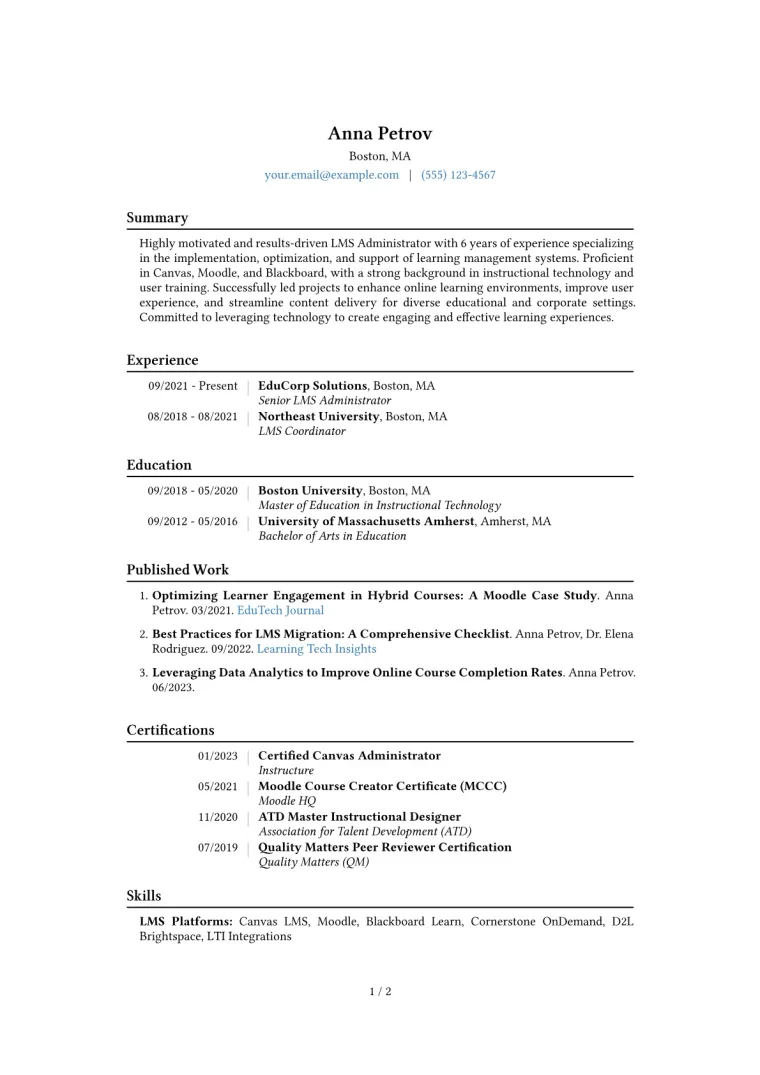
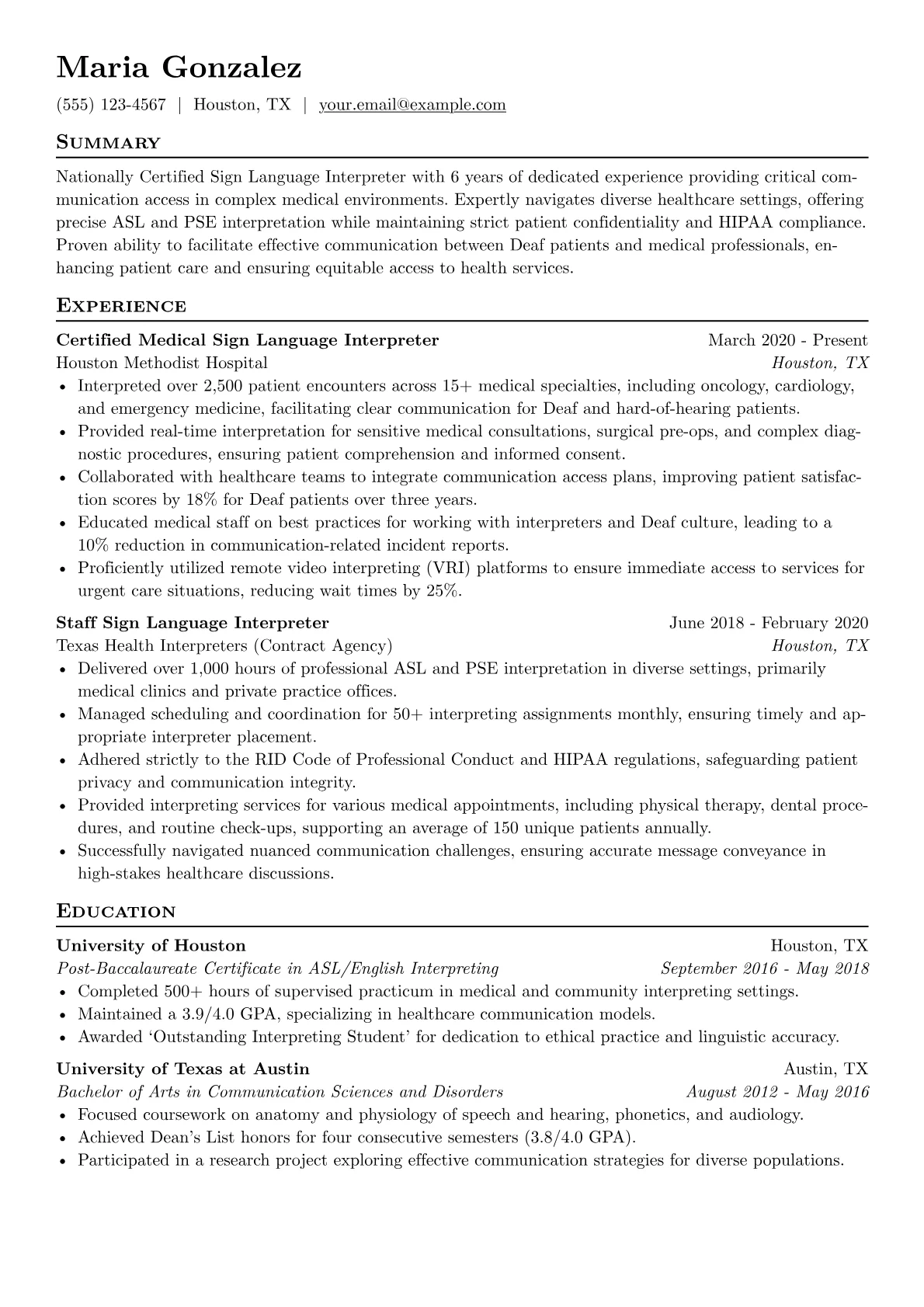
Maria Gonzalez · Sign Language Interpreter
Summary
Nationally Certified Sign Language Interpreter with 6 years of dedicated experience providing critical communication access in complex medical environments. Expertly navigates diverse healthcare settings, offering precise ASL and PSE interpretation while maintaining strict patient confidentiality and HIPAA compliance. Proven ability to facilitate effective communication between Deaf patients and medical professionals, enhancing patient care and ensuring equitable access to health services.
Experience
Certified Medical Sign Language Interpreter · Houston Methodist Hospital
Houston, TX · 2020 - Present
- Interpreted over 2,500 patient encounters across 15+ medical specialties, including oncology, cardiology, and emergency medicine, facilitating clear communication for Deaf and hard-of-hearing patients.
- Provided real-time interpretation for sensitive medical consultations, surgical pre-ops, and complex diagnostic procedures, ensuring patient comprehension and informed consent.
- Collaborated with healthcare teams to integrate communication access plans, improving patient satisfaction scores by 18% for Deaf patients over three years.
- Educated medical staff on best practices for working with interpreters and Deaf culture, leading to a 10% reduction in communication-related incident reports.
- Proficiently utilized remote video interpreting (VRI) platforms to ensure immediate access to services for urgent care situations, reducing wait times by 25%.
Staff Sign Language Interpreter · Texas Health Interpreters (Contract Agency)
Houston, TX · 2018 - 2020
- Delivered over 1,000 hours of professional ASL and PSE interpretation in diverse settings, primarily medical clinics and private practice offices.
- Managed scheduling and coordination for 50+ interpreting assignments monthly, ensuring timely and appropriate interpreter placement.
- Adhered strictly to the RID Code of Professional Conduct and HIPAA regulations, safeguarding patient privacy and communication integrity.
- Provided interpreting services for various medical appointments, including physical therapy, dental procedures, and routine check-ups, supporting an average of 150 unique patients annually.
- Successfully navigated nuanced communication challenges, ensuring accurate message conveyance in high-stakes healthcare discussions.
Education
Post-Baccalaureate Certificate in ASL/English Interpreting · University of Houston
Houston, TX · 2016 - 2018
- Completed 500+ hours of supervised practicum in medical and community interpreting settings.
- Maintained a 3.9/4.0 GPA, specializing in healthcare communication models.
- Awarded 'Outstanding Interpreting Student' for dedication to ethical practice and linguistic accuracy.
Bachelor of Arts in Communication Sciences and Disorders · University of Texas at Austin
Austin, TX · 2012 - 2016
- Focused coursework on anatomy and physiology of speech and hearing, phonetics, and audiology.
- Achieved Dean's List honors for four consecutive semesters (3.8/4.0 GPA).
- Participated in a research project exploring effective communication strategies for diverse populations.
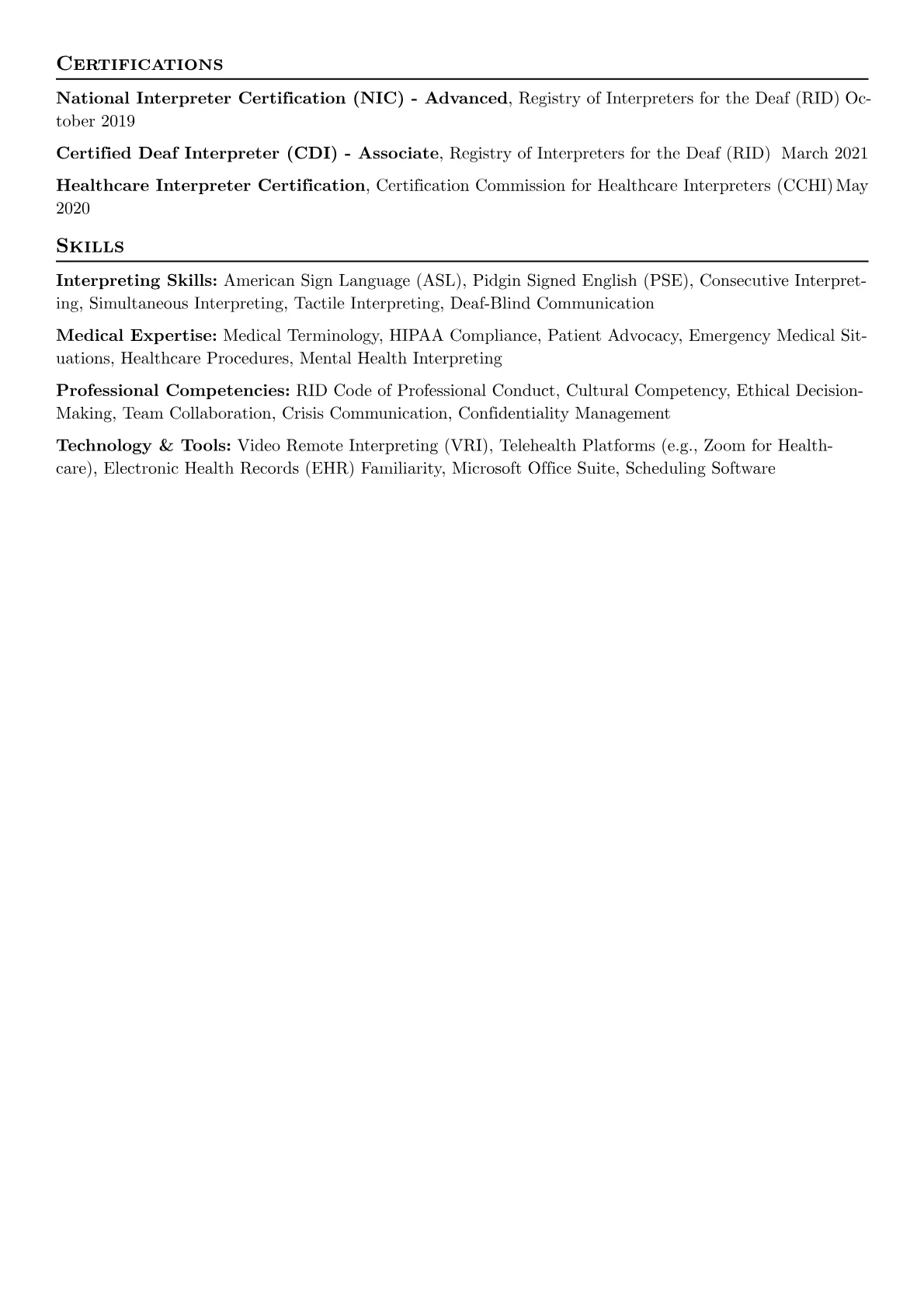
Skills
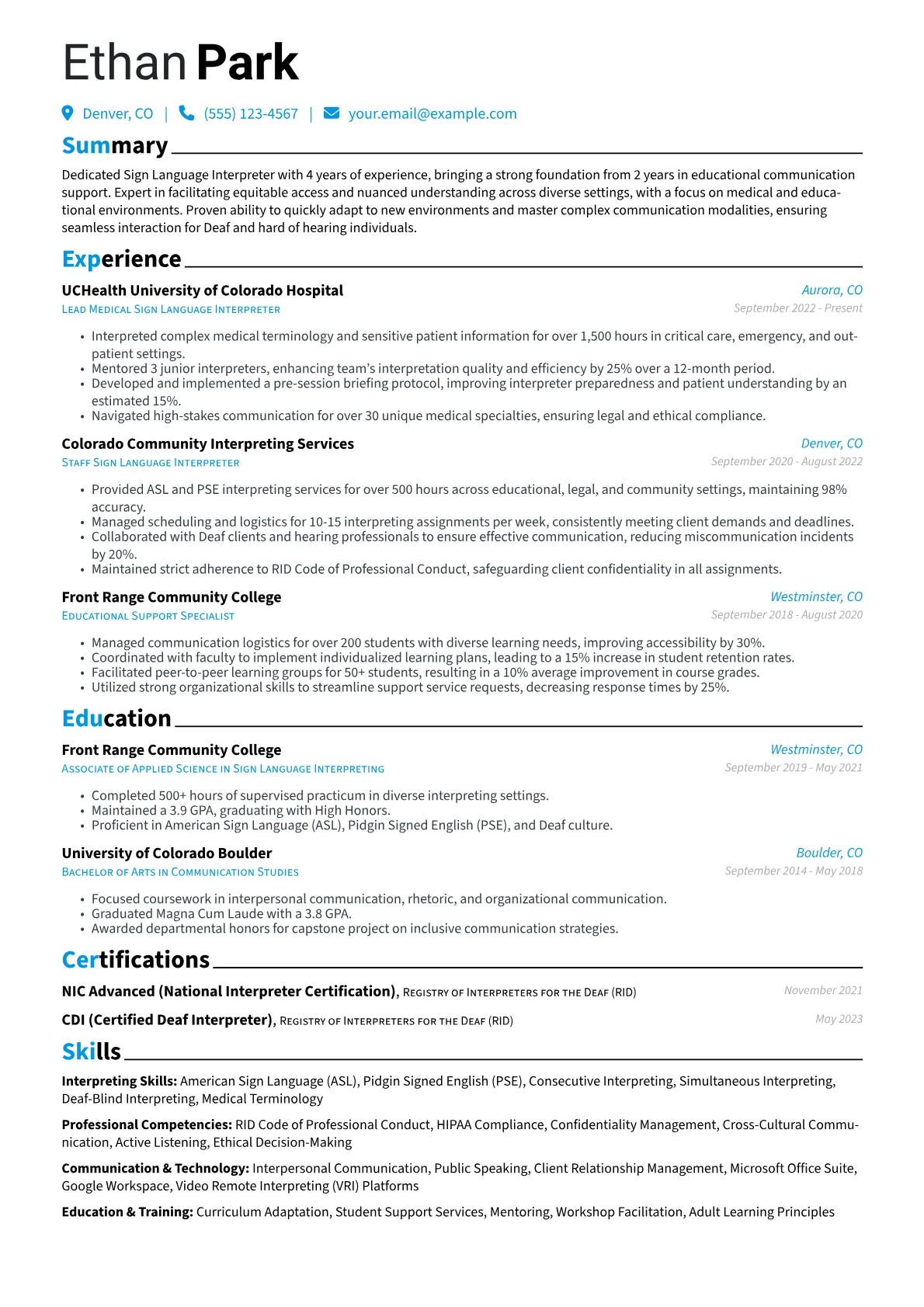
Sign Language Interpreter resume example: Career Changer
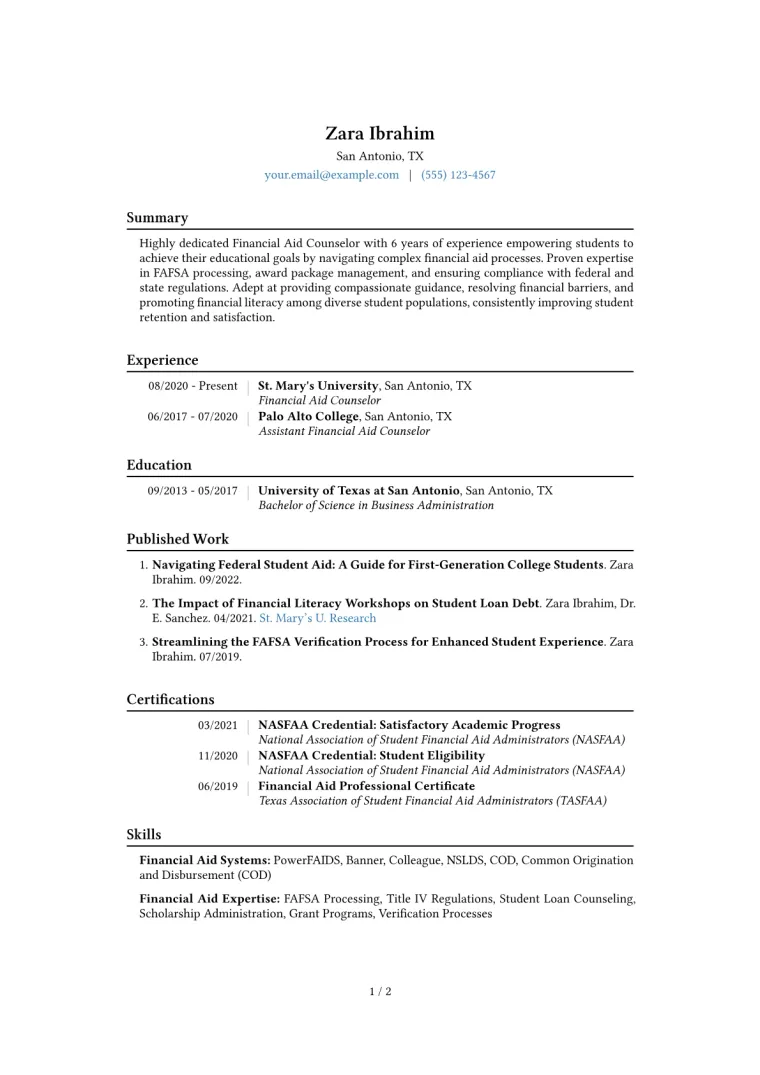
Ethan Park · Sign Language Interpreter
Summary
Dedicated Sign Language Interpreter with 4 years of experience, bringing a strong foundation from 2 years in educational communication support. Expert in facilitating equitable access and nuanced understanding across diverse settings, with a focus on medical and educational environments. Proven ability to quickly adapt to new environments and master complex communication modalities, ensuring seamless interaction for Deaf and hard of hearing individuals.
Experience
Lead Medical Sign Language Interpreter · UCHealth University of Colorado Hospital
Aurora, CO · 2022 - Present
- Interpreted complex medical terminology and sensitive patient information for over 1,500 hours in critical care, emergency, and outpatient settings.
- Mentored 3 junior interpreters, enhancing team's interpretation quality and efficiency by 25% over a 12-month period.
- Developed and implemented a pre-session briefing protocol, improving interpreter preparedness and patient understanding by an estimated 15%.
- Navigated high-stakes communication for over 30 unique medical specialties, ensuring legal and ethical compliance.
Staff Sign Language Interpreter · Colorado Community Interpreting Services
Denver, CO · 2020 - 2022
- Provided ASL and PSE interpreting services for over 500 hours across educational, legal, and community settings, maintaining 98% accuracy.
- Managed scheduling and logistics for 10-15 interpreting assignments per week, consistently meeting client demands and deadlines.
- Collaborated with Deaf clients and hearing professionals to ensure effective communication, reducing miscommunication incidents by 20%.
- Maintained strict adherence to RID Code of Professional Conduct, safeguarding client confidentiality in all assignments.
Educational Support Specialist · Front Range Community College
Westminster, CO · 2018 - 2020
- Managed communication logistics for over 200 students with diverse learning needs, improving accessibility by 30%.
- Coordinated with faculty to implement individualized learning plans, leading to a 15% increase in student retention rates.
- Facilitated peer-to-peer learning groups for 50+ students, resulting in a 10% average improvement in course grades.
- Utilized strong organizational skills to streamline support service requests, decreasing response times by 25%.
Education
Associate of Applied Science in Sign Language Interpreting · Front Range Community College
Westminster, CO · 2019 - 2021
- Completed 500+ hours of supervised practicum in diverse interpreting settings.
- Maintained a 3.9 GPA, graduating with High Honors.
- Proficient in American Sign Language (ASL), Pidgin Signed English (PSE), and Deaf culture.
Bachelor of Arts in Communication Studies · University of Colorado Boulder
Boulder, CO · 2014 - 2018
- Focused coursework in interpersonal communication, rhetoric, and organizational communication.
- Graduated Magna Cum Laude with a 3.8 GPA.
- Awarded departmental honors for capstone project on inclusive communication strategies.
Skills
How useful was this template?
Example by JobSprout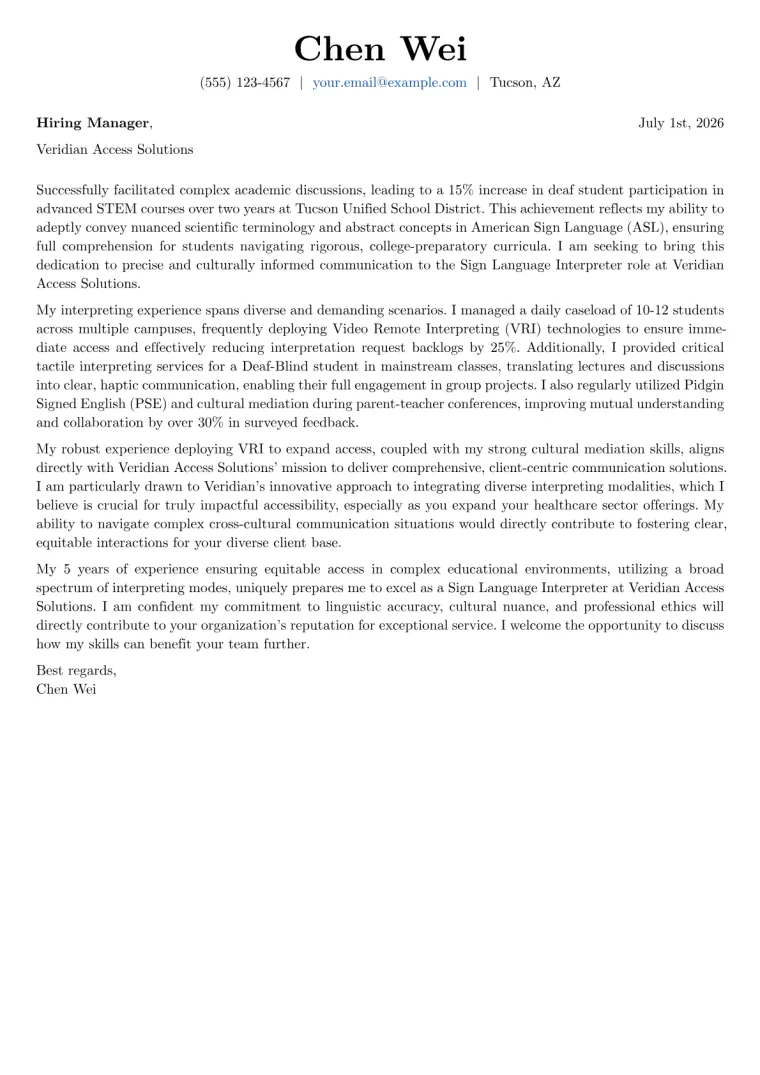
Sign Language Interpreter Cover Letter Example
Written for the same person as this resume, ready to adapt.
Sign Language Interpreter resume summary example
Highly skilled and nationally certified Sign Language Interpreter with over 7 years of experience facilitating clear communication in diverse educational and community settings. Adept at providing accurate and culturally sensitive ASL and PSE interpretations, ensuring full access for Deaf and hard-of-hearing individuals. Proven ability to manage complex interpreting scenarios, uphold strict ethical guidelines, and collaborate effectively with multidisciplinary teams to support inclusive environments.
Sign Language Interpreter salary by country
| Country | 25th percentile | Median | 75th percentile |
|---|---|---|---|
| US | $63,433 | $85,944 | $137,331 |
| UK | £25,000 | £30,741 | £37,407 |
| Canada | C$61,429 | C$74,286 | C$110,000 |
| Australia | A$81,573 | A$97,932 | A$124,030 |
| Germany | €41,304 | €59,718 | €72,819 |
| France | €26,998 | €34,650 | €42,911 |
| Netherlands | €40,158 | €49,152 | €62,025 |
| Italy | €17,965 | €23,981 | €29,327 |
| Austria | €34,500 | €56,250 | €71,293 |
| New Zealand | NZ$78,854 | NZ$101,126 | NZ$125,255 |
| India | ₹92,000 | ₹184,000 | ₹276,000 |
| Poland | zł159,882 | zł198,275 | zł221,495 |
Annual salaries in local currency, aggregated from live job postings via Adzuna. Figures refresh continuously and reflect advertised pay, not negotiated offers.
Sign Language Interpreter resume skills and keywords
Recruiters and applicant tracking systems scan Sign Language Interpreter resumes for these skills and keywords. Include the ones that match your experience and mirror the wording in the job description. Check your resume against them with the free ATS checker.
Hard skills
Tools & software
Certifications
Soft skills
Market Insights
Sign Language Interpreter
Salary Range
Salary Trend
Sep 2025 – Aug 2026
12-Month Trend
Based on advertised Education & Teaching roles.
US market data · Source: Adzuna · Updated Sep 2026
Frequently Asked Questions
What's the best resume structure for a mid-level Sign Language Interpreter?
What key skills and qualifications should I highlight as a Sign Language Interpreter?
How can I write strong achievement bullets or a professional summary for this role?
Which optional sections, like certifications or a portfolio, are important for a Sign Language Interpreter?
How can JobSprout's 'Remix with AI' feature help me tailor my Sign Language Interpreter resume for a specific job?
The blank page is the hard part. Skip it.
Free to use. No download fee.
![How to Write a CV for Teaching Applications [2026 Guide]](/thumbnails/cv-for-teaching-applications.webp)