![Academic CV for PhD Applications: How to Write One [2026]](/thumbnails/cv-for-academic-applications.webp)
PDF or DOCX · up to 2MB
Learn how to write an academic CV for PhD applications. Real template analysis, what research committees look for, and common mistakes to avoid.
![PhD CV vs Resume: Which One to Send [2026]](/thumbnails/phd-cv-vs-resume.webp)
When a PhD needs an academic CV and when a one-page resume wins, what changes between them, and how to convert one into the other without starting again.
![Postdoc CV: Structure, Template and Example [2026]](/thumbnails/postdoc-cv.webp)
What a postdoctoral CV needs that a doctoral one does not: independence, funding, and a publication list a panel can audit. With a full worked example.
![Research CV: UK Format, Structure and Examples [2026]](/thumbnails/research-cv-uk.webp)
How to write a research CV for UK universities and institutes. The section order panels expect, how to list publications and funding, and how long it should actually be.
Short answer: Two to four pages, led by research rather than employment. Education first with your thesis title, then research experience, then publications and conference presentations, then methods, then teaching and service. The one-page rule does not apply.
Writing a CV for academic applications requires a fundamentally different approach than industry CVs. Academic CVs can be longer, prioritise publications and research experience, and need to demonstrate potential for scholarly contribution.
Competition for academic positions and graduate programmes is intense. According to data from HESA (Higher Education Statistics Agency) and Nature's survey of graduate students, top PhD programmes receive hundreds of applications for limited positions. Your CV needs to communicate research potential and scholarly fit clearly.
One habit carries across from industry writing, and most applicants skip it. In the JobSprout Resume Index, measured across 27,100 work-experience bullet points to 18 August 2026, only 29.7% carried a figure of any kind. Research entries have numbers available almost by definition, and a supervisor reading two hundred CVs can tell a cohort of 12 from "a small cohort".
This guide breaks down exactly what academic committees look for, with a detailed example.
The order matters more than the length. A committee reads the first half page to decide whether to read the rest, so the thesis title and the strongest project belong above the fold.
Academic hiring and admissions operate differently than industry. Based on guidance from Vitae (the UK's researcher development organisation) and advice from faculty at research institutions, here is what evaluators prioritise:
This is the primary criterion for academic positions and PhD applications:
For PhD applications, committees assess whether you can succeed in research, not whether you already have a publication record.
For postdoctoral and faculty positions, publications are critical:
For PhD applications, publications are impressive but not expected. Do not worry if you do not have any yet.
Academic credentials matter:
Strong academic performance signals ability to handle rigorous research.
Research requires specific competencies:
Be specific about what you can do, not generic claims about being "research-oriented."
For faculty positions especially:
Academic CVs follow a different structure than industry CVs:
For PhD Applications:
Contact Information
Education
Research Experience
Publications (if any)
Awards and Fellowships
Volunteering (if relevant)
Skills and Methods
References (or note that they are available)
For Faculty Positions:
Contact Information
Education
Academic Positions
Publications
Grants and Funding
Teaching Experience
Service and Committees
Awards and Honors
Professional Memberships
ReferencesLength is not restricted. Academic CVs can be 2-5+ pages. Include all relevant scholarly activity. However, PhD applicants typically have 1-2 pages because they have less to include.
Publications deserve their own section. List every publication with full citation. For extensive publication records, organise by type (articles, chapters, proceedings).
Chronology works differently. Education comes first for students and recent graduates. For established academics, positions and publications may come first.
References are often included. Unlike industry CVs where "references available upon request" is standard, academic CVs often list 2-3 references with contact information.
Let us analyse an academic CV that demonstrates principles that work for research applications.
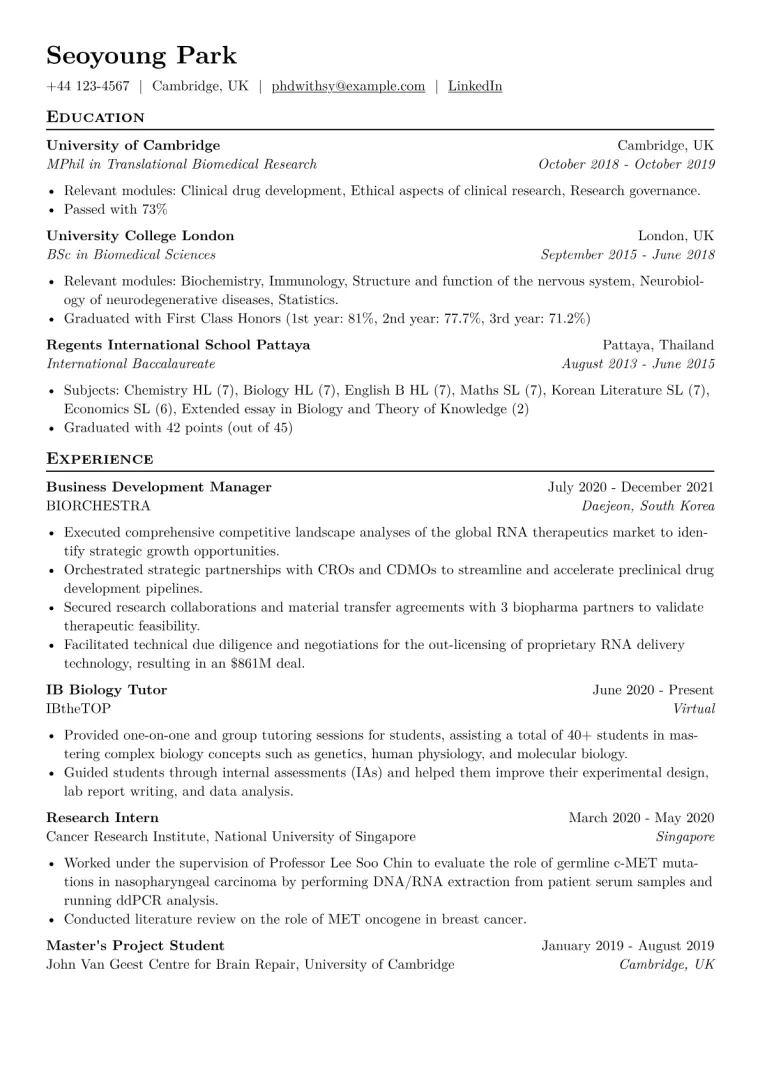
This CV got Seoyoung into Cambridge's PhD programme. The structure is textbook: education up top, research positions next, then awards and publications. Reviewers can find what they need in seconds.
Her bullet points are specific. "Facilitated technical due diligence and negotiations... resulting in an $861M deal" is concrete and memorable. The skills section lists actual techniques: Western blot, ddPCR, confocal microscopy. No vague "laboratory proficiency" claims.
If you are applying to academic programmes, this is a solid template to follow.
Here is exactly what Seoyoung's CV contains - the real data, not made-up examples.
Her education section leads with her most advanced degree and includes relevant details:
EDUCATION

MPhil in Translational Biomedical Research | University of Cambridge | 2018-2019
- Relevant modules: Clinical drug development, Ethical aspects of clinical
  research, Research governance
- Passed with 73%

BSc in Biomedical Sciences | University College London | 2015-2018
- Relevant modules: Biochemistry, Immunology, Structure and function of the
  nervous system, Neurobiology of neurodegenerative diseases, Statistics
- Graduated with First Class Honors (1st year: 81%, 2nd year: 77.7%,
  3rd year: 71.2%)

International Baccalaureate | Regents International School Pattaya | 2013-2015
- Subjects: Chemistry HL (7), Biology HL (7), English B HL (7), Maths SL (7),
  Korean Literature SL (7), Economics SL (6)
- Graduated with 42 points (out of 45)
Note what is included: relevant coursework, specific grades, and degree classification. This gives evaluators a complete picture of academic preparation.
Seoyoung's research experience shows a clear progression from undergraduate to postgraduate level:
RESEARCH EXPERIENCE

Master's Project Student | John Van Geest Centre for Brain Repair,
University of Cambridge | Jan-Aug 2019
- Worked under the supervision of Dr Kirsten Scott in Barker/Williams Gray lab
  to study the role of B lymphocytes in Parkinson's disease pathogenesis via
  immunofluorescence analysis of mouse and post-mortem human brains
- Final thesis mark: 77%

Undergraduate Project Student | Molecular Neuroscience,
University College London | Jan-Jun 2018
- Worked under the supervision of Professor David Attwell in the Attwell lab
  to study the role of different actin isoforms and calcium signalling in
  microglial physiology, by performing confocal imaging of microglia in
  mouse brain slices
- Final thesis mark: 76%

Research Intern | Cancer Research Institute,
National University of Singapore | Mar-May 2020
- Worked under the supervision of Professor Lee Soo Chin to evaluate the
  role of germline c-MET mutations in nasopharyngeal carcinoma by performing
  DNA/RNA extraction from patient serum samples and running ddPCR analysis
- Conducted literature review on the role of MET oncogene in breast cancer
The bullets follow the pattern: Supervisor + Specific Research Focus + Techniques Used + Outcome
Seoyoung has one publication in preparation - this is normal for PhD applicants:
PUBLICATIONS

In Preparation

Scott, K.M., Chong, Y.T., Park, S., et al. B lymphocyte responses in
Parkinson's disease and their possible significance in disease progression.
For PhD applicants who do not yet have publications: this is completely normal. Committees expect potential, not a publication record at this stage.
When you do have publications to list, most CV builders make you type every author, journal, volume, and page number by hand. JobSprout lets you auto-fill citation details from a paper title or DOI — and includes full publication support on the free plan. Students applying to PhD programmes shouldn't have to pay just to list their research.
Add publications by title or DOI - citation details are auto-filled
Her skills section lists specific, verifiable techniques:
TECHNICAL SKILLS

Biochemistry: Western blot, Immunohistochemistry

Molecular Biology: DNA/RNA extraction and analysis from tissue/patient
                   samples, PCR, qPCR, ddPCR

Imaging & Analysis: Fluorescence microscopy, Confocal microscopy,
                    Stereological analysis
Notice how specific this is - not "laboratory techniques" but actual methods she has used. "ddPCR" tells reviewers exactly what she can do.
Weak: One-page CV with brief job descriptions
Strong: Comprehensive CV with full publication details and research descriptions
Academic committees expect detail. A sparse CV suggests you have nothing to report, not that you are being concise.
Weak: "Conducted research in neuroscience laboratory."
Strong: "Investigated NMDA receptor-mediated synaptic plasticity in hippocampal CA1 neurons using whole-cell patch clamp recordings."
Specificity demonstrates that you actually did the work and understand what you were doing.
Weak: "Published in peer-reviewed journals."
Strong: Full citations with all authors, journal name, volume, pages, and DOI.
Academic readers expect complete citations. Incomplete references look careless.
Weak: Only listing completed, published work
Strong: Including manuscripts under review, works in progress, and conference submissions
Academic CVs should show the pipeline of your scholarly activity, not just finished products.
Weak: Detailed descriptions of retail jobs or unrelated experience
Strong: Focus on research, teaching, and academic service
Non-academic work can be mentioned briefly if it demonstrates relevant skills, but it should not dominate an academic CV.
PhD applications are about potential, not achievement. Focus on:
Do not worry about publications. Very few PhD applicants have them. Your research experience descriptions should demonstrate your potential instead.
The CV is one piece of a much longer process that also includes supervisor outreach, research proposals, funding deadlines and interviews.
For research-only posts rather than doctoral applications, the section order shifts: see the UK research CV. If you are already past submission, the postdoc CV covers the independence evidence panels look for at that stage.
Postdoc applications require demonstrated productivity:
Include a brief statement of research interests if the application does not require a separate research statement.
Faculty applications require comprehensive evidence:
Faculty CVs are the longest because committees need to evaluate all aspects of academic work.
Use consistent citation style throughout. Common formats:
APA (Psychology, Education, Social Sciences): Park, S., & Smith, J. (2023). Title of article. Journal Name, 43(2), 123-145.
MLA (Humanities): Park, Seoyoung, and John Smith. "Title of Article." Journal Name, vol. 43, no. 2, 2023, pp. 123-145.
Science (STEM): S. Park, J. Smith, Title of article. Journal Name 43, 123-145 (2023).
Match the convention in your field.
Include presentations with full details:
PRESENTATIONS

Invited Talks
Park, S. "Memory consolidation mechanisms." Department of Psychology
  Colloquium, Stanford University, March 2024.

Conference Presentations
Park, S., & Smith, J. "NMDA receptor subtypes in learning." Poster
  presented at Society for Neuroscience Annual Meeting, San Diego, CA,
  November 2023.
Distinguish between invited talks (more prestigious) and submitted presentations.
JobSprout is designed to help you create professional CVs for academic applications. Here is how our tools can help with your PhD, postdoc, or faculty application:
Browse our template gallery to find templates designed for academic applications. Every template uses clean, readable formatting that admissions committees and search committees expect - professional presentation without distracting design elements.
Struggling to describe your research contributions? JobSprout's AI Writer helps you:
Unlike most CV builders, JobSprout has a dedicated publications section: paste a DOI, PubMed, or arXiv link and the title, authors, date, and source fill themselves in from the publisher's record, one link at a time. Works in progress are supported, and the section is on the free plan. See how it works on the academic CV builder.
Our AI Cover Letter Writer creates personalised letters for each programme or institution. The Deep Research feature pulls real information about the department and potential supervisor, so your letter demonstrates genuine fit with their research focus.
JobSprout uses Typst - the same professional typesetting technology used in academic publishing. Your CV will have the polished appearance that signals attention to detail.
Create and download your CV for free. No watermarks, no paywall when you are ready to apply. Export as PDF for consistent formatting across all application portals.
It depends on your career stage:
Unlike industry CVs, length is acceptable in academia. However, everything included should be relevant.
Include it if it is strong (First Class, 2:1, or 3.5+ GPA). For doctoral applications, academic performance matters. If your GPA is lower, focus on research experience and recommendations to compensate.
This is normal for PhD applicants and early-career researchers. Focus instead on:
Publications come with time. Committees understand this.
In the UK and US: No. In some European countries: Yes. Research the convention for your target institution and country.
Use standard citation format with all authors in the order they appear on the paper. You can bold your own name to make it easy to identify: "Park, S., Smith, J., & Jones, A. (2023)..."
You now know what admissions committees look for: research experience, technical skills, and clear presentation of your scholarly preparation.
Next steps:
No credit card required. No watermarks. Your CV, ready in minutes.