Writing a CV for legal applications demands precision and adherence to convention. Law is a conservative profession, and your CV should reflect that. Creativity in formatting or content can work against you in ways it would not in other industries.
The legal job market remains competitive. According to The Law Society of England and Wales and NALP (National Association for Law Placement), top law firms receive thousands of applications for training contracts and associate positions. Your CV needs to communicate competence, attention to detail, and appropriate credentials quickly.
This guide breaks down exactly what legal recruiters look for, with a detailed example.
What Legal Hiring Managers Look For
Legal recruiting follows established conventions. Based on guidance from NALP, The Law Society, and insights from legal recruiters, here is what gets evaluated:
1. Educational Credentials
Law school pedigree matters more in legal recruiting than in most industries:
Law school ranking and reputation
Degree classification or GPA
Law Review, Moot Court, or similar honours
Academic awards and scholarships
Whether this should carry such weight is debatable. That it does is simply reality in legal hiring.
2. Bar Admissions and Qualifications
These are non-negotiable prerequisites:
UK: Solicitor qualification (SQE) or Barrister qualification (Bar course)
US: State bar admissions
International: Relevant local qualifications
List all jurisdictions where you are admitted to practice.
3. Relevant Experience
Legal experience is evaluated by:
Firm prestige and reputation
Practice area depth
Transaction or case experience
Client exposure
In transactional practices (M&A, corporate finance), deal size and complexity are the currency. In litigation, case outcomes and court experience matter.
4. Transaction or Case Record
Your matters are your track record:
Deal size (for transactional work)
Case complexity and outcome (for litigation)
Your specific role and contribution
Notable clients (if appropriate to disclose)
5. Professional Activities
Beyond client work, firms value:
Publications in legal journals
Speaking engagements
Pro bono contributions
Professional organisation involvement
Business development (for senior roles)
CV Structure for Legal Applications
Legal CVs follow a specific structure that puts credentials first:
For Law Students and Trainees:
Contact InformationEducationLegal Experience (including vacation schemes/internships)Other Work Experience (if relevant)Skills and LanguagesActivities and Interests
Conservative formatting is mandatory. Like finance, law expects traditional formatting. No creative templates, colours, or unusual fonts. Black text, standard font, single column.
Education stays prominent. Unlike other industries, legal CVs keep education near the top even for experienced lawyers. Law school pedigree matters throughout a legal career, and the template reflects this with Education before Bar Admissions.
Bar Admissions follow Education. Your qualifications to practise are critical, but they come after your educational credentials. The template shows this clearly.
Transactions/cases are woven into experience. Rather than a separate matters section, deal details are integrated into each role description.
Length expectations. One page for students and junior lawyers. Two pages acceptable for senior associates and partners. Never more than two pages in private practice.
Real Example: Corporate Attorney CV
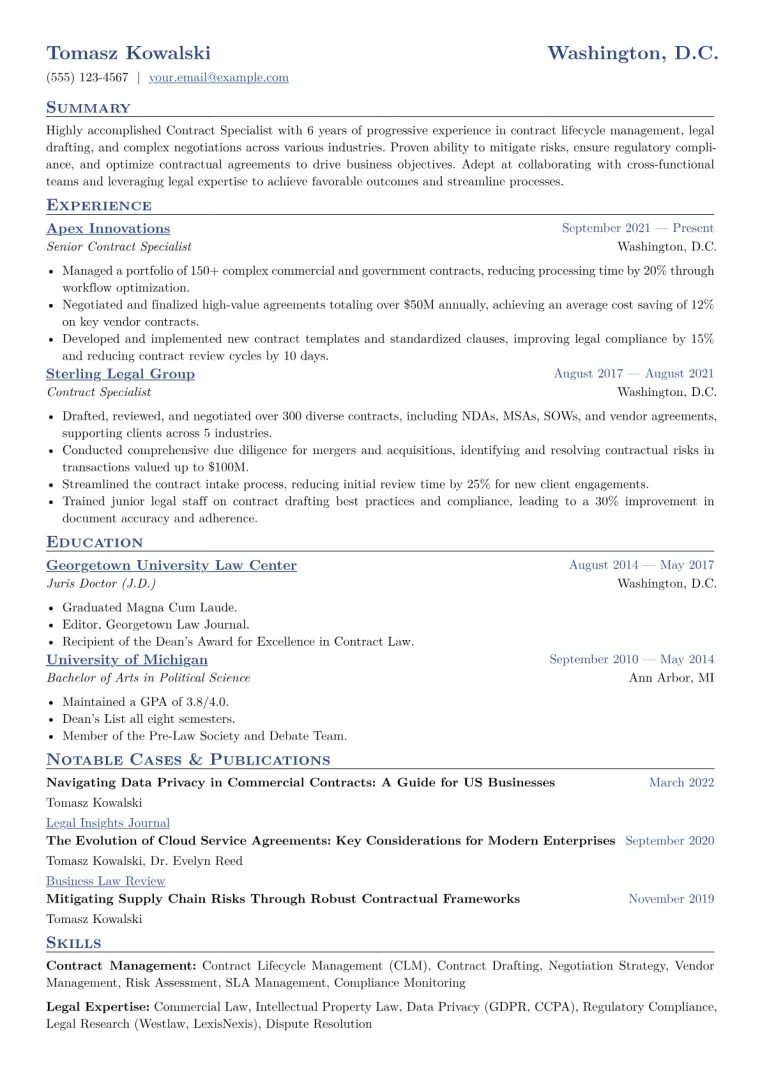
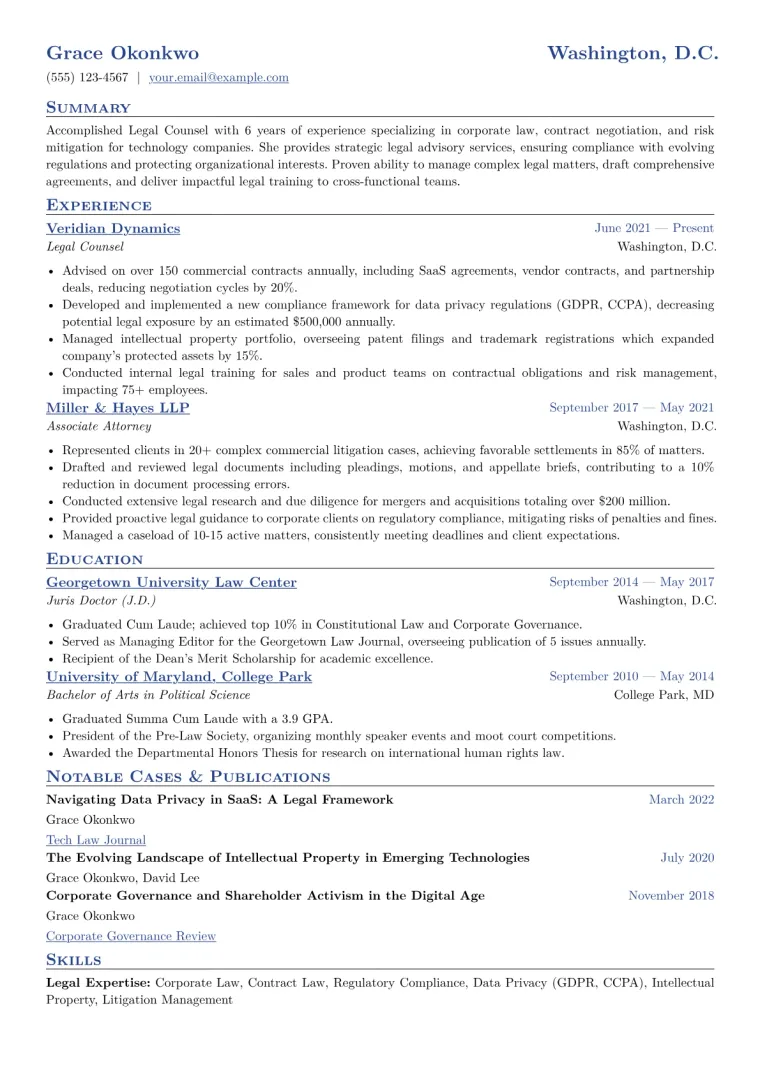
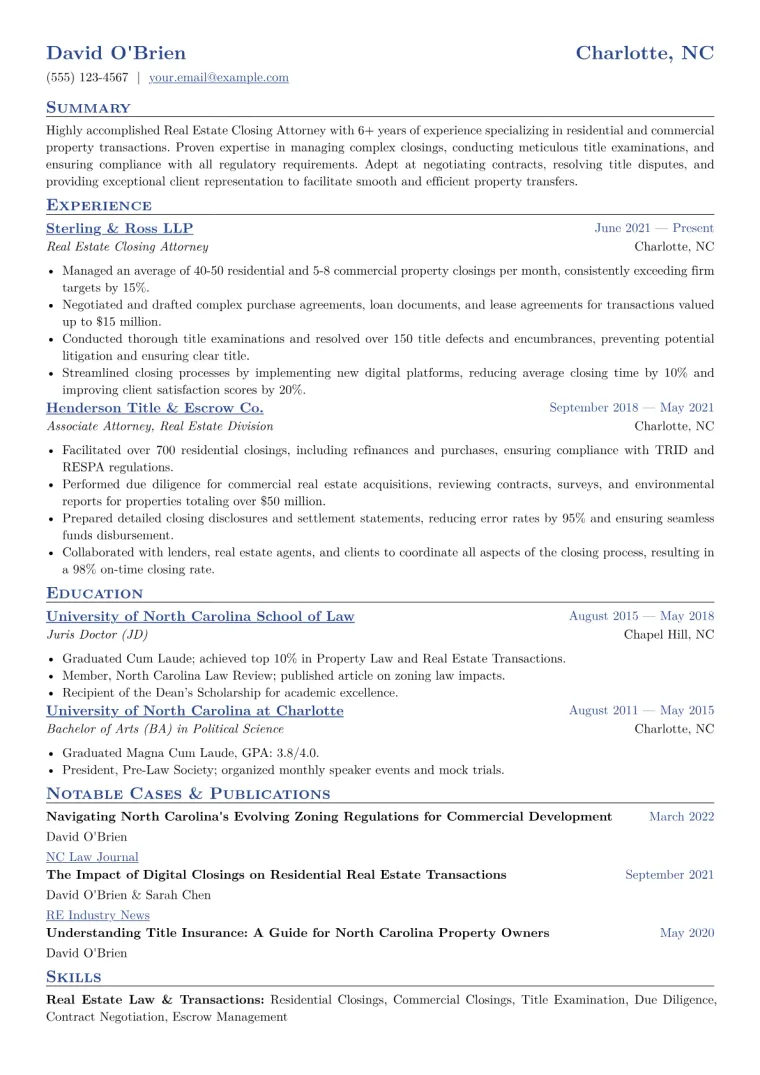
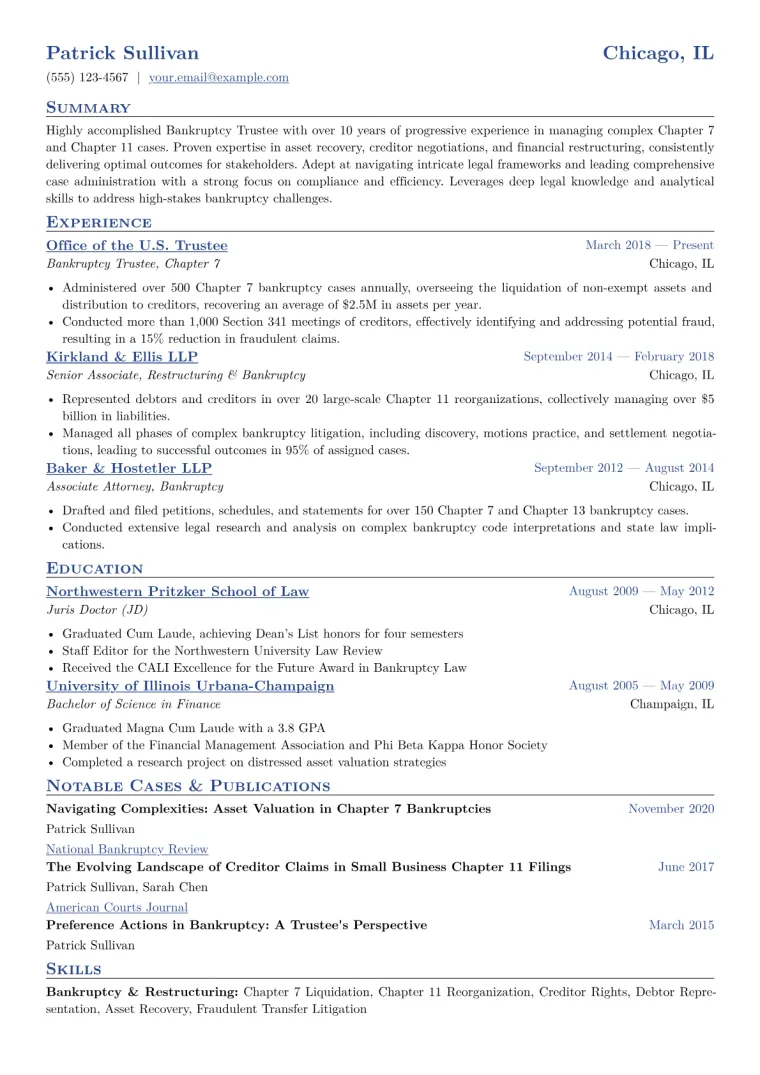
Let us analyse a real CV from a corporate attorney. This CV demonstrates every principle discussed above.
What Makes This CV Work
Legal CVs are conservative by design. The classic template is the right call here because anything creative would raise eyebrows at a white-shoe law firm.
Education comes first because law school pedigree still matters in BigLaw. Harvard Law, cum laude, Law Review. That is the shorthand that gets you in the door. Bar admissions follow immediately because they are prerequisites.
The experience section focuses on transactions, not responsibilities. "$2.1B cross-border acquisition" tells the story. "Advised clients on M&A matters" does not. Deal size is the currency of BigLaw.
The publication entry is strategic. Most associates do not publish, so having one article in a respected journal signals you are thinking about the field, not just billing hours. It does not need to be groundbreaking. It needs to exist.
Section-by-Section Breakdown
Education Section
For legal CVs, education includes law school details:
EDUCATIONHarvard Law School | Juris Doctor | 2018- cum laude- Harvard Law Review, Articles Editor- Ames Moot Court Competition, Quarterfinalist- Dean's Scholar (Top 20%)Yale University | Bachelor of Arts, Political Science | 2015- magna cum laude- Phi Beta Kappa
For UK legal CVs:
EDUCATIONUniversity of Oxford | Graduate Diploma in Law (GDL) | 2020- DistinctionUniversity of Cambridge | BA History | 2019- First Class Honours- College Scholar
Note what is included: honours, activities that demonstrate legal aptitude, and academic recognition. Law Review membership and moot court are particularly valued because they demonstrate legal writing and advocacy skills.
Bar Admissions Section
List all jurisdictions clearly:
BAR ADMISSIONSNew York (2018)England and Wales (2020)California (2019, inactive)
For UK solicitors:
QUALIFICATIONSSolicitor, England and Wales | SRA Roll Number: [Number] | Admitted 2021
Experience Section
Each role includes transaction details:
CORPORATE ASSOCIATE | Sullivan & Cromwell LLP | New York | 2018-PresentMergers & Acquisitions Group- Lead associate on $2.1B cross-border acquisition of European technology company, coordinating with legal, tax, and regulatory advisors across six jurisdictions- Represented financial sponsor in $1.4B leveraged buyout of healthcare services company, including negotiation of definitive agreements and management equity arrangements- Advised public company board on $800M hostile takeover defence, including poison pill implementation and SEC disclosure requirements- Drafted and negotiated merger agreements, stock purchase agreements, and ancillary transaction documents for deals ranging from $50M to $3BSUMMER ASSOCIATE | Sullivan & Cromwell LLP | New York | Summer 2017- Conducted due diligence and drafted memoranda for pending M&A transactions- Received offer for full-time associate position
The bullets follow the pattern: Transaction Type + Size + Your Role + Complexity
Selected Transactions Section
For senior lawyers with extensive deal experience:
SELECTED TRANSACTIONSMergers & Acquisitions- $2.1B acquisition of [Target] by [Acquirer] (Acquirer counsel)- $1.4B leveraged buyout of [Company] by [Sponsor] (Sponsor counsel)- $800M hostile defence for [Company] (Target counsel)Capital Markets- $500M high-yield bond offering for [Issuer]- $350M initial public offering for [Company]Private Equity- Formation of $1.2B private equity fund- Various portfolio company acquisitions totalling $800M+
For litigation attorneys, substitute with:
SELECTED MATTERS- Lead trial counsel in [Case Name], achieving complete defence verdict in $50M breach of contract dispute (State Court, 2023)- Successfully argued motion for summary judgment in securities class action involving $200M in alleged damages (Federal Court, 2022)
Publications Section
Legal publications signal engagement with the profession:
PUBLICATIONS"Cross-Border M&A in the Post-Brexit Landscape," Harvard Business Law Review, Vol. 12, 2022."Fiduciary Duties in Take-Private Transactions," M&A Lawyer, July 2021.
Note that publications do not need to be groundbreaking. Having something published in a respected outlet matters more than the specific topic.
Common Mistakes in Legal CVs
1. Creative Formatting
Weak: Coloured headers, unusual fonts, graphics
Strong: Black text, Times New Roman or Garamond, clean layout
Legal hiring committees view creative formatting as poor judgment. The profession is conservative, and your CV should reflect that.
2. Vague Matter Descriptions
Weak: "Worked on various M&A transactions."
Strong: "Represented acquirer in $2.1B cross-border acquisition of technology company, negotiating definitive agreement and coordinating regulatory approvals across six jurisdictions."
Deal size, your role, and complexity are mandatory details.
3. Omitting Law School Honours
Weak: Just listing law school and graduation year
Strong: Including Law Review, moot court, academic honours, and relevant activities
Law school activities signal legal aptitude. Law Review membership, in particular, demonstrates writing ability - critical for any legal role.
4. Excessive Length
Students and associates: One page maximum
Senior associates: One to two pages
Partners: Two pages maximum
Even partners should not exceed two pages. If you cannot summarise your career effectively, that reflects poorly on your legal drafting ability.
5. Including Irrelevant Experience
Weak: Detailed descriptions of pre-law jobs unless directly relevant
Strong: Focus on legal experience, with brief mention of other experience only if it adds value
A summer job as a lifeguard does not belong on a lawyer's CV. Pre-law experience in finance, government, or relevant industries can be included briefly.
Legal-Specific Tips
For Law Students
Law student CVs should emphasise:
Academic performance (if strong)
Law Review, moot court, or other legal activities
Legal internships and vacation schemes
Relevant pre-law experience (briefly)
Do not worry about having limited legal experience. Firms hiring students expect to train them. Show potential and academic capability.
For Training Contract Applicants (UK)
Training contract applications in the UK require:
Academic credentials (ideally 2:1 or above)
Vacation scheme or other legal work experience
Evidence of commercial awareness
Clear articulation of why you want that specific firm
Commercial awareness is particularly valued. Show you understand the business context of legal work.
For Lateral Associate Moves
When moving between firms:
Lead with your transaction or case experience
Quantify your practice (deal sizes, billable hours if impressive)
Demonstrate portable skills
Show progression in responsibility
For In-House Counsel Positions
In-house CVs can be slightly different:
Business impact and partnership with stakeholders
Efficiency improvements and cost savings
Risk management contributions
Project management and team leadership
In-house roles value business partnership skills alongside legal expertise.
Pro Bono and Community Service
Include meaningful pro bono work:
PRO BONO- Lead counsel for asylum seeker from [Country], successfully obtaining asylum based on religious persecution (2022)- Provided corporate governance advice to local nonprofit organisations through [Law Firm] Pro Bono Program
Pro bono demonstrates commitment to the profession and often involves substantive legal work that students and junior lawyers would not otherwise access.
How JobSprout Helps You Write a Legal CV
JobSprout is designed to help you create professional CVs that meet the strict conventions of legal recruiting. Here is how our tools can help with your law firm or in-house application:
1. Choose a Conservative, Professional Template
Browse our template gallery to find templates designed for legal applications. Every template uses the traditional, single-column formatting that law firm recruiting committees expect - no colours, no creative elements, just polished professionalism.
2. AI-Powered Matter Descriptions
Struggling to describe your transaction or case experience? JobSprout's AI Writer helps you:
Transform generic descriptions into matter-specific statements with deal sizes and outcomes
Generate bullet points that follow the Transaction Type + Size + Your Role + Complexity formula
Rewrite vague bullets like "worked on M&A matters" into strong ones like "lead associate on $2.1B cross-border acquisition, coordinating regulatory approvals across six jurisdictions"
3. Maintain Strict Formatting Standards
Legal CVs have specific conventions - education placement, credentials formatting, transaction lists. Our templates enforce these standards automatically so you focus on content, not layout.
4. Generate Tailored Cover Letters
Our AI Cover Letter Writer creates personalised letters for each firm. The Deep Research feature pulls real information about the firm's recent matters and practice areas, so your letter demonstrates genuine knowledge of their work.
5. One-Page Precision
Law firm CVs for students and associates must fit on one page. JobSprout's templates automatically handle spacing to maximise content while maintaining the clean, professional appearance legal recruiters expect.
6. Free Export, No Watermarks
Create and download your CV for free. No watermarks, no paywall when you are ready to apply. Export as PDF for consistent formatting when submitting through firm portals.
Include it if it is strong (2:1 or above in UK; 3.3+ GPA in US). Legal hiring, especially for students and junior lawyers, places significant weight on academic performance. If your grades are lower but you have strong experience, you may omit them - but be prepared to discuss.
How important is law school prestige?
More important than it should be, frankly. Top law firms recruit disproportionately from highly ranked schools. However, strong academic performance at any accredited law school, combined with relevant experience, can open doors. Focus on what you can control.
Should I list all my bar admissions?
List all active admissions. For inactive admissions, include them with "(inactive)" notation. Multiple jurisdictions can be valuable for cross-border work.
Industry knowledge relevant to your target practice area
Reasons for the career change (briefly, in cover letter)
Former bankers going into finance law, former engineers going into IP - these transitions are common and valued.
Do I need a cover letter?
For most legal applications, yes. Legal cover letters should be:
One page maximum
Tailored to the specific firm and practice area
Free of any errors (typos in legal applications are particularly damaging)
Clear about why you want this role at this firm
Ready to Build Your Legal CV?
You now know what law firm recruiters look for: conservative formatting, matter experience with specific details, and credentials prominently displayed.
![How to Write a CV for Legal Applications [2026 Guide]](/thumbnails/cv-for-legal-applications.webp)
![PhD CV vs Resume: Which One to Send [2026]](/thumbnails/phd-cv-vs-resume.webp)
![Postdoc CV: Structure, Template and Example [2026]](/thumbnails/postdoc-cv.webp)
![Research CV: UK Format, Structure and Examples [2026]](/thumbnails/research-cv-uk.webp)