

AI Infrastructure Engineer Resume Example

TechnologySoftware EngineeringSenior (5-10 years)AI InfrastructureMLOps

Free to use. No download fee.

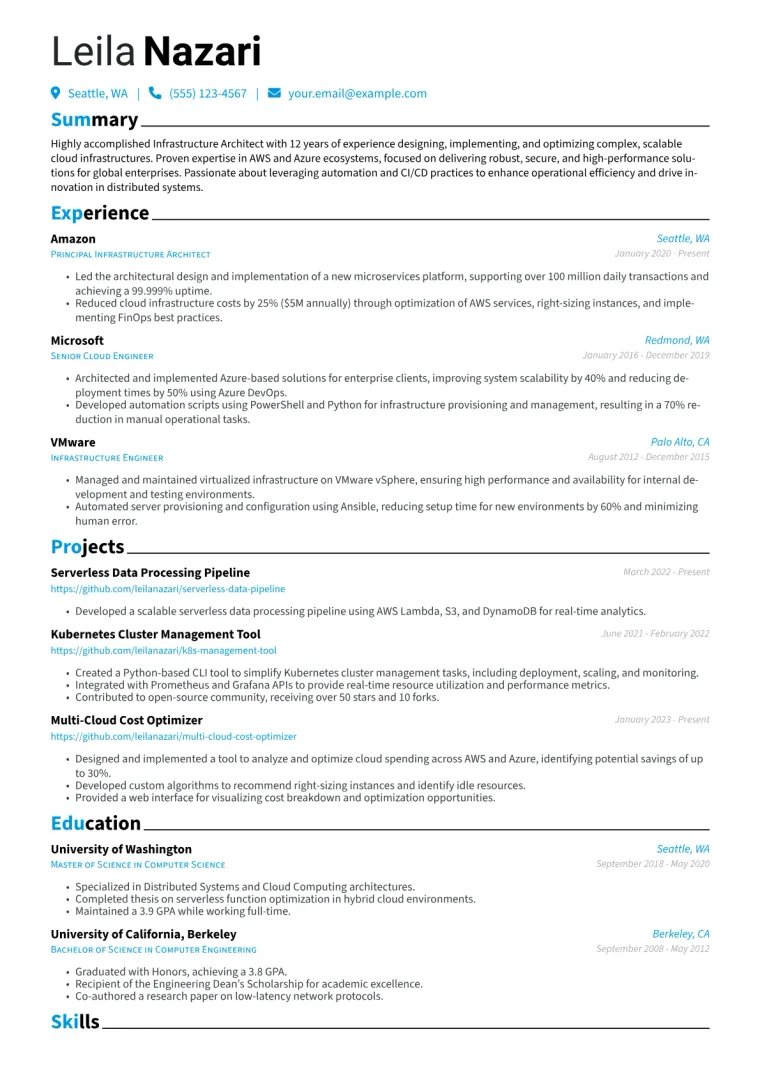
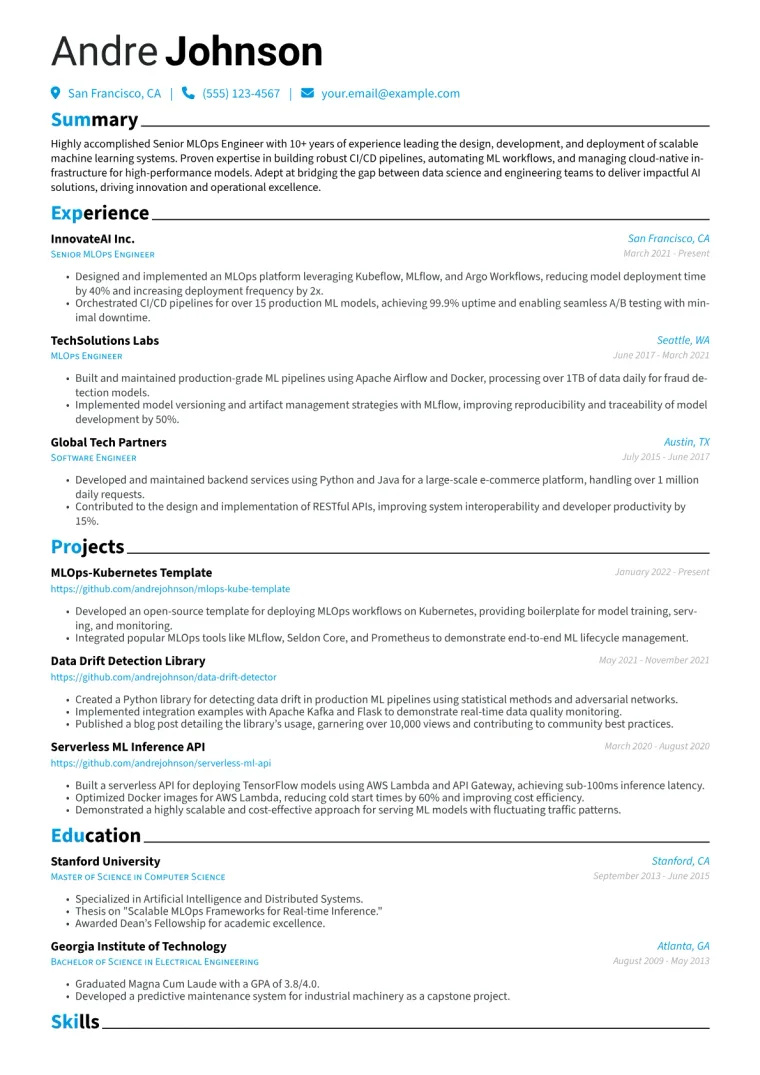
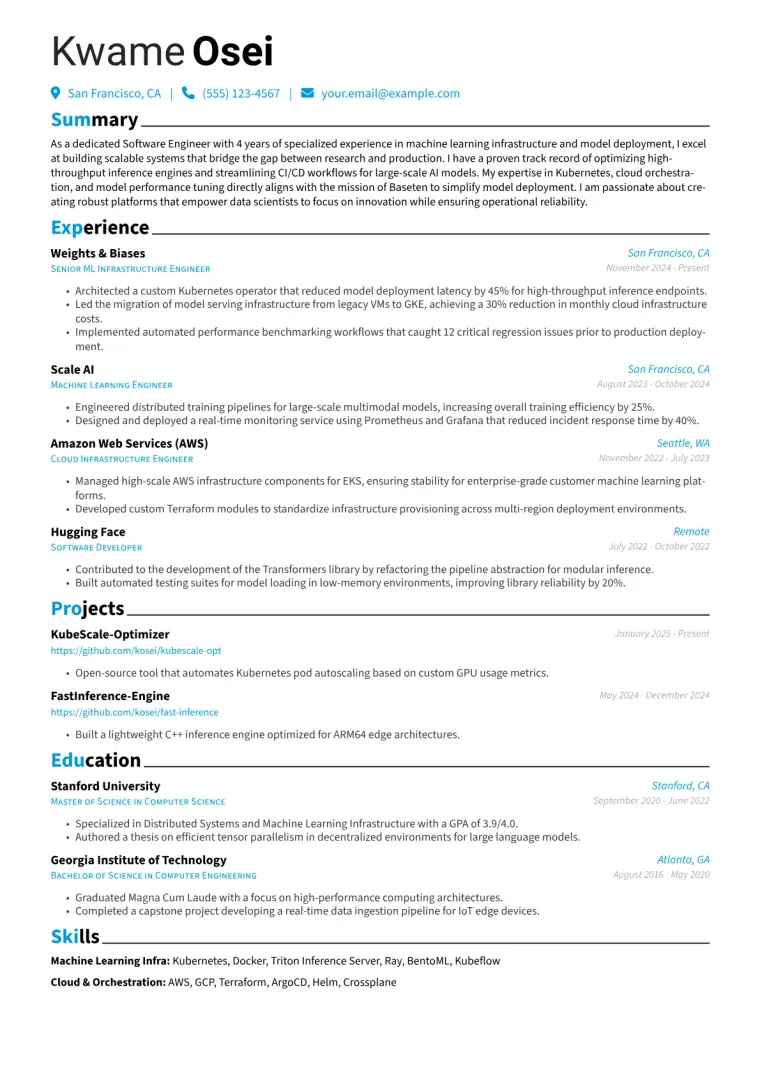
AI Infrastructure Engineer resume samples

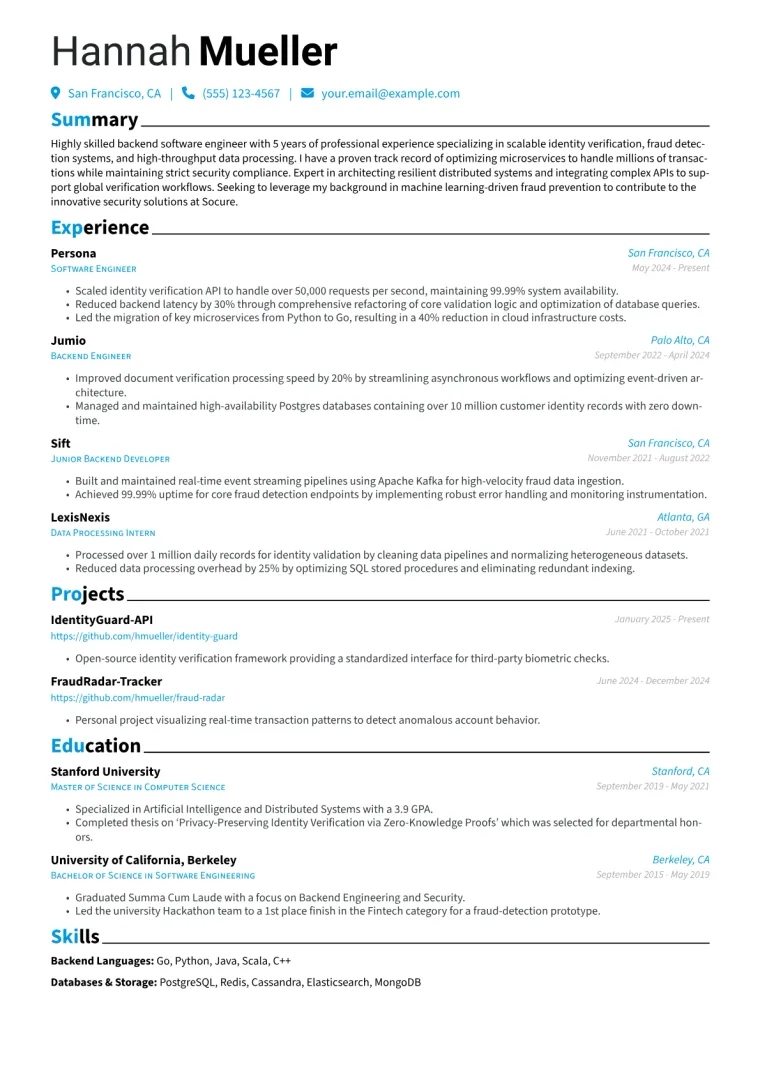
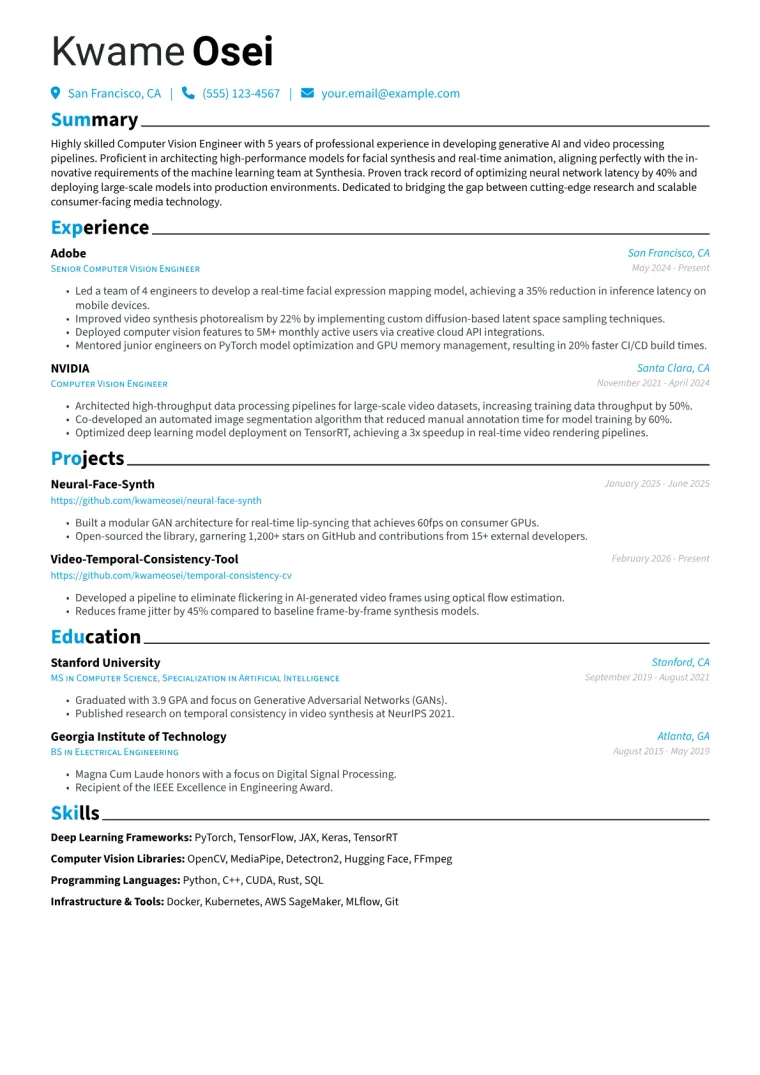
Three complete resumes, each in a different design.

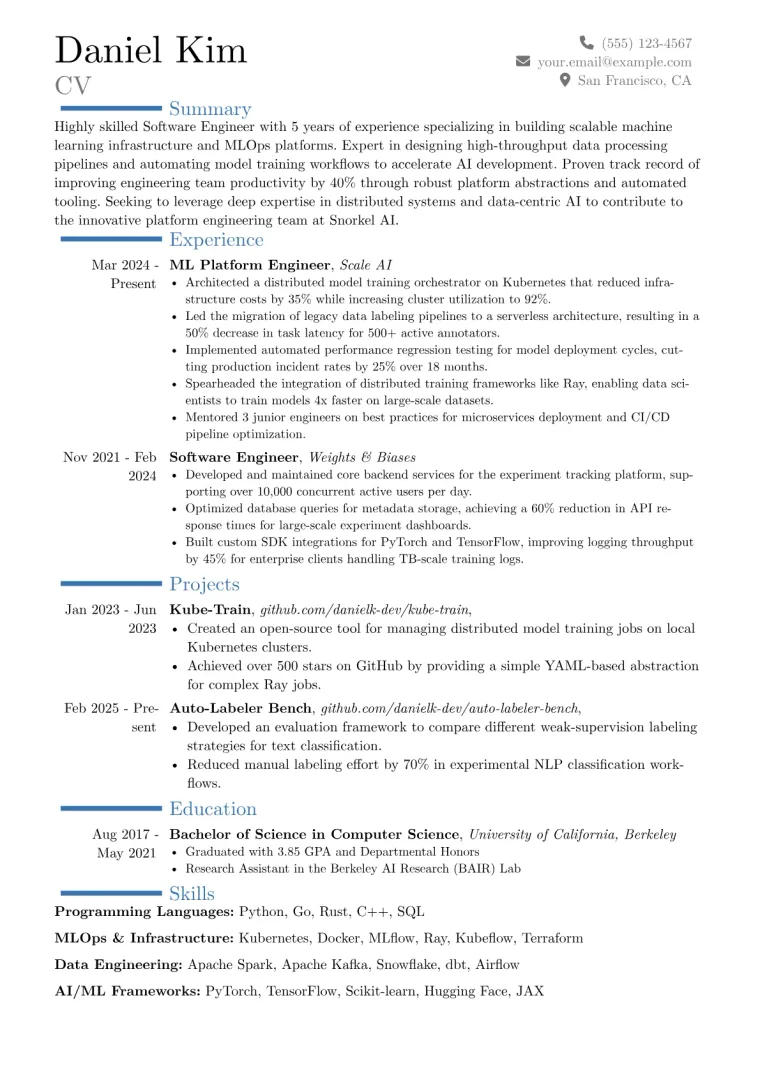
AI Infrastructure Engineer resume example, page 1
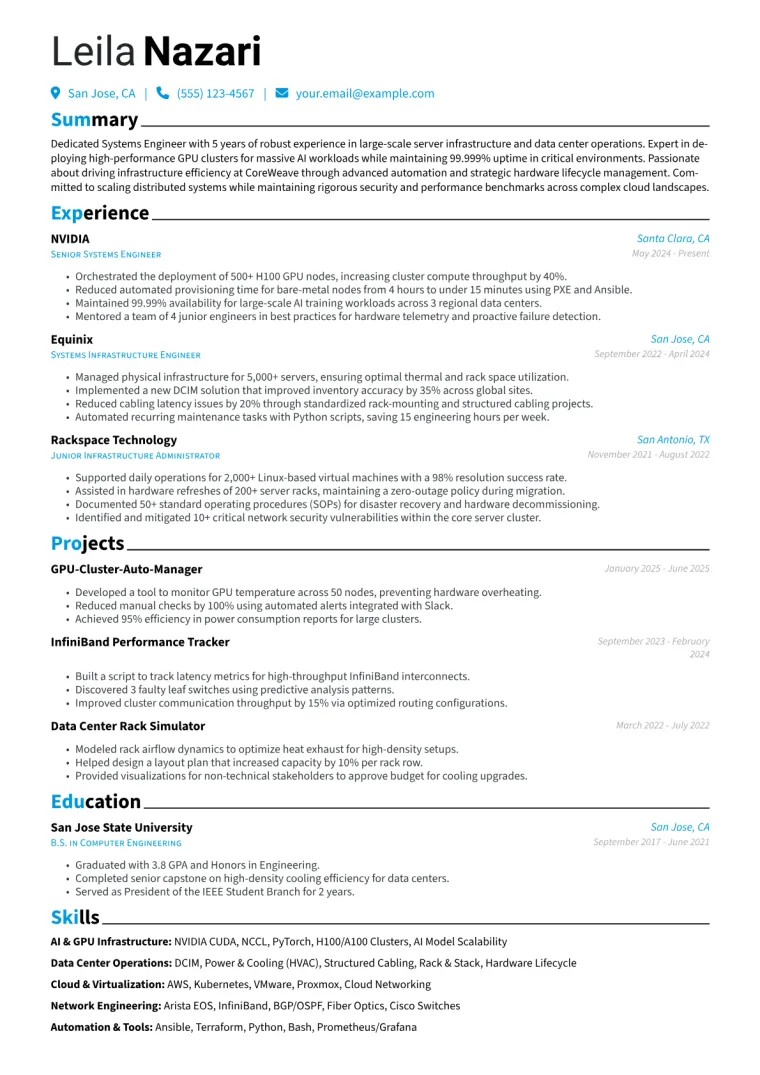
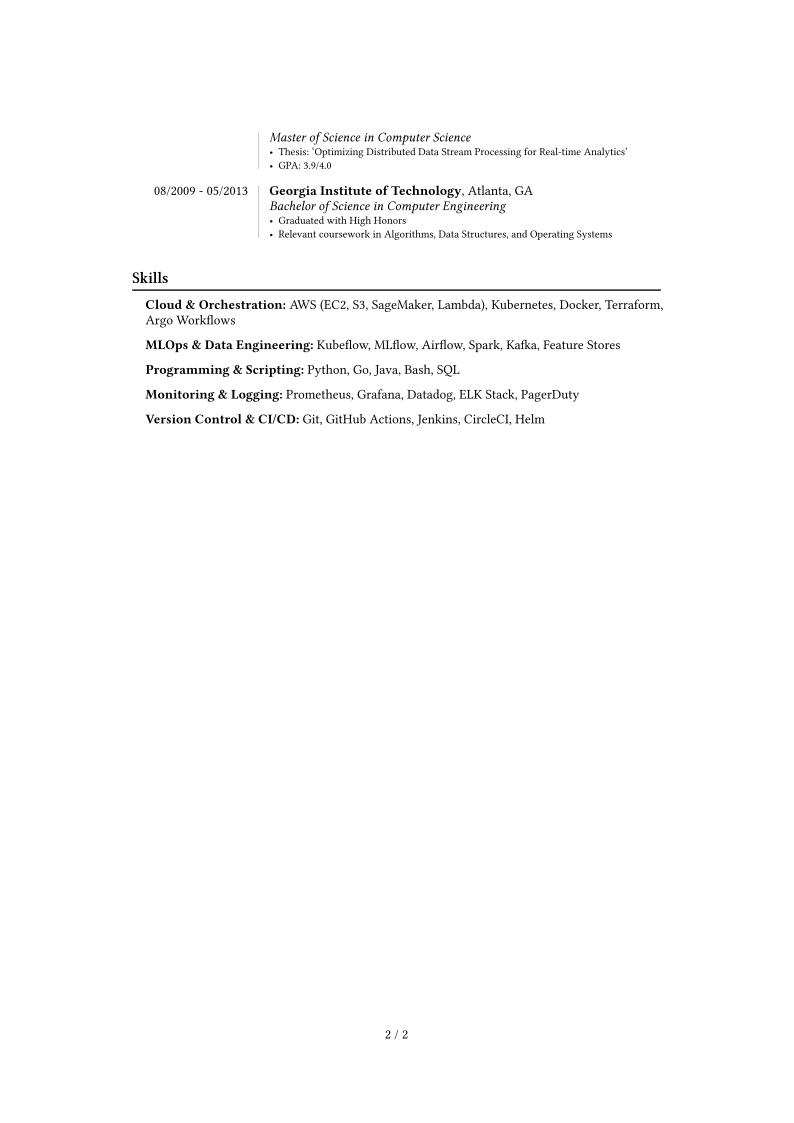
AI Infrastructure Engineer resume example, page 2
1 / 2
AI Infrastructure Engineer resume example, AI Infrastructure, page 1
AI Infrastructure Engineer resume example, Career changer, page 1
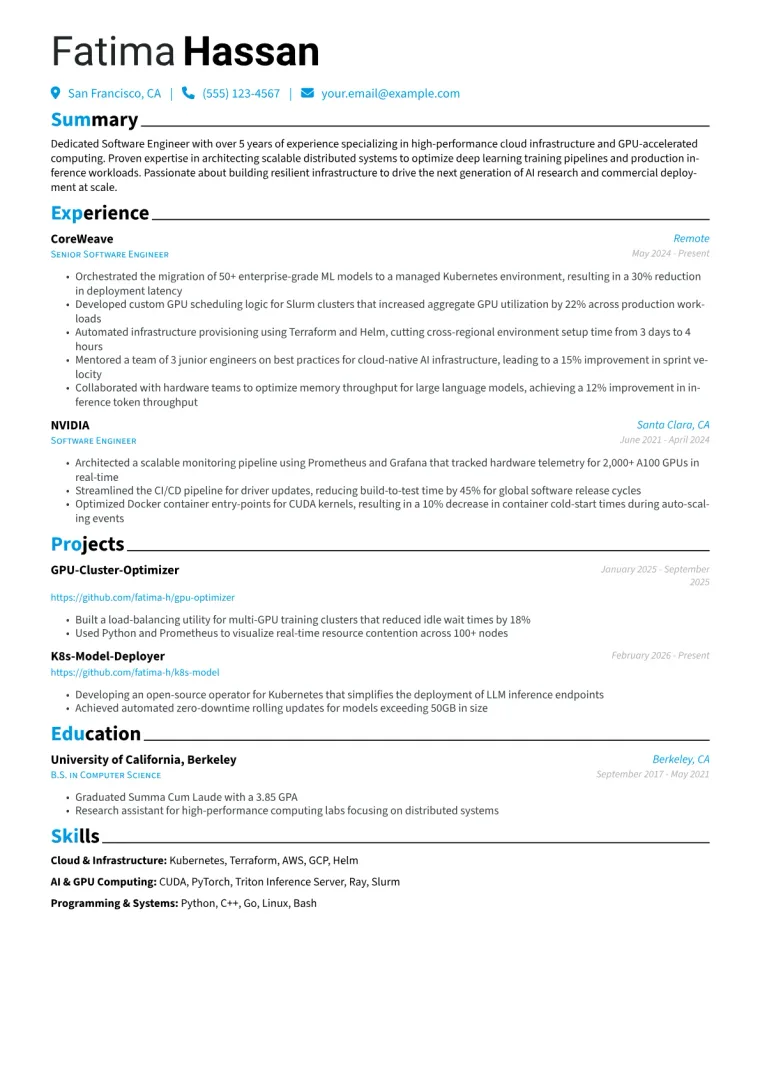
AI Infrastructure Engineer resume example, Career changer, page 2
1 / 2

Free to use. No download fee.

What makes a strong AI Infrastructure Engineer resume?

US median salary $175,675 ·

A strong AI Infrastructure Engineer resume for a senior professional must highlight impact on scalable AI systems. Hiring managers prioritize candidates who have demonstrably engineered robust, high performance platforms for machine learning training and inference. Concrete achievements involve optimizing GPU cluster utilization, reducing model deployment latency across distributed systems, or building resilient MLOps pipelines on cloud platforms like AWS or GCP. Expertise in Kubernetes, Terraform, and proficiency with frameworks like PyTorch or TensorFlow, alongside system architecture achievements, are crucial.

Why this example works

This JobSprout example effectively showcases these elements. Achievements are quantified, detailing improvements in system efficiency or throughput, such as “reduced inference latency by 25% for high-volume production models.” Skills are thoughtfully grouped by category, differentiating between Cloud Platforms, Orchestration Tools, and MLOps Frameworks, which helps recruiters quickly identify relevant expertise. Important certifications like AWS Certified Machine Learning Specialty or CKA are prominently featured, validating specialized knowledge and practical application.

AI Infrastructure Engineer resume example (text version)

Jessica Thompson · AI Infrastructure Engineer

Summary

Highly accomplished AI Infrastructure Engineer with over 10 years of experience designing, building, and optimizing scalable MLOps platforms and distributed systems for machine learning workflows. Proven ability to drive significant improvements in model deployment efficiency, resource utilization, and operational stability across diverse cloud environments. Seeking to leverage deep expertise in Kubernetes, cloud infrastructure, and data pipelines to architect next-generation AI solutions.

Experience

Senior AI Infrastructure Engineer · Google

Mountain View, CA · 2021 - Present

  • Led the design and implementation of a scalable MLOps platform on Google Cloud, reducing model deployment time by 40% for 100+ production models.
  • Architected and deployed Kubernetes clusters for ML inference, handling over 1 billion daily predictions with 99.99% uptime.
  • Developed automated CI/CD pipelines for ML models, integrating with internal tooling and decreasing manual effort by 60%.
  • Optimized cloud resource utilization for ML training workloads, achieving a 25% cost reduction across multiple projects.

AI Platform Engineer · NVIDIA

Santa Clara, CA · 2017 - 2021

  • Engineered and maintained a distributed training infrastructure using Kubernetes and Slurm, supporting 50+ data scientists and researchers.
  • Implemented GPU-aware scheduling solutions, increasing GPU utilization by 30% for deep learning workloads.
  • Developed custom monitoring and alerting systems for ML pipelines, improving incident response time by 50%.
  • Collaborated on the development of a containerization strategy for ML applications, reducing environment setup time by 70%.

Software Engineer, Machine Learning · Microsoft

Redmond, WA · 2014 - 2017

  • Built and maintained core components of a large-scale data pipeline for machine learning features, processing terabytes of data daily.
  • Optimized data ingestion and transformation processes, leading to a 20% reduction in processing latency.
  • Developed and deployed RESTful APIs for ML model serving, supporting integration with various internal products.
  • Contributed to the design of a fault-tolerant system for model training, ensuring data integrity and recovery in failures.

Education

MS in Computer Science · Carnegie Mellon University

Pittsburgh, PA · 2012 - 2014

  • Specialized in Distributed Systems and Artificial Intelligence.
  • Published research on optimizing resource management in cloud environments, resulting in a 10% efficiency gain.
  • Graduated with a 3.9/4.0 GPA.

BS in Electrical Engineering · University of California, Berkeley

Berkeley, CA · 2008 - 2012

  • Completed coursework focused on algorithms, data structures, and computer architecture.
  • Dean's List 6 semesters; awarded departmental scholarship.

Skills

MLOps & Orchestration:KubernetesDockerAirflowMLflowTensorFlow Extended (TFX)Kubeflow
Cloud Platforms:Google Cloud Platform (GCP)AWSAzureTerraformAnsibleServerless Functions
Programming & Data:PythonGoJavaSQLNoSQL (Cassandra, MongoDB)Spark
Monitoring & Observability:PrometheusGrafanaDatadogElastic Stack (ELK)JaegerOpenTelemetry
DevOps & CI/CD:GitJenkinsGitHub ActionsArgoCDCircleCISentry

How useful was this template?

4.7 (12 votes)
JobSprout logoExample by JobSprout

See this resume as a website

The same content, live on your own jobsprout.me page. Share a link instead of a PDF.

View live example
AI Infrastructure Engineer Cover Letter Example
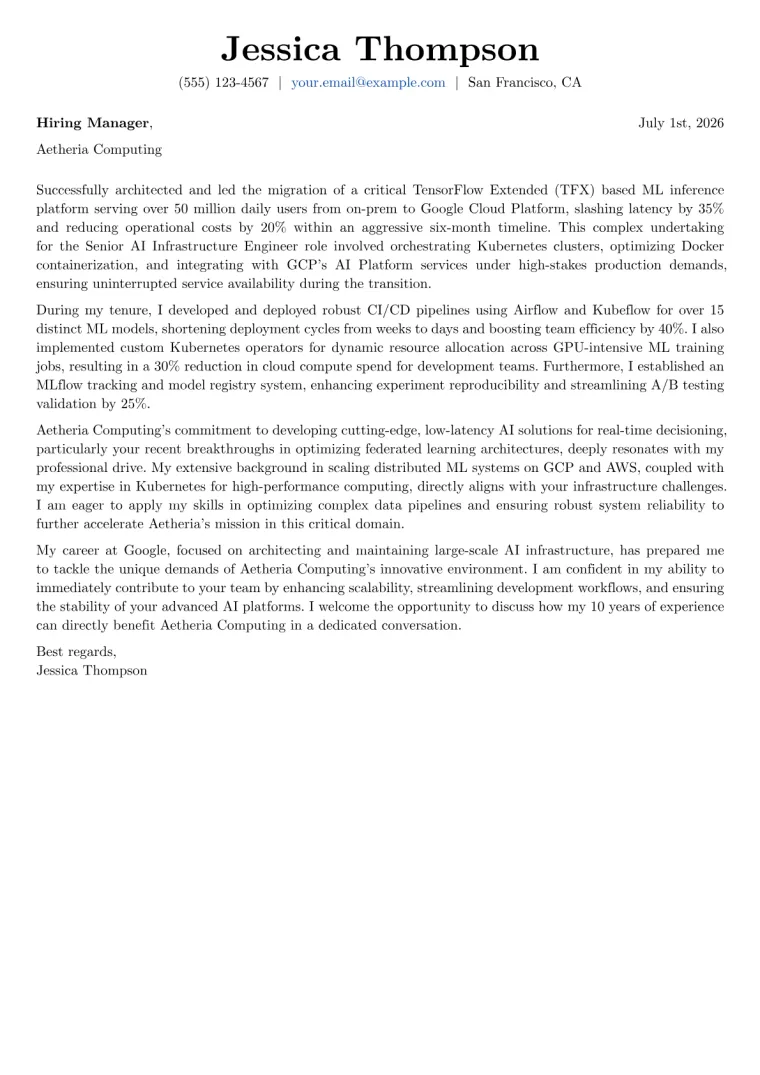
Matching cover letter

AI Infrastructure Engineer Cover Letter Example

Written for the same person as this resume, ready to adapt.

See the cover letter

AI Infrastructure Engineer resume summary example

Highly accomplished AI Infrastructure Engineer with over 10 years of experience designing, building, and optimizing scalable MLOps platforms and distributed systems for machine learning workflows. Proven ability to drive significant improvements in model deployment efficiency, resource utilization, and operational stability across diverse cloud environments. Seeking to leverage deep expertise in Kubernetes, cloud infrastructure, and data pipelines to architect next-generation AI solutions.

AI Infrastructure Engineer salary by country

Country25th percentileMedian75th percentile
US$143,368$175,675$207,981
UK£80,862£91,723£102,585
CanadaC$143,781C$151,344C$158,907
AustraliaA$101,935A$126,667A$147,857
Germany€59,500€70,570€77,887
France€37,875€44,167€49,750
Netherlands€61,500€63,000€64,500
Italy€55,000€60,000€65,000
Austria€46,250€58,750€67,500
New ZealandNZ$102,500NZ$120,000NZ$162,500
India₹570,786₹1,167,051₹1,840,563
Polandzł247,444zł314,887zł382,331

Annual salaries in local currency, aggregated from live job postings via Adzuna. Figures refresh continuously and reflect advertised pay, not negotiated offers.

AI Infrastructure Engineer resume skills and keywords

Recruiters and applicant tracking systems scan AI Infrastructure Engineer resumes for these skills and keywords. Include the ones that match your experience and mirror the wording in the job description. Check your resume against them with the free ATS checker.

Hard skills

MLOps PrinciplesDistributed SystemsCloud ArchitectureContainer OrchestrationData Pipeline DesignModel DeploymentScalable SystemsPerformance OptimizationInfrastructure as CodeCI/CD PipelinesMachine Learning EngineeringDeep Learning FrameworksBig Data TechnologiesAPI Development

Tools & software

KubernetesTerraformAWS Cloud ServicesDockerGitPythonMLflowPrometheus

Certifications

AWS Certified Solutions ArchitectGoogle Cloud Professional Machine Learning EngineerKubernetes Certified AdministratorAzure AI Engineer Associate

Soft skills

Cross-functional CollaborationProblem SolvingSystem Design ThinkingTechnical LeadershipCommunication SkillsMentorship

Market Insights

AI Infrastructure Engineer

Salary Range

$175,675median annual
$20k$208k

Salary Trend

Mar 2025 – Feb 2026

12-Month Trend

Stable
+2.4% YoY

Based on advertised Software Engineering roles.

US market data · Source: Adzuna · Updated Mar 2026

Frequently Asked Questions

What's the best resume structure for a senior AI Infrastructure Engineer?
For a senior AI Infrastructure Engineer, a technical, reverse-chronological format is optimal. Begin with a strong professional summary highlighting your expertise in scalable AI infrastructure and MLOps. Follow with a detailed experience section, emphasizing your contributions to designing, building, and optimizing AI platforms. A prominent 'Technical Skills' section detailing cloud platforms, orchestration tools, and data technologies is crucial. Focus on large-scale systems and performance.
What key skills and qualifications should an AI Infrastructure Engineer highlight?
Highlight deep expertise in cloud platforms (AWS, Azure, GCP), Kubernetes, Docker, and CI/CD pipelines for machine learning. Emphasize experience with MLOps tools, data orchestration (e.g., Airflow), distributed computing frameworks (e.g., Spark), and GPU acceleration technologies. Include skills in system architecture, performance optimization, security best practices for AI, and proficiency in relevant programming languages like Python or Go. Mention experience with large-scale data storage solutions.
How can I write strong achievement bullets or a compelling professional summary as an AI Infrastructure Engineer?
Your professional summary should immediately establish your ability to build and scale robust, high-performance infrastructure for AI/ML workloads. Achievement bullets must be highly technical and quantifiable. For example, 'designed and deployed a Kubernetes-based ML platform, reducing model deployment time by 40% and cutting operational costs by 20%' or 'optimized data ingestion pipelines for large-scale AI training, handling petabytes of data with 99.9% uptime.' Focus on scalability, efficiency, and reliability.
Which optional sections are important for an AI Infrastructure Engineer's resume?
A 'Technical Skills' section is paramount, detailing specific cloud services, orchestration tools, monitoring systems, and programming languages. A 'Projects' section can showcase significant infrastructure builds or open-source contributions. Relevant 'Certifications' in cloud architecture (e.g., AWS Solutions Architect Professional, Google Cloud Professional Cloud Architect) or Kubernetes are highly valuable. Any 'Publications' or 'Speaking Engagements' on MLOps or scalable AI systems are also beneficial.
How can I tailor this resume template for a specific AI Infrastructure Engineer job posting?
When tailoring your resume, closely examine the job description for specific cloud providers, MLOps tools, data volumes, or performance requirements mentioned. Use JobSprout's 'Remix with AI' feature; by pasting the job description, the AI will adapt your resume to highlight your most relevant infrastructure projects, technical expertise, and achievements that directly align with the employer's specific technology stack and scaling challenges. This ensures a strong, targeted application.

The blank page is the hard part. Skip it.

Free to use. No download fee.