PDF or DOCX · up to 2MB
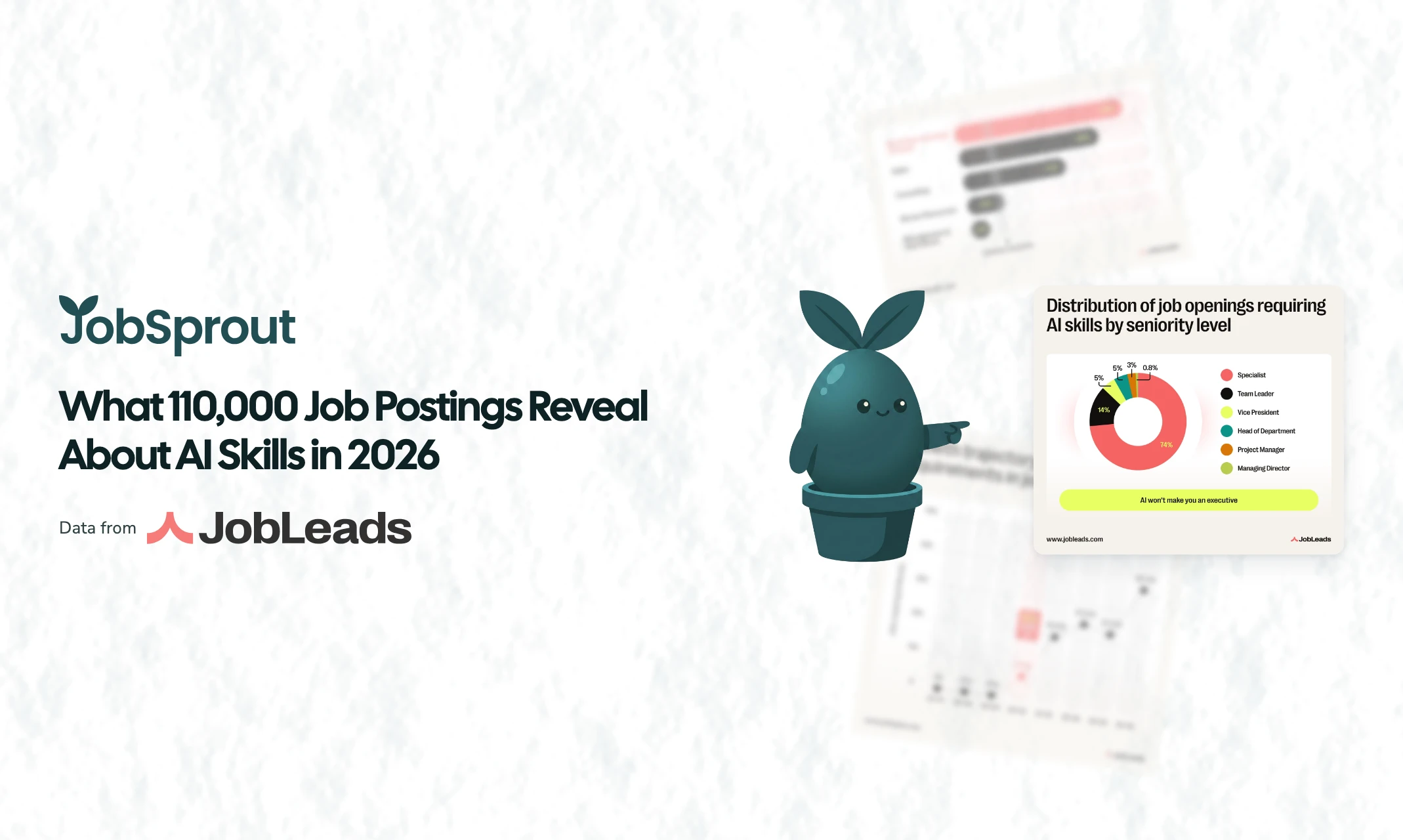
JobLeads screened 60 million US job postings and found 110,000 that require AI skills. Demand exploded 1,300% in 18 months while average salaries fell 4%. The average misleads: here is the industry-by-industry breakdown.
Eye-tracking research reveals where recruiters look during their initial resume scan. What gets noticed, what gets skipped, and how to optimise for it.
100+ statistics on AI in UK CV writing, job applications and recruitment in 2026, sourced from the ONS, CIPD, Acas, Ada Lovelace Institute, and JobSprout's own data.
The AI skills employers actually want on your resume in 2026. Practical examples for every industry, plus how to describe them the right way.
If you added "AI literacy" to your CV in 2025 and you work in healthcare, you probably got a pay rise. If you work in marketing, you probably took a pay cut. Same year. Same skill. Two different signals.
JobLeads' analysis of 60 million US job postings between January 2024 and December 2025 shows that demand for AI skills exploded 1,300% in 18 months, while the average salary for AI-tagged roles fell 4%. The headline drop is real, but the average misleads. The split by industry is the story, and it's where the actionable read lives.
This piece walks through that split, what's behind it, and what each industry's CV strategy should be in 2026.
The five numbers that shape the rest of this piece, all from JobLeads' analysis:
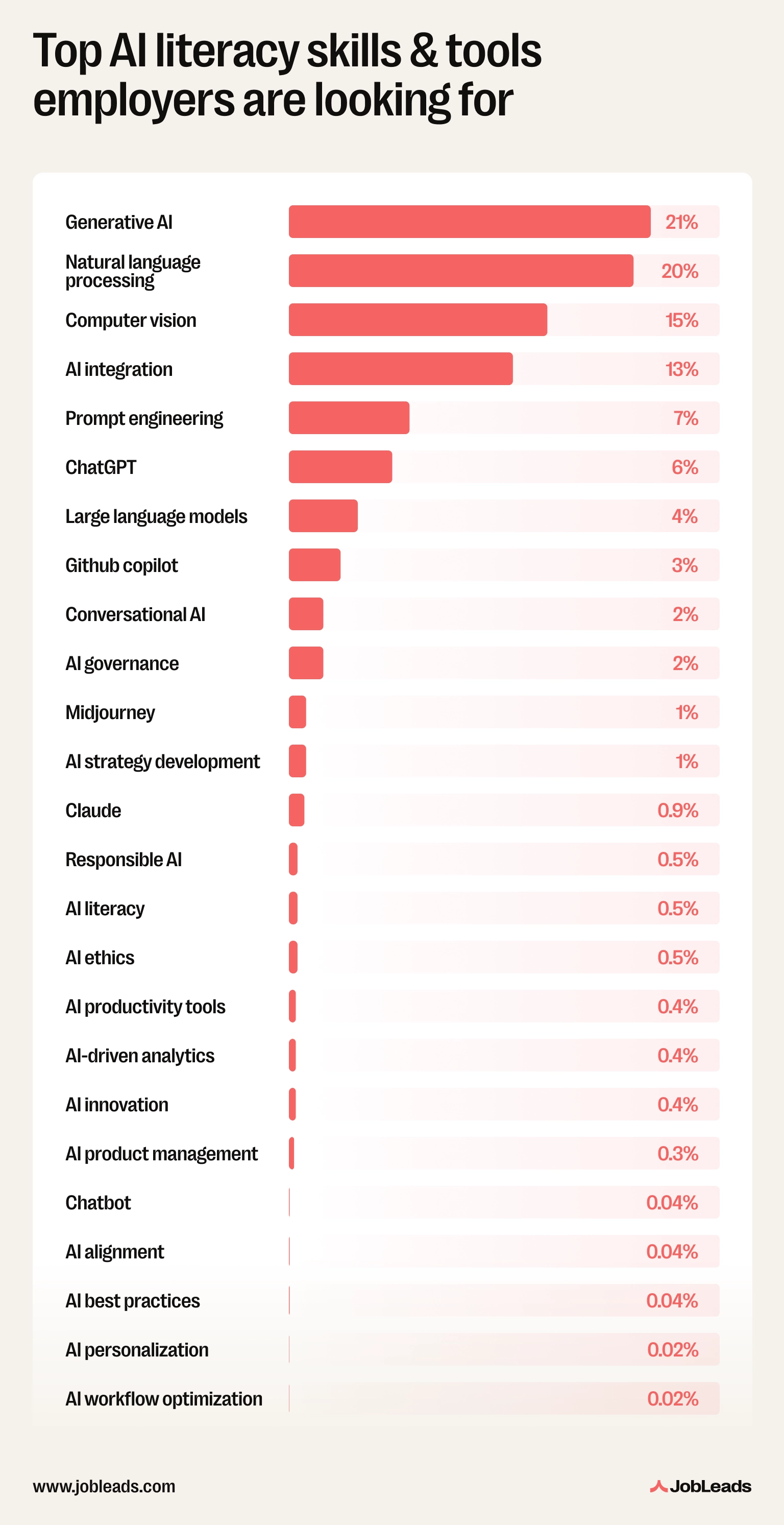
The most-demanded skills mirror the same story: Generative AI (21%), Natural Language Processing (20%) and Computer Vision (15%) lead employer requirements. ChatGPT itself appears in just 6% of listings, GitHub Copilot in 3%. Employers want the concepts, not the brand.
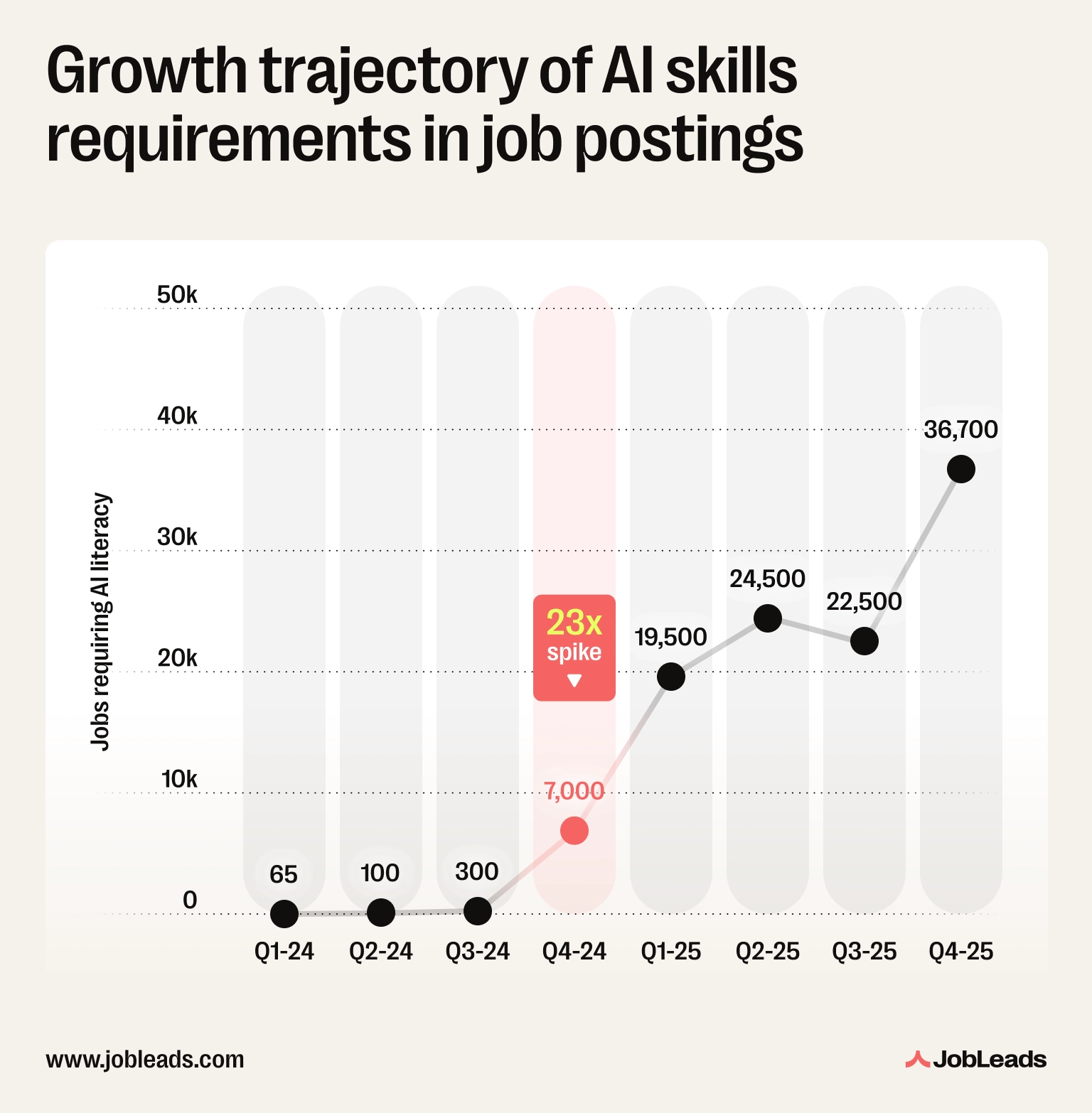
In Q1 2024, JobLeads' scrape recorded 65 US postings that mentioned AI literacy. By Q4 2025, that number was 36,700 per quarter. The biggest jump came in a single quarter: Q4 2024, when postings went from 300 to 7,000 in one window. A 23x spike. From there, the curve never came back down.
Source: JobLeads, AI Skill Demand 2026 Study.
The pattern matches what was happening in the broader economy. OpenAI announced over one million paying business customers in late 2025, with message volume growing 8x year-over-year. US enterprises spent $37 billion on generative AI in 2025, more than triple the $11.5 billion of 2024, per Menlo Ventures' enterprise benchmark. The hiring market reacted on the same curve.
The methodology is worth knowing before reading the rest. JobLeads scraped 60 million US job ads posted between January 2024 and December 2025 and classified them as AI roles if the listing mentioned any of 35 keywords related to AI literacy, mainstream AI tools, or AI usage as a requirement. The final pool was 110,000 postings. US-only. Salaries reported in USD.
That last point matters. This is what employers wrote in their listings. Whether the candidates they hired actually had those skills, and whether those skills materially affected their work, is a different question.
"When millions of candidates can claim AI literacy and when learning those skills becomes a commodity, the reward becomes scarce. As a result, in certain industries, those with deep AI knowledge are no longer competing for scarce specialist roles. They're competing against the flood."
Jan Hendrik von Ahlen, Managing Director, JobLeads
The commoditisation thesis is the right frame for the headline 4% salary drop. But the average is doing work it shouldn't. When you split the dataset by industry, the picture changes shape entirely.
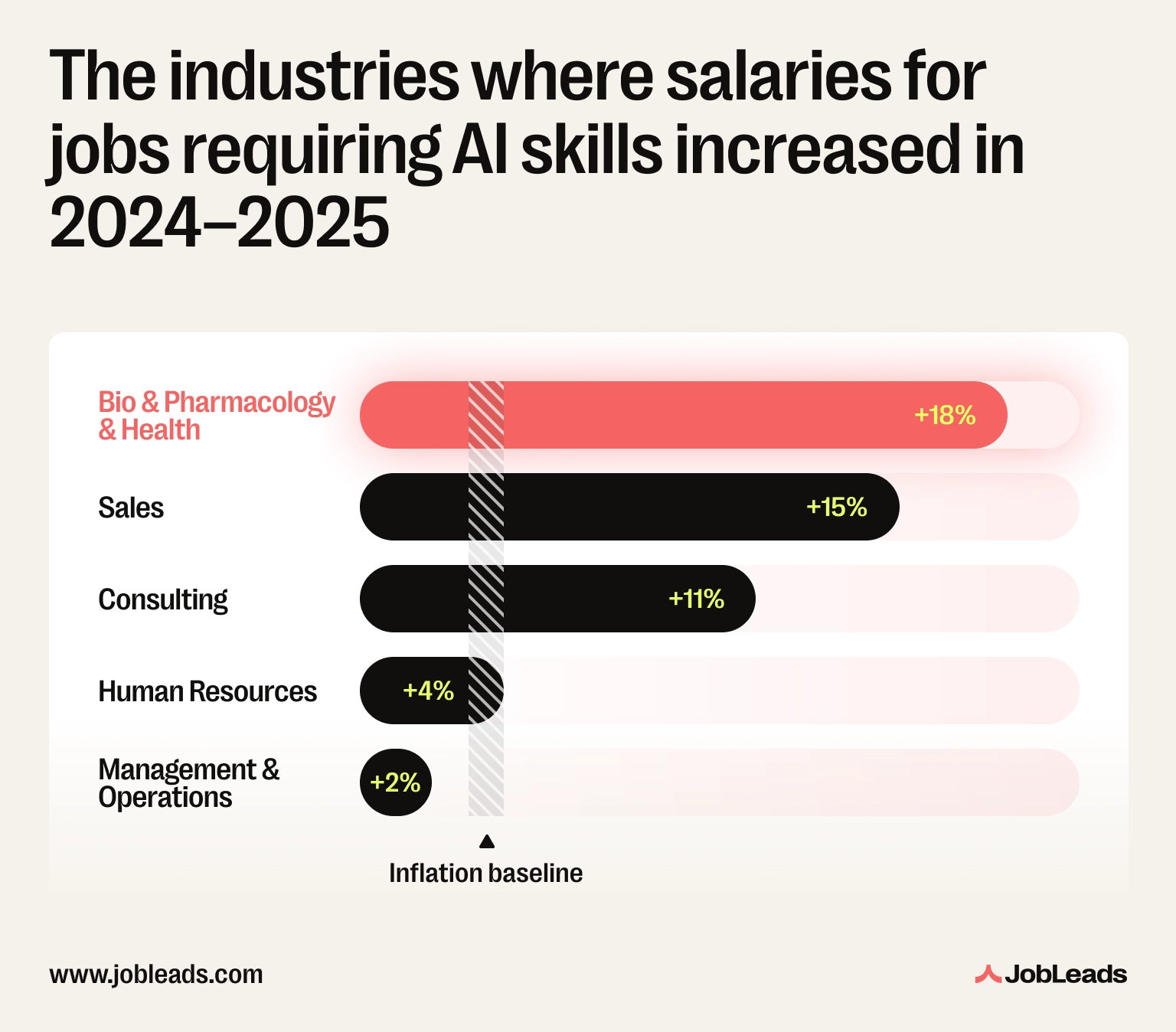
This is the chart the whole piece sits on:
Source: JobLeads, AI Skill Demand 2026 Study.
Five industries paid more for AI literacy in 2025 than they did in 2024. Five paid less. The full picture:
| Industry | Job growth | Salary change | 2025 median |
|---|---|---|---|
| Bio & Pharmacology & Health | high | +18% | $106K |
| Sales | high | +15% | $98K |
| Consulting | very high | +11% | $118K |
| Human Resources | high | +4% | $75K |
| Management & Operations | high | +2% | $111K |
| Engineering | +1,021% | 0% | $140K |
| Finance | high | -0.9% | $109K |
| IT & Technology | high | -2% | $118K |
| Legal | high | -4% | $120K |
| Marketing & Media | +2,551% | -7.5% | $86K |
A 25-point spread, top to bottom. That isn't random.
Three forces explain the winners. Each industry has a different mix of them.
Healthcare and Bio-Pharma: the talent pool that combines clinical or scientific depth with AI fluency is small. Most healthcare professionals have not yet learned AI tools in a meaningful way. The minority who have can command a real premium because the market hasn't yet saturated. A $16,000 median jump from $90K to $106K is the largest absolute increase in the dataset.
Sales: AI sales tooling (Salesforce Einstein, Gong, Apollo, AI-powered sales enablement platforms) is producing measurable productivity gains. A rep who can actually operate those tools well, not just claim to, generates more pipeline. Sales is one of the few functions where AI-driven output is directly attributable, so the premium is paid.
Consulting: consultancies sell expertise. AI literacy is now part of the expertise stack clients expect them to bring. Clients pay for that, which the firms pay forward. Consulting also has the highest density of six-figure roles in the AI dataset: 70% of consulting AI jobs pay above $100K.
The thread connecting all three: AI literacy in these industries is scarce, and when paired with deep domain knowledge it remains hard to replicate. The market still rewards it.
HR sits in a fourth category. Its modest +4% median hides an aggressive split. JobLeads notes that 22% of HR AI roles pay between $10K and $60K, the largest entry-level tail in the dataset. AI in HR (resume screening, ATS automation, candidate communication) is the most commoditised role-type in the study. The middle of the market still pays for it. The bottom is paying entry rates for what is now baseline-expected work.
Engineering saw the largest job growth in the dataset, 1,021%. Yet salaries did not move. The median stayed at $140K.
The reading: AI literacy was already implicit in engineering job descriptions. Employers added the explicit "AI required" tag to listings without changing the role's scope or budget. The job was the same job. The keyword changed.
Marketing & Media is the more interesting case. Job postings grew 2,551%, the steepest growth in the entire dataset. Salaries fell 7.5%. The split has a specific shape: marketing is the function where generative AI is most directly disruptive. Content generation, image generation, copywriting, basic campaign creative, all of these can now be produced by AI tools. Hiring managers don't need to pay a senior marketer to do them; they can pay a junior marketer who's good with the tools.
You see the same pattern, less aggressively, in Legal (-4%), IT & Technology (-2%) and Finance (-0.9%). These are mature, well-paid industries where AI is partially replacing tasks rather than adding to them. Job descriptions expand to include AI fluency requirements; salaries don't expand to match, because the budgeted spend on each role is roughly fixed and the work AI now handles was previously paid for at the same rate.
If you're in one of the loser industries, the read is not "stop learning AI." It is: do not expect AI literacy alone to lift your salary band. The industry's pricing of that skill has shifted.
Source: JobLeads, AI Skill Demand 2026 Study.
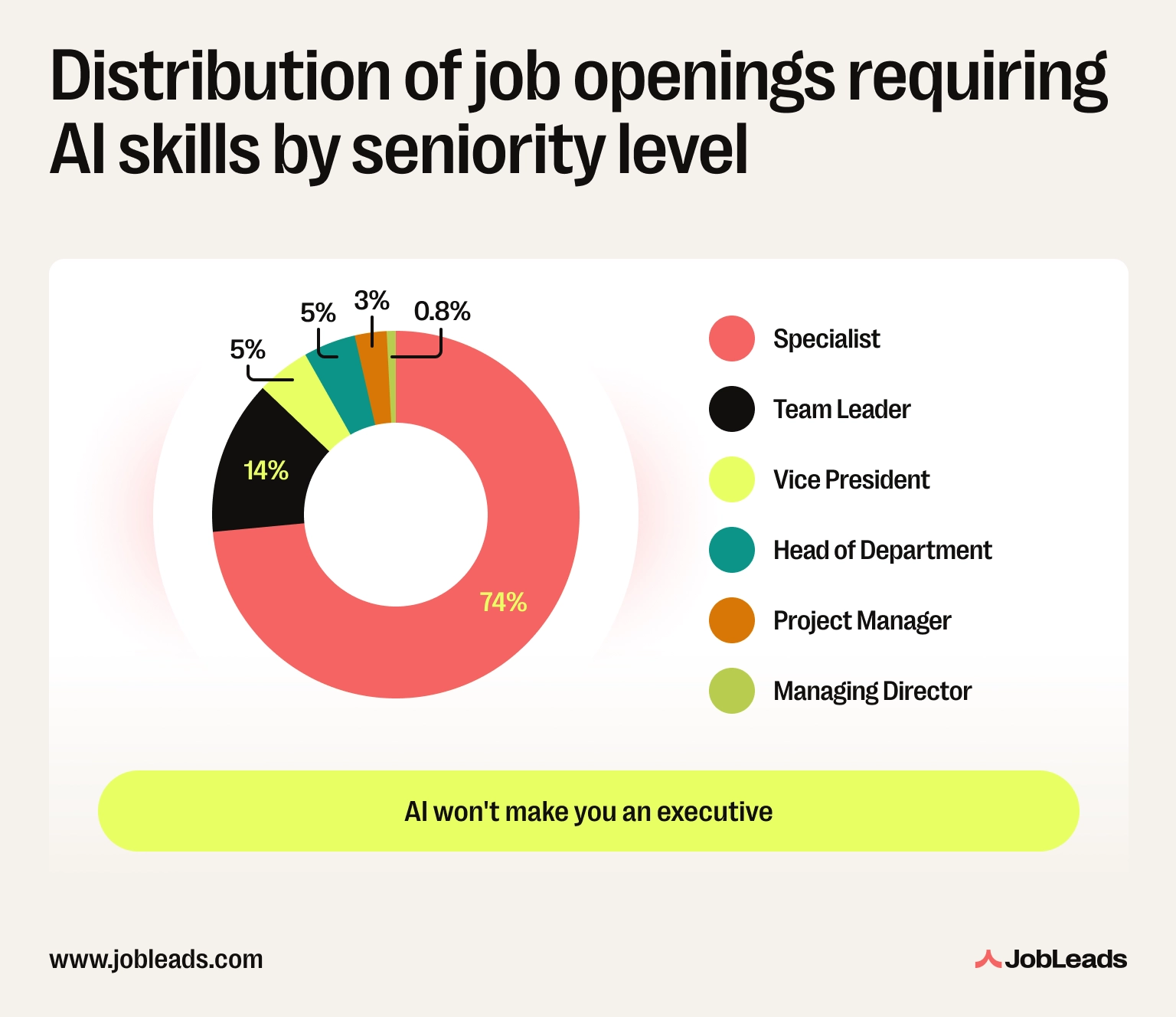
The shape of this chart matters more than the numbers. Three out of four AI-tagged roles are mid-level individual contributors. Fewer than one in a hundred are Managing Director. For every 100 AI jobs posted, 74 are specialists, 14 are team leads, and fewer than one is C-suite.
This contradicts a story you might have heard, that AI literacy fast-tracks you into senior roles. The data says it does not. The market is hiring AI-literate specialists, not promoting them. If your career strategy is "learn AI to get promoted," the postings disagree.
The practical implication for a CV: pair AI fluency with the things that actually unlock seniority. Mentorship, scope, P&L responsibility, headcount, judgment under ambiguity. A marketing manager pitching for a director role should not lead with "Generative AI proficient." They should lead with "Led 12-person team through AI-driven workflow redesign, $2.4M annual cost reduction." The data is the same; the framing is the difference. Our guide on achievements vs responsibilities on a resume goes deeper on this.
The salary distribution within AI roles confirms the seniority shape: 52% of AI postings pay six figures, but only 11% reach the $200K threshold. The cluster sits at $80,000 to $125,000, which is exactly where mid-level specialist roles are priced.
Source: JobLeads, AI Skill Demand 2026 Study.
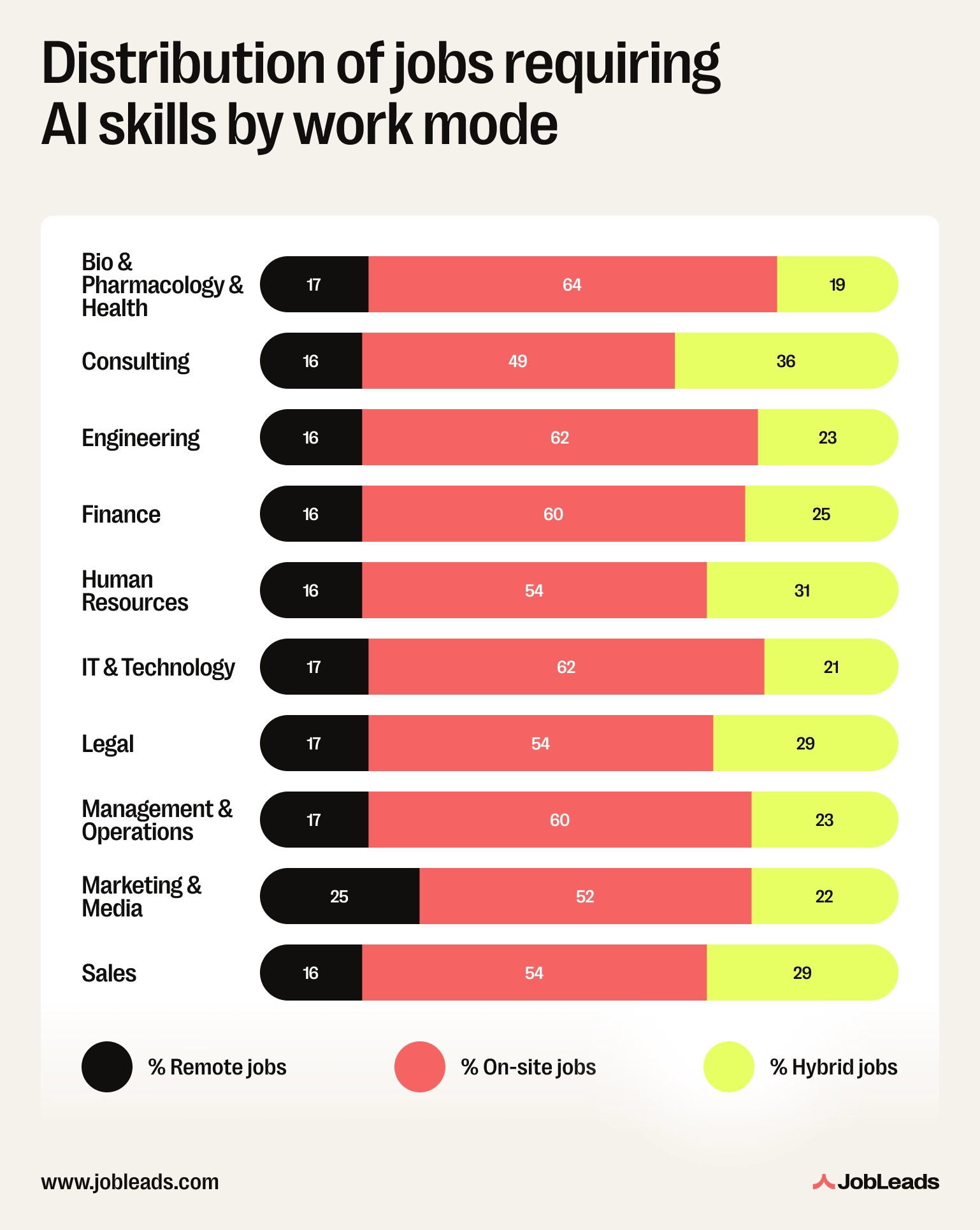
Of all the findings in the JobLeads study, this is the most counter-intuitive. AI work is digital. There's no physical infrastructure to be near, no specialised lab, no hardware that needs to live in an office. And yet 57% of postings are fully on-site, 26% are hybrid, and only 17% are fully remote.
The breakdown by industry shows where the on-site dominance is strongest. Engineering posts 82% of its AI roles on-site. IT & Technology posts 62%. Bio-Pharma (64%), Finance (60%) and Legal (54%) all skew similarly heavy.
Marketing & Media leads on fully-remote AI roles at 25%, the highest in the dataset. Consulting leads on total flexibility, with 36% hybrid and 16% remote, putting 52% of consulting AI postings off the traditional on-site path. Both are industries where the work product is portable and the team interaction is less hands-on-equipment.
The read on the on-site dominance is a mix of three things. Management culture (post-2024, US enterprise has been actively pulling people back to offices regardless of role). AI tooling security concerns (some companies have policies that AI tools can only be used inside the corporate network). And straightforward team-building preferences (newer functions are often co-located until the workflows are understood).
What this means for your CV and your search: do not assume AI roles are remote-friendly by default. Filter at the search stage. Read the listing carefully. Negotiate location early in the process, not late. And if you're applying to consulting, marketing or sales AI roles, you have meaningfully better odds of flexibility than if you're applying to engineering, IT or healthcare AI roles.
For UK-specific context on remote and hybrid trends in AI hiring, see our 2026 UK AI job search statistics report.
Source: JobLeads, AI Skill Demand 2026 Study.
When listings ask for "AI literacy", they mean specific things. The top of the demand list is dominated by concepts, not tools. Generative AI (21%), Natural Language Processing (20%) and Computer Vision (15%) together account for over half of all AI skill requirements. AI Integration (13%) and Prompt Engineering (7%) come next.
Notice where the specific tools land. ChatGPT is named in 6% of postings. GitHub Copilot in 3%. Claude in 0.9%. Midjourney in 1.4%. The tools matter less than the underlying concepts. Employers are hiring for people who understand what these systems do and how to apply them, not people who can only operate one branded interface.
The practical CV implication: stop writing "AI literacy" or "familiar with AI tools." That phrase has become noise. Replace it with the specific concept or tool you can demonstrate. "Built customer-support agent on AWS Bedrock using prompt engineering and retrieval-augmented generation, reduced first-response time 38%" is a sentence that a hiring manager can actually evaluate. "AI literate" is not.
For the underlying mechanics of how to phrase AI skills credibly on your CV by industry, our AI skills to put on your resume guide walks through worked examples for every industry.
Five concrete moves, drawn from the data above.
1. Match the AI vocabulary to your industry. Healthcare, sales and consulting reward specific demonstrated AI fluency. In these industries, lead with the tools and the outcomes. Marketing, legal and IT have shifted: a generic "AI proficient" line is doing nothing for you and may even price you down. Lead with quantified human-side outcomes instead, and let AI fluency surface where it has done observable work.
2. Stop saying "AI literacy." It is the new "computer literate." The phrase is so common that recruiters skim past it. Replace with specific tools and outcomes: "Used Claude to draft and red-team contract clauses, reduced legal review time 42%." "Built no-code automation in Make using GPT-4 API calls, saved 14 hours of weekly ops work."
3. Pair AI fluency with leadership signals. The seniority chart is the proof. AI alone is not unlocking executive roles. If you want to move up, the CV needs both: AI competence and clear evidence of scope, team, judgment, or P&L impact. Our action verbs reference has the right vocabulary for this kind of framing.
4. Filter for location early. 57% of AI roles are on-site. If you need remote, do not apply broadly and hope. Filter to remote-friendly industries (marketing, consulting, sales) or sub-functions (research, strategy roles) at the search stage. Negotiate location in the first conversation, not at the offer stage.
5. Read the job description carefully. When a listing says "AI required" but the actual work is unchanged from a 2023 version of the same role, you are looking at keyword inflation. The salary will reflect the old role, not the new label. This is most common in IT, legal and finance, and it's the main reason salaries fell in those industries.
For broader context on how AI is reshaping the hiring side of the process, our piece on the AI hiring arms race covers the screening and application side of the same shift.
This is US data. The UK and EU markets typically lag US hiring trends by six to twelve months for technology-related skill demand, so the salary split you see here may not yet be visible in non-US postings. Our UK AI job search statistics piece tracks the equivalent UK numbers.
The "AI literacy" classification is keyword-based. JobLeads' 35-keyword filter captures AI as a stated requirement in postings, but it will undercount deep machine-learning research roles where the keywords might be more specific ("transformer architecture," "RLHF") rather than the general ones in the filter. Those roles also pay differently.
Salary figures are advertised salaries from the postings themselves. They are not negotiated final compensation, and they do not include equity, bonus, or benefits. Total compensation could shift the picture by 10 to 30% either way at the top of the band.
And the 18-month window of 2024 to 2025 is a snapshot. The next 12 months will not look like the last 12. The commoditisation thesis suggests the average salary for AI-tagged roles will continue to drop as the skill becomes baseline. The industry split will shift as different functions absorb AI at different speeds. The piece you're reading is true today and worth re-reading in mid-2027.
The dataset for this piece comes entirely from JobLeads' AI Skill Demand 2026 Study. JobLeads scraped 60 million US job ads posted between January 2024 and December 2025 and classified 110,000 of them as AI-requiring roles using a 35-keyword filter covering AI literacy, mainstream AI technologies, and named tools. The analysis is US-only and salary figures are in USD.
The breakdowns by industry, seniority and work mode are JobLeads' analysis of that dataset. The industry-by-industry interpretation, the CV-level recommendations, and the framing of the salary paradox are JobSprout's.
Charts in this piece are sourced from the JobLeads study and reproduced with permission. JobLeads, a Hamburg-based career platform with 12 million users globally, ships a major research piece every four to eight weeks. Their full study and methodology details are at jobleads.com.
AI literacy in 2026 is settling into something that looks more like literacy in general. Necessary, not differentiating. The signal it sends to a hiring manager has dropped from "this person is ahead of the curve" to "this person is keeping up." That shift will continue as the next cohort of graduates enters the market with these tools as their starting baseline.
What differentiates is what it has always been. Domain depth. Judgment. The ability to know what to do with the output. AI is a productivity multiplier, but it multiplies whatever is already there. If the underlying expertise is strong, AI makes it stronger. If it's thin, AI makes it visibly thinner.
Your CV in 2026 should reflect that. Lead with the depth. Let the tools follow.
If you're updating your CV with the kind of AI-fluency framing this piece argues for, JobSprout is the fastest way to do it. Free to use, real templates, no credit card required.