![Project Manager Resume Examples & Writing Guide [2026]](/thumbnails/project-manager-resume.webp)
PDF or DOCX · up to 2MB
Write a project manager resume that lands interviews. PM resume examples, bullet point formulas, certifications, and ATS tips for every experience level.
Learn the best way to list languages on your resume, including proficiency level frameworks, formatting options, and industry-specific advice. Complete guide with examples.
Learn how to write a resume for a part-time job. Includes tailored examples for students, parents, retirees, and side-job seekers, plus templates for retail, food service, tutoring, and more.
Struggling with the first sentence of your cover letter? Discover 20+ proven opening lines, 5 formulas that work, and the mistakes that get your application binned.
Project managers are expected to deliver results on time and on budget. Your resume should demonstrate exactly that.
The problem? Most PM resumes I review read like job descriptions, not track records. "Responsible for managing cross-functional teams" tells a hiring manager nothing about whether you actually delivered anything. And in a field where only 2% of resumes result in an interview, generic descriptions are a fast track to the rejection pile.
According to the Project Management Institute's Talent Gap report, the global economy will need 25 million new project professionals by 2030. That's enormous demand, but it also means fierce competition for the best roles. Employers aren't short of candidates; they're short of candidates who can clearly prove their impact.
This guide shows you how to write a PM resume that proves you can manage complexity, not just list duties. I'll walk through real examples, a bullet point formula you can steal, and the specific details that separate PMs who get interviews from those who don't.
Before writing a single word, it helps to understand what's actually being evaluated. Having reviewed PM resumes as part of hiring teams, I've seen the same themes come up repeatedly in what separates strong candidates from weak ones.
This is the biggest differentiator. Hiring managers want to see numbers: budget managed, team size, number of stakeholders, timeline adherence, cost savings. A PM resume without metrics is like a financial report without figures.
Agile, Scrum, Waterfall, PRINCE2, hybrid: hiring managers want to know how you work, not just what you've delivered. According to the 2024 State of Agile Report, 71% of organisations use Agile approaches, so methodology fluency is non-negotiable for most PM roles.
PMs rarely manage people directly. They lead through influence, coordination, and communication. Show that you've worked across departments, managed external vendors, and aligned diverse stakeholders toward a common goal.
Every project hits obstacles. Hiring managers want to see how you've identified risks early, mitigated issues, and adapted when things went sideways. This is where your resume moves from "task manager" to "strategic leader."
Jira, Asana, Monday.com, Microsoft Project, Confluence, Smartsheet: the specific tools matter less than demonstrating you're comfortable with modern project management technology. If you've used AI-powered PM tools, that's increasingly worth mentioning.
Choosing the right format is the foundation. Get this wrong and even great content won't land. For a deeper dive on formatting options, see our best resume format guide.
The reverse-chronological format is the gold standard for project managers. It puts your most recent (and presumably most impressive) projects front and centre, which is exactly what hiring managers want to see.
This format works because PM careers tend to follow a clear progression: larger budgets, bigger teams, more strategic scope. A chronological layout makes that growth visible at a glance.
If you're transitioning into project management from another field (operations, consulting, engineering), a combination format can highlight your transferable skills before diving into your work history. Lead with a robust skills section that maps your experience to PM competencies, then follow with your chronological work history.
According to research from ResumeGo, two-page resumes receive 2.9x more callbacks than one-page resumes for managerial positions. But that only works if every line earns its space. Padding with filler will hurt you.
| Section | Priority | Notes |
|---|---|---|
| Professional Summary | Essential | Your elevator pitch with metrics |
| Work Experience | Essential | The core of your PM resume |
| Skills | Essential | Technical tools + methodologies |
| Certifications | High | PMP, PRINCE2, CSM, etc. |
| Education | Standard | Degree + relevant coursework |
| Projects (if career changer) | Situational | Volunteer or personal PM work |
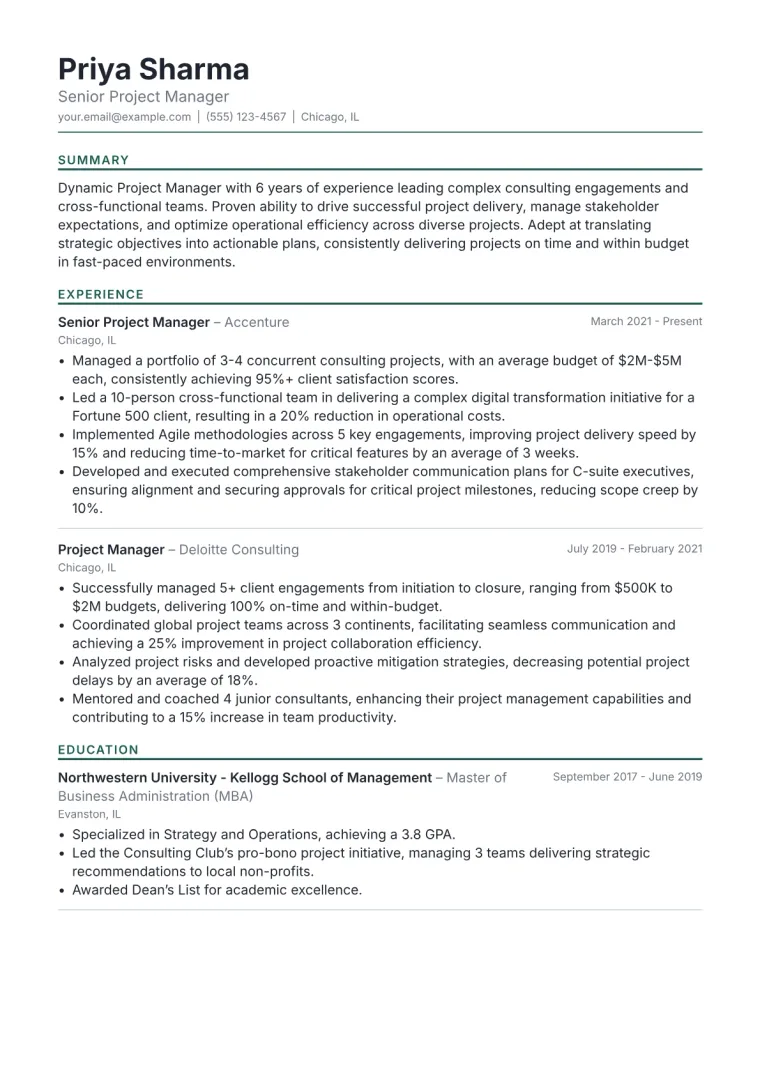
Here is a real project manager resume from consulting that shows how to demonstrate delivery at scale.
Priya's resume leads with budget and team scope. At Accenture, she "managed a portfolio of 3-4 concurrent consulting projects, with an average budget of $2M-$5M each, consistently achieving 95%+ client satisfaction scores." For PM hiring, these numbers are the first filter: how big were your projects, and did they land on time?
The experience section shows both delivery execution and process improvement. She "led a 10-person cross-functional team" on a Fortune 500 digital transformation that "resulted in a 20% reduction in operational costs." Then she "implemented Agile methodologies" to improve delivery. This combination of tactical delivery and strategic improvement is exactly what senior PM roles require.
Skills are organized into three categories: Project Management Methodologies (Agile, Scrum, Waterfall, SAFe, Lean Six Sigma), Tools (Jira, Asana, Microsoft Project, Confluence, Smartsheet), and Consulting & Strategy (stakeholder management, change management, risk management).
Her Accenture role demonstrates consulting-grade PM scope:
ACCENTURE (Senior Project Manager, 2021 - Present)
- Managed a portfolio of 3-4 concurrent consulting projects,
  with an average budget of $2M-$5M each, consistently
  achieving 95%+ client satisfaction scores
- Led a 10-person cross-functional team in delivering a
  complex digital transformation initiative for a Fortune 500
  client, resulting in a 20% reduction in operational costs
- Implemented Agile methodologies across project teams
Every bullet includes project count, budget size, team size, or client impact.
MBA from Northwestern Kellogg specializing in Strategy and Operations with a 3.8 GPA. Combined with her PMP certification, this signals both academic rigor and professional credibility.
If you want to use this as your starting point, hit "Remix with AI" on the template above.
Your professional summary is the first thing a recruiter reads, and often the only thing during that initial scan. For PMs, the formula is straightforward:
[PM Title] + [Years of Experience] + [Methodology Expertise] + [Industry/Domain] + [Key Achievement]
Here are three examples across experience levels:
Associate Project Manager with 2 years of experience supporting Agile software delivery teams in fintech. Coordinated sprint planning and stakeholder updates for a 9-person team, contributing to a product launch that onboarded 15,000 users in the first quarter. CAPM certified with strong foundations in Jira and Confluence.
Project Manager with 6 years leading cross-functional technology projects in healthcare. Delivered a £4.2M EHR migration programme on time and 8% under budget, managing a team of 22 across 3 departments. PMP certified with deep expertise in Agile and hybrid methodologies, Jira, and Smartsheet.
Senior Programme Manager with 12 years directing enterprise-scale digital transformation initiatives across financial services. Managed a portfolio of 8 concurrent projects totalling £18M in annual budget, consistently delivering within 5% of timeline targets. Expert in PRINCE2 and SAFe, with a track record of building PMO capabilities and mentoring junior project managers.
Notice the pattern: every summary contains at least one concrete metric. No vague claims about being "results-driven" or "detail-oriented." For more on writing strong summaries, check our resume summary examples guide.
This is where PM resumes succeed or fail. The difference between a good PM resume and a forgettable one almost always comes down to how you describe your work experience.
Use this structure for every bullet point:
Led [project type] for [team size] delivering [outcome] [metric] within [constraint]
Not every bullet will include all five elements, but aim for at least three. The goal is to show scope, impact, and context in a single line.
Use strong action verbs to lead every bullet. Here are real-world examples across different PM domains:
IT / Software Projects:
Led the delivery of a cloud migration programme for a team of 16 engineers, migrating 140+ microservices to AWS with zero unplanned downtime, completing 3 weeks ahead of the 9-month timeline.
Managed the end-to-end development of a customer-facing mobile application, coordinating 4 vendor teams and 12 internal stakeholders to deliver within a £1.8M budget.
Directed Agile transformation across 3 development squads, reducing average sprint cycle time by 34% and increasing release frequency from monthly to bi-weekly.
Construction / Engineering:
Oversaw construction of a 12-storey commercial office building (£28M budget), managing 6 subcontractor teams and achieving BREEAM Excellent certification on schedule.
Coordinated site logistics and procurement for a highway infrastructure project spanning 14 months, reducing material waste by 18% through improved vendor scheduling.
Led risk assessment and mitigation planning for a £9M bridge rehabilitation project, identifying 23 potential hazards and implementing controls that resulted in zero lost-time incidents.
Marketing Campaigns:
Managed a cross-channel product launch campaign with a £450K budget, coordinating creative, digital, and PR teams to generate 2.1M impressions and 38% above-target lead volume.
Directed the rebranding project for a mid-market SaaS company, aligning 5 departments over a 6-month timeline and delivering brand assets 10 days ahead of schedule.
Product Launches:
Led go-to-market coordination for a B2B SaaS product, managing dependencies across engineering, marketing, sales, and customer success to achieve a launch date with 98% feature completeness.
Coordinated a phased product rollout across 4 international markets, managing regulatory compliance requirements and localisation for each region within a 10-month window.
Digital Transformation:
Directed a company-wide digital transformation programme (£6.5M budget, 18-month timeline), consolidating 4 legacy systems into a single cloud platform and reducing operational costs by 22%.
Managed the implementation of a new ERP system across 3 business units, training 180+ end users and achieving 94% adoption within the first quarter post-launch.
Led automation of manual reporting workflows using Power Automate and Power BI, saving an estimated 320 staff hours per month across the finance and operations teams.
The difference between weak and strong bullet points often comes down to specificity. Here's what that looks like in practice:
| Weak | Strong |
|---|---|
| Responsible for managing IT projects | Led delivery of 6 concurrent IT projects (£2.4M combined budget) across 3 business units, achieving 95% on-time completion |
| Managed project budgets and timelines | Managed a £3.1M programme budget with monthly variance reporting, finishing 6% under budget while meeting all milestone deadlines |
| Worked with cross-functional teams | Coordinated a 19-person cross-functional team spanning engineering, design, QA, and marketing to deliver a product launch 2 weeks ahead of schedule |
| Handled stakeholder communications | Delivered weekly executive status reports to a steering committee of 8 C-suite stakeholders, maintaining project sponsorship through two scope changes |
| Used Agile methodology | Implemented Scrum across 3 development teams, facilitating sprint planning, daily standups, and retrospectives that improved velocity by 28% over 4 sprints |
The pattern is clear: strong bullets include what you did, for whom, at what scale, and with what result. For more on choosing the right language, see our action verbs guide.
Your skills section serves two purposes: it helps ATS systems match you to the role, and it gives hiring managers a quick snapshot of your toolkit. Organise your skills into clear categories.
List the tools you've actually used. Don't pad with tools you've only heard of.
Methodologies are a critical keyword category for PM roles. Include every framework you have genuine experience with:
Listing "communication" or "leadership" on its own adds nothing. These skills should be demonstrated through your bullet points, not just listed. If you do include a soft skills section, pair each skill with context:
This is an emerging differentiator in 2026. If you've used AI-powered tools in your PM work, include them. According to PMI's research on GenAI adoption, 93% of high GenAI adopters among project professionals report increased productivity, and 75% of knowledge workers overall are already using GenAI tools.
Certifications carry real weight in project management. Unlike many fields where they're "nice to have," PM certifications can meaningfully increase your earning potential and interview rate. According to PMI's Earning Power Salary Survey, PMP holders earn significantly higher median salaries than non-certified PMs, with a 24% premium in the US.
Here's what each major certification signals to employers:
| Certification | Full Name | Best For | Difficulty | Recognition |
|---|---|---|---|---|
| PMP | Project Management Professional | Experienced PMs (3+ years) | High | Gold standard globally |
| PRINCE2 | Projects in Controlled Environments | PMs in UK, Europe, Australia | Medium-High | Dominant in public sector and Europe |
| CSM | Certified ScrumMaster | Agile team leads | Medium | Strong in tech and software |
| PMI-ACP | Agile Certified Practitioner | Agile-focused PMs | Medium-High | Growing demand |
| CAPM | Certified Associate in Project Management | Entry-level PMs | Medium | Good stepping stone to PMP |
| Google PM Certificate | Google Project Management Professional Certificate | Career changers, beginners | Low-Medium | Recognised, beginner-friendly |
If you hold PMP, PRINCE2, or CSM, put the abbreviation after your name at the top of your resume (e.g., "Sarah Chen, PMP") and include a dedicated Certifications section. For ATS purposes, spell out the full certification name as well as the abbreviation.
The way you position yourself should evolve as your career progresses. Here's how to adjust your approach at each stage.
You may not have "Project Manager" in your title yet, but you've almost certainly managed projects in some capacity. The key is translating your experience into PM language.
Focus on:
Example summary:
Career-transitioning professional with 4 years in operations management and a Google Project Management Certificate. Coordinated cross-departmental process improvements that reduced order fulfilment time by 19%. Experienced in Asana, stakeholder reporting, and Agile fundamentals. Seeking an Associate PM role in technology.
At this stage, you should have clear ownership of projects with measurable outcomes. Your resume should demonstrate growing scope: larger budgets, bigger teams, more complex stakeholder environments.
Focus on:
Example bullet:
Managed a portfolio of 4 concurrent software delivery projects (£5.8M combined budget), coordinating 3 Scrum teams and reporting to a steering committee of 6 VP-level stakeholders. Achieved 92% on-time delivery rate across all projects.
Senior PMs need to show strategic impact, not just project delivery. At this level, hiring managers are evaluating your ability to shape how projects are run, not just run them.
Focus on:
Example bullet:
Established the enterprise PMO for a 600-person technology division, defining governance frameworks, standardised reporting templates, and resource allocation processes. Improved portfolio-level on-time delivery from 71% to 93% within 18 months.
Applicant Tracking Systems are the first gate your resume passes through. According to Jobscan research, over 98% of Fortune 500 companies use ATS software. If your resume isn't optimised for these systems, a human may never see it.
These are the terms that appear most frequently in PM job descriptions. Include the ones that genuinely apply to your experience:
Don't just dump keywords into a skills section. Weave them into your bullet points:
Keyword-stuffed (bad): "Agile Scrum Waterfall PRINCE2 project management stakeholder management risk management"
Natural (good):
Transitioned a 4-team development department from Waterfall to Scrum, facilitating sprint ceremonies and coaching product owners. Reduced average delivery time by 31% within the first two quarters.
ATS systems and recruiters alike use numbers as relevance signals. A PM who managed a £500K project and one who managed a £50M programme are different candidates entirely. Always include:
I see these consistently when reviewing PM resumes. Avoiding them puts you ahead of the majority of applicants. For a broader look at resume pitfalls, see our common resume mistakes guide.
This is the single most common mistake. "Managed project timelines and budgets" is a job description, not an achievement. Always answer the question: "What happened because I did this?"
A PM resume without numbers is like a sales resume without revenue figures. If you can't share exact figures due to confidentiality, use ranges or percentages: "managed a programme budget in the £2-5M range" or "reduced delivery time by approximately 25%."
"Used Agile" is not enough. Were you running Scrum with 2-week sprints? Kanban with WIP limits? A hybrid approach? Specificity demonstrates genuine expertise rather than buzzword familiarity.
This phrase adds zero value. Every PM is responsible for project management. Replace it with what you specifically delivered, how you delivered it, and what the outcome was.
A PM who delivered construction projects and one who delivered software products have very different skill sets. Make sure your resume speaks the language of your target industry. If you're switching industries, explicitly bridge the gap by highlighting transferable frameworks and outcomes.
You don't need to list every project you've ever touched. Curate your experience to highlight the 3-5 most impressive and relevant projects per role. Quality over quantity, always.
No. Curate your experience to showcase the most impactful and relevant projects. For each role, highlight 3-5 key projects that demonstrate scope, methodology, and results. If you've managed dozens of projects, a line like "Delivered 40+ projects across a 3-year tenure" provides scale without cluttering your resume.
PMP is valuable but not essential, especially early in your career. Focus on demonstrable delivery experience, relevant tools proficiency, and any certifications you do hold (CAPM, Google PM Certificate, PRINCE2 Foundation, CSM). Many successful PMs build strong careers before pursuing PMP. Highlight your results and methodology knowledge to compensate.
Not directly, but you can reference challenging projects where you managed through adversity. Frame it around risk management and problem-solving: "Identified scope creep risk 6 weeks into a 12-month programme, leading a re-baselining effort with stakeholders that realigned deliverables and recovered the timeline." This shows maturity and resilience without highlighting failure.
Technical PMs should emphasise their understanding of the technology stack, development lifecycle, and engineering workflows. Include specific technologies, architecture decisions you influenced, and technical debt management. Non-technical PMs should focus on business outcomes, stakeholder management, process improvement, and industry domain expertise. Both should quantify their impact.
Experience almost always wins, but certifications accelerate your career at specific inflection points. For entry-level PMs, certifications like CAPM or Google PM Certificate can open doors. For mid-level PMs, PMP or PRINCE2 validates your expertise and meaningfully increases earning potential according to PMI's salary data. For senior PMs, certifications matter less than your track record, but they're still worth maintaining.
Writing a strong project manager resume takes effort, but it doesn't have to take hours. The key is leading with metrics, demonstrating methodology expertise, and speaking the language your target employers use.
If you want to skip the formatting headaches and focus on content, JobSprout can help. Our AI-powered platform generates professionally formatted, ATS-optimised resumes that you can customise to any PM role. Choose from our professionally designed templates and let the AI handle the structure while you focus on showcasing your project delivery track record.
The best PM resumes prove you can deliver results. Make sure yours does the same.
Have questions about your PM resume? Reach out to me at david@jobsprout.ai or connect with me on LinkedIn.