![CV vs Resume: What's the Difference? [2026 Guide]](/thumbnails/cv-vs-resume.webp)
PDF or DOCX · up to 2MB
CV vs resume: learn the key differences, when to use each, and how geographic conventions vary. A complete 2026 guide for job seekers.
Write a prompt engineer resume that gets interviews. Full resume example, summary templates, 10+ experience bullets, technical skills breakdown, and tips for career changers from software engineering, copywriting, data science, and UX research.
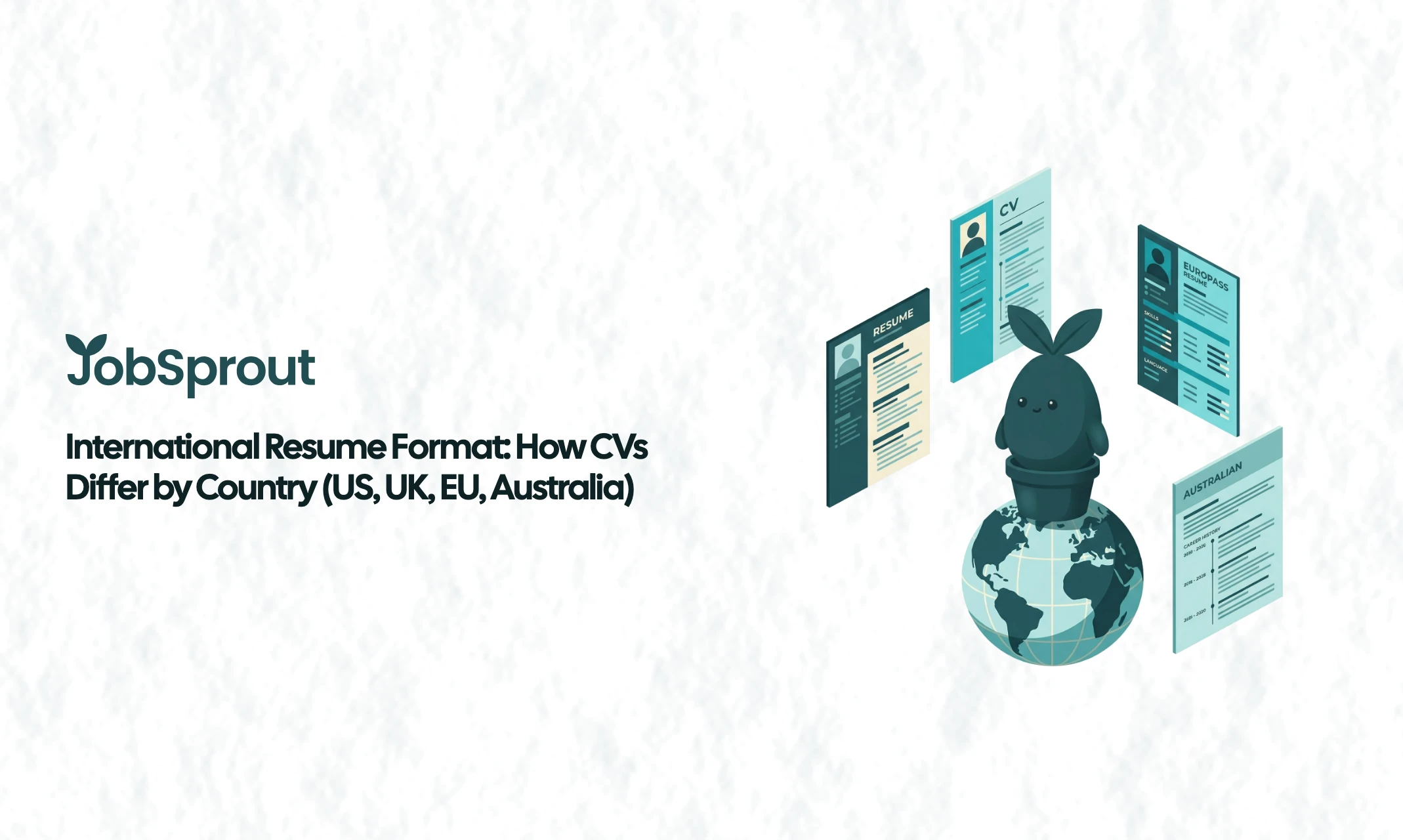
Learn how resume and CV formats differ across countries. Covers the US, UK, Germany, France, Australia, Japan, and the Middle East with comparison tables and practical tips.
Learn how to write a resume for an internal transfer. Includes a full example, summary templates for lateral moves, promotions and department changes, weak vs strong comparisons, and advice on navigating the politics.
The terms "CV" and "resume" cause more confusion than almost any other career topic. I've seen people agonise over which label to put on their document, as if choosing the wrong word would disqualify them on the spot.
Here's the truth: the answer depends almost entirely on where you're applying. What British job seekers call a "CV" is functionally the same document that Americans call a "resume." Meanwhile, what American academics call a "CV" is a completely different beast. Three terms, two documents, and a whole lot of geographic confusion.
Let's clear it up.
If you're short on time, here's what you need to know:
If you're applying for a corporate role in London, you send a CV. If you're applying for the same role in New York, you send a resume. The document itself? Nearly identical.
The real distinction isn't between the words. It's between two different types of document: a concise, tailored summary (called a "resume" in the US, or a "CV" in the UK) and a comprehensive academic record (called a "CV" in the US). More on that below.
A resume is a concise, targeted summary of your qualifications, tailored to a specific role. The word comes from the French résumé, meaning "summary," and that's exactly what it should be.
Key characteristics:
According to ResumeGo's hiring manager study, recruiters were 2.3x more likely to prefer two-page resumes overall, with the preference even stronger for mid-level and managerial candidates. The "one page only" rule is a myth for experienced professionals, but brevity still matters. Every line should earn its place.
Example: A software engineer applying for a role at a tech company in San Francisco would submit a resume highlighting relevant programming languages, key projects, and quantifiable achievements. They would not include their undergraduate thesis topic or a list of conference presentations (unless directly relevant).
The goal of a resume is to get you an interview, not to document your entire career. If you want a deeper dive into writing one, check out our complete guide to writing a CV/resume.
This is where the confusion starts, because "CV" means different things depending on where you are.
In the United States, a CV (short for curriculum vitae, Latin for "course of life") is a comprehensive record of your entire academic and professional history. It's used for academic, research, and medical positions.
Key characteristics:
Example: A professor applying for a tenure-track position would submit a CV listing every publication, every conference presentation, every course taught, every grant received, and every committee served on. Length is expected. Brevity would actually work against them.
For a detailed guide on academic CVs, see our guide to CVs for academic applications.
In the UK, Ireland, much of Europe, Australia, and New Zealand, "CV" simply means the document you submit when applying for a job. Any job. It's the exact same document Americans call a "resume."
Key characteristics:
This is the source of most confusion. When a British recruiter asks for your "CV," they want a concise, tailored document. When an American academic department asks for your "CV," they want a comprehensive record. Same word, very different expectations.
Here's the comparison that most guides miss. There are really three documents being discussed, not two:
| Aspect | Resume (US/Canada) | Academic CV (US) | CV (UK/Europe) |
|---|---|---|---|
| Length | 1-2 pages | 2-10+ pages | 1-2 pages |
| Content | Tailored highlights | Complete academic history | Tailored highlights |
| Purpose | Corporate/business roles | Academic/research positions | All job applications |
| Customisation | Heavily tailored per role | Minimal (cumulative record) | Moderately tailored per role |
| Photo included | Never | Rarely | Varies by country |
| Publications listed | Only if relevant | Always, in full | Only if relevant |
| References | "Available on request" or omitted | Often included in full | Sometimes included |
| Personal statement | Optional summary section | Research statement (separate) | Common |
| What it's called locally | "Resume" | "CV" or "curriculum vitae" | "CV" |
The key takeaway: a US resume and a UK CV are essentially the same document with different names. A US academic CV is a fundamentally different document with different rules.
Understanding local conventions is critical when applying internationally. Submitting the wrong type of document signals that you haven't done your research, and recruiters notice.
The distinction is firm. Sending a 6-page academic CV for a marketing manager role will get you rejected. Sending a 1-page resume for a tenure-track faculty position will get you ignored.
Pro tip: When in doubt about local conventions, look at job postings in your target country. The language they use ("submit your CV" vs "submit your resume") tells you what to call your document. The requirements they list tell you what to include.
If you're in the US and wondering whether you need a CV or a resume, here's a clear checklist. Use an academic CV when applying for:
An academic CV should contain sections you would never put on a resume:
The length is dictated by your record. A recently graduated PhD might have a 3-4 page CV. A full professor could have 15+ pages. Both are appropriate.
For a complete walkthrough with examples, see our academic CV guide.
For everything outside academia and medicine (in the US), you want a concise, tailored document. This applies whether you call it a "resume" (US) or a "CV" (UK):
The core principle: relevance over completeness. A recruiter scanning your document doesn't need your entire history. They need to quickly see why you're a strong fit for this specific role.
If you're building a resume from scratch, our how-to guide walks through every section. And if you're worried about getting past automated screening, the ATS-friendly resume guide covers formatting and keyword optimisation.
I see these mistakes regularly, and they're all avoidable with a little research.
This is the most common mistake for people transitioning from academia to industry. A 6-page document listing every conference poster and committee membership will overwhelm a corporate recruiter. They want 1-2 pages of relevant, quantified achievements.
Fix: Create a separate resume for industry applications. Translate academic accomplishments into business language ("led a research team of 8" rather than "served as principal investigator").
The reverse mistake. Academic hiring committees expect a comprehensive CV. A 1-page summary suggests you don't understand academic norms, or worse, that you don't have enough to fill a proper CV.
Fix: Include all publications, presentations, teaching, and service. Length is expected and appropriate.
A British colleague tells you to "send your CV." If you're American, you might think they mean a multi-page academic document. They don't. They mean a concise, tailored document (what you'd call a resume).
Fix: Pay attention to the geographic context. A "CV" requested by a London-based company means 1-2 pages. A "CV" requested by an American university means your full academic record.
Applying internationally without understanding the local document expectations is a red flag. Including a photo on a US resume, omitting one in Germany, or sending 5 pages for a UK role all signal that you haven't done your homework.
Fix: Before applying in a new country, research what's expected. Check local job boards, read country-specific career advice, and look at how job postings phrase their requirements.
Whether you call it a CV or a resume, the document should be tailored. Research covered by CNBC found that candidates who match 50% of a job's requirements are just as likely to get an interview as those matching 90%, but only when their application is tailored to the role.
Fix: Adjust your document for each role. Emphasise different experiences, reorder sections, and mirror the language of the job description. JobSprout's one-click job tailoring makes this easy: paste the job description and your CV is rewritten to match the role, with a word-level diff showing every change.
Sometimes you need both a resume and an academic CV, or you're moving between geographic conventions. Here's how to handle the transitions.
This is mostly a terminology and formatting swap:
| Element | UK CV | US Resume |
|---|---|---|
| Document title | "CV" or just your name | "Resume" or just your name |
| Personal statement | Common at the top | Optional (called "summary") |
| Date format | DD/MM/YYYY | MM/DD/YYYY |
| Spelling | British (organisation, specialised) | American (organization, specialized) |
| Paper size | A4 | US Letter |
| References | Sometimes included | "Available upon request" or omitted |
Pro tip: If you're applying to international companies, they usually accept either convention. Focus on the content rather than agonising over which date format to use.
It depends on which "CV" you mean. A US academic CV is longer than a resume, often significantly so (2-20+ pages). A UK CV is roughly the same length as a US resume (1-2 pages). The confusion comes from the same term referring to different documents in different countries.
If you're applying for similar roles in the same country, a single base document with minor tailoring works fine. But if you need both an academic CV (for university positions) and a resume (for corporate roles), you'll need two fundamentally different documents. The academic CV includes sections like publications and teaching that don't belong on a corporate resume.
In nearly all European countries, submit a "CV." This means a concise, 1-2 page document (similar to a US resume). Don't submit a multi-page academic-style CV unless you're applying for an academic or research role. Check country-specific conventions for details like photos and personal information, and if the employer or institution asks for the EU standard, see the Europass CV format.
You don't necessarily need a completely new document, but you should adapt it. Adjust the terminology (CV vs resume), date formats, spelling conventions, and whether to include photos or personal details. The core content of your experience and achievements stays the same. A well-structured document can be adapted for different markets with relatively minor changes.
In the US, Canada, and the UK: no. Photos can introduce unconscious bias, and many companies actively discourage them. In Germany, France, and parts of Asia and the Middle East, photos are more common and sometimes expected. When in doubt, check local norms. If the job posting or application form asks for one, include one. Otherwise, leave it off.
Whether you need a tailored resume for a US tech role or a polished CV for a position in London, the fundamentals are the same: clear formatting, relevant content, and professional presentation.
JobSprout helps you build both. Choose from professionally designed templates that work across geographies, use AI to tailor your content for specific roles, and export a clean PDF that looks great whether you call it a CV or a resume.
The terminology matters less than the quality of your document. Get that right, and the interviews will follow.
If you have questions about CVs, resumes, or international job applications, feel free to reach out at david@jobsprout.ai or connect with me on LinkedIn. Also check out our guide to writing a cover letter to complete your application package.