Executive Assistant Resume Examples That Get Interviews (2026)
Write an executive assistant resume that proves you can run a C-suite office. EA resume examples, experience bullets with metrics, skills tables, and ATS keywords for every career level.
The executive assistant role has quietly become one of the most strategically important positions in any organisation. Demand for skilled EAs has grown steadily as C-suite roles become more complex and organisations recognise EAs as strategic partners rather than administrative support. Executives need more than someone to manage their inbox. They need a trusted partner who can handle confidential board materials, coordinate international travel across a dozen time zones, and keep a leadership team running smoothly while fires break out everywhere.
Yet most EA resumes I review still read like job descriptions from 2015. "Managed calendars and arranged travel" tells a hiring manager nothing about your actual capabilities. The average corporate job posting attracts roughly 250 resumes, with only 4 to 6 candidates called to interview, so vague descriptions are the fastest way to get filtered out.
This guide will show you how to write an executive assistant resume that demonstrates strategic value, not just task completion. You'll find real examples, metric-driven bullet points, and templates for every level from administrative assistant to Chief of Staff.
What Hiring Managers Look For in EA Resumes
Before writing anything, you need to understand what separates a strong EA candidate from a good admin assistant in a hiring manager's eyes. Having spoken with executives and recruitment leads who hire EAs, the same themes come up repeatedly.
1. Discretion and Judgement
Executives trust their EA with sensitive information: compensation data, board decisions, M&A discussions, and personnel issues. Your resume needs to signal that you understand confidentiality without being so vague that it says nothing. Phrases like "managed confidential executive correspondence" or "prepared materials for non-disclosed acquisition due diligence" strike the right balance.
2. Proactive Problem-Solving
The difference between a good EA and a great one is anticipation. Good EAs respond to requests. Great EAs solve problems before the executive even knows they exist. Your resume should demonstrate this through examples: catching a scheduling conflict before it derails a board meeting, rebooking a cancelled international flight within 20 minutes, or creating a briefing document that saves an executive 3 hours of preparation.
3. Technology Proficiency
Modern EAs are expected to navigate far more than Outlook and Word. Hiring managers look for comfort with project management platforms (Asana, Monday.com, Notion), CRM systems (Salesforce, HubSpot), expense management tools (Concur, Expensify), video conferencing platforms, and increasingly, AI-powered productivity tools. If you use these daily, say so explicitly.
4. Calendar and Travel Management at Scale
Anyone can schedule a meeting. What sets senior EAs apart is managing complex, overlapping calendars for multiple executives across time zones, coordinating international travel itineraries with multiple legs, and handling last-minute changes without anything falling through. The scale and complexity matter more than the task itself.
5. Stakeholder Management
EAs interact with everyone from board members to external vendors to junior staff. Hiring managers want evidence that you can communicate professionally across all levels, manage competing demands diplomatically, and represent the executive's office with authority when needed.
Real Example: Executive Assistant Resume
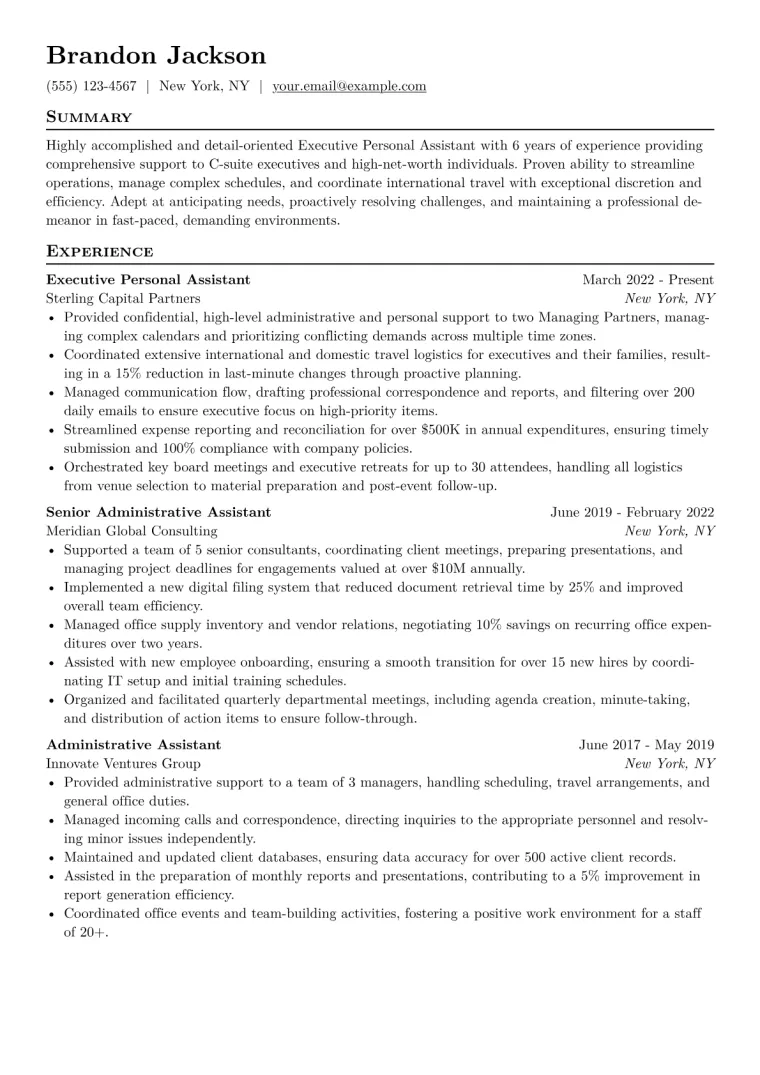
Here is a real EA resume that shows how to prove you can run a C-suite office.
What Makes This Resume Work
Marcus's resume immediately communicates scale. As EA to the CEO, he managed "100+ high-priority meetings monthly" and coordinated travel that "reduced delays by 25%." These aren't vague claims about being organized; they're proof that he can handle the volume and complexity of a senior executive's schedule.
The experience section shows clear progression: from Administrative Coordinator to Executive Assistant to the VP of Operations, then to EA to the CEO. Each step up comes with bigger numbers: larger budgets ($50,000 for corporate events), more stakeholders, and more complex logistics.
His skills are grouped into three practical categories: Executive Support (calendar, travel, meeting planning), Office & Project Management (vendor management, workflow optimization), and Software Proficiency. This structure helps both ATS systems and human reviewers quickly assess his capabilities.
Section-by-Section Breakdown
Here is what Marcus's resume contains, drawn from the real template above.
Summary
Highly organized and proactive Executive Assistant with 6 yearsof experience providing comprehensive administrative and operationalsupport to C-suite executives in fast-paced corporate environments.Expert in managing complex calendars, coordinating intricate domesticand international travel logistics.
The summary names the exact level of executive supported (C-suite), the years of experience, and the core competencies. No generic phrases about being "detail-oriented."
Experience
His CEO-level role demonstrates high-stakes responsibility:
EA TO CEO (Current Role)- Managed a complex calendar for the CEO, scheduling over 100 high-priority meetings monthly, resulting in a 15% increase in efficient time allocation- Coordinated all domestic and international travel logistics for the CEO and senior leadership team, reducing travel-related delays by 25%- Planned and executed 8 major corporate events and board meetings annually, managing budgets up to $50,000- Streamlined expense reporting and budget tracking processes, achieving 98% accuracy and reducing reconciliation time by 10 hours monthly
Every bullet includes who he supported, the scale of the task, and a measurable outcome.
Education
BS in Business Administration from DePaul University, graduating Cum Laude with a 3.7 GPA. At the entry level this adds credibility; for experienced EAs, the work history carries more weight.
If you want to use this as your starting point, hit "Remix with AI" on the template above.
Professional Summary Examples
Your professional summary is the first thing a hiring manager reads. For EA roles, it needs to communicate three things immediately: who you've supported, the scale of your responsibilities, and what makes you more than a scheduler.
Entry-Level: Administrative Assistant Transitioning to EA
Organised and resourceful administrative professional with 2 years of experience supporting teams of up to 15 people in professional services. Skilled in calendar coordination, document preparation, and vendor management. Reduced office supply costs by 14% through contract renegotiation and maintained a shared scheduling system with zero double-bookings over 18 months. Seeking to leverage strong organisational skills and attention to detail in an executive assistant role.
Why it works: It acknowledges the transition honestly while demonstrating EA-relevant skills (calendar coordination, vendor management) with metrics that prove reliability.
Mid-Level: Experienced EA Supporting VP/Director Level
Executive Assistant with 5 years of experience supporting Vice Presidents and Directors across operations and finance. Managed calendars with 35+ weekly appointments, coordinated domestic and international travel for leadership teams of up to 8 people, and streamlined board meeting preparation processes that saved 6 hours of executive time per quarter. Known for discretion with sensitive materials and the ability to manage competing priorities under pressure.
Why it works: It specifies the level of executives supported, quantifies calendar complexity, and highlights the trust factor that senior EA roles demand.
Senior: EA to C-Suite or Chief of Staff Hybrid
Senior Executive Assistant and Chief of Staff with 9 years of experience supporting CEOs and Managing Directors in FTSE 250 companies. Managed complex global calendars across 6 time zones, oversaw travel budgets exceeding £200,000 annually, and led the planning of 3 annual leadership summits averaging 80 attendees each. Trusted gatekeeper for board-level correspondence and M&A-sensitive materials. Combines deep operational expertise with strategic project ownership.
Why it works: The language shifts from "assistant" to "strategic partner." Terms like "trusted gatekeeper," "strategic project ownership," and the FTSE 250 reference signal seniority and gravitas.
Experience Bullet Point Examples
The experience section makes or breaks an EA resume. Hiring managers want to see what you actually did, not what your job description said. Every bullet should follow a simple formula: Action verb + what you did + scale/metric + result.
Here are 12 examples across different EA responsibilities.
Calendar and Schedule Management
Weak: Managed executive calendars and scheduled meetings.
Strong: Coordinated a calendar of 60+ weekly appointments for the CFO across 5 time zones, maintaining a 95% conflict-free rate and proactively rescheduling 15+ last-minute changes per week without disruption.
Weak: Handled scheduling for multiple executives.
Strong: Managed overlapping calendars for 3 C-suite executives simultaneously, balancing 120+ combined weekly commitments and implementing a colour-coded priority system that reduced scheduling errors by 70%.
Travel Coordination
Weak: Arranged travel for executives.
Strong: Planned and booked 80+ international trips annually for the CEO and COO with a combined travel budget of £185,000, negotiating corporate rates that saved £22,000 per year.
Weak: Booked flights and hotels.
Strong: Coordinated multi-leg international itineraries across 14 countries in a single quarter, managing visas, ground transport, and contingency plans, with zero missed connections despite 3 airline cancellations.
Board and Meeting Preparation
Weak: Prepared materials for board meetings.
Strong: Compiled and distributed board packs for quarterly meetings with 15 directors, consolidating inputs from 6 departments and delivering final materials 7 business days ahead of deadline with a 100% accuracy rate over 2 years.
Weak: Took meeting minutes.
Strong: Recorded and distributed minutes for 12 weekly leadership meetings, tracking 40+ action items per month and following up on overdue tasks, improving on-time completion from 65% to 89%.
Expense Management and Budgets
Weak: Processed expense reports for the department.
Strong: Managed expense reporting for a £340,000 annual travel and entertainment budget across the executive team, identifying £28,000 in duplicate charges and policy violations over 18 months through monthly audits.
Weak: Handled office budgets.
Strong: Oversaw the executive office operating budget of £95,000, renegotiating 4 vendor contracts and consolidating 2 service providers, reducing annual costs by 22% without impacting service quality.
Event Planning and Coordination
Weak: Organised company events.
Strong: Led the end-to-end planning of the annual company conference for 250 attendees with a £120,000 budget, managing venue selection, catering, AV, speaker logistics, and post-event surveys that recorded a 4.7/5 satisfaction rating.
Weak: Planned team offsites.
Strong: Organised 6 quarterly leadership offsites for 30 senior managers, sourcing venues across 4 UK cities and delivering each event within 5% of the £18,000 per-event budget.
Communication and Gatekeeping
Weak: Handled correspondence for the CEO.
Strong: Served as the primary gatekeeper for the CEO's office, triaging 100+ daily emails and 30+ phone enquiries, drafting responses for 40% of routine communications and escalating only priority items, saving an estimated 2 hours of executive time daily.
Weak: Liaised with internal teams.
Strong: Acted as the central point of contact between the Managing Director and 10 department heads, coordinating cross-functional projects and ensuring alignment on 25+ strategic initiatives across a 12-month period.
Top Skills for Executive Assistants
Your skills section should be specific to the EA role, not a generic list of software names. Here's what to include and, more importantly, how to demonstrate each skill beyond just listing it.
Skill
Why It Matters
How to Demonstrate
Calendar Management
Executives lose hours to scheduling chaos. A strong EA eliminates that.
"Managed 55+ weekly appointments across 4 time zones with 97% conflict-free rate"
Travel Coordination
International travel involves visas, time zones, contingency plans, and budgets.
"Coordinated 80+ international trips annually within a £185,000 budget"
Expense Reporting
Budget oversight and policy compliance directly impact the bottom line.
"Audited £340,000 annual T&E budget, recovering £28,000 in duplicate charges"
Board Meeting Preparation
Board packs require accuracy, confidentiality, and tight deadlines.
"Delivered quarterly board packs 7 days early with 100% accuracy over 2 years"
Confidential Correspondence
EAs handle sensitive M&A, HR, and financial communications daily.
"Managed board-level correspondence for 3 non-disclosed acquisition processes"
Project Management Tools
Modern EAs coordinate projects, not just schedules. Asana, Monday.com, Notion.
"Implemented Asana for the executive office, tracking 40+ action items per month"
CRM Systems
Many EAs manage executive relationship tracking in Salesforce or HubSpot.
"Maintained Salesforce records for 200+ executive contacts and investor relations"
Event Planning
From quarterly offsites to annual conferences, EAs run the logistics.
"Planned annual conference for 250 attendees within £120,000 budget"
Minute-Taking and Action Tracking
Meetings without follow-up are wasted time. EAs ensure accountability.
"Tracked 40+ monthly action items, improving on-time completion to 89%"
Microsoft 365 / Google Workspace
Daily tools, but proficiency level matters. Advanced Excel, PowerPoint, Docs.
"Created automated reporting templates in Excel, saving 5 hours per week"
Stakeholder Communication
EAs speak to board members, vendors, and junior staff equally well.
"Served as liaison between CEO and 10 department heads on 25+ strategic initiatives"
AI and Automation Tools
Forward-thinking EAs use AI to draft communications, summarise meetings, and automate workflows.
"Introduced AI-powered scheduling and email drafting tools, reducing admin time by 30%"
When listing skills on your resume, aim for a mix of tools (Outlook, Concur, Salesforce), competencies (travel coordination, board preparation), and soft skills framed as outcomes (stakeholder communication, confidential correspondence). Avoid listing "Microsoft Word" on its own. That's expected. Instead, say "Advanced Microsoft 365 Suite including Excel pivot tables, PowerPoint executive presentations, and SharePoint document management."
EA Resume Templates by Career Level
The EA career path has distinct stages, and your resume should reflect where you are. A senior EA's resume looks fundamentally different from an admin assistant's. Here's what to emphasise at each level.
Level 1: Administrative Assistant Transitioning to Executive Assistant
At this stage, you're proving that your existing admin skills translate to the higher stakes of executive support.
Summary approach: Emphasise transferable skills (organisation, calendar management, discretion) and quantify everything you can from your current role.
Key sections to prioritise:
Experience: Focus on any exposure to senior leadership, even indirect. Did you prepare documents that went to the board? Did you schedule meetings for a director, even occasionally?
Skills: Highlight tools you already know that EAs use (Outlook calendar, expense systems, presentation software)
Education/Certifications: If you have a CAP or Microsoft Office Specialist certification, feature it prominently
Example bullet points for this level:
Provided administrative support to a team of 14 consultants, handling scheduling, correspondence, and client communications with a 98% on-time response rate
Managed the office manager's calendar during a 3-month absence, coordinating 20+ weekly appointments without supervision
Prepared quarterly client presentation decks for the Regional Director, consolidating data from 4 departments into cohesive 30-slide presentations
Processed and reconciled monthly expense reports totalling £8,500, reducing processing time by 2 days through Expensify automation
What to avoid: Don't oversell your experience. Hiring managers can tell when someone inflates "I occasionally helped the director" into "Provided executive-level support to C-suite leadership." Honesty about your current level, combined with clear evidence of readiness, is far more compelling.
Level 2: Mid-Level EA Supporting VP or Director
You've been in the EA role for 2 to 5 years. The focus shifts from proving you can do the job to proving you do it exceptionally well.
Summary approach: Specify the level of executives you support, the scale of your calendar and travel management, and one or two headline achievements.
Key sections to prioritise:
Experience: Lead with complexity. How many executives, how many time zones, how large were the budgets?
Skills: Add project management tools and any CRM experience. Show you're beyond basic admin.
Achievements: If you've streamlined a process, saved money, or improved something measurable, make it prominent.
Example bullet points for this level:
Managed calendars for 2 Vice Presidents with a combined 45+ weekly appointments, proactively resolving conflicts and prioritising client-facing meetings
Coordinated international travel for a 6-person leadership team across 8 countries, managing a £95,000 annual travel budget and achieving 15% cost reduction through preferred vendor agreements
Planned and executed 4 quarterly leadership offsites for 25 attendees each, handling venue sourcing, catering, and agenda coordination within a £15,000 per-event budget
Streamlined the executive onboarding process for new Vice Presidents, creating a standardised 30-day checklist that reduced setup time from 3 weeks to 5 days
Introduced a shared task management system in Asana for the operations leadership team, improving cross-functional project visibility and reducing missed deadlines by 35%
Level 3: Senior EA Supporting C-Suite
At the senior level, you're not just supporting an executive. You're running their operational life. The resume should reflect strategic partnership, not task execution.
Summary approach: Name the executive level (CEO, CFO, Managing Director). Reference company scale (revenue, headcount, FTSE listing). Lead with trust and impact.
Key sections to prioritise:
Experience: Every bullet should demonstrate scope, judgement, or impact. Scheduling a meeting is not noteworthy at this level, but managing the CEO's time allocation strategy across 6 direct reports and 4 board committees is.
Skills: Include board governance, investor relations support, and any involvement in strategic projects
Professional development: Executive assistant conferences, leadership training, or any C-suite shadowing experience
Example bullet points for this level:
Served as Executive Assistant to the CEO of a £450M revenue organisation, managing all scheduling, travel, correspondence, and board-related logistics
Coordinated the CEO's calendar of 65+ weekly commitments across 6 time zones, implementing a priority framework that increased availability for strategic planning sessions by 30%
Managed an annual executive travel budget of £210,000 for 4 C-suite members, negotiating corporate agreements with 3 airline partners and 2 hotel chains that saved £35,000 per year
Prepared and distributed materials for 8 board and committee meetings annually, liaising with the Company Secretary and external auditors to ensure compliance with governance timelines
Acted as the CEO's delegate in 3 internal working groups, representing executive priorities and providing updates that eliminated the need for 2 standing meetings per week
Handled confidential correspondence related to 2 acquisitions and 1 restructuring programme, maintaining strict information barriers and NDA compliance
Level 4: Chief of Staff / EA Hybrid
The Chief of Staff role blends executive support with operational leadership. Your resume should reflect both dimensions, showing that you can manage an executive's time and also drive projects independently.
Summary approach: Lead with the strategic scope. How many people reported through you? What projects did you own? What decisions did the executive delegate to you?
Key sections to prioritise:
Experience: Split between executive support duties and operational leadership. Show that you didn't just assist with projects; you led them.
Skills: Add budget ownership, team management, and strategic planning
Impact: This level demands clear business outcomes. Revenue influenced, costs saved, processes redesigned.
Example bullet points for this level:
Served as Chief of Staff and Executive Assistant to the Managing Director of a 600-person professional services firm, combining personal executive support with operational oversight of 3 cross-functional workstreams
Managed the MD's calendar and communications while simultaneously leading a £500,000 office consolidation project that reduced annual facilities costs by 28%
Oversaw a team of 4 administrative staff, conducting performance reviews, managing workload distribution, and implementing training programmes that improved team satisfaction scores from 3.2 to 4.5 out of 5
Designed and implemented a new executive reporting cadence, replacing 8 ad-hoc update meetings with a single weekly dashboard review, saving 12 hours of cumulative leadership time per week
Coordinated the due diligence process for a £15M acquisition, managing document rooms, scheduling 40+ meetings with legal and financial advisors, and tracking 200+ action items to completion
Represented the Managing Director at 2 industry conferences and 4 client dinners, building relationships that contributed to £2.3M in new business pipeline
Common Mistakes on EA Resumes
Even experienced EAs make these errors. Avoiding them puts you ahead of most applicants immediately.
1. Listing Tasks Instead of Achievements
This is the most common problem by far. "Managed calendars" is a task. "Managed 55+ weekly appointments across 4 time zones with a 97% conflict-free rate" is an achievement. Every bullet should answer the question: "So what?"
2. Being Too Vague About Who You Supported
"Supported senior leadership" could mean anything. "Supported the CFO and COO of a £300M fintech company" tells the hiring manager exactly where you sit in the organisation. The level of executive you've supported is one of the most important signals on your resume, so be specific.
3. Ignoring the Technology Stack
Many EAs underplay their tech skills because they don't think of tools as "technical." But hiring managers actively look for Concur, Salesforce, Asana, SharePoint, and advanced Microsoft 365 skills. If you use these tools daily, list them explicitly. A tool like JobSprout can help you identify which skills to highlight based on the specific job description you're targeting.
4. Writing a Generic Summary
"Experienced executive assistant seeking a challenging role" tells the reader nothing. Your summary should include years of experience, who you supported, the scale of your responsibilities, and one quantified achievement. See the examples earlier in this guide.
5. Forgetting to Show Discretion
EAs handle confidential information constantly. If your resume doesn't mention this at all, hiring managers may wonder whether you understand the importance of it. You don't need to name specific confidential matters, but phrases like "managed board-level confidential correspondence" or "maintained information barriers during M&A process" signal awareness.
6. Using the Same Resume for Every Application
EA roles vary enormously. Supporting a tech startup CEO is completely different from supporting a FTSE 100 board chair. Tailor your resume for each application, emphasising the skills and experiences most relevant to that specific role. If you need help adapting your resume quickly, JobSprout's AI tailoring feature can match your experience to individual job descriptions.
7. Overloading with Soft Skills
"Excellent communicator with strong organisational skills and attention to detail" appears on virtually every EA resume. Instead of listing these as standalone skills, demonstrate them through your experience bullets. A bullet about delivering board packs 7 days early with 100% accuracy proves attention to detail far more effectively than claiming it in a skills list.
ATS Keywords for Executive Assistant Roles
Most large companies use Applicant Tracking Systems to filter resumes before a human ever sees them. For a thorough overview of how ATS filtering works, see our ATS-friendly resume guide.
For EA roles specifically, here are the keywords and phrases that appear most frequently in job descriptions. Include the ones that genuinely reflect your experience.
Core EA Keywords
Executive Assistant
C-suite support / C-level support
Calendar management
Travel coordination / Travel logistics
Expense management / Expense reporting
Board meeting preparation / Board packs
Minute-taking / Meeting minutes
Confidential correspondence
Stakeholder management
Gatekeeper
Executive communications
Tools and Platforms
Microsoft 365 / Microsoft Office Suite
Outlook
SharePoint
Google Workspace
Concur / SAP Concur
Expensify
Salesforce
HubSpot
Asana
Monday.com
Notion
Slack
Zoom / Microsoft Teams
DocuSign
Trello
Operational Keywords
Office management
Vendor management / Vendor negotiation
Event planning / Event coordination
Budget management
Invoice processing
Purchase orders
Facilities coordination
Onboarding
Project coordination
Cross-functional collaboration
Process improvement
Senior EA / Chief of Staff Keywords
Chief of Staff
Strategic planning
Executive reporting
Board governance
Investor relations
Due diligence
Change management
Team leadership
Performance management
Business operations
Key performance indicators (KPIs)
Organisational development
How to Use These Keywords
Do not stuff keywords into your resume randomly. ATS systems are increasingly sophisticated, and many now evaluate context around keywords rather than just counting them. Instead:
Read the specific job description and note which terms appear multiple times
Mirror the exact phrasing used in the posting. If they say "calendar management," don't write "diary coordination"
Use keywords in your experience bullets, not just in a skills list. "Managed calendar for 3 C-suite executives" is more ATS-friendly than listing "Calendar Management" alone
Include both spelled-out terms and abbreviations where relevant. Write "Applicant Tracking System (ATS)" on first use, or "Microsoft 365 (M365)"
Don't force keywords that don't reflect your real experience. A hiring manager will spot fabricated skills in the interview
Closing Thoughts
The executive assistant role has evolved far beyond traditional administrative support. Today's EAs are strategic operators who manage complex logistics, protect executive time, handle sensitive information, and increasingly drive projects independently. Your resume should reflect that evolution.
Focus on three things above all else: be specific about who you supported and at what scale, quantify every achievement you can, and demonstrate the judgement and discretion that separate a true EA from a general admin assistant.
Whether you're transitioning from an admin role or positioning yourself for a Chief of Staff title, the formula is the same. Show the hiring manager that you don't just complete tasks. You make the people around you more effective.