PDF or DOCX · up to 2MB
Learn exactly how to answer "walk me through your resume" with a proven 90-second framework, five complete example answers, and the mistakes that cost candidates the job.
Browse 30+ professional bio examples for LinkedIn, company websites, conferences, and social media. Includes templates for every industry, career level, and platform.
Write a prompt engineer resume that gets interviews. Full resume example, summary templates, 10+ experience bullets, technical skills breakdown, and tips for career changers from software engineering, copywriting, data science, and UX research.
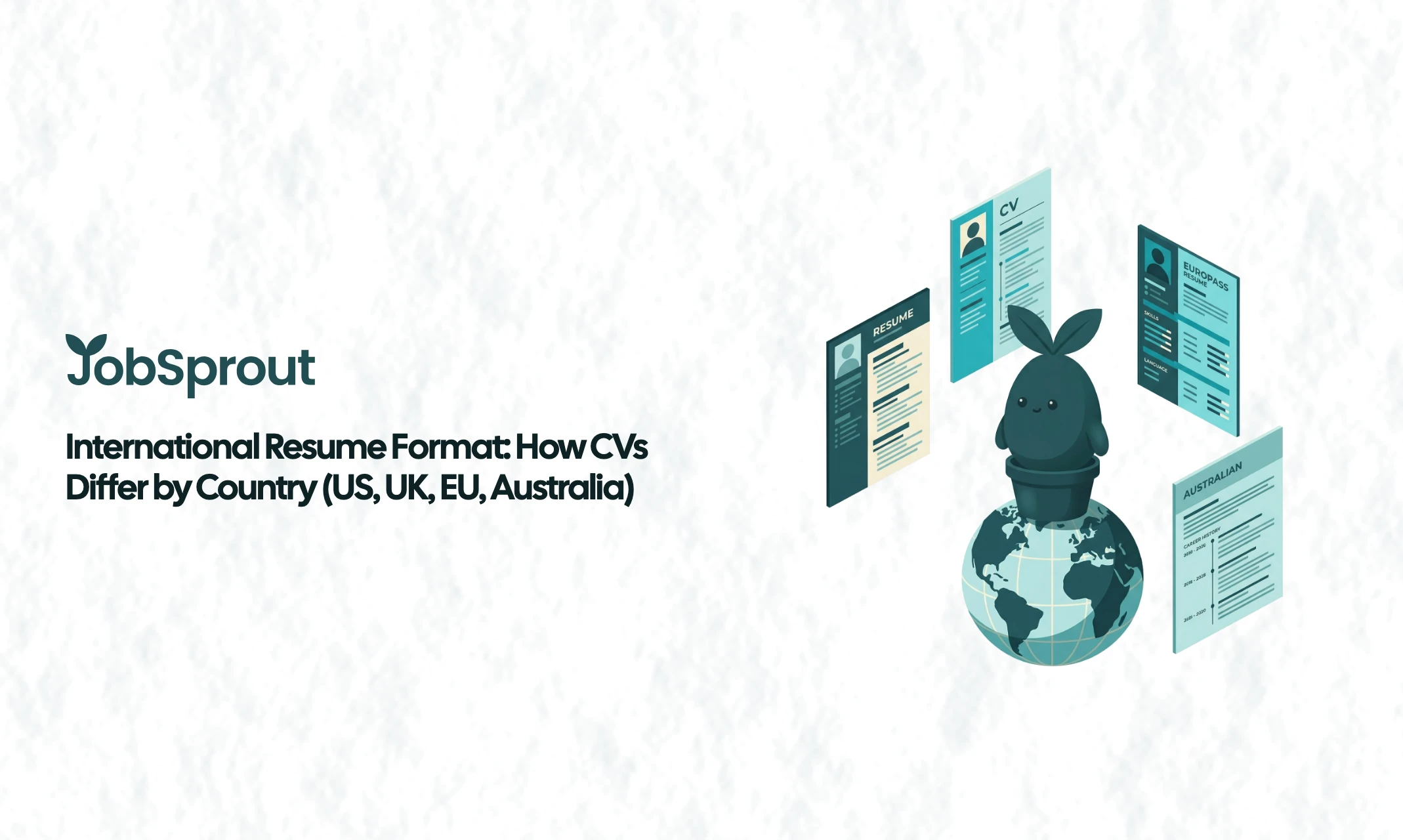
Learn how resume and CV formats differ across countries. Covers the US, UK, Germany, France, Australia, Japan, and the Middle East with comparison tables and practical tips.
"Walk me through your resume."
Six words. No fanfare. Usually delivered before you've even settled into your chair. And yet this single question shapes the entire trajectory of your interview more than almost anything else you'll be asked.
It is, by a wide margin, the most common opening question in job interviews. Research from LinkedIn and Glassdoor consistently places it at or near the top of the list, regardless of industry, seniority level, or geography. Recruiters use it as a warm-up. Hiring managers use it to assess communication skills. Panel interviewers use it to calibrate how the rest of the conversation will go.
And most candidates get it completely wrong.
The most common mistake? Treating it as an invitation to read your resume out loud, starting from your first job (or worse, your education) and plodding through every role, every responsibility, every bullet point. By the time you reach your current position, you've been talking for four minutes, the interviewer's eyes have glazed over, and you've burned through the most important window of the conversation without making a single memorable impression.
This guide will teach you a different approach. You'll learn what interviewers actually want when they ask this question, a 90-second framework that keeps your answer tight and compelling, five complete example answers for different career situations, and the mistakes that quietly cost candidates offers.
Your resume is already in the interviewer's hands. They've read it. They don't need you to read it back. What they need is the story behind it.
Before we get into the framework, it helps to understand why interviewers ask this question in the first place. Once you understand the intent behind it, crafting a strong answer becomes much more intuitive.
The question is deceptively open-ended. There's no single correct answer, which is precisely the point. Interviewers are watching how you handle ambiguity. Can you take a broad, unstructured prompt and deliver something clear, concise, and well-organised? That skill matters in virtually every professional role.
If you ramble for five minutes without structure, that tells the interviewer something. If you deliver a crisp, purposeful narrative in 90 seconds, that tells them something very different.
The biggest misconception is that "walk me through your resume" means "read me your resume." It doesn't. The interviewer already has your resume. They can see your job titles, your dates, your bullet points. What they cannot see is the thread that connects everything together.
They want to understand:
Think of it as the difference between a table of contents and an introduction. Your resume is the table of contents. Your walkthrough is the introduction that makes someone want to read the rest.
This question almost always comes first. It sets the emotional and intellectual tone for the entire interview. A strong answer creates momentum. It gives the interviewer specific follow-up threads to pull on, and it positions you as someone who understands the role and has thought carefully about why you're a match.
A weak answer does the opposite. It puts you on the back foot for the rest of the conversation, and the interviewer has to work harder to find reasons to be interested in your candidacy.
Not everything on your resume matters equally for the job you're interviewing for. Interviewers want to see whether you can identify the most relevant parts of your background and emphasise those, rather than giving equal airtime to every position you've ever held.
If you're applying for a product management role and you spend 45 seconds talking about your summer internship at a coffee shop eight years ago, that's a signal that you don't fully understand what the role requires.
The key to a great resume walkthrough is structure. Without it, you'll either ramble too long or forget to make your key points. With it, you can deliver a polished, compelling answer that feels natural and unrehearsed.
Here's the framework, broken into four segments that add up to roughly 90 seconds. That timing isn't arbitrary. Research on attention spans during interviews suggests that answers between 60 and 120 seconds hit the sweet spot for this type of open-ended question. Anything shorter feels underprepared. Anything longer starts to lose the interviewer.
Open with a brief statement about your current situation. This grounds the conversation and gives the interviewer immediate context.
What to include:
What to avoid:
Example: "I'm currently a senior marketing manager at a B2B SaaS company, where I lead a team of six and own our demand generation strategy."
That's it. Ten seconds, and the interviewer already knows who they're talking to.
This is the meat of your answer. Pick two or three experiences, achievements, or career moves that are most relevant to the role you're interviewing for, and briefly explain each one.
You don't need to cover every job. You don't need to go in chronological order. You're curating, not cataloguing.
What to include:
What to avoid:
Example: "Before this, I spent three years at a Series B startup where I built the content marketing function from scratch and grew organic traffic from 5,000 to 120,000 monthly visitors. And before that, I cut my teeth at a digital agency, working across a dozen different clients, which gave me a really broad foundation in channel strategy."
Notice how this covers two prior roles in about 30 seconds, highlights specific results, and uses natural transition language ("before this," "and before that") to create flow.
This is where you connect your background to the specific opportunity. Most candidates skip this entirely, which is a huge missed opportunity. The interviewer wants to know that you're not just qualified, but that you're intentionally pursuing this role for reasons that make sense.
What to include:
What to avoid:
Example: "When I saw this role, it felt like a natural next step. You're at that inflection point where demand gen needs to scale beyond paid channels, and that's exactly the kind of challenge I've spent the last six years solving. I'm particularly excited about the opportunity to build out your organic and partner channels."
This segment turns your answer from a backward-looking summary into a forward-looking pitch. It tells the interviewer: "I understand what you need, and I'm the person who can deliver it."
End with a brief statement that signals enthusiasm and invites the conversation to continue. This creates a natural transition to the next question.
What to include:
What to avoid:
Example: "So that's the arc. I'd love to get into the specifics of what you're building here and how I can contribute."
Simple. Clean. Forward-looking. And it naturally hands the conversation back to the interviewer with a clear signal that you're ready to go deeper.
Here's how the four segments flow as a single, cohesive answer:
"I'm currently a senior marketing manager at a B2B SaaS company, where I lead a team of six and own our demand generation strategy. Before this, I spent three years at a Series B startup where I built the content marketing function from scratch and grew organic traffic from 5,000 to 120,000 monthly visitors. And before that, I cut my teeth at a digital agency, working across a dozen different clients, which gave me a really broad foundation in channel strategy. When I saw this role, it felt like a natural next step. You're at that inflection point where demand gen needs to scale beyond paid channels, and that's exactly the kind of challenge I've spent the last six years solving. I'm particularly excited about the opportunity to build out your organic and partner channels. So that's the arc. I'd love to get into the specifics of what you're building here and how I can contribute."
Read that aloud. It takes about 80 seconds. It covers an entire career arc. It's specific, it's relevant, and it ends with energy rather than trailing off.
If you're building your resume from scratch or want to make sure your CV supports this kind of narrative, our guide on how to write a resume covers the foundations.
Every career situation is different. A recent graduate's walkthrough will sound very different from a senior executive's. Here are five complete examples, each tailored to a specific situation, with timing annotations so you can see how they map to the framework.
Context: A marketing manager with seven years of experience interviewing for their first product management role.
[15 sec - Who you are] "I'm currently a marketing manager at Databridge, a mid-size analytics platform, where I've spent the last three years leading our go-to-market strategy for new product launches.
[30 sec - Key highlights] What's interesting about my path is that I've gradually moved closer and closer to the product side. At Databridge, I've been embedded with the product team for every launch, running customer research, defining positioning, and building the feedback loops between our users and the engineering team. Before that, I was at a growth-stage startup where I owned the full funnel, from acquisition through retention, which gave me a really data-driven lens on what actually moves the needle for users.
[30 sec - Why you're here] I've reached the point where I want to be making product decisions, not just marketing them. This role stood out because you're looking for someone who can bridge the gap between customer insight and product strategy, and that's exactly the intersection I've been operating in for the last few years.
[15 sec - Close] I'm really keen to talk about how you think about product discovery here and where I could make the biggest impact."
Why it works: It doesn't apologise for lacking a traditional PM background. Instead, it reframes marketing experience as product-adjacent and highlights the specific skills that transfer.
Context: A 2026 graduate with internship experience and a strong academic project, interviewing for a junior data analyst position.
[15 sec - Who you are] "I've just finished my degree in Economics and Statistics at the University of Edinburgh, where my focus was on applied data analysis and econometric modelling.
[30 sec - Key highlights] During my time there, I had two experiences that really shaped my direction. First, I interned at a fintech startup last summer where I built a churn prediction model that the team actually put into production. It reduced their false positive rate by 30%, which meant the retention team could focus on the accounts that genuinely needed attention. Second, my dissertation project involved analysing NHS waiting time data across 200 trusts, and I built an interactive dashboard that the department is now using as a teaching tool.
[30 sec - Why you're here] Both of those experiences showed me that I love the process of turning messy data into something actionable. Your role is exciting because it's not just reporting. The job description talks about building models that inform product decisions, and that's exactly the kind of work I want to be doing every day.
[15 sec - Close] I'd love to hear more about the kinds of problems the data team is working on and where a junior analyst would have the most ownership."
Why it works: Graduates often struggle because they feel they don't have enough experience. This answer focuses on depth over breadth, picking just two experiences and going into enough detail to demonstrate real capability. The specific numbers (30% false positive reduction, 200 trusts) add credibility. Notice also how the candidate doesn't apologise for being new to the workforce. Confidence without arrogance is the target tone for any early-career walkthrough.
For more on how to write impactful bullet points that translate well into interview talking points, see our guide on resume bullet point examples.
Context: A secondary school teacher with eight years of experience transitioning into UX design after completing a bootcamp.
[15 sec - Who you are] "For the last eight years, I've been a secondary school design and technology teacher, and over the past year I've been transitioning into UX design through a combination of formal training and freelance projects.
[30 sec - Key highlights] What might not be obvious from my resume is how much my teaching background prepared me for this work. I spent years breaking down complex concepts for different audiences, running iterative design projects with students, and learning to read the room when something wasn't landing. On the UX side, I completed a six-month bootcamp at General Assembly and have since taken on three freelance projects, including a full redesign of a local charity's donation flow that increased completions by 40%.
[30 sec - Why you're here] I'm drawn to this role specifically because you're looking for someone with strong research skills. My teaching career was built on understanding how different people think and learn, and that's essentially what UX research is. I've also noticed your product serves an older demographic, and my experience communicating with non-technical users gives me a real advantage in that space.
[15 sec - Close] I know my background is non-traditional, but I think that's a strength. I'd love to talk about how my perspective could bring something different to the team."
Why it works: Career changers often make the mistake of downplaying their previous experience. This answer does the opposite. It draws a clear line between teaching and UX skills, uses a specific freelance result to demonstrate capability, and turns the non-traditional background into a selling point.
Context: A VP of Engineering with 18 years of experience interviewing for a CTO position at a growth-stage startup.
[15 sec - Who you are] "I'm currently VP of Engineering at Meridian Health, where I lead a 120-person engineering organisation across four product lines and manage a combined annual budget of roughly 15 million.
[30 sec - Key highlights] The thread through my career has been scaling engineering organisations through periods of rapid growth. At Meridian, I took the team from 40 to 120 over three years while maintaining our deployment frequency and keeping attrition below 8%. Before that, I was at Cloudware for five years, where I led the platform team through our SOC 2 compliance journey and our expansion into the European market, which required building an entirely new infrastructure layer for data residency.
[30 sec - Why you're here] What's compelling about this opportunity is that you're at the exact inflection point I've navigated twice before. You've got product-market fit, you're scaling your team, and you need someone who can build the engineering culture and infrastructure to support 10x growth without breaking what already works. I've done that, and I have strong opinions about how to do it well.
[15 sec - Close] I'd like to hear your perspective on the biggest technical and organisational challenges you're facing, because that's where I think the most productive conversation happens."
Why it works: Senior candidates sometimes over-explain. This answer is selective and strategic. It picks two prior roles, uses specific metrics (120 people, 15 million budget, 8% attrition), and positions the candidate as someone who has already solved the exact problem the company is facing.
Context: A project manager who took a two-year career break to care for a family member, now interviewing for a return-to-work role.
[15 sec - Who you are] "Most recently, I was a senior project manager at a digital agency called Bright Pixel, where I led a portfolio of client projects worth about 2 million annually. I stepped away from work two years ago for family reasons, and I'm now actively looking to return.
[30 sec - Key highlights] Before the break, I spent six years in project management across agency and in-house settings. At Bright Pixel, I managed a team of eight and was responsible for our largest accounts, including a year-long platform migration for a retail client that came in on time and 12% under budget. The role before that was at a SaaS company, where I introduced agile methodology to a team that had been running waterfall, which cut our average delivery time by about a third.
[30 sec - Why you're here] During my time away, I kept my skills current. I completed a PMP renewal, took a couple of courses on hybrid project management frameworks, and did some part-time consulting for a former colleague's startup. I'm looking for a role that lets me hit the ground running, and your team's focus on operational efficiency is exactly where my strengths lie.
[15 sec - Close] I'm energised to get back into a team environment and I'd love to discuss how my experience aligns with what you're building."
Why it works: This answer addresses the gap directly, briefly, and without over-explaining. It doesn't apologise. It acknowledges the break in one sentence, then quickly pivots to what the candidate did before the break and what they did during it to stay sharp. The forward-looking close reinforces readiness.
Even strong candidates stumble on this question. Here are the five most common mistakes and why they're so damaging.
This is the number one mistake, and it's the most common. The interviewer has your resume in front of them. If you simply narrate it from top to bottom, you're adding zero value. You're also signalling that you can't synthesise information or prioritise what matters.
Think about it from the interviewer's perspective. They've already read your resume. They invited you to the interview because the written version was good enough. Now they want to hear something different. They want your interpretation, your priorities, your narrative thread. When you read the resume back to them, you're essentially telling them, "I have nothing to add beyond what's already on paper."
The fix: Treat your resume as source material, not a script. Pick the highlights, explain the connections, and leave out anything that doesn't directly support your candidacy for this specific role.
"So, I went to school at..." is one of the weakest possible openings. Unless your education is exceptionally recent or directly relevant to the role, starting with school history wastes your most important seconds on your least important information.
The fix: Start with where you are now. The framework above deliberately opens with your current role because that's what the interviewer cares about most. If your education is relevant, weave it into your highlights naturally.
Anything beyond two minutes starts to feel like a monologue. The interviewer's attention fades, they lose the thread of your story, and they start thinking about how to politely interrupt you rather than listening to what you're saying.
Interview experts generally recommend keeping your response between 60 and 120 seconds, depending on the complexity of the question. For "walk me through your resume," 90 seconds is the sweet spot.
Here's a useful mental model: your walkthrough should feel like a film trailer, not the full film. A good trailer gives you enough to be intrigued and excited without spoiling the whole story. That's exactly what your walkthrough should do. Give the interviewer enough to be genuinely interested, then let the rest of the interview fill in the details.
If you find yourself consistently going over two minutes, that's a sign you're trying to cover too many roles or going into too much detail on each one. The framework above deliberately limits you to two or three highlights for exactly this reason.
The fix: Time yourself. Literally. Use a stopwatch and practise until you can consistently deliver your answer in 80 to 100 seconds. If you're going over two minutes, you're including too much.
"I left because my manager was terrible" or "the company was a mess" might be true, but saying it in an interview is never a good idea. It raises questions about your professionalism, your ability to navigate difficult situations, and whether you'll say the same things about this company someday.
The fix: Frame transitions positively. Instead of "I left because of bad management," try "I was looking for an environment where I could take on more ownership." The facts are the same. The framing is entirely different.
If your walkthrough could be delivered in any interview for any job, it's not specific enough. The "why you're here" segment exists precisely to create that connection. Without it, your answer is a generic summary rather than a tailored pitch.
The fix: Research the company and the role before every interview. Identify two or three specific things about the opportunity that genuinely interest you, and weave them into your answer. This takes five minutes of preparation and makes an enormous difference.
Knowing the framework is one thing. Delivering it smoothly under pressure is another. Here's a practical approach to building the muscle memory.
Start by writing a full draft of your walkthrough. Don't worry about timing yet. Just get your story on paper, following the four-segment framework. Focus on which experiences to highlight and how to connect them to the type of role you're targeting.
If you need help structuring the underlying resume that your walkthrough will be based on, JobSprout can help you build a well-organised CV that naturally lends itself to a strong narrative.
Your first draft will almost certainly be too long. That's fine. Now go through it and cut ruthlessly. Remove any sentence that doesn't directly serve one of the four segments. Trim adjectives. Eliminate filler phrases like "I was responsible for" or "my role involved."
A useful test: read each sentence and ask, "Does this make the interviewer more likely to hire me?" If the answer is no or maybe, cut it.
Use your phone to record yourself delivering the answer. This feels awkward the first time, and that's precisely why it works. Most people have never heard themselves give an interview answer. The gap between how you think you sound and how you actually sound can be significant.
Record at least three takes. On the first take, you'll notice the big issues: pacing, length, structure. By the third take, you'll start catching the subtler things. Listen for:
Get a stopwatch app and time every practice run. After a few rounds, you'll develop an intuitive sense for when you're on pace and when you're running long. The goal is to hit your timing without having to think about it.
Solo practice only takes you so far. The dynamic changes completely when another person is in the room. You'll feel the pressure of being watched, the temptation to rush, the urge to fill silences. That's exactly the environment you need to practise in.
Ask a friend, family member, or mentor to sit across from you and listen. Have them give you honest feedback on:
If possible, practise with someone who works in a similar industry. They'll be better equipped to judge whether your highlights are genuinely impressive and whether the technical language lands correctly.
You shouldn't have just one version of your walkthrough. Different roles emphasise different skills, so you'll need to adjust which highlights you feature and how you frame the "why you're here" segment. Build two or three variations and practise switching between them.
For guidance on writing the kind of resume summary that naturally supports a strong walkthrough, our examples guide covers dozens of approaches across industries and experience levels.
Once you're comfortable with the content and timing, practise under conditions that mimic the real thing. Sit in a chair facing another person (or a camera). Wear what you'd wear to an interview. Start the conversation with small talk, then have someone ask the question cold.
The goal is to make the delivery feel automatic so that in the actual interview, your brain is free to focus on reading the room and adapting in real time rather than trying to remember what comes next.
The framework works across all interview types, but there are nuances worth knowing.
Phone screens are typically shorter and more transactional. The interviewer is screening for basic fit, not doing a deep dive. Keep your walkthrough closer to 60 seconds and lean heavily on the "who you are" and "why you're here" segments. Save the detailed highlights for the on-site.
One important difference: on the phone, the interviewer cannot see your body language or facial expressions. Your voice has to do all the work. Speak slightly more slowly than you would in person, and make sure to pause briefly between segments so the interviewer can process what you've said.
On video, energy matters even more because the medium naturally flattens your presence. Sit up straight, maintain eye contact with the camera (not the screen), and vary your vocal tone. The 90-second framework works well here, but make sure you're not reading from notes. It's incredibly obvious on camera.
When multiple interviewers are present, your walkthrough needs to be slightly more general because different panellists may care about different aspects of your background. Address your answer to the group rather than to one person, and make brief eye contact with each panellist as you speak.
Even in casual settings, some version of this question will come up. It might be phrased as "so, tell me about yourself" or "what's your story?" The framework still applies, but you can loosen the language and make it more conversational. Drop the structured transitions and let it flow more naturally.
Your walkthrough is the opening move, not the whole game. Once you've delivered it, the interview transitions into a conversation. Here's how to maximise that transition:
Listen for follow-up cues. A good interviewer will pick up on something you said and dig deeper. Pay attention to what they ask about, because that tells you what they care about most.
Have stories ready. Your walkthrough will reference experiences. For each one, have a detailed story prepared using the STAR method (Situation, Task, Action, Result) in case they ask you to elaborate.
Don't repeat yourself. If a later question covers something you already mentioned in your walkthrough, go deeper rather than repeating the same summary. Add new details, different perspectives, or lessons learned.
Stay flexible. Sometimes the interviewer will interrupt your walkthrough to ask a question. That's not rude. It means something you said piqued their interest. Answer their question, then smoothly return to your narrative if there's a key point you still need to make.
Your walkthrough is only as strong as the resume behind it. If your CV is a disjointed list of jobs with generic bullet points, it's going to be very hard to extract a compelling narrative from it.
A well-structured resume naturally lends itself to a good walkthrough because the highlights are already clear, the achievements are quantified, and the progression makes sense. If you're struggling to find the narrative in your resume, that's a sign the resume itself might need work.
JobSprout is designed to help you build a resume that supports exactly this kind of storytelling. Its AI-powered tools help you improve your bullet points, refine your summary, and structure your CV so that the narrative flows naturally.
Your resume is the script. Your walkthrough is the performance.
The words on the page got you the interview. But the way you talk about those words is what gets you the job. A strong walkthrough doesn't just summarise your experience. It tells a story. It creates a connection. It gives the interviewer a reason to root for you.
Spend the time to build your 90-second answer. Practise it until it feels effortless. And remember: the goal isn't to cover everything on your resume. The goal is to make the interviewer want to learn more.
That's how you turn six simple words into the start of your next chapter. The preparation takes an hour. The payoff lasts an entire career.