PDF or DOCX · up to 2MB
88% of professionals believe a strong personal brand is essential. A practical, data-backed guide to building yours across LinkedIn, portfolios, and beyond.
Browse 30+ professional bio examples for LinkedIn, company websites, conferences, and social media. Includes templates for every industry, career level, and platform.
Write a prompt engineer resume that gets interviews. Full resume example, summary templates, 10+ experience bullets, technical skills breakdown, and tips for career changers from software engineering, copywriting, data science, and UX research.
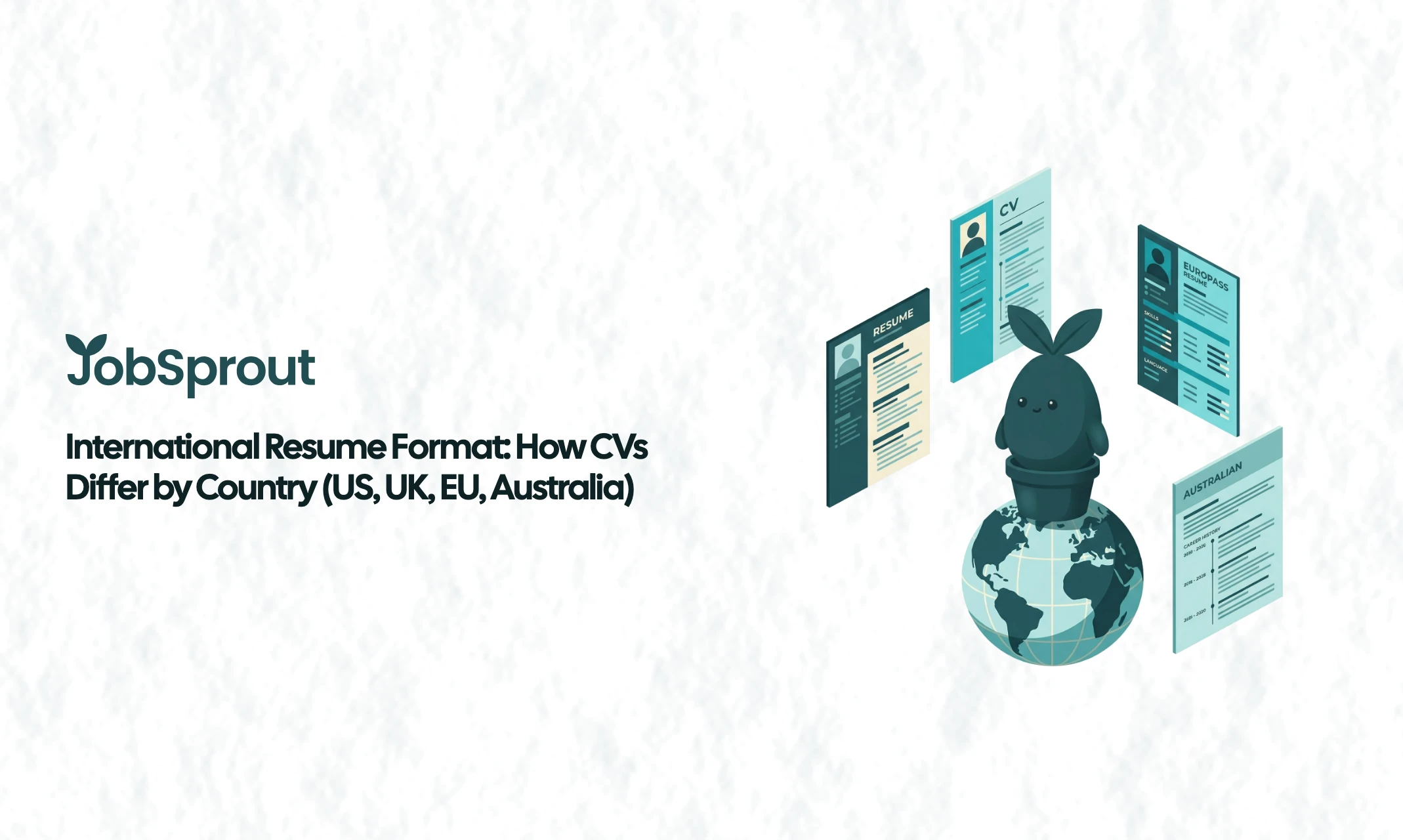
Learn how resume and CV formats differ across countries. Covers the US, UK, Germany, France, Australia, Japan, and the Middle East with comparison tables and practical tips.
"Personal branding" sounds like something for influencers and motivational speakers. The phrase itself carries a certain amount of corporate cringe. I get it.
But the data says something you can't ignore: 88% of professionals globally now believe a strong professional brand is essential, up 45% from the previous year. 52% of job seekers report landing employment directly through their online presence. And 85% of hiring managers say personal branding helps candidates stand out.
On the flip side, 57% of hiring managers have rejected candidates because of their digital footprint. Not because of something scandalous. Because of something absent, inconsistent, or unprofessional.
Personal branding for job seekers isn't about building an audience or becoming a thought leader. It's about answering one question satisfactorily: when someone Googles your name (and they will), what do they find?
This guide covers how to build a personal brand that works for your job search. No fluff, no "be authentic and the rest will follow" platitudes. Just practical steps backed by data.
Let's strip away the jargon. Your personal brand is the sum of what people find, read, and conclude about you before they ever speak with you. For job seekers, it consists of three surfaces:
The goal isn't to become famous. The goal is consistency across these surfaces. When a recruiter reads your resume, checks your LinkedIn, and Googles your name, the story should be coherent. The job titles should match. The narrative should align. The impression should be: "this person is credible and intentional about their career."
Inconsistency, by contrast, raises red flags. Different job titles on your resume and LinkedIn. A LinkedIn summary that contradicts your cover letter's stated career direction. Social media posts that conflict with the professional image you're presenting. These discrepancies create doubt, and doubt leads to rejection.
The shift has been dramatic. Here's what the research shows:
| Metric | Stat | Source |
|---|---|---|
| Professionals who believe strong brand is essential | 88% (up 45% YoY) | Canva/Startups Magazine |
| Job seekers who landed roles through online presence | 52% | WiFi Talents |
| Recruiters who use LinkedIn to find candidates | 95% | Headshotly |
| Hiring managers who reject based on digital footprint | 57% | RKY Careers |
| Hiring managers say branding helps candidates stand out | 85% | WiFi Talents |
| Professionals with strong brands more likely to be referred | 12x | WiFi Talents |
| Increase in interview callbacks from branding efforts | 33% | WiFi Talents |
Two numbers stand out. 52% of job seekers have landed roles through their online presence. That means your digital presence isn't supplementary to your job search. For half of all candidates, it is the job search.
And professionals with strong personal brands are 12x more likely to be referred for new roles. Referrals are the highest-converting source of hires, which means personal branding doesn't just help you get found. It makes your entire network more effective on your behalf.
95% of recruiters use LinkedIn to find and vet candidates. This is where the vast majority of personal branding work happens for job seekers, and it's also the area with the most low-hanging fruit.
Your profile picture accounts for 74% of first impressions on LinkedIn, and recruiters form judgements within 100 milliseconds of seeing it. Profiles with professional photos receive 21x more views and 9x more connection requests.
What works:
What doesn't:
Your headline is the second most visible element after your photo. It appears in search results, connection requests, and comments. Most people leave it as their job title, which is a missed opportunity.
Formula: [Title] | [Specialisation or Value Proposition] | [Key Skill or Achievement]
| Weak Headline | Strong Headline |
|---|---|
| "Marketing Manager at Acme Corp" | "Marketing Manager |
| "Software Engineer" | "Senior Software Engineer |
| "Looking for new opportunities" | "Product Designer |
The "looking for new opportunities" headline is particularly harmful. It centres your unemployment status rather than your value. Lead with what you do, not what you need.
This is your 2,600-character opportunity to tell your professional story. Most people either leave it blank (bad) or fill it with generic buzzwords (almost as bad).
An effective summary includes:
Example:
I help B2B SaaS companies turn content into revenue. Over the past 8 years, I've built and scaled content programmes that collectively drove £12M in pipeline, grew organic traffic from zero to 500K monthly visits, and consistently outranked competitors with 10x our budget.
Currently exploring senior content strategy roles at growth-stage companies. Particularly interested in teams that treat content as a revenue function, not a cost centre.
Reach me at: name@email.com
Write in first person. Be specific. Avoid buzzwords like "passionate," "results-driven," or "thought leader." Let your results do the talking. For more examples of effective professional summaries, see our resume summary examples guide.
Profiles with multiple skill endorsements receive 17x more views from recruiters. This section also feeds LinkedIn's search algorithm, so the skills you list directly affect whether recruiters find you.
Practical steps:
Complete profiles receive 21x more views and 36x more messages. LinkedIn considers a profile "complete" when it has: a photo, headline, summary, current position, two past positions, education, skills, and location.
Users with at least two past roles are 12x more likely to appear in recruiter searches. If your profile is missing any of these elements, that's the first thing to fix.
For a deep dive on LinkedIn optimisation, see our complete LinkedIn profile guide.
Your resume and LinkedIn profile need to tell the same story. Discrepancies between them are one of the fastest ways to lose a recruiter's trust.
Job titles must match. If your LinkedIn says "Senior Marketing Manager" and your resume says "Marketing Lead," a recruiter will wonder which is accurate. Use the same titles on both.
Dates must align. Even small discrepancies (like saying "March 2024" on LinkedIn and "Q1 2024" on your resume) create unnecessary friction.
Achievement claims should be compatible. If your resume says you "grew revenue by 34%" and your LinkedIn says "significantly improved revenue," the inconsistency weakens both claims. Use the same specific numbers in both places.
Your narrative should be coherent. If your resume positions you as a data analyst transitioning into product management, your LinkedIn summary should reflect the same direction. A recruiter who sees conflicting career narratives will move on.
The most effective job seekers treat their resume as one expression of a unified brand story. The resume provides the detailed, tailored version for a specific role. LinkedIn provides the broader, always-on version that recruiters discover independently.
For guidance on building a strong resume that aligns with your LinkedIn presence, see our complete resume writing guide. And for making sure your formatting passes ATS screening while maintaining a professional appearance, see our ATS-friendly resume guide.
If you want to ensure your resume matches the professional standard your brand sets, JobSprout generates clean, Typst-typeset documents that are ATS-friendly and visually polished. No formatting inconsistencies between what you claim on LinkedIn and what your resume actually looks like.
What happens when a hiring manager Googles your name? 65% of UK hiring managers regularly review candidates' social media, and the figure is similar globally. Your LinkedIn is just one data point. Here's how to manage the rest.
Start by searching your own name (in an incognito/private browsing window) and reviewing the first two pages of results. What shows up?
Ideal first-page results:
Red flag results:
You don't need to scrub your social media clean. But you do need to ensure that anything publicly visible is consistent with the professional image you're presenting.
Quick audit checklist:
80% of UK hiring managers prefer candidates who provide portfolios, yet only 40% of job seekers provide them. This is a significant competitive advantage for anyone willing to create one.
A portfolio doesn't need to be elaborate. A simple personal website with the following elements is sufficient:
Platform options (simplest to most complex):
| Platform | Best For | Cost | Technical Skill Required |
|---|---|---|---|
| JobSprout | A site built from your CV, with the PDF attached | Free | None |
| Notion (public page) | Quick portfolio setup | Free | None |
| Carrd | Simple one-page site | Free to $19/yr | Minimal |
| WordPress.com | Blog + portfolio | Free to $48/yr | Low |
| Squarespace | Design-focused portfolio | $16/mo | Low |
| GitHub Pages | Developers | Free | Moderate |
For technical professionals, a GitHub profile with active repositories is often more valuable than a traditional portfolio. For creative professionals, platform-specific portfolios (Behance, Dribbble) are industry standard.
You don't need to become a content creator. But sharing professional insights, even occasionally, can meaningfully boost your visibility and credibility.
If you don't want to write long posts or articles, these minimal-effort actions still build your brand:
If you're willing to invest 30-60 minutes per week:
| Share | Avoid |
|---|---|
| Professional lessons learned | Complaints about former employers |
| Industry observations and trends | Controversial political opinions |
| Useful resources and tools | Desperate-sounding job search updates |
| Project outcomes and case studies | Negative commentary about competitors |
| Thoughtful commentary on others' work | Generic motivational quotes |
The golden rule: would you be comfortable if a hiring manager at your dream company saw this post? If yes, share it. If not, don't.
Here's a practical exercise you can complete in 30 minutes. It covers all three surfaces of your personal brand.
The most common and most damaging mistake. Your LinkedIn says one thing, your resume says another, and your portfolio tells a third story. Pick a narrative and align everything to it.
A brand that tries to appeal to everyone appeals to no one. The more specific your positioning ("I help B2B SaaS companies build content engines"), the more memorable and effective it is. Specificity is strength.
Effective personal branding isn't about constantly talking about yourself. It's about being visibly competent and helpful. Sharing useful resources, offering thoughtful commentary, and demonstrating expertise through your work are all forms of branding that don't feel self-promotional.
Some people spend hours crafting the perfect LinkedIn post while their profile has a missing photo and an empty summary. Fix the foundation first. A complete, professional profile with no content activity is far better than an incomplete profile with an active posting schedule.
The biggest branding mistake of all: having no presence. If a recruiter Googles you and finds nothing, you're at a disadvantage compared to candidates who show up with a complete LinkedIn profile, a personal website, and evidence of professional engagement. Even small actions like sending a few networking emails per week build visibility over time. Being invisible isn't neutral. It's a negative signal.
Not necessarily, but it helps significantly. 80% of hiring managers prefer candidates who provide portfolios, and a personal website gives you complete control over your narrative. If you can't build a website, a well-optimised LinkedIn profile is the minimum viable personal brand. But if you're competing for roles where 20+ qualified candidates apply, a personal website is a meaningful differentiator.
For active job seekers, 2-3 hours per week is a reasonable investment. This covers LinkedIn profile maintenance, 1-2 posts or comments, and keeping your portfolio updated. The 30-minute audit above is a good starting point. Once your foundation is solid, ongoing maintenance is minimal.
Yes, if done poorly. Oversharing personal opinions, posting controversial content, or presenting yourself inconsistently can hurt your job search. The rule of thumb: everything you post publicly should be something you'd be comfortable discussing in a job interview. When in doubt, don't post.
It depends. The recruiter-only visibility setting is generally recommended. It makes you discoverable to recruiters without broadcasting your status to your entire network. The public green banner ("Open to Work") can attract low-quality recruiter outreach and, for some hiring managers, carries a subtle stigma (unfairly). Use the private setting unless you want maximum visibility.
Focus on transferable skills and the narrative of your transition. Your LinkedIn summary should explicitly state where you're coming from and where you're heading: "Former financial analyst transitioning into data science. Bringing 6 years of quantitative analysis experience and a newly completed Google Data Analytics Certificate." Portfolio projects in your new field are especially valuable. Even personal projects demonstrate commitment and capability. For more on career transition, see our resume trends guide on how skills-first hiring is changing the landscape.
Here's the reality: you already have a personal brand. It's whatever shows up when someone searches your name. The question is whether you're actively shaping it or letting it be shaped by default.
For job seekers, the stakes are concrete. The difference between a curated, consistent professional presence and a neglected one can be the difference between getting callbacks and getting ignored. Not because branding is magic, but because recruiters are human beings making fast decisions with limited information. When the information they find is clear, consistent, and compelling, you advance. When it's confusing, absent, or unprofessional, you don't.
The good news: fixing this doesn't require becoming someone you're not. It requires making what you already are visible and coherent.
Start with the 30-minute audit. Fix your LinkedIn. Align your resume. Google yourself and address what you find. These are small actions with outsized returns.
And make sure the resume you're putting into the world represents you at your best. JobSprout helps you build a professional, ATS-friendly resume with clean Typst typesetting and AI-assisted writing. Your experience, your voice, presented with the polish your personal brand deserves.
Build your resume with JobSprout. Free to create and download.
Questions or feedback? Email david@jobsprout.ai or connect on LinkedIn.