PDF or DOCX · up to 2MB
72% of job seekers report mental health impacts from searching. A practical guide to managing job search burnout and staying effective.
Write a prompt engineer resume that gets interviews. Full resume example, summary templates, 10+ experience bullets, technical skills breakdown, and tips for career changers from software engineering, copywriting, data science, and UX research.
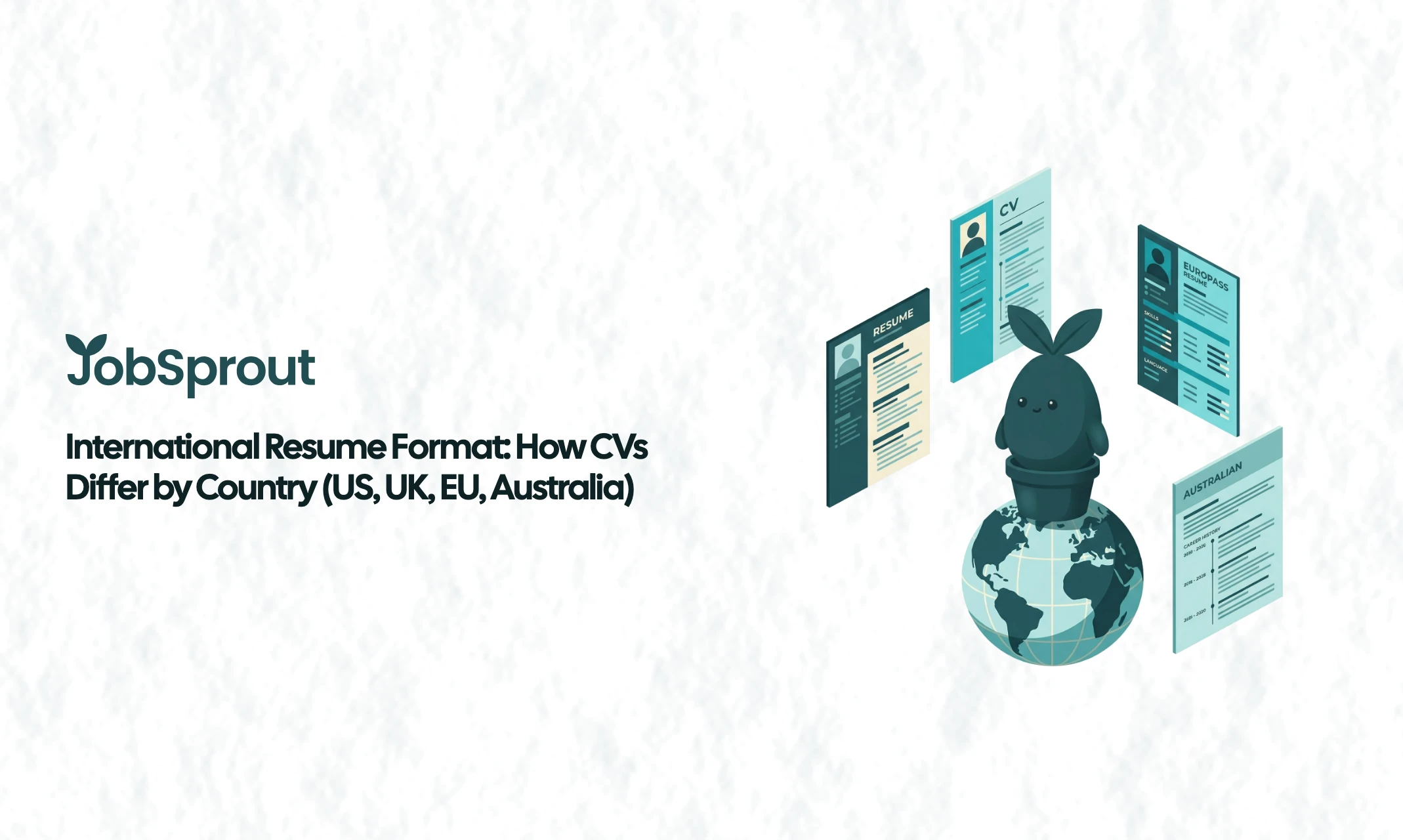
Learn how resume and CV formats differ across countries. Covers the US, UK, Germany, France, Australia, Japan, and the Middle East with comparison tables and practical tips.
Learn how to write a resume for an internal transfer. Includes a full example, summary templates for lateral moves, promotions and department changes, weak vs strong comparisons, and advice on navigating the politics.
Job search burnout is real, and I'm not going to tell you to "stay positive" or "trust the process." If you've been searching for weeks or months without meaningful progress, you don't need platitudes. You need practical strategies for managing a process that is genuinely exhausting.
72% of job seekers report that searching for employment negatively impacts their mental health. That's from a comprehensive 2026 research report by The Interview Guys, and the number has been climbing steadily. 80% experience anxiety. 66% feel burned out. And 514,000 people have stopped looking for work entirely, classified by the Bureau of Labor Statistics as "discouraged workers" who believe no jobs exist for them.
Those numbers represent real people sitting at their kitchen tables, refreshing their email for the fourth time today, wondering whether they're doing something wrong.
If that sounds familiar, this article is for you.
Job search burnout isn't a character flaw. It's a rational response to an irrational system. Here's what's changed.
Job applications have increased 182% year-over-year, largely driven by AI tools that make it easy to mass-apply. Browser extensions auto-fill applications. AI generates cover letters in seconds. One-click apply buttons are everywhere.
The result: employers are drowning in applications, and the bar for getting noticed has risen dramatically. When a single posting receives 250 or more applications (common for mid-level roles at recognisable companies), your resume is competing against a wall of noise. Only 2% of applications result in an interview, and most receive no response at all.
55% of job seekers say that waiting to hear back from employers is their single biggest source of stress. This includes employer ghosting, which has become endemic. Companies that invested millions in employer branding routinely fail to send rejection emails, leaving candidates in a permanent state of uncertainty.
The average time-to-hire is now approximately 42 days. That's nearly six weeks from application to offer. For many candidates, the actual timeline is much longer because most applications go nowhere, and the clock resets with each new submission.
38.8% of job seekers cite rejection as a major stressor. But the modern job search has added a particular cruelty: most rejections are automated. You don't get a conversation. You don't get feedback. You get a templated email (if you get anything at all) that tells you nothing about why you weren't selected.
When the rejection is impersonal, it's harder to process. Your brain searches for reasons, and in the absence of information, it tends to fill the gap with self-doubt: maybe I'm not good enough, maybe my experience isn't relevant, maybe I'm too old or too young or too something.
Work is deeply tied to identity. Research on unemployment and mental health consistently shows that job loss affects self-esteem, social connections, sense of purpose, and financial security simultaneously. The job search isn't just a logistical challenge. It's an emotional one that touches the foundations of how you see yourself.
This is why job search burnout hits differently from workplace burnout. It's not just about being tired. It's about feeling invisible.
Burnout isn't just "feeling tired of applying." It's a specific pattern with recognisable symptoms. If you're experiencing several of these, you're not being dramatic. You're burned out.
Behavioural signs:
Emotional signs:
Physical signs:
If you're seeing yourself in this list, it's worth acknowledging what's happening before trying to push through it. Burnout doesn't respond to willpower. It responds to changed behaviour.
Most career advice about job search burnout falls into one of three categories, and none of them are particularly helpful.
This is the most common and least useful advice. Positivity is not a strategy. It's a mood that can't be manufactured on demand, especially when your bank balance is declining and your inbox is empty. Telling a burned-out job seeker to "stay positive" is like telling someone with a broken leg to "think happy thoughts."
What actually helps: acknowledging that the process is difficult and focusing on actions you can control rather than emotions you can't.
Volume-based strategies make burnout worse, not better. If you're already sending out dozens of untailored applications and getting nowhere, sending more of the same won't change the outcome. It will just accelerate the exhaustion.
What actually helps: tailoring fewer applications more carefully. Two well-researched, customised applications will consistently outperform ten generic ones. And the act of doing focused, quality work feels better psychologically than mindless repetition. Tools like JobSprout's one-click job tailoring reduce the effort: paste a job description and tailor your CV in seconds, with a diff preview so you stay in control without the manual grind.
Networking is genuinely valuable. But the way it's usually prescribed ("just reach out to people") ignores the reality that networking while burned out feels performative and draining. And the pressure to network adds yet another task to an already overwhelming list.
What actually helps: building small, sustainable networking habits rather than forcing yourself into marathon outreach sessions. Our networking email templates guide covers how to do this with minimal daily effort.
Here's what the research and practical experience suggest. None of these are quick fixes. All of them are sustainable.
This is the single most impactful change most job seekers can make. Instead of making your job search an all-day, every-day activity, give it a defined window: two to three hours per day, with clear start and stop times.
Research on goal-setting and motivation consistently shows that defined boundaries reduce stress and improve output quality. An open-ended job search creates a permanent sense of unfinished work. A time-boxed search creates a sense of completion, even on days when the results aren't visible.
Example schedule:
| Time | Activity |
|---|---|
| 9:00 to 9:30 | Review new listings, identify 2-3 worth applying to |
| 9:30 to 10:30 | Tailor resume and write cover letter for best-fit role |
| 10:30 to 11:00 | Send 1 networking message or follow up on a previous application |
| 11:00 | Stop. Do something else. |
After your allotted time, close the job boards. Close LinkedIn. Close your email. The search will be there tomorrow. Giving your brain a break from the constant scanning and hoping is not lazy. It's maintenance.
Outcomes (interviews, offers, callbacks) are largely outside your control. Inputs (applications sent, connections made, skills improved) are entirely within it. When you measure progress by inputs, you can see forward movement even on weeks when the outcomes are discouraging.
Build a simple tracking system:
| Metric | Weekly Target | This Week |
|---|---|---|
| Tailored applications sent | 5 | |
| Networking messages sent | 3 | |
| Skills/certifications progressed | 1 session | |
| Resume improvements made | 1 update | |
| Informational conversations | 1 |
When you hit your input targets, you've had a good week, regardless of whether anyone replied. This reframes success from "did I get an interview" to "did I do the work," which is a psychologically healthier foundation.
Instead of applying to one job per day every day, batch your applications into two or three sessions per week. On those days, do focused, deep work: research the company, tailor your resume, write a thoughtful cover letter. On the other days, do lighter tasks: networking, skills development, or nothing related to job searching at all.
Batching reduces the constant low-level anxiety of "I should be applying right now." It also produces better applications because you're working in focused bursts rather than spreading your energy thin across seven days.
For guidance on efficiently tailoring your resume for each application, see our step-by-step tailoring guide.
Rejections are inevitable. The question isn't whether you'll get them. It's how you process them.
A rejection ritual is a brief, repeatable process you follow every time you receive a "no" (or silence that functions as a "no"):
The goal isn't to stop feeling disappointed. It's to prevent each rejection from triggering a spiral that derails the rest of your day.
One of the most insidious effects of prolonged job searching is that it starts to consume your entire identity. Every conversation becomes about the search. Every free moment is spent thinking about the search. Your sense of self-worth becomes entirely contingent on whether someone calls you back.
Deliberately maintain activities that have nothing to do with your career:
These aren't luxuries. They're maintenance for the mental infrastructure that makes you effective when you do sit down to work on applications. A burned-out, depleted applicant writes worse cover letters and performs worse in interviews than a rested, balanced one. Taking care of yourself isn't selfish. It's strategic.
If the applications aren't working, the answer isn't always "send more." Sometimes it's "send better."
Take a week off from active applications and invest in improving your foundation:
If you want to make the rebuild faster, JobSprout lets you upload your old CV, restructure it in a clean template, and use AI-assisted writing to sharpen your achievements. It's designed to make the "rebuild from scratch" process less daunting.
This kind of investment feels productive because it is productive. And the improvement in your materials often produces better results when you resume active applications.
Job search isolation is real. Many people feel embarrassed about their situation and withdraw from friends, family, and professional contacts. This makes burnout worse.
You don't need to announce your unemployment status to the world. But having one or two people you can be honest with about how the search is going makes a significant difference. This could be a friend, a family member, a former colleague, a career coach, or a therapist.
If you're experiencing persistent depression, anxiety, or hopelessness that extends beyond normal job search frustration, consider speaking with a mental health professional. Job search depression is a well-documented phenomenon, and there's no shame in getting support.
Sometimes the most productive thing you can do is stop.
If you're exhibiting multiple burnout symptoms, if the quality of your applications has dropped noticeably, or if you've been searching intensively for more than three months without meaningful traction, a deliberate pause might be the right move.
This doesn't mean giving up. It means stepping back for a defined period (one to two weeks) to recharge, reassess, and return with better energy and potentially a revised strategy.
During a break:
The fear with taking a break is that you'll miss opportunities. But the cost of continuing to search while burned out is typically higher: lower-quality applications, poor interview performance, and declining mental health that makes everything harder.
Sometimes burnout isn't the problem. It's a symptom of a strategy that isn't working. Before attributing everything to mindset or motivation, check whether these apply:
You're applying broadly with an untailored resume. If you're sending the same document to every opening, your hit rate will be very low regardless of your qualifications. Tailored resumes are 6x more likely to get interviews.
Your resume isn't passing ATS screening. If you're getting zero responses, including automated rejections, your resume might not be reaching human reviewers. Run it through an ATS compatibility check.
You're targeting roles that don't match your experience level. Applying to roles where you meet fewer than 50% of the requirements will produce very low callback rates. Focus on roles where you meet 60-80% of the listed qualifications.
You're relying entirely on job boards. Referrals and direct outreach have significantly higher conversion rates than cold applications. If your entire strategy is "apply online and wait," diversifying your approach could change your results.
Your interview skills need work. If you're getting interviews but not offers, the issue isn't your resume. It's your interview performance. That's a different problem with a different solution.
There's no universal cutoff. The Bureau of Labor Statistics reports that average unemployment duration hovers around 20 to 23 weeks, but individual circumstances vary enormously. What matters more than the timeline is whether you're making strategic adjustments along the way. If you've been searching for three or more months without an interview, it's time to reassess your materials and approach, not just your motivation.
It depends on your financial situation and career goals. Taking a role below your level can provide income, routine, and reduced stress, all of which help. But it can also create its own problems if it consumes time and energy that could go toward finding the right role. If you take a bridge job, keep your search active (even at reduced intensity) and be clear with yourself that it's a strategic pause, not a permanent settlement.
Yes. Job search depression is a well-documented phenomenon that affects a significant percentage of job seekers. The combination of rejection, uncertainty, financial pressure, and identity disruption creates conditions that can trigger depression even in people with no prior history. If you're experiencing persistent low mood, loss of interest, or difficulty functioning, please reach out to a mental health professional. This isn't something you need to push through alone.
For most people, 5 to 10 high-quality, tailored applications per week is sustainable and effective. This is very different from 50 generic applications per week, which produces worse results and significantly more burnout. Quality consistently beats quantity. Focus on roles where you're a genuine fit, research the company, tailor your resume, and write a specific cover letter.
You don't need to use the word "burnout" in interviews. Frame the gap around what you did during it: "I took time to refocus my career direction, completed [certification/course], and am now targeting [specific type of role]." If you did any freelancing, volunteering, or skill development during the gap, lead with that. For detailed guidance on handling gaps, see our post-layoff resume guide.
I want to be direct about something: if you're experiencing job search burnout, it doesn't mean you're weak, lazy, or doing something wrong. It means you're a human being going through a process that is structurally difficult.
The 2026 job market asks you to submit dozens of applications, each tailored to a specific role, into a system where 91% of employers use AI to screen you out before a human ever sees your resume. Then it asks you to wait weeks for a response that may never come. Then it asks you to do it again.
That's hard. Acknowledging that it's hard is the first step toward managing it sustainably.
The strategies in this guide won't make the process easy. But they can make it bearable: time-boxing your search, tracking inputs instead of outcomes, batching applications, processing rejection constructively, and maintaining the parts of your life that aren't about work.
And when you're ready to improve your materials, JobSprout can help you build a resume that's worth the effort you put into each application. Professional formatting, AI-assisted writing, ATS-friendly templates, and the ability to quickly create tailored versions for different roles. Your experience, presented at its best.
Start building with JobSprout. Free to create and download.
If you're struggling with job search burnout and need someone to talk to, the NAMI Helpline (1-800-950-NAMI) and Crisis Text Line (text HOME to 741741) offer free, confidential support.
Questions or feedback? Email david@jobsprout.ai or connect on LinkedIn.