PDF or DOCX · up to 2MB
These 30 resume buzzwords are killing your job applications. Recruiters spot cliches instantly. Here are the specific, measurable alternatives that actually get interviews.

Browse 30+ professional bio examples for LinkedIn, company websites, conferences, and social media. Includes templates for every industry, career level, and platform.

Write a prompt engineer resume that gets interviews. Full resume example, summary templates, 10+ experience bullets, technical skills breakdown, and tips for career changers from software engineering, copywriting, data science, and UX research.
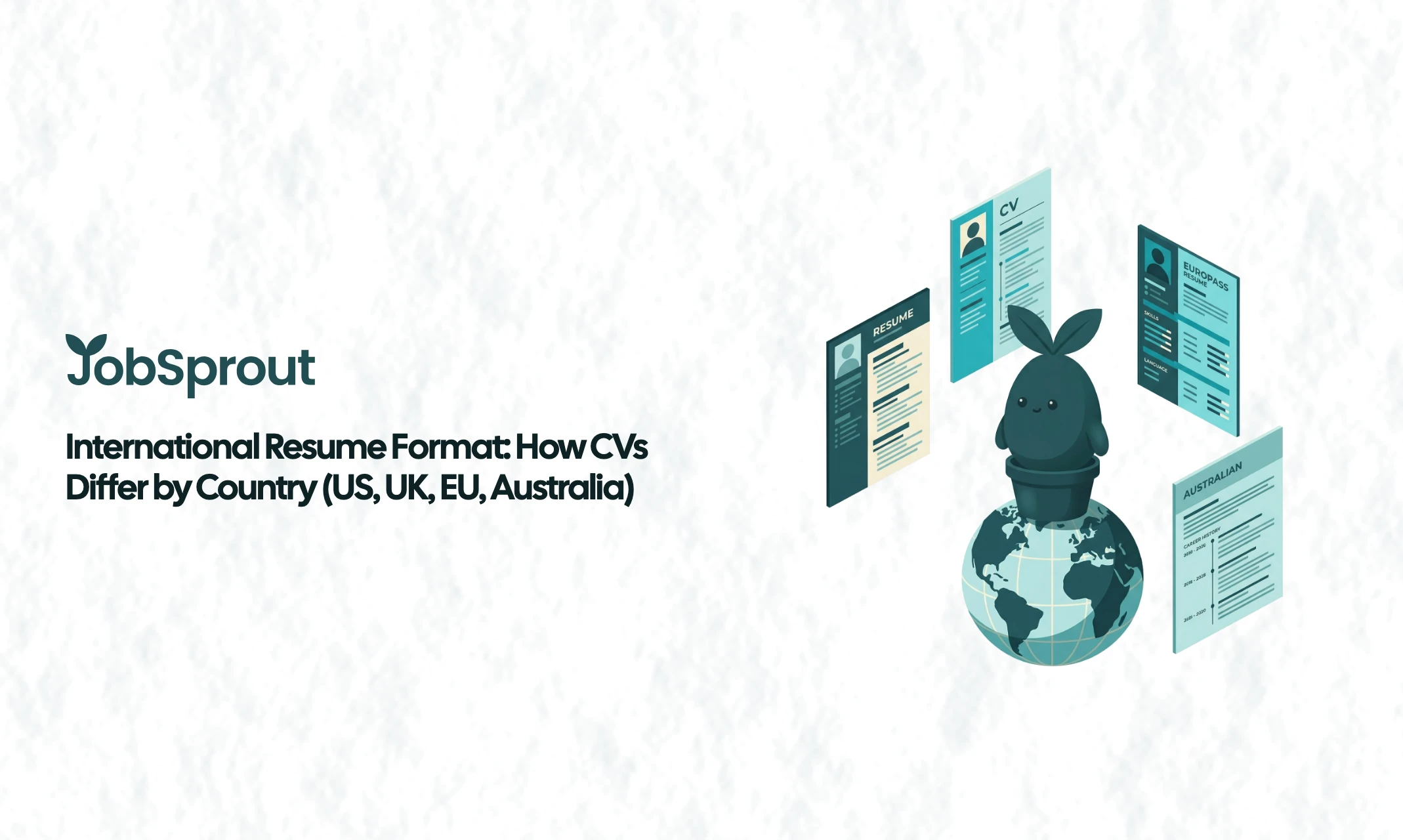
Learn how resume and CV formats differ across countries. Covers the US, UK, Germany, France, Australia, Japan, and the Middle East with comparison tables and practical tips.
Hiring managers consistently report that buzzword-heavy resumes get rejected faster than any other type. Not because the candidate lacks experience, but because the writing signals a lack of effort.
When every second resume on the pile says "results-driven team player with excellent communication skills," those words stop meaning anything. They become noise. And in 2026, with AI-powered ATS systems scanning for substance over fluff, buzzwords are more dangerous than ever.
This guide breaks down the 30 worst resume buzzwords, explains why each one hurts you, and gives you a specific, measurable replacement you can use today.
Buzzwords feel safe. They sound professional. But they actively work against you for three reasons.
Recruiters have read "detail-oriented self-starter" thousands of times. When they see it again, they don't think "this person pays attention to detail." They think "this person copied a resume template and didn't bother to customise it."
What does "results-driven" actually mean? Every professional wants results. The phrase tells a recruiter nothing about what kind of results, how big they were, or how you achieved them. Vague claims are the opposite of compelling evidence.
Modern Applicant Tracking Systems are increasingly sophisticated, with 97.4% of Fortune 500 companies using an ATS. They look for specific skills, quantifiable achievements, and industry-relevant terminology. Generic buzzwords like "synergy" and "leverage" don't match any job description. They're dead weight on your resume.
For more on how ATS filtering works, see our guide to common resume mistakes.
We've organised these into four categories: vague descriptors, empty action phrases, corporate jargon, and overused claims. Each entry includes the buzzword, why it fails, and a concrete alternative you can adapt.
These words try to describe who you are, but they're so overused they describe nobody.
| Buzzword | Why It's Bad | Say This Instead |
|---|---|---|
| Results-driven | On a significant portion of resumes. Says nothing about what results you've driven. | "Grew quarterly revenue by 23% through restructured sales pipeline" |
| Detail-oriented | Everyone claims this. Zero proof attached. | "Reduced invoice errors by 34% by implementing a three-step verification process" |
| Go-getter | Informal and subjective. No hiring manager searches for this. | "Volunteered to lead the CRM migration project, completing it 2 weeks ahead of schedule" |
| Self-starter | Means nothing without context. Who isn't? | "Identified and launched an internal training programme that reduced onboarding time by 40%" |
| Team player | The most overused phrase in resume history. | "Collaborated with 4 cross-functional teams to ship a product update serving 50K users" |
| Hard worker | Vague and impossible to verify. | "Consistently exceeded quarterly targets by 15-20% over 8 consecutive quarters" |
| Passionate | Subjective emotion, not a professional qualification. | "Built and maintained a technical blog with 12K monthly readers on front-end architecture" |
| Motivated | Same problem as "passionate." It's a feeling, not a fact. | "Completed AWS Solutions Architect certification within 3 months of joining the team" |
| Proactive | Tells the recruiter nothing about what you actually did. | "Flagged a supplier pricing discrepancy that saved £45K annually before it reached audit" |
These phrases appear in bullet points but strip out all the impact. They describe job duties, not achievements.
| Buzzword | Why It's Bad | Say This Instead |
|---|---|---|
| Responsible for | Passive. Describes a job description, not a result. | Lead with a strong action verb: "Managed," "Directed," "Oversaw" |
| Duties included | You're listing tasks, not achievements. Recruiters want outcomes. | "Negotiated vendor contracts worth £200K, reducing costs by 18%" |
| Helped with | Diminishes your role. Were you the helper or the doer? | "Co-led the website redesign that increased conversion rates by 27%" |
| Assisted in | Same problem as "helped with." It hides your contribution. | "Coordinated logistics for 15 client events with 500+ attendees each" |
| Worked on | So vague it's meaningless. Everyone "works on" things. | "Developed a real-time analytics dashboard used by 30 sales reps daily" |
| Participated in | Passive. Doesn't indicate level of involvement. | "Contributed market analysis that informed a £3M product launch strategy" |
| Was involved in | The weakest possible way to describe your work. | "Designed the user research framework adopted across 3 product teams" |
| Handled | Vague and passive. What does "handling" look like? | "Resolved 200+ customer escalations monthly with a 96% satisfaction rating" |
These words sound impressive in meetings but are meaningless on paper. Recruiters actively dislike them.
| Buzzword | Why It's Bad | Say This Instead |
|---|---|---|
| Synergy | The single most mocked word in corporate language. | "Merged two departmental workflows, cutting handoff delays by 3 days" |
| Leverage | Used so broadly it means nothing specific. | "Used Salesforce automation to reduce manual data entry by 60%" |
| Paradigm shift | Pretentious. Nobody talks like this in an interview. | "Introduced agile methodology that shortened release cycles from 6 weeks to 2" |
| Think outside the box | A cliche about avoiding cliches. Ironic. | "Proposed a referral programme that generated 35% of Q3 new hires at zero ad spend" |
| Move the needle | Vague metric language without an actual metric. | "Increased email open rates from 18% to 31% through A/B-tested subject lines" |
| Circle back | Meeting speak, not resume speak. | Remove entirely. This never belongs on a resume. |
| Value-add | Jargon that sounds like you're justifying your existence. | "Created an automated reporting tool that saved the finance team 8 hours per week" |
| Bleeding edge | Trying too hard. Let your actual work speak. | "Implemented containerised microservices architecture serving 2M daily requests" |
These phrases try to establish credibility, but they're so common they achieve the opposite.
| Buzzword | Why It's Bad | Say This Instead |
|---|---|---|
| Excellent communication skills | On nearly every resume. Never backed by evidence. | "Presented quarterly business reviews to C-suite stakeholders across 4 regions" |
| Proven track record | Proven by whom? This is a claim, not proof. | "Exceeded annual revenue targets for 3 consecutive years (2023: 112%, 2024: 118%, 2025: 121%)" |
| Strategic thinker | Subjective label. Strategy is demonstrated, not declared. | "Developed a market entry plan for Southeast Asia that captured 8% market share in 12 months" |
| Dynamic | Means energetic? Flexible? Nobody knows. | "Adapted team processes during a company merger, maintaining 98% client retention" |
| Innovative | The word itself is the opposite of innovative. | "Filed 3 patents for supply chain optimisation algorithms adopted by 12 distribution centres" |
| Best-in-class | Compared to what? By whose measurement? | "Ranked #1 in customer satisfaction scores across 25 regional branches for 2 consecutive years" |
| Thought leader | Self-awarded title that carries no weight. | "Published 15 articles in industry journals and spoke at 4 international conferences in 2025" |
Every buzzword replacement follows the same structure. Once you learn the formula, you can rewrite any vague bullet point in seconds.
| Component | What It Does | Example |
|---|---|---|
| Action verb | Shows ownership | "Redesigned" |
| Specific task | Gives context | "the customer onboarding workflow" |
| Measurable result | Proves impact | "reducing churn by 22% in the first 90 days" |
Combined: "Redesigned the customer onboarding workflow, reducing churn by 22% in the first 90 days."
Compare that to: "Innovative self-starter with a proven track record in customer success."
Both sentences try to say the same thing. Only one gives the recruiter a reason to call you.
Not every role produces neat percentages. That's fine. You can still be specific.
| Instead of metrics, use... | Example |
|---|---|
| Scale (team size, budget, users) | "Managed a team of 12 across 3 time zones" |
| Frequency | "Conducted weekly code reviews for a 6-person engineering team" |
| Scope | "Oversaw compliance for operations across 8 European markets" |
| Speed | "Delivered the project 3 weeks ahead of the 6-month deadline" |
| Recognition | "Selected by senior leadership to lead the company's first sustainability initiative" |
For a deeper look at choosing the right verbs, check our guide on action verbs for your resume.
Theory is useful, but seeing the transformation in context makes the difference. Here are four complete resume sections rewritten from buzzword-heavy to evidence-based.
Before (buzzword-heavy):
After (specific and measurable):
Before (buzzword-heavy):
After (specific and measurable):
Before (buzzword-heavy):
After (specific and measurable):
Before (buzzword-heavy):
After (specific and measurable):
The difference is stark. The "before" versions could describe almost anyone. The "after" versions describe someone worth interviewing.
Not every commonly used word is a buzzword. Some terms are perfectly acceptable when they're backed by evidence or used in the right context.
| Word | When It Works | When It Doesn't |
|---|---|---|
| Led | When followed by what you led and the outcome | When used alone: "Led various initiatives" |
| Managed | When paired with specifics (team size, budget, scope) | When vague: "Managed day-to-day operations" |
| Developed | When describing something you built from scratch | When it's just "Developed strategies" with no detail |
| Optimised | When you include the before and after metrics | When it's just "Optimised processes" |
| Collaborated | When you specify with whom and on what | When it replaces describing your actual contribution |
| Spearheaded | When describing genuine initiative ownership | When everything on your resume was "spearheaded" |
The rule is simple: any word works if the sentence that follows it contains evidence. "Managed" is not a buzzword when it's "Managed a £2M budget across 3 product lines." It becomes one when it's "Managed various responsibilities."
Technical terminology specific to your field is different from generic corporate language. A software engineer should use terms like "containerised," "CI/CD," and "microservices." A financial analyst should use "discounted cash flow," "variance analysis," and "P&L management."
These aren't buzzwords. They're the vocabulary recruiters and ATS systems are specifically scanning for. The key distinction: buzzwords try to sound impressive without saying anything. Industry terms carry real, specific meaning.
For more on choosing the right words to describe yourself, we have a dedicated guide with 100+ options organised by category.
Before you submit your next application, run this quick audit:
Search for the word "responsible." If it appears anywhere, rewrite that bullet point with an action verb.
Count your adjectives. If more than 2 bullet points start with an adjective (innovative, dynamic, passionate), replace them with verbs.
Look for orphan claims. Any statement that makes a claim without evidence ("excellent communication skills") needs to either gain a metric or get deleted.
Read each bullet point and ask: "Could anyone in my industry write this exact sentence?" If yes, it's too generic. Make it yours.
Check for the word "various." It's a sign you're being vague. "Managed various projects" should become "Managed 8 client projects simultaneously, worth £1.5M total."
Tools like JobSprout can help with this process. The AI writer analyses your bullet points and suggests specific, evidence-based alternatives, taking the guesswork out of rewriting.
Keep this table handy when writing or editing your resume:
| If You Wrote... | Replace With... |
|---|---|
| Results-driven | [Specific result you drove, with a number] |
| Responsible for | [Action verb]: Managed, Led, Directed, Oversaw |
| Team player | Collaborated with [who] to achieve [what] |
| Excellent communication | Presented to [audience], Published [where], Trained [how many] |
| Self-starter | Identified [opportunity] and [action taken + result] |
| Proven track record | [The actual track record, with dates and figures] |
| Detail-oriented | Reduced [errors/issues] by [percentage] through [method] |
| Hard worker | Exceeded [targets] by [amount] for [duration] |
| Passionate about | Built [project], Contributed to [community], Created [thing] |
| Innovative | Filed [patents], Designed [new system], Introduced [process] |
Buzzwords persist because they feel safe. Writing "strategic thinker with a proven track record" is easier than digging through your work history to find the actual numbers.
But safe is invisible. In a stack of 200 resumes, invisible means rejected.
The fix is straightforward: replace every adjective with a verb, every claim with evidence, and every vague phrase with a specific number. Your resume doesn't need to sound impressive. It needs to prove that you are.
For more ways to strengthen your resume language, explore our guides on action verbs and resume summary examples.