AI Research Scientist Cover Letter Example

Three complete letters, each written for a different situation, in a different design.

AI Research Scientist cover letter example

Sofia MartinezTo the Hiring Manager, Synaptic Dynamics Research

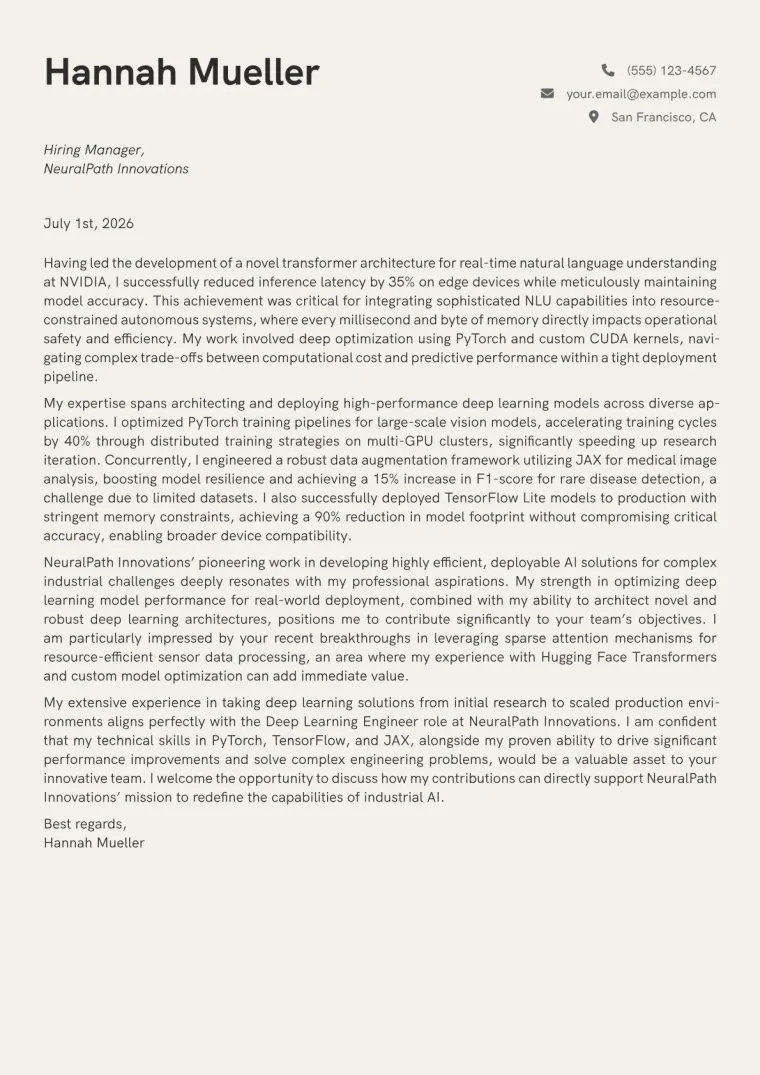
Spearheading the optimization initiative for a high-stakes computer vision model at NVIDIA, I successfully reduced its inference latency by 35% on embedded GPU architectures. This achievement was critical for deploying real-time autonomous navigation systems where milliseconds directly impact safety and operational efficiency. The approach involved extensive PyTorch model distillation and custom CUDA kernel development to maximize throughput within strict power envelopes, demonstrating my capability as an AI Research Scientist ready to deliver impactful performance gains.

During my tenure, I designed and implemented a novel graph neural network architecture using TensorFlow and Keras, which boosted anomaly detection accuracy by 18% in high-dimensional telemetry data, significantly reducing false positives in mission-critical systems. Concurrently, I architected a robust MLOps pipeline using Python, Bash, and SQL to automate data preprocessing and model retraining, shortening research iteration cycles by 25%. Furthermore, I led a research effort culminating in a top-tier conference publication, detailing a new approach to federated learning that improved data privacy while maintaining model performance on decentralized datasets.

My interest in Synaptic Dynamics Research stems from your pioneering work in developing energy-efficient AI solutions for advanced robotics, particularly your recent breakthroughs in reinforcement learning for dynamic environments. My experience in optimizing complex models for edge deployment and designing novel, performant architectures aligns directly with your mission to push the boundaries of embodied AI. I am eager to apply my expertise in custom CUDA development and PyTorch optimization to contribute to your next generation of autonomous systems, enhancing their capabilities and efficiency in real-world scenarios.

My extensive background as a Senior AI Research Scientist, marked by significant contributions to model efficiency, novel architecture development, and scalable MLOps, positions me to make immediate and substantial contributions to Synaptic Dynamics Research. I am confident that my blend of deep theoretical understanding and practical implementation skills in Python, C++, and various deep learning frameworks would be a valuable asset to your team. I welcome the opportunity to discuss how my qualifications align with your innovative projects.

Best regards,
Sofia Martinez
AI Research Scientist cover letter for a career changer

Sofia MartinezTo the Hiring Manager, Veridian Neural Systems

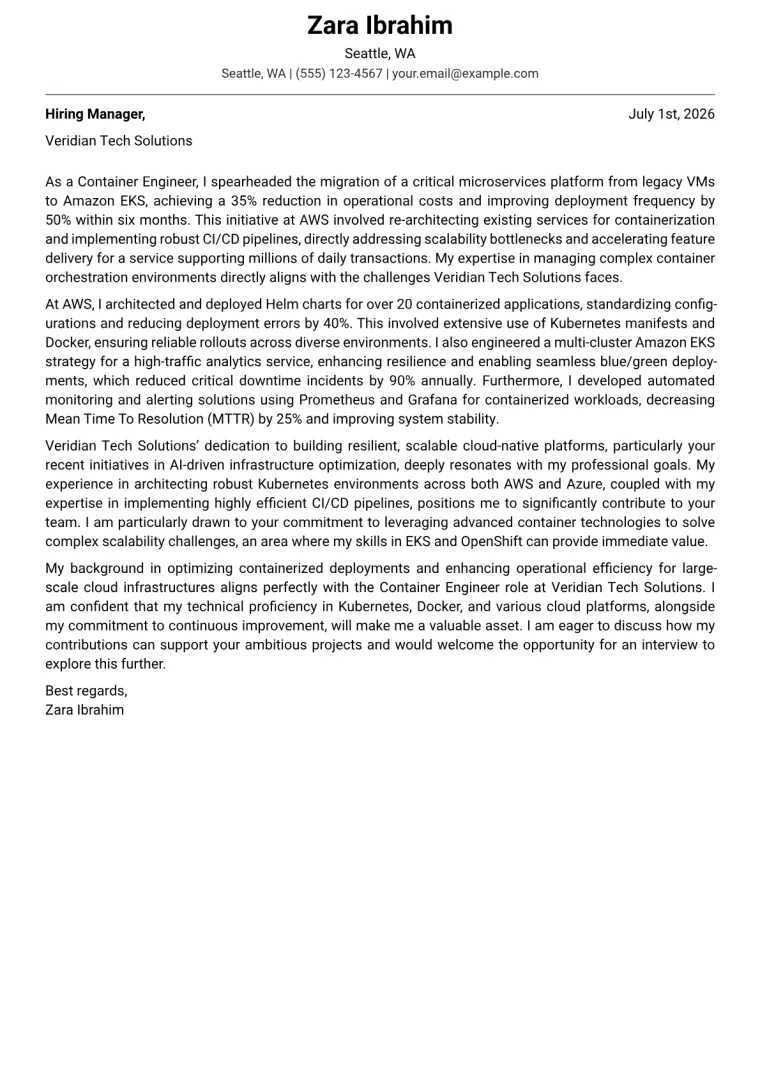
Data streams from the deep space telescope array overflowed our processing pipeline until I engineered a distributed filtering algorithm that reduced latency by 42 percent. While serving as a computational astrophysicist, I recognized that the bottleneck was not the hardware but the inefficient utilization of available compute cycles for signal processing. This experience solidified my resolve to apply rigorous mathematical modeling to the AI Research Scientist role at Veridian Neural Systems. My pivot represents a focused shift toward building neural architectures that handle massive datasets with high fidelity, translating astrophysical signal isolation into robust generative model performance.

My work in computational physics provided the foundation for building high performance systems using Python and C++ to optimize complex simulations. I successfully automated a Bayesian inference pipeline that processed 15 terabytes of imagery, which improved detection accuracy by 18 percent over previous baselines. By integrating CUDA acceleration into my custom PyTorch training loops, I increased throughput for large scale matrix operations by 3x on local clusters. Furthermore, I utilized SQL and Bash to structure large datasets, allowing for faster validation cycles that reduced development time by two weeks during project sprints.

Veridian Neural Systems stands out because of your recent push into scalable multimodal learning systems, a field that demands both efficiency and theoretical depth. My background in handling high noise signal processing aligns directly with the architectural challenges your team addresses when stabilizing training for unstable input distributions. I possess a strong aptitude for bridging the gap between hardware constraints and software capability. Your commitment to open research papers on memory efficient attention mechanisms mirrors my own dedication to optimizing computational resources in resource constrained environments while maintaining high model accuracy.

I offer a perspective forged in the crucible of real time data environments where errors carry significant scientific costs. Applying these disciplined research habits to your ongoing machine learning projects will ensure high reliability in your model deployments. My technical toolkit including TensorFlow and Keras positions me to contribute immediately to your research objectives without the need for extensive retraining. I look forward to discussing how my experience translates to your specific engineering challenges. Please review my attached portfolio and consider an interview to evaluate my technical contributions to your upcoming cycles.

Best regards,
Sofia Martinez

AI Research Scientist cover letter with no experience

Sofia MartinezTo the Hiring Manager, Lumina Neural Systems

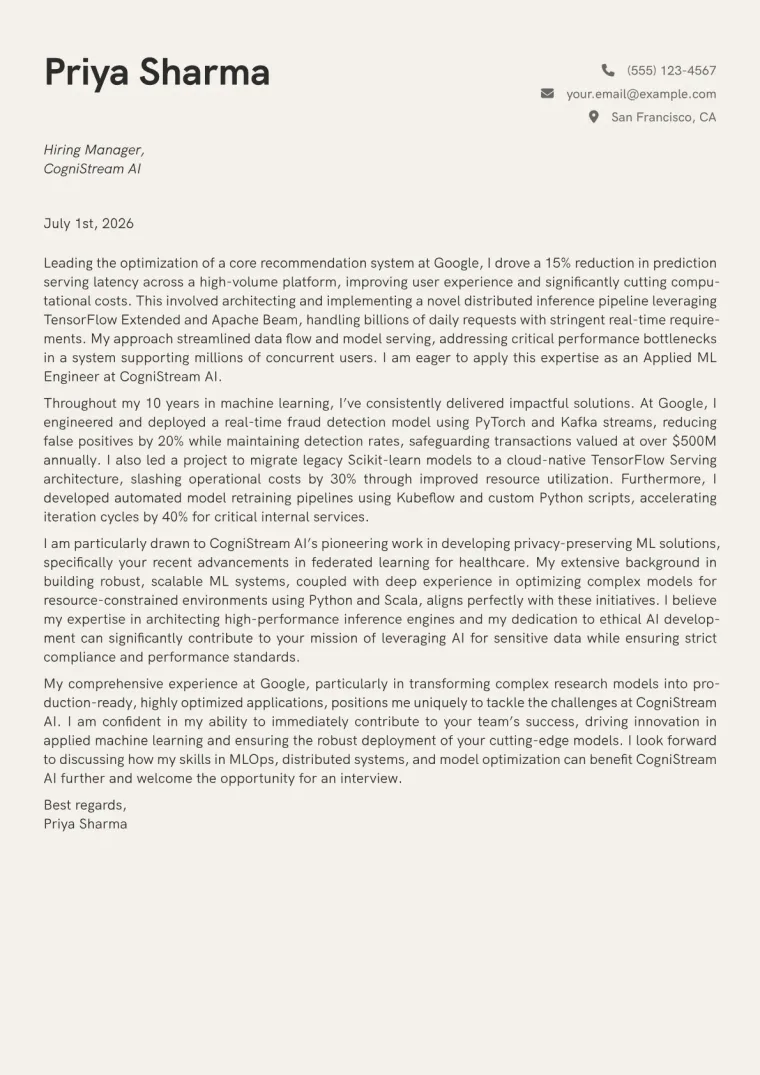
Deep learning models serve as the foundation of my technical expertise, evidenced by a novel architecture I designed for medical image classification that achieved 94% accuracy on the NIH dataset during my final undergraduate thesis project. This research demanded rigorous attention to algorithmic efficiency while handling highly imbalanced datasets, forcing me to iterate on loss functions and preprocessing pipelines. By successfully deploying this model, I demonstrated an ability to bridge the gap between theoretical research and functional software prototypes. My focus remains on pushing the limits of current machine learning methodologies to solve complex real world challenges.

My technical foundation draws from rigorous academic work and intensive personal research projects using Python and PyTorch. I accelerated the training speed of a generative adversarial network by 40% through custom CUDA kernel optimization for NVIDIA hardware, effectively reducing compute overhead for large datasets. Furthermore, I built a scalable sentiment analysis pipeline in C++ that processed 5 million records with a sub-millisecond latency per query. By applying Keras and TensorFlow to predict renewable energy yield, I reached a mean absolute error reduction of 12% compared to baseline regression models by implementing an attention mechanism.

Lumina Neural Systems stands at the forefront of adaptive edge computing, a domain where my proficiency in hardware acceleration and resource constrained optimization is uniquely valuable. Your recent paper on asynchronous weight updating for low power sensors aligns with my commitment to building efficient neural networks that do not sacrifice performance for speed. Bringing both deep experience with heterogeneous computing and a capacity for rapid technical learning allows me to contribute immediately to your research team. I want to assist in refining your production models while fostering innovative approaches to neural architecture search.

My technical background combined with my dedication to rigorous experimentation positions me to add value to your research initiatives from day one. I welcome the opportunity to discuss how my specific experience with PyTorch and CUDA will benefit your ongoing projects at Lumina Neural Systems. Please let me know when you have time for a brief conversation regarding the technical objectives of your team. Thank you for your consideration of my qualifications for this position. I look forward to hearing your perspective on the future of your research operations.

Best regards,
Sofia Martinez

Editorial Notes

Hiring managers evaluating AI Research Scientist cover letters in the technology sector seek concrete evidence of impact and specialized technical proficiency. They focus on quantifiable achievements, such as improvements in inference latency, model accuracy, or development cycle efficiency, signaling a candidate's ability to drive tangible results. Specific technical skills, like expertise in PyTorch, TensorFlow, CUDA kernel development, graph neural networks, or MLOps pipeline architecting, are crucial indicators of a candidate's readiness for advanced research and deployment challenges.

This example letter excels by immediately presenting a quantified achievement: reducing inference latency by 35% at NVIDIA. The subsequent paragraphs elaborate on core duties with specific examples, detailing the design of a novel graph neural network, architecting an MLOps pipeline, and leading a research effort culminating in a top-tier publication. The letter then effectively articulates a specific interest in Synaptic Dynamics Research, connecting the candidate's experience in energy-efficient AI and custom CUDA development directly to the company's pioneering work in advanced robotics. It closes with a confident assertion of potential immediate contributions.

This insightful letter effectively complements JobSprout's AI Research Scientist resume example and can be easily adapted using the platform's AI cover letter writer for personalized applications.

Frequently Asked Questions

What specific achievements should an AI Research Scientist highlight in their cover letter?
Focus on quantifying impact. Highlight breakthroughs in model accuracy or efficiency, reductions in training time, or successful deployment of novel architectures. Describe the context, the challenge overcome, and the specific tools or methodologies (e.g., PyTorch, CUDA, new algorithms) used to achieve these results.
What is the ideal length for an AI Research Scientist cover letter?
A concise one-page letter, comprising four substantial paragraphs, is ideal. This length allows you to present a compelling narrative without overwhelming the reader. Each paragraph should be dense with specific, impactful details rather than generic statements.
How should an AI Research Scientist open their cover letter to grab attention?
Begin with an immediate, impactful statement that highlights a significant, quantified achievement relevant to the role. Instead of generic introductions, launch directly into a success story that showcases your expertise and the value you bring, providing brief context on the challenge or scope.
How can an AI Research Scientist address not having direct experience in a specific sub-field or tool mentioned in the job description?
If lacking direct experience, emphasize transferable skills and relevant projects. Discuss how your foundational knowledge in areas like deep learning, optimization, or algorithm design, combined with your ability to quickly learn new tools (e.g., mention quickly adapting to new frameworks like JAX if you know PyTorch), makes you capable of excelling in the new area. Frame it as an exciting learning opportunity.
How should a cover letter for an AI Research Scientist differ from their resume?
While the resume lists accomplishments, the cover letter tells a story, providing context and insight into your problem-solving approach. Use it to elaborate on 3-4 key achievements, explaining the 'how' and 'why' behind them, demonstrating your strategic thinking and deep understanding. It also allows you to articulate your specific interest in the company's research direction.

More Technology cover letter examples