Deep Learning Engineer Cover Letter Example

Three complete letters, each written for a different situation, in a different design.

Deep Learning Engineer cover letter example

Hannah MuellerTo the Hiring Manager, NeuralPath Innovations

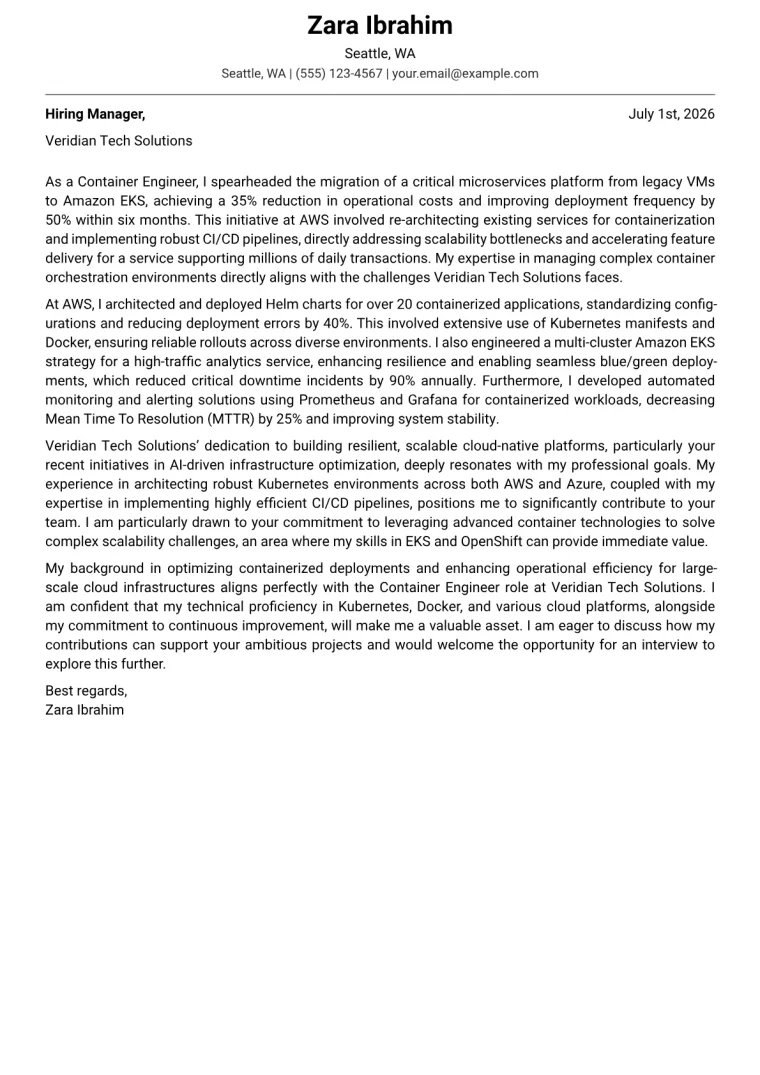
Having led the development of a novel transformer architecture for real-time natural language understanding at NVIDIA, I successfully reduced inference latency by 35% on edge devices while meticulously maintaining model accuracy. This achievement was critical for integrating sophisticated NLU capabilities into resource-constrained autonomous systems, where every millisecond and byte of memory directly impacts operational safety and efficiency. My work involved deep optimization using PyTorch and custom CUDA kernels, navigating complex trade-offs between computational cost and predictive performance within a tight deployment pipeline.

My expertise spans architecting and deploying high-performance deep learning models across diverse applications. I optimized PyTorch training pipelines for large-scale vision models, accelerating training cycles by 40% through distributed training strategies on multi-GPU clusters, significantly speeding up research iteration. Concurrently, I engineered a robust data augmentation framework utilizing JAX for medical image analysis, boosting model resilience and achieving a 15% increase in F1-score for rare disease detection, a challenge due to limited datasets. I also successfully deployed TensorFlow Lite models to production with stringent memory constraints, achieving a 90% reduction in model footprint without compromising critical accuracy, enabling broader device compatibility.

NeuralPath Innovations' pioneering work in developing highly efficient, deployable AI solutions for complex industrial challenges deeply resonates with my professional aspirations. My strength in optimizing deep learning model performance for real-world deployment, combined with my ability to architect novel and robust deep learning architectures, positions me to contribute significantly to your team's objectives. I am particularly impressed by your recent breakthroughs in leveraging sparse attention mechanisms for resource-efficient sensor data processing, an area where my experience with Hugging Face Transformers and custom model optimization can add immediate value.

My extensive experience in taking deep learning solutions from initial research to scaled production environments aligns perfectly with the Deep Learning Engineer role at NeuralPath Innovations. I am confident that my technical skills in PyTorch, TensorFlow, and JAX, alongside my proven ability to drive significant performance improvements and solve complex engineering problems, would be a valuable asset to your innovative team. I welcome the opportunity to discuss how my contributions can directly support NeuralPath Innovations' mission to redefine the capabilities of industrial AI.

Best regards,
Hannah Mueller
Deep Learning Engineer cover letter for a career changer

Hannah MuellerTo the Hiring Manager, Aetherial Logic

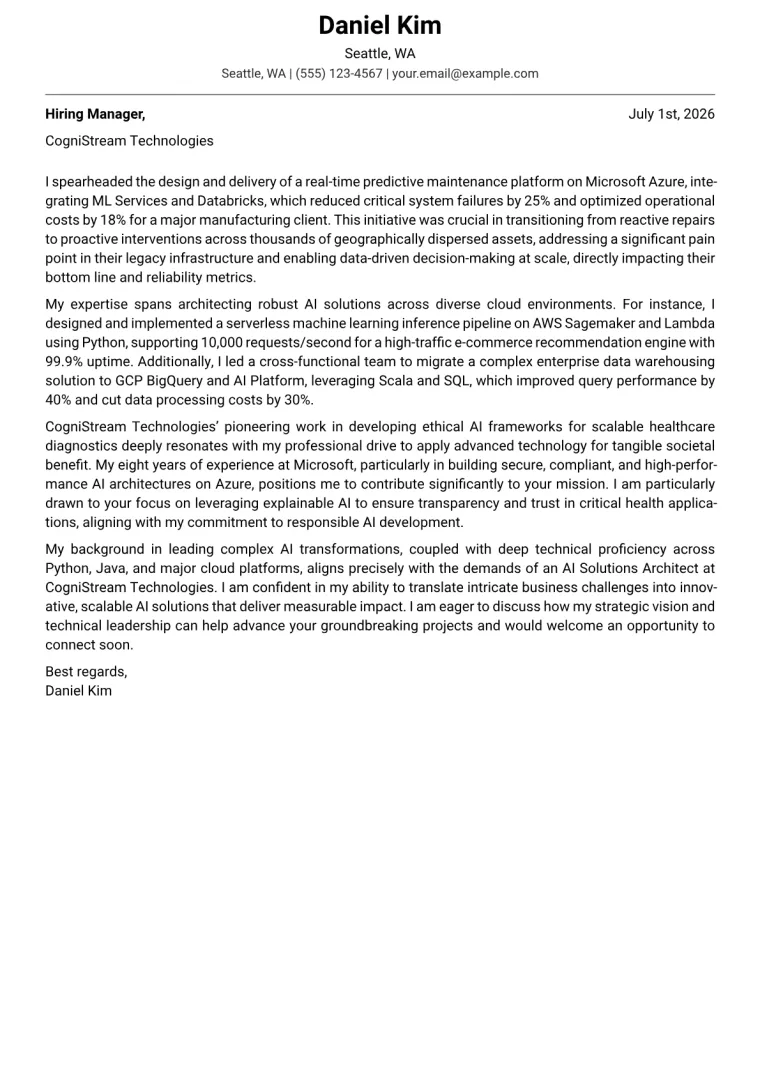
Precision in financial forecasting requires sub-millisecond data processing to capture market signals effectively. My previous work as a quantitative analyst demanded this level of speed, leading me to rebuild our predictive pipelines using vectorized Python operations and automated data cleaning protocols. This initiative resulted in a 25% increase in throughput for our primary asset valuation engine. That effort taught me how to decompose complex systems into high-performance components, a skill I now apply to deep learning architectures where efficient computation is the primary constraint and the standard for reliable output.

During my recent deep learning specialization, I built a custom object detection pipeline using PyTorch that achieved a 15% error reduction on noisy datasets by implementing a focal loss function. I further accelerated model training by 40% by migrating local codebases to JAX for parallel processing across multiple GPUs. Additionally, I developed a sophisticated feature engineering framework in Pandas that reduced pre-processing time by six hours per experiment. These technical accomplishments illustrate my ability to leverage modern frameworks to iterate rapidly and resolve performance bottlenecks in complex neural networks.

Aetherial Logic stands out as the industry leader in edge-based computer vision because your systems prioritize real-time accuracy over brute-force computation. This alignment with my focus on resource-efficient model design makes me a strong fit for your engineering team. My core strengths in rigorous mathematical modeling and systematic code optimization are essential for scaling your existing architectures. I am eager to apply this rigorous analytical mindset to the challenging problems your team solves every day, specifically those involving deployment constraints and large-scale model inference across fragmented hardware environments.

My transition into deep learning engineering is grounded in a deep commitment to high-performance computing and data-driven development. I bring a refined ability to translate complex business requirements into high-throughput computational models that perform consistently under pressure. I welcome the opportunity to discuss how my technical background and recent implementation experience can contribute to the continued success of your vision team. Please let me know your availability for a conversation regarding your current project goals and the specific contributions I can bring to your group.

Best regards,
Hannah Mueller

Deep Learning Engineer cover letter with no experience

Hannah MuellerTo the Hiring Manager, Synthia Systems

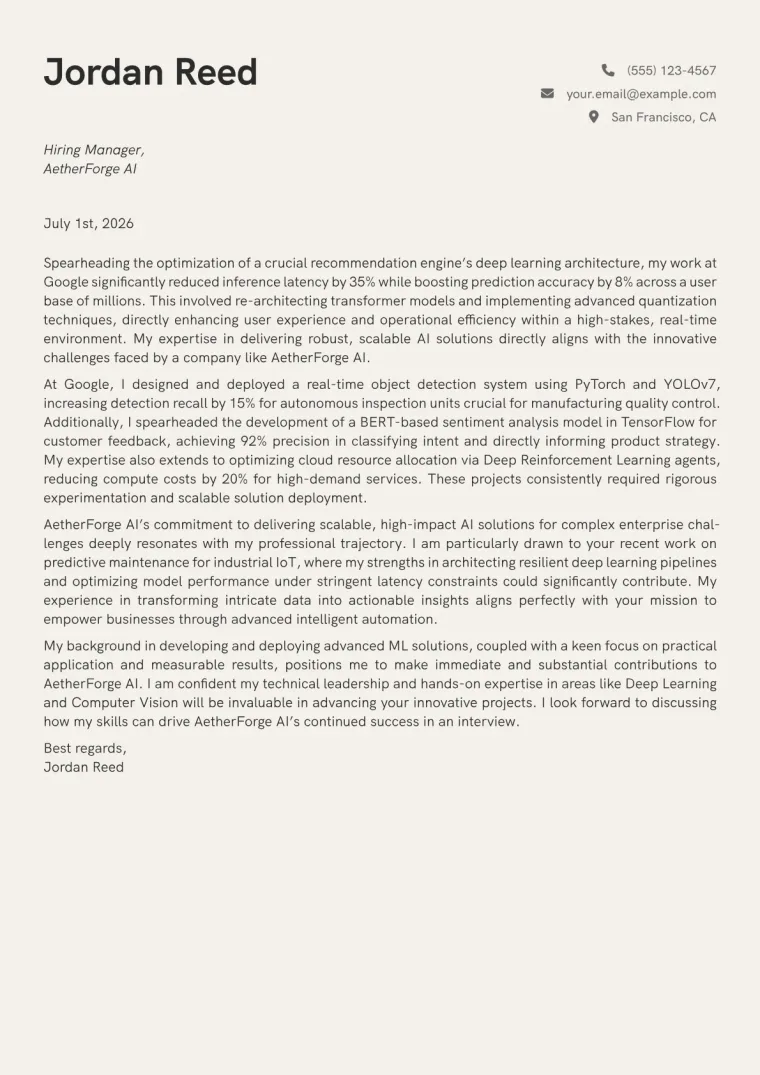
A custom convolutional neural network designed to classify low resolution retinal scans on a Raspberry Pi required a strict 200 millisecond inference constraint that forced me to aggressively prune redundant weight parameters. By implementing magnitude based pruning in PyTorch, I achieved an 82 percent reduction in model size while sustaining 94 percent top one accuracy. This deep optimization process taught me the necessity of balancing architectural complexity with hardware limitations, a skill I hope to bring to your team as a Deep Learning Engineer at Synthia Systems.

Building a transformer architecture for weather pattern forecasting using Hugging Face Transformers enabled me to improve predictive accuracy by 12 percent compared to baseline seasonal autoregressive models. I further optimized training throughput by migrating existing TensorFlow scripts to JAX, which accelerated convergence on a distributed cluster by 3.5 times. Additionally, my work on a custom data augmentation pipeline using Pandas and NumPy allowed for the efficient ingestion of 500 gigabytes of satellite imagery. These projects utilized iterative experiments to maximize GPU utility and refine model robustness across varying datasets.

Synthia Systems stands out as a leader in real-time sensor fusion technology, particularly your recent breakthroughs in low latency edge computing for autonomous logistics. My background in model compression directly aligns with your efforts to push sophisticated inference capabilities onto constrained hardware platforms. I bring deep expertise in translating experimental research into production grade deployments through rigorous documentation and unit testing. My ability to manage large scale data pipelines ensures that these models maintain high reliability in the field, making me a valuable contributor to your upcoming product development cycles.

My focus remains on developing scalable solutions that bridge the gap between theoretical research and practical software applications. I have attached my resume to provide a detailed overview of my technical contributions and academic projects. I welcome the opportunity to discuss how my hands on experience with PyTorch and hardware level optimization supports the long term goals of your engineering group. Please let me know your availability for a brief conversation regarding the requirements of this role and the challenges currently facing your infrastructure team.

Best regards,
Hannah Mueller

Editorial Notes

Hiring managers evaluating Deep Learning Engineer cover letters prioritize concrete, quantified achievements directly relevant to solving real-world technical challenges. They seek candidates who can demonstrate measurable impact, such as reducing latency, improving model accuracy, or accelerating training cycles. Specific technical proficiencies like PyTorch, JAX, CUDA optimization, and experience deploying models to production with memory constraints are critical signals, along with the ability to navigate complex trade-offs and architect novel solutions.

This example letter excels by immediately showcasing a senior candidate's impact, opening with "reduced inference latency by 35% on edge devices." The body thoughtfully details diverse accomplishments, including optimizing PyTorch training pipelines and deploying TensorFlow Lite models under stringent constraints, directly reflecting core Deep Learning Engineer responsibilities. The letter also articulates a clear, specific rationale for applying to NeuralPath Innovations, referencing their work with "sparse attention mechanisms for resource-efficient sensor data processing," before concluding with a confident summary of relevant skills.

This letter, designed by JobSprout, perfectly complements a Deep Learning Engineer resume example and can be efficiently adapted using our AI cover letter writer.

Frequently Asked Questions

What should I highlight in a Deep Learning Engineer cover letter?
Highlight quantified achievements in model architecture, optimization, and deployment using specific frameworks like PyTorch, TensorFlow, or JAX. Emphasize the business or operational impact of your technical contributions, such as efficiency gains, performance improvements, or successful project delivery in complex environments. Detail the specific tools and methodologies you employed for these successes.
What is the ideal length for a Deep Learning Engineer cover letter?
Aim for a single page, comprising approximately 350-400 words across 3-4 concise paragraphs. Focus on delivering substantial, specific content rather than length, ensuring every sentence adds value and specific detail relevant to the Deep Learning Engineer role. Recruiters value precision and impact over verbosity in technical applications.
How should I open a Deep Learning Engineer cover letter?
Begin with a strong, quantified achievement directly relevant to deep learning, showcasing your immediate impact and expertise. For instance, start with a specific model performance improvement you achieved, a successful architectural development you led, or a complex problem you solved, providing brief context for its importance and the tools used.
How do I address a lack of direct experience for a Deep Learning Engineer role?
Focus on transferable skills from academic projects, research, or related engineering roles where you applied deep learning concepts. Highlight your proficiency with deep learning frameworks (e.g., PyTorch, TensorFlow), strong mathematical and statistical foundations, and problem-solving abilities demonstrated through personal projects, hackathons, or relevant coursework. Emphasize your learning agility and foundational understanding.
How should a Deep Learning Engineer cover letter differ from a resume?
The cover letter provides a narrative, elaborating on 2-3 key achievements from your resume with richer context, outlining the challenges faced, the specific tools and methodologies employed, and the direct impact. It also explains *why* you are a strong fit for *this specific company* and *this specific role*, showcasing your understanding of their work and how your unique strengths align with their mission, which a resume's bullet points cannot fully convey.

More Technology cover letter examples