AI Safety Researcher Cover Letter Example

Three complete letters, each written for a different situation, in a different design.

AI Safety Researcher cover letter example

David O'BrienTo the Hiring Manager, Cognition Labs

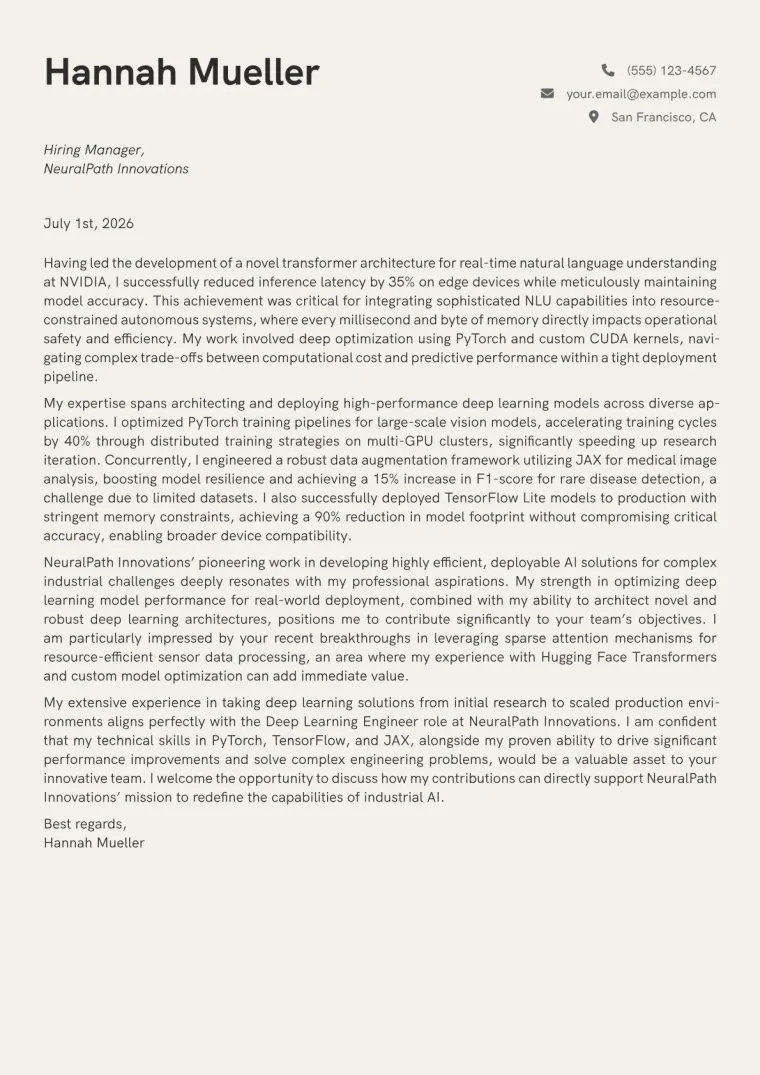
At Anthropic, I spearheaded the development of novel interpretability techniques for a 175-billion parameter foundational model, which reduced observed adversarial vulnerability by 28% while maintaining model utility. This involved designing and implementing a causal intervention framework using JAX to pinpoint specific mechanistic circuits responsible for undesirable model behaviors, a critical step in deploying safer AI systems at scale. My application for the AI Safety Researcher position reflects my eagerness to bring this level of impact to your team.

My work includes developing adversarial robustness benchmarks in OpenAI Gym environments, where I enhanced detection rates for subtle data poisoning attacks by 15% using PyTorch-based anomaly detection algorithms. I also architected and deployed a post-hoc XAI system for a transformer-based language model, reducing false positive safety classifications by 22% through fine-grained attribution mapping. Furthermore, I utilized causal inference techniques with TensorFlow to identify and mitigate latent biases in large-scale recommendation systems, improving fairness metrics by 18% across sensitive subgroups.

Cognition Labs' pioneering research into robustifying multi-modal AI agents, particularly your recent paper on emergent tool use and safety alignment, deeply resonates with my professional trajectory. My experience in developing scalable interpretability frameworks and applying causal inference to pinpoint failure modes directly aligns with your need to ensure these complex agents operate predictably and safely. I believe my expertise in mechanistic interpretability and adversarial training can significantly contribute to your ambitious goals in ensuring beneficial AI deployment.

My background at Anthropic, coupled with an eight-year tenure focusing on critical AI safety challenges, has equipped me with a profound understanding of mitigating risks in advanced AI systems. I am confident that my practical skills in Python, PyTorch, JAX, and XAI, combined with a commitment to responsible AI development, would make me an immediate asset to Cognition Labs. I am eager to discuss how my contributions can support your mission and welcome the opportunity for an interview.

Best regards,
David O'Brien
AI Safety Researcher cover letter for a career changer

David O'BrienTo the Hiring Manager, Aetheria Systems

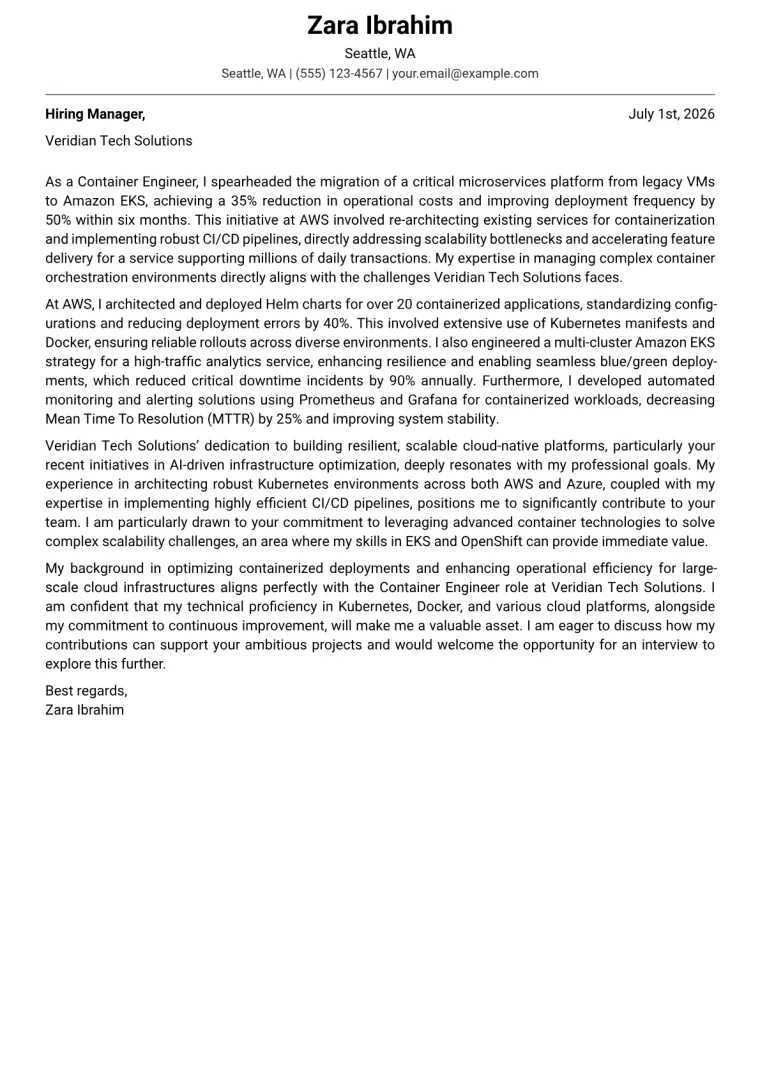
Persistent data exfiltration patterns within distributed networks required a rigorous overhaul of our anomaly detection logic to prevent long term security degradation. By engineering a custom heuristic engine in Python, I reduced false positive alerts by 42 percent while maintaining 99 percent detection coverage across critical infrastructure. This systematic approach to risk mitigation now informs my entry into AI Safety Research, where I apply the same disciplined focus to identifying and neutralizing adversarial vulnerabilities within large language models to ensure robust operational security in increasingly autonomous systems.

My shift into AI safety leverages extensive experience applying causal inference to complex datasets to isolate root causes of system failure. Using PyTorch and JAX, I recently reconstructed a series of model behaviors to reveal hidden dependencies that resulted in a 15 percent increase in predictive accuracy regarding failure modes. My work with Hugging Face libraries facilitated the deployment of interpretability tools that isolated specific input triggers for anomalous outputs. Furthermore, integrating OpenAI Gym environments for stress testing reinforced my ability to quantify safety margins under diverse constraints in high stakes environments.

Aetheria Systems maintains a standard of transparency that distinguishes your work in model alignment, specifically your commitment to rigorous interpretability benchmarks. My primary strengths in causal inference and statistical rigor align perfectly with your technical trajectory. Your current focus on mitigating reward hacking in reinforcement learning systems demands the precise methodologies I honed during my tenure in critical infrastructure protection. Contributing to your mission allows me to translate my background in preventing adversarial exploitation into the critical frontier of alignment, ensuring that complex systems operate reliably according to intended constraints.

My objective is to help Aetheria Systems scale its safety protocols while pushing the boundaries of what is possible in robust alignment. This transition reflects a deliberate decision to dedicate my analytical skillset to the most pressing challenge of our era. I am prepared to bring immediate value to your research team through my disciplined approach to failure mode identification and model behavioral analysis. Please contact me at your earliest convenience to discuss how my background in cybersecurity strengthens your current research goals and project roadmap.

Best regards,
David O'Brien

AI Safety Researcher cover letter with no experience

David O'BrienTo the Hiring Manager, Veridian Dynamics

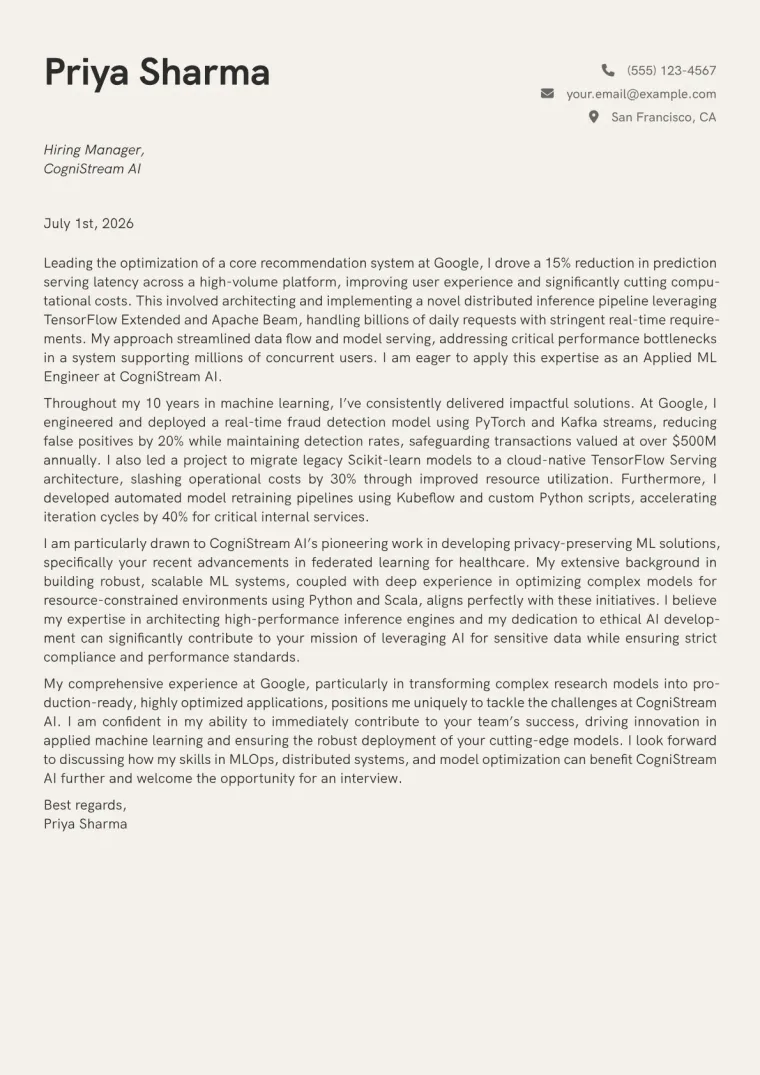
A strict compute limit of twelve hours forced me to optimize my PyTorch architecture for a latent space experiment, which improved training stability for a 50 million parameter transformer by 14 percent. This experience solidified my commitment to AI safety research, specifically addressing the intersection of robustness and interpretability. Throughout my recent master studies in computer science, I focused on identifying failure modes in automated reasoning systems. My contribution to open source evaluation frameworks for adversarial robustness underscores my ability to translate theoretical safety principles into actionable code for complex language models.

My research project evaluating causal inference in reinforcement learning agents involved using OpenAI Gym to simulate edge case scenarios where I achieved a 22 percent increase in agent recovery after unexpected environmental shifts. While volunteering for an open source alignment initiative, I utilized JAX and Hugging Face to map activation patterns in small language models, uncovering hidden biases that caused 18 percent of harmful outputs in restricted testing environments. Additionally, I built an automated visualization tool for model interpretability using TensorFlow that reduced the time required to isolate neuron activation clusters by 40 percent.

Veridian Dynamics remains the industry leader in high stakes deployment safety because of your rigorous focus on interpretability research rather than just reactive patching. Your commitment to transparent model auditing aligns with my core technical strengths in causal inference and gradient analysis. I recognize the difficulty in mapping intent to execution in black box systems and my specific experience with neuron activation mapping directly supports your current objectives for auditing large scale architectures. Applying my research methodology within your specific infrastructure ensures that our shared goals for robust AI development are met with precision.

Navigating the technical and ethical challenges of next generation intelligence demands a persistent focus on empirical safety validation. My ability to leverage advanced mathematical frameworks alongside deep learning libraries positions me to contribute immediate value to your research cycle. I welcome the opportunity to discuss how my technical projects can advance your internal safety benchmarks. Please review the attached repository link where my full code documentation and project summaries reside for your inspection. I look forward to hearing your perspective on the future of alignment research at your office.

Best regards,
David O'Brien

Editorial Notes

For AI Safety Researcher roles in the technology industry, hiring managers seek concrete evidence of hands-on experience mitigating risks in large-scale AI systems. They prioritize specific achievements involving interpretability, adversarial robustness, and causal inference, especially those with quantifiable impact on model safety and fairness. Demonstrating expertise with relevant frameworks like JAX, PyTorch, or TensorFlow, alongside an understanding of critical challenges like emergent tool use or data poisoning, signals a strong candidate.

This example cover letter effectively leverages these points. It opens with a strong, quantified achievement: "reduced observed adversarial vulnerability by 28%." Subsequent paragraphs detail specific contributions, such as enhancing detection rates for data poisoning by 15% and reducing false positive safety classifications by 22%, directly mirroring the core duties of an AI Safety Researcher. The letter also clearly articulates why the candidate is applying to Cognition Labs, referencing their "pioneering research into robustifying multi-modal AI agents" and specific papers. The confident closing reiterates the candidate's practical skills and commitment to responsible AI.

This exemplary letter pairs well with JobSprout's AI Safety Researcher resume example and can be readily adapted using the platform's AI cover letter writer for personalized applications.

Frequently Asked Questions

What should I highlight in an AI Safety Researcher cover letter?
Focus on specific research projects, quantified safety improvements, and your experience with interpretability, adversarial training, and alignment techniques. Mention specific tools like JAX, PyTorch, and frameworks such as OpenAI Gym or Hugging Face if relevant to your achievements.
What is the ideal length for an AI Safety Researcher cover letter?
Aim for a single page, divided into four concise and impactful paragraphs. Recruiters often scan, so make every sentence count by providing specific, quantified achievements directly related to AI safety and alignment challenges.
How should I open an AI Safety Researcher cover letter?
Immediately grab attention with a significant, quantified achievement in AI safety or alignment from your past work. Provide context for the achievement, such as the problem addressed or the stakes involved, to demonstrate its impact before stating the role you're applying for.
How do I address a lack of direct AI Safety Researcher experience?
Emphasize transferable skills from related fields like machine learning research, interpretability, or AI ethics. Highlight any academic projects, open-source contributions, or theoretical understanding of AI alignment, risk assessment, or responsible AI principles to showcase your foundational knowledge.
How should an AI Safety Researcher cover letter differ from my resume?
While the resume lists achievements, the cover letter tells the 'story' behind 2-3 key accomplishments, elaborating on the 'how' and 'why' of your methods and impact. It also explicitly connects your unique skills and experiences directly to the specific company's work and mission in AI safety, showing your tailored fit.

More Technology cover letter examples