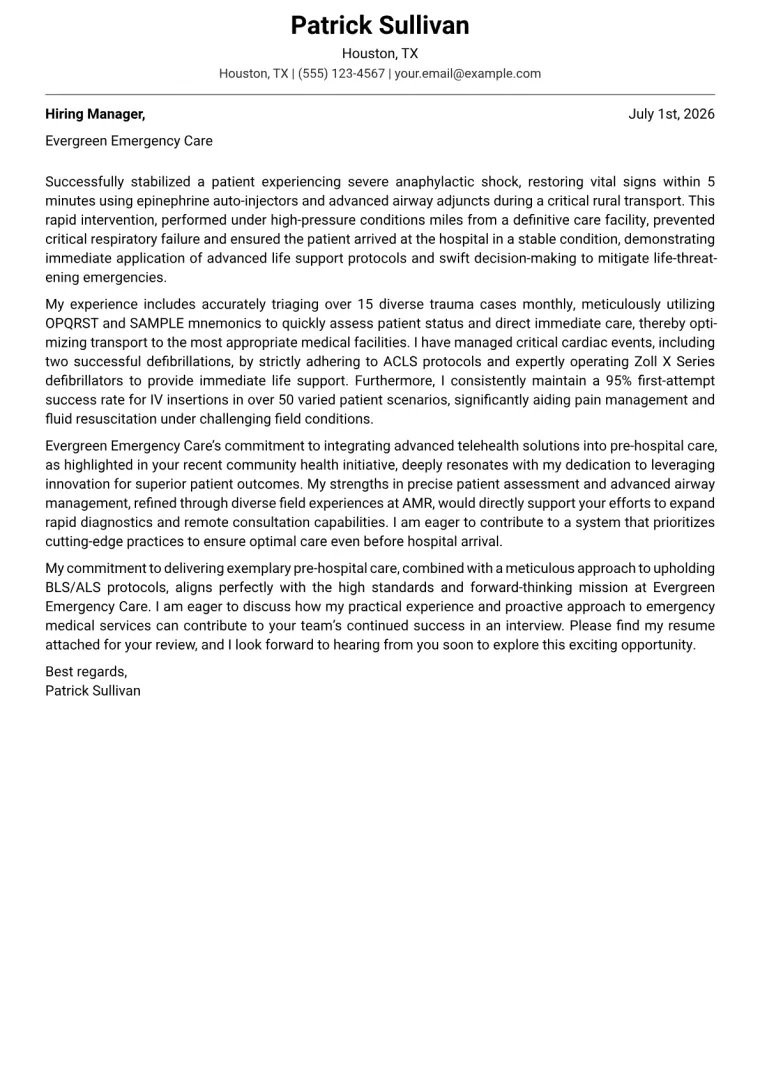
EMT Interview Questions

12 questions from the recruiter screen to the situational round, each with what the interviewer is checking.

What interviewers look for

EMT recruiters evaluate your ability to stabilize patients under pressure while following strict medical protocols. You will be tested on your proficiency with tools like backboards and suction devices, your readiness to manage trauma, and your ability to maintain composure during high stakes emergency calls in diverse clinical settings.

Recruiter screen

  1. What specific experience do you have with the NREMT certification requirements in this state?

    What they're checking: Whether you meet the regulatory prerequisites to start working on an ambulance.

    NREMT Certification
  2. How does your current BLS certification status align with our agency scheduling needs for night shifts?

    What they're checking: Whether your availability matches the operational demands of our specific emergency service shifts.

    BLS Certification

Behavioral

  1. Tell me about a time you had to perform CPR for an extended duration while dealing with bystanders.

    What they're checking: How you manage physical exertion while keeping medical focus during intense cardiac interventions.

    Cardiopulmonary ResuscitationSample answer
  2. Describe a moment when you managed a patient with a traumatic injury while your partner handled the radio communication.

    What they're checking: How you coordinate medical duties with a partner to maintain patient safety in busy environments.

    Teamwork and Collaboration
  3. Tell me about a time you experienced a high stress call that required you to maintain your focus on vital signs.

    What they're checking: How you process emotional pressure to prevent errors in your patient monitoring tasks.

    Stress Management

Role knowledge

  1. Explain your sequence of actions when using a suction device for an airway obstruction in an unconscious patient.

    What they're checking: Whether you follow the standard technical sequence for clearing an airway to prevent aspiration.

    Suction Devices
  2. How do you perform a primary patient assessment once you arrive on a scene with potential cervical spine injuries?

    What they're checking: Whether you prioritize life threatening injuries correctly according to clinical protocols.

    Patient Assessment
  3. Describe the proper method for operating an AED during a cardiac arrest call.

    What they're checking: How you interpret device prompts and coordinate shocks with manual chest compressions.

    AED Operation
  4. What steps do you follow when checking oxygen delivery systems before the start of a shift?

    What they're checking: Whether you perform necessary equipment maintenance to avoid failures during patient transport.

    Oxygen Delivery Systems
  5. How do you correctly document medical findings using the electronic patient care reporting software?

    What they're checking: How you record accurate patient data to maintain legal and clinical chart standards.

    Electronic Patient Care Reporting

Situational

  1. What would you do if a patient with a suspected spinal injury suddenly begins to vomit while immobilized on a backboard?

    What they're checking: Whether you act correctly to clear the airway without compromising the integrity of the spine.

    Spinal ImmobilizationSample answer
  2. How would you manage a patient with a severe extremity wound if direct pressure fails to stop the bleeding?

    What they're checking: Whether you apply tourniquets or other measures appropriately when initial pressure is ineffective.

    Bleeding ControlSample answer

Sample answers

AI-written STAR examples to swap your own facts into.

Tell me about a time you had to perform CPR for an extended duration while dealing with bystanders.

Situation
I arrived at a cardiac arrest scene where a family member was blocking our path to the patient. I had to focus on the patient despite the shouting.
Task
My goal was to initiate chest compressions immediately while clearing the scene of people.
Action
I moved the bystander out of the way and began CPR cycles while my partner set up the AED.
Result
We restored a pulse in under six minutes and successfully handed off the patient at the hospital.
What would you do if a patient with a suspected spinal injury suddenly begins to vomit while immobilized on a backboard?

Situation
During a transfer of a patient on a long board, the patient began to vomit violently without warning.
Task
I needed to clear the airway immediately without causing further spinal damage to the neck.
Action
I quickly rotated the patient and the backboard to the side while maintaining manual stabilization of the head.
Result
This move cleared the vomit in five seconds and prevented aspiration entirely.

How would you manage a patient with a severe extremity wound if direct pressure fails to stop the bleeding?

Situation
I encountered a patient with a deep leg laceration where direct pressure was not stopping the rapid flow of blood.
Task
I had to stop the blood loss to prevent the patient from going into shock.
Action
I applied a tourniquet high above the wound and tightened the windlass until the bleeding stopped completely.
Result
The bleeding halted within two minutes, which kept the patient's heart rate stable until we arrived at the trauma center.

Say your answers out loud before the real thing

Answer by voice or text, with questions drawn from your CV and the job ad. Your answers come back rewritten using only facts from your CV or what you said.

Applying for EMT jobs