Summary
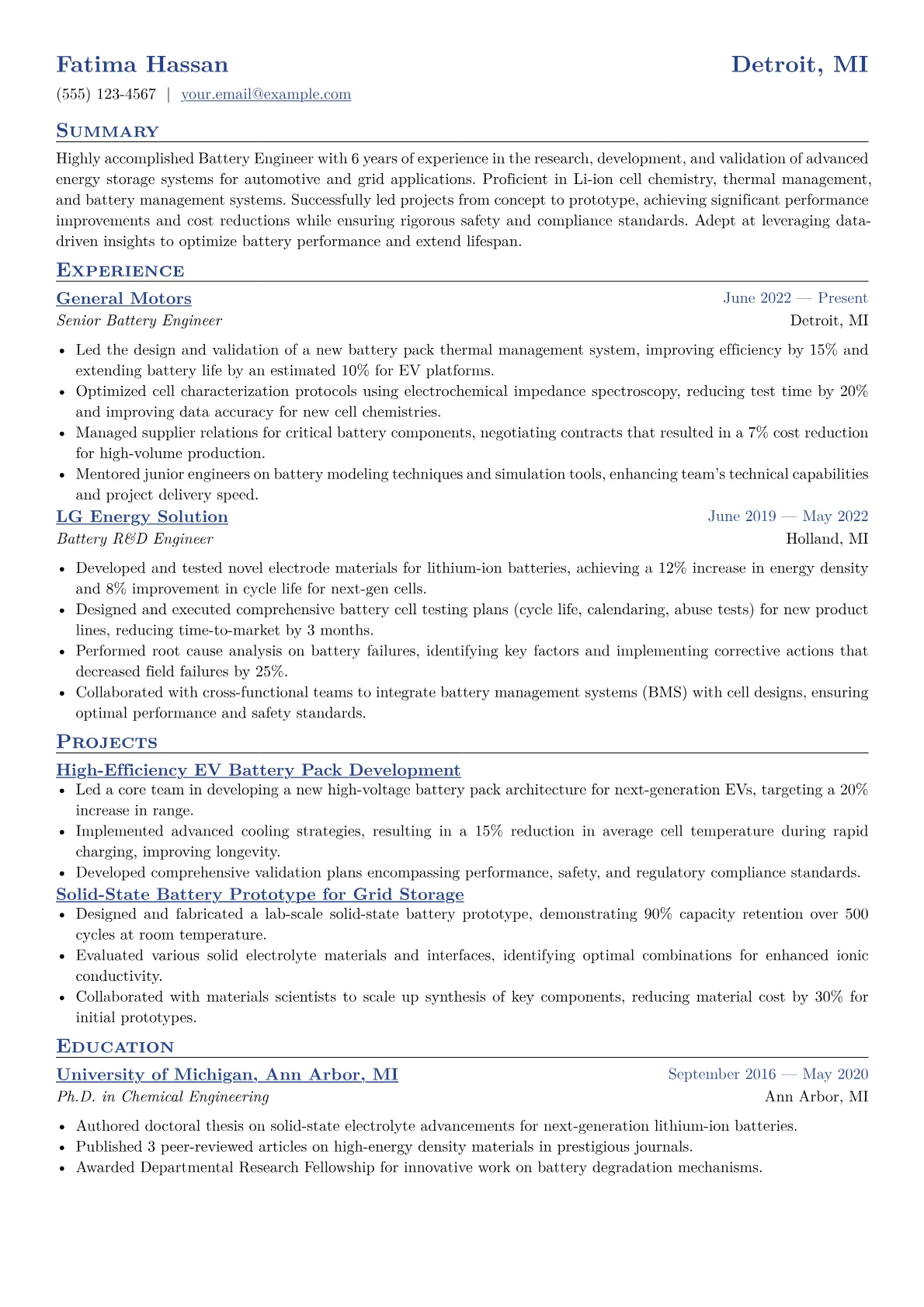
Highly accomplished Battery Engineer with 6 years of experience in the research, development, and validation of advanced energy storage systems for automotive and grid applications. Proficient in Li-ion cell chemistry, thermal management, and battery management systems. Successfully led projects from concept to prototype, achieving significant performance improvements and cost reductions while ensuring rigorous safety and compliance standards. Adept at leveraging data-driven insights to optimize battery performance and extend lifespan.
Experience
Senior Battery EngineerGeneral Motors
- Led the design and validation of a new battery pack thermal management system, improving efficiency by 15% and extending battery life by an estimated 10% for EV platforms.
- Optimized cell characterization protocols using electrochemical impedance spectroscopy, reducing test time by 20% and improving data accuracy for new cell chemistries.
- Managed supplier relations for critical battery components, negotiating contracts that resulted in a 7% cost reduction for high-volume production.
- Mentored junior engineers on battery modeling techniques and simulation tools, enhancing team's technical capabilities and project delivery speed.
Battery R&D EngineerLG Energy Solution
- Developed and tested novel electrode materials for lithium-ion batteries, achieving a 12% increase in energy density and 8% improvement in cycle life for next-gen cells.
- Designed and executed comprehensive battery cell testing plans (cycle life, calendaring, abuse tests) for new product lines, reducing time-to-market by 3 months.
- Performed root cause analysis on battery failures, identifying key factors and implementing corrective actions that decreased field failures by 25%.
- Collaborated with cross-functional teams to integrate battery management systems (BMS) with cell designs, ensuring optimal performance and safety standards.
Projects
High-Efficiency EV Battery Pack Development
- Led a core team in developing a new high-voltage battery pack architecture for next-generation EVs, targeting a 20% increase in range.
- Implemented advanced cooling strategies, resulting in a 15% reduction in average cell temperature during rapid charging, improving longevity.
- Developed comprehensive validation plans encompassing performance, safety, and regulatory compliance standards.
Solid-State Battery Prototype for Grid Storage
- Designed and fabricated a lab-scale solid-state battery prototype, demonstrating 90% capacity retention over 500 cycles at room temperature.
- Evaluated various solid electrolyte materials and interfaces, identifying optimal combinations for enhanced ionic conductivity.
- Collaborated with materials scientists to scale up synthesis of key components, reducing material cost by 30% for initial prototypes.
Education
University of Michigan, Ann Arbor, MIPh.D. in Chemical Engineering
- Authored doctoral thesis on solid-state electrolyte advancements for next-generation lithium-ion batteries.
- Published 3 peer-reviewed articles on high-energy density materials in prestigious journals.
- Awarded Departmental Research Fellowship for innovative work on battery degradation mechanisms.
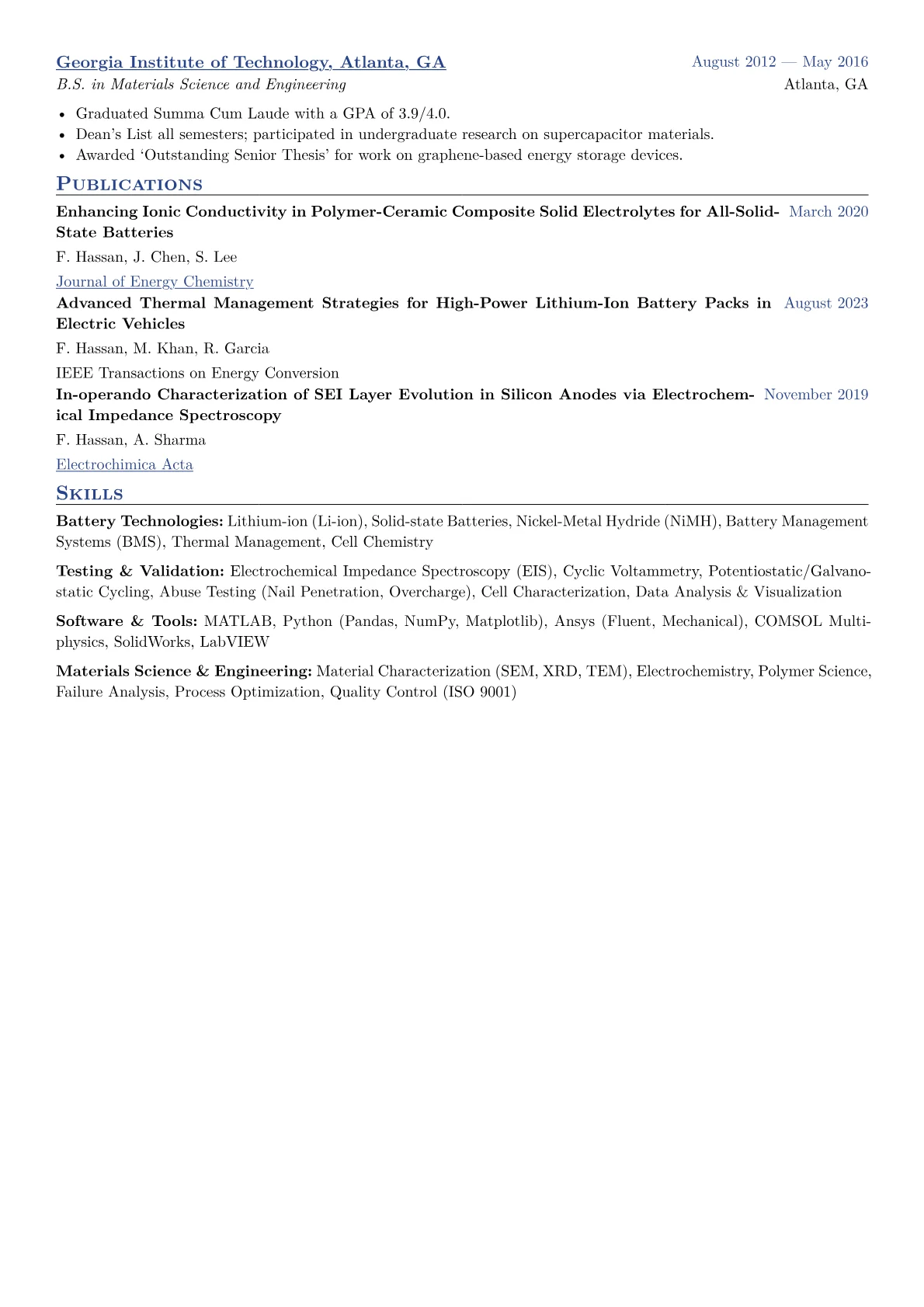
Georgia Institute of Technology, Atlanta, GAB.S. in Materials Science and Engineering
- Graduated Summa Cum Laude with a GPA of 3.9/4.0.
- Dean's List all semesters; participated in undergraduate research on supercapacitor materials.
- Awarded 'Outstanding Senior Thesis' for work on graphene-based energy storage devices.
Publications
Enhancing Ionic Conductivity in Polymer-Ceramic Composite Solid Electrolytes for All-Solid-State Batteries
Advanced Thermal Management Strategies for High-Power Lithium-Ion Battery Packs in Electric Vehicles
In-operando Characterization of SEI Layer Evolution in Silicon Anodes via Electrochemical Impedance Spectroscopy
Skills
Battery Technologies
Lithium-ion (Li-ion)Solid-state BatteriesNickel-Metal Hydride (NiMH)Battery Management Systems (BMS)Thermal ManagementCell Chemistry
Testing & Validation
Electrochemical Impedance Spectroscopy (EIS)Cyclic VoltammetryPotentiostatic/Galvanostatic CyclingAbuse Testing (Nail Penetration, Overcharge)Cell CharacterizationData Analysis & Visualization
Software & Tools
MATLABPython (Pandas, NumPy, Matplotlib)Ansys (Fluent, Mechanical)COMSOL MultiphysicsSolidWorksLabVIEW
Materials Science & Engineering
Material Characterization (SEM, XRD, TEM)ElectrochemistryPolymer ScienceFailure AnalysisProcess OptimizationQuality Control (ISO 9001)
![How to Write a CV for Manufacturing Applications [2026 Guide]](/thumbnails/cv-for-manufacturing-applications.webp)