Biology Research Assistant Resume Example
 Example by JobSprout
Free to use. No download fee.
Market Insights
Biology Research Assistant
Salary Range
Salary Trend
Mar 2025 – Feb 2026
12-Month Trend
Based on advertised Research roles.
US market data · Source: Adzuna · Updated Mar 2026
How useful was this template?
Biology Research Assistant resume samples
Three complete resumes, each in a different design.
Free to use. No download fee.
What makes a strong Biology Research Assistant resume?
US median salary $70,519 ·
For entry-level Biology Research Assistant roles in Academia, hiring managers seek candidates who demonstrate strong technical competency, attention to detail, and a foundational understanding of the scientific process. Concrete achievements that quantify practical laboratory skills, such as successful molecular cloning experiments, precise RNA sequencing data analysis, or optimization of cell culture protocols, are highly valued. Certifications like Good Laboratory Practice (GLP) and Biosafety Level 2 (BSL-2) are critical for showcasing safety compliance, while publications, even entry-level contributions, signal a commitment to scientific rigor and dissemination. Proficiency in specialized software and data analysis is also essential.
Why this example works
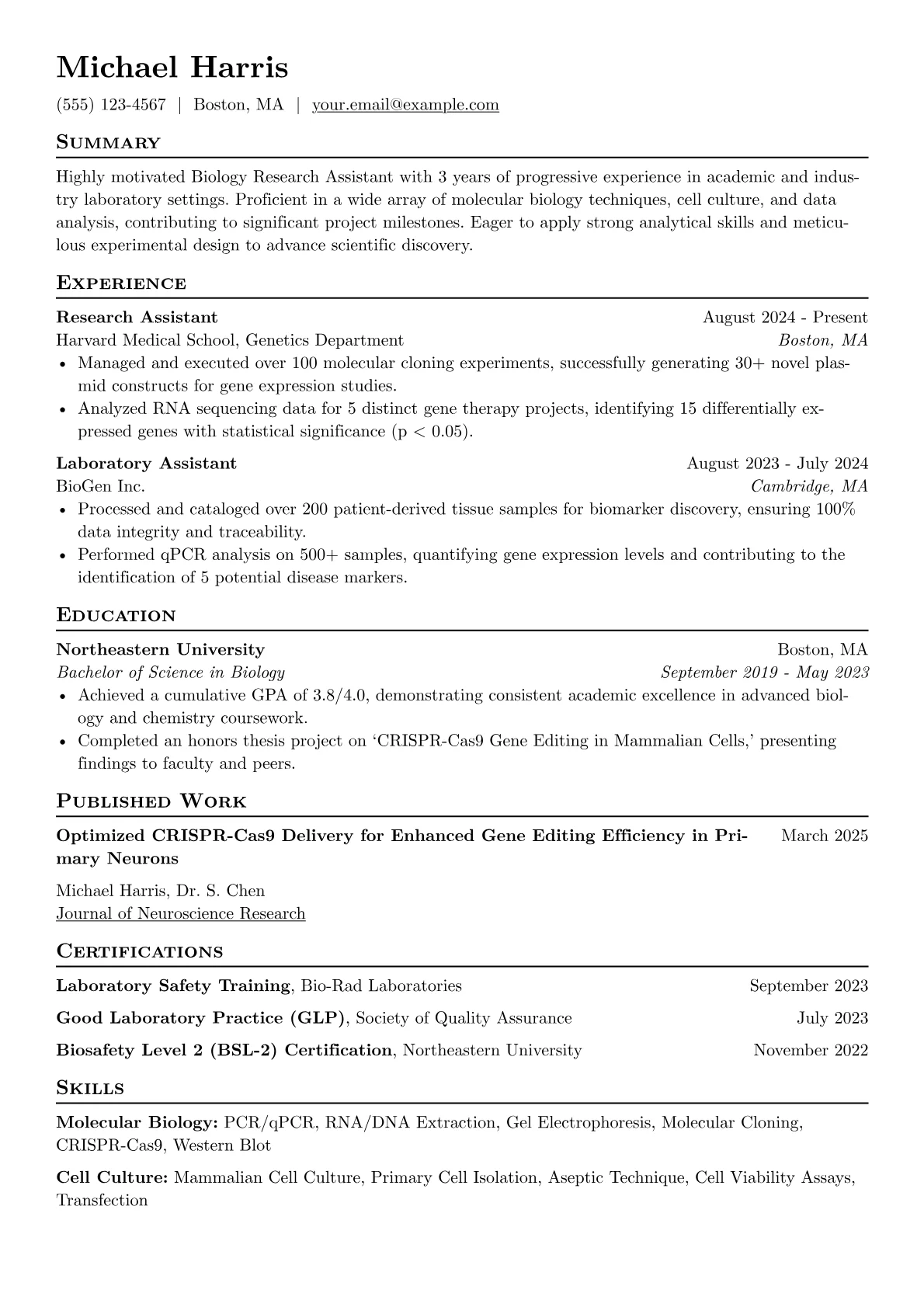
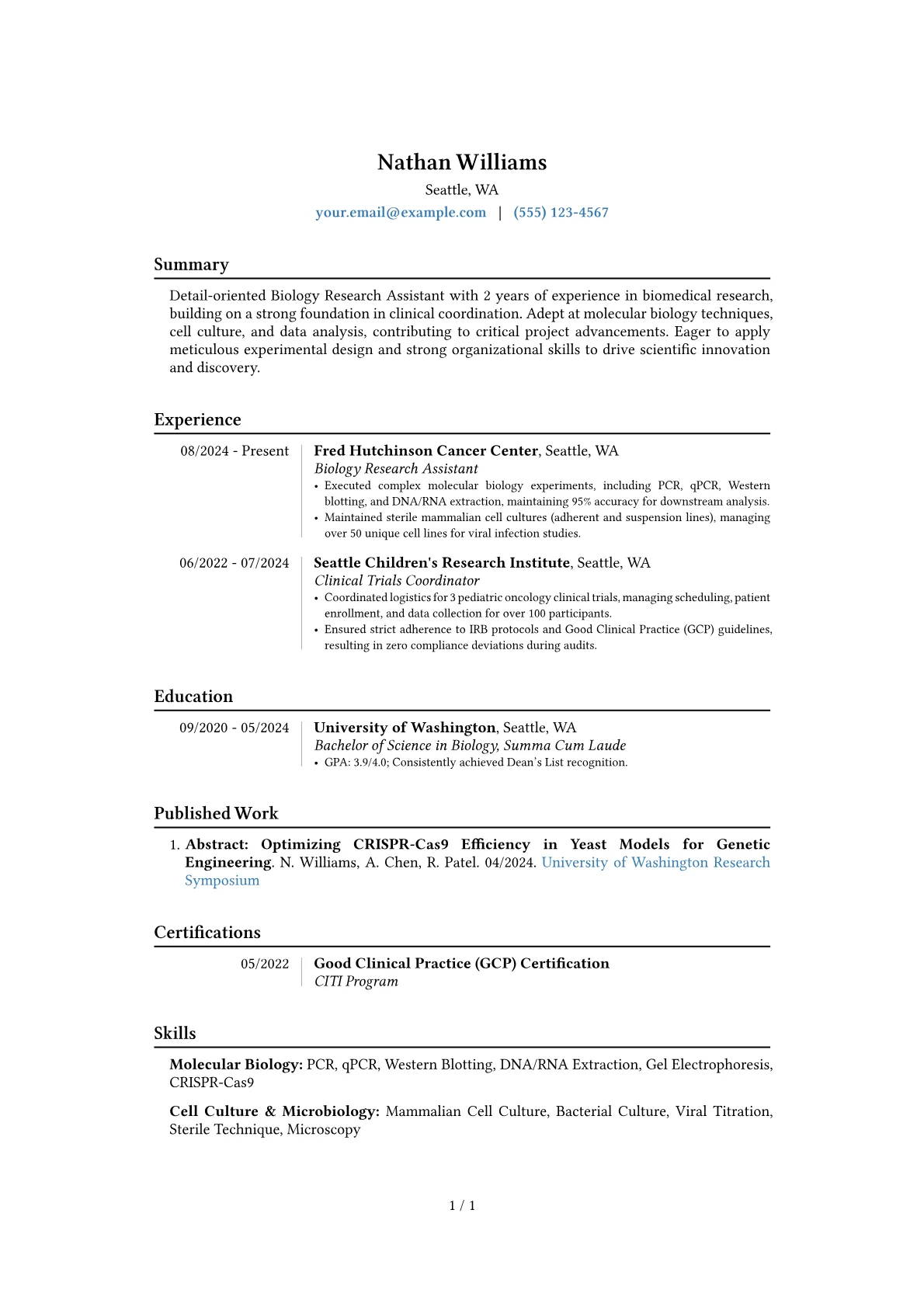
This example resume for Michael Harris effectively highlights these key qualifications. His experience at Harvard Medical School quantifies significant contributions, including managing over 100 molecular cloning experiments and analyzing RNA sequencing data for 5 distinct projects, identifying 15 differentially expressed genes. The previous role at BioGen Inc. further details his practical skills, processing over 200 patient-derived tissue samples and performing qPCR analysis on 500+ samples. The structured skill groups, such as “Molecular Biology” (PCR/qPCR, CRISPR-Cas9) and “Data Analysis & Software” (RStudio (basic), Statistical Analysis), along with specific certifications and publications like “Optimized CRISPR-Cas9 Delivery,” directly align with academic research demands.
How useful was this template?
Example by JobSproutBiology Research Assistant resume summary example
Highly motivated Biology Research Assistant with 3 years of progressive experience in academic and industry laboratory settings. Proficient in a wide array of molecular biology techniques, cell culture, and data analysis, contributing to significant project milestones. Eager to apply strong analytical skills and meticulous experimental design to advance scientific discovery.
Biology Research Assistant salary by country
| Country | 25th percentile | Median | 75th percentile |
|---|---|---|---|
| US | $51,528 | $70,519 | $96,807 |
| UK | £26,827 | £33,833 | £40,926 |
| Canada | C$54,074 | C$68,966 | C$94,286 |
| Australia | A$88,750 | A$101,111 | A$117,222 |
| Germany | €35,750 | €41,500 | €47,250 |
| India | ₹404,412 | ₹808,824 | ₹1,659,091 |
Annual salaries in local currency, aggregated from live job postings via Adzuna. Figures refresh continuously and reflect advertised pay, not negotiated offers.
Biology Research Assistant resume skills and keywords
Recruiters and applicant tracking systems scan Biology Research Assistant resumes for these skills and keywords. Include the ones that match your experience and mirror the wording in the job description. Check your resume against them with the free ATS checker.
Hard skills
Tools & software
Certifications
Soft skills
Market Insights
Biology Research Assistant
Salary Range
Salary Trend
Mar 2025 – Feb 2026
12-Month Trend
Based on advertised Research roles.
US market data · Source: Adzuna · Updated Mar 2026
Frequently Asked Questions
What is the best resume format for an entry-level Biology Research Assistant?
Which laboratory and research skills should I highlight on my Biology Research Assistant resume?
How do I write a strong summary and achievement bullets for an entry-level Biology Research Assistant resume?
Are there any optional sections that are good for an entry-level Biology Research Assistant resume?
Can JobSprout's 'Remix with AI' help me tailor my Biology Research Assistant resume to a job posting?
The blank page is the hard part. Skip it.
Free to use. No download fee.
Related Articles
Research CV: UK Format, Structure and Examples [2026]
How to write a research CV for UK universities and institutes. The section order panels expect, how to list publications and funding, and how long it should actually be.

Postdoc CV: Structure, Template and Example [2026]
What a postdoctoral CV needs that a doctoral one does not: independence, funding, and a publication list a panel can audit. With a full worked example.

Academic CV for PhD Applications: How to Write One [2026]
Learn how to write an academic CV for PhD applications. Real template analysis, what research committees look for, and common mistakes to avoid.
Career moves from Biology Research Assistant
Usually need more experience or training
Usually need less experience or training
Includes information from the O*NET 30.3 Database by the U.S. Department of Labor, Employment and Training Administration (USDOL/ETA), used under the CC BY 4.0 license. We have modified it; USDOL/ETA has not approved, endorsed or tested these modifications. O*NET is a trademark of USDOL/ETA.