PDF or DOCX · up to 2MB
Learn how to write a compelling cover letter with no work experience. Includes 5 complete examples for graduates, career changers, school leavers, and more.
Write a prompt engineer resume that gets interviews. Full resume example, summary templates, 10+ experience bullets, technical skills breakdown, and tips for career changers from software engineering, copywriting, data science, and UX research.
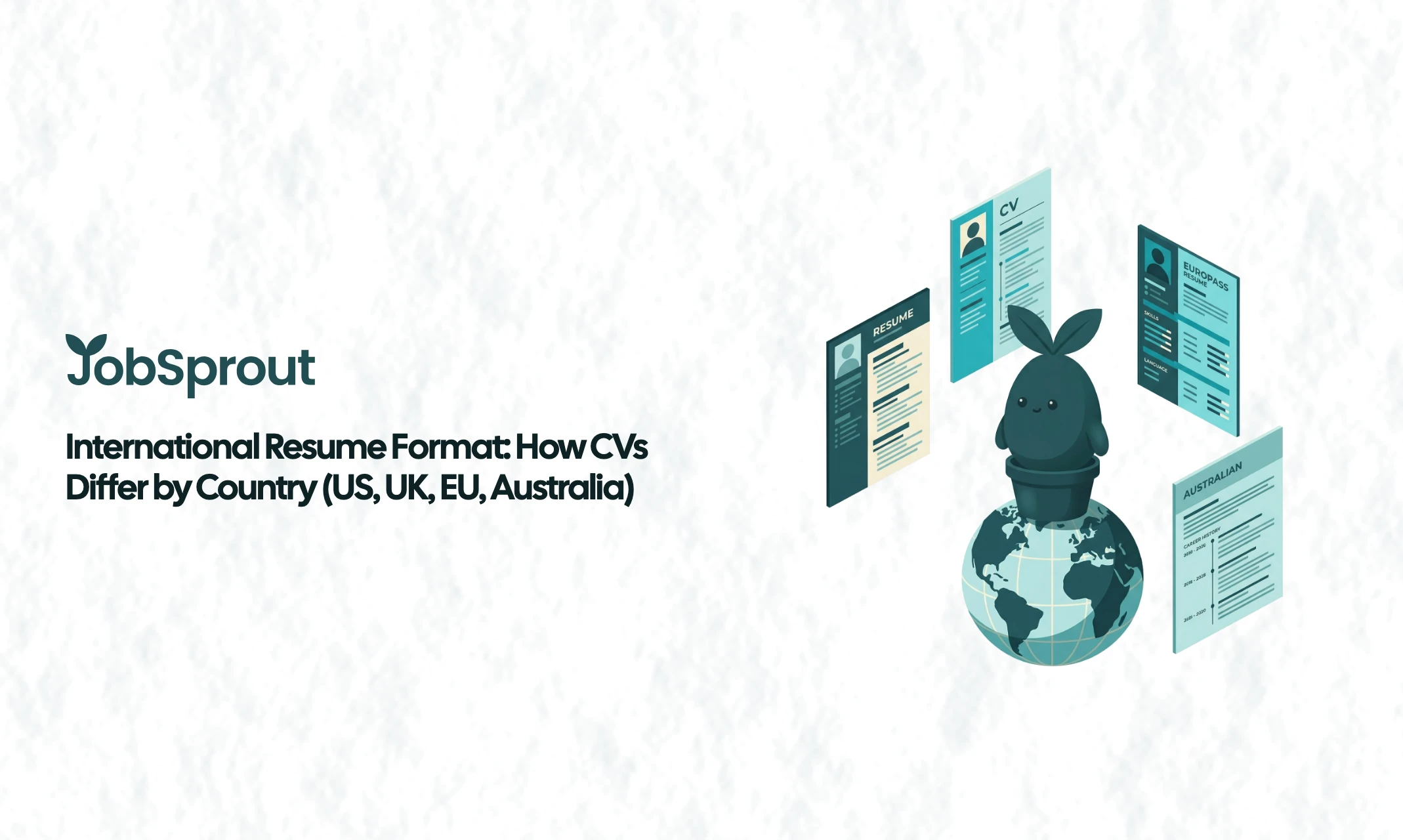
Learn how resume and CV formats differ across countries. Covers the US, UK, Germany, France, Australia, Japan, and the Middle East with comparison tables and practical tips.
Learn how to write a resume for an internal transfer. Includes a full example, summary templates for lateral moves, promotions and department changes, weak vs strong comparisons, and advice on navigating the politics.
Short answer: Open with the specific role and why this employer. Spend the middle turning study, volunteering or part-time work into evidence of the skills the advert asks for. Close by asking for the interview. Never apologise for the experience you do not have.
Research shows that 89% of hiring professionals expect cover letters, and the majority say they are important in their hiring decisions. For entry-level candidates, that sentiment is even stronger, because when every applicant has a thin CV, the cover letter becomes the primary way to stand out.
Yet most people with no experience either skip the cover letter entirely or write some version of: "I am writing to apply for the position advertised on your website. Although I have no relevant experience..."
That opening kills your application before the hiring manager reaches paragraph two.
Here's the good news: you almost certainly have more to offer than you think. The challenge isn't a lack of skills or accomplishments. It's learning how to frame what you already have in a way that speaks directly to an employer's needs. This guide will show you exactly how to do that, with a proven structure and five complete examples you can adapt today.
When two candidates have similar qualifications and neither has direct work experience, what separates them? The cover letter.
Your CV tells an employer what you've done. Your cover letter tells them why you're applying, how you think, and what kind of colleague you'd be. For experienced candidates, the CV does most of the heavy lifting. For entry-level applicants, the balance shifts dramatically towards the cover letter.
Here's why:
Your CV has gaps, and that's normal. Without professional experience, your CV is naturally shorter. A cover letter gives you space to fill in the context that a bare-bones CV can't provide. You can explain why you chose your degree, what drew you to this company, or how a university project prepared you for this role.
Employers expect less experience but more enthusiasm. When a company posts an entry-level role, they know they won't get candidates with five years of industry expertise. What they're screening for is someone who's genuinely motivated, quick to learn, and a good cultural fit. A cover letter is the best vehicle for demonstrating all three.
It proves you can communicate. Written communication is one of the top skills employers look for in junior hires. A well-structured, error-free cover letter is itself a work sample. It shows you can organise your thoughts, write clearly, and present yourself professionally.
It differentiates you from the pile. Many entry-level applicants don't bother with a cover letter at all, especially when it's listed as "optional." Simply writing one puts you ahead of everyone who didn't. Writing a good one puts you in a different league entirely.
If you want a broader overview of cover letter fundamentals, our complete guide to writing a cover letter covers everything from formatting to tone. This post focuses specifically on the no-experience scenario.
The most effective cover letters follow a simple, predictable structure. Hiring managers appreciate this because it makes your letter easy to scan. You appreciate it because it gives you a framework to fill in rather than staring at a blank page.
Open with the specific role you're applying for and a genuine reason you're excited about the company. This is not the place for generic flattery ("I have always admired your company"). Instead, reference something concrete: a product you use, a project they launched, a value on their careers page that resonates with you.
What this paragraph achieves: It tells the hiring manager you've done your homework and that this isn't a copy-paste application.
Example opening: "I'm applying for the Marketing Coordinator role at Innocent Drinks because your approach to brand voice, playful, honest, and occasionally absurd, is exactly the kind of creative environment where I do my best work."
This is the core of your cover letter. Without professional experience, you draw on everything else: academic projects, volunteering, extracurricular leadership, part-time jobs, and personal projects. The key is to connect each example directly to the job requirements.
Don't just list activities. Explain what you did, what the result was, and why it matters for this role.
What this paragraph achieves: It proves you have relevant capabilities even without the job title to match.
Example body: "During my final year at the University of Leeds, I led a four-person team that developed a social media campaign for a local charity, increasing their Instagram following by 40% over eight weeks. I handled content planning, copywriting, and performance tracking, skills that directly align with the day-to-day responsibilities listed in your job description."
Shift from what you've done to what you'll bring. This is where you demonstrate self-awareness and ambition. Acknowledge that you're early in your career, but frame it as an advantage: you're eager to learn, adaptable, and ready to grow within the organisation.
Avoid being vague. Instead of "I'm a fast learner," describe how you learn. Instead of "I'm passionate about this industry," explain what specifically excites you about it.
What this paragraph achieves: It helps the employer picture you in the role and shows you're thinking beyond day one.
Keep this short and confident. Thank them for their time, express your interest in discussing the role further, and mention your availability. Don't be apologetic or overly formal.
What this paragraph achieves: It closes the letter professionally and prompts the next step.
Example closing: "I'd welcome the chance to discuss how my background could contribute to your team. I'm available for an interview at your convenience and can be reached at [phone] or [email]. Thank you for considering my application."
Each example below follows the 4-paragraph structure. They're written for different situations, so find the one closest to yours and adapt it. For more examples across different industries, see our cover letter examples by industry guide.
Dear Hiring Manager,
I'm writing to apply for the Junior Account Executive position at Ogilvy UK. I first became interested in advertising during a second-year module on consumer behaviour, and Ogilvy's recent "Reverse Selfie" campaign for Dove confirmed that this is the kind of purposeful, insight-driven work I want to build my career around.
At the University of Manchester, I completed a dissertation analysing how Gen Z responds to cause-driven marketing, surveying 200 participants and presenting my findings to a panel of three lecturers. I also served as Vice President of the Marketing Society, where I organised six speaker events and grew our membership from 45 to 120 students in one academic year. Both experiences sharpened my research, presentation, and project management skills, all of which are central to the Account Executive role.
What excites me most about this position is the opportunity to learn from experienced strategists while contributing fresh perspective. I'm comfortable working to tight deadlines, I actively seek feedback to improve, and I bring genuine curiosity about what makes people pay attention. I'm confident that my academic grounding and my drive to keep learning would make me a strong addition to your team.
Thank you for taking the time to consider my application. I'd love the opportunity to discuss how I could contribute to Ogilvy's client work, and I'm available for an interview at your convenience.
Yours sincerely, Emma Richardson
Why it works: Emma doesn't apologise for lacking experience. She leads with a specific reason she admires Ogilvy, backs it up with quantified achievements from university, and frames her lack of industry experience as eagerness to learn rather than a weakness.
Dear Ms Hartley,
I'm a second-year Computer Science student at Imperial College London, and I'm applying for the Summer Software Engineering Internship at Monzo. I've been a Monzo customer since I was 17, and the transparency of your product development process, especially the public product roadmap and community forum, is what originally sparked my interest in fintech.
This year, I built a budgeting web app as a personal project using React and Node.js that helps students track their spending across multiple accounts. It has 80 active users among my coursemates, and I've iterated on it based on their feedback, fixing bugs and adding features like recurring transaction detection. I've also completed two group software projects using agile methodologies, where I was responsible for code reviews and writing unit tests. These experiences taught me how to write clean, maintainable code and collaborate effectively in a team.
I'm particularly drawn to this internship because Monzo's engineering blog describes a culture of ownership and learning that matches how I work best. I want to understand how production-grade financial software is built, tested, and deployed, and I'm ready to contribute meaningfully from week one.
I'd be grateful for the chance to discuss my application further. I'm available throughout June to September and can be reached at [email] or [phone].
Best regards, Aiden Okonkwo
Why it works: Aiden demonstrates genuine product knowledge (not just "I like your app"), shows technical skills through a real project with measurable usage, and connects his learning goals to Monzo's specific engineering culture.
Dear Hiring Manager,
I'm applying for the Trainee UX Researcher position at the BBC. After eight years as a secondary school English teacher, I've decided to transition into user research, a field that draws on the same core skills I've spent my career developing: asking the right questions, listening carefully, and synthesising complex information into actionable insights.
Teaching required me to assess how 150 different students were absorbing material and to adapt my approach based on continuous feedback. I designed and analysed student surveys each term, ran focus groups with parents, and presented findings to senior leadership to inform curriculum changes. Last year, I completed the Google UX Design Certificate on Coursera and applied my learning by conducting usability testing on my school's parent portal, identifying three navigation issues that the IT team subsequently fixed. These experiences gave me practical exposure to research planning, moderation, analysis, and stakeholder communication.
I'm drawn to the BBC because of your commitment to accessibility and inclusive design. I want to bring my understanding of diverse audiences, honed through years of working with students from varied backgrounds, to a team that's shaping how millions of people access information and entertainment. I'm prepared for the learning curve of a new industry and energised by it.
Thank you for considering my application. I would welcome the opportunity to discuss how my teaching background translates to user research, and I'm available for an interview at your convenience.
Yours sincerely, Rachel Osei
Why it works: Rachel doesn't hide her career change. She reframes teaching as research in disguise, provides specific evidence of UX-adjacent skills, and shows she's already invested in the transition through self-directed learning.
Dear Mr Jenkins,
I'm writing to apply for the Customer Service Apprenticeship at John Lewis. I'm finishing my A-levels this summer, and I've chosen to go straight into work rather than university because I learn best through hands-on experience, and I want to start building a career in retail management.
Over the past two years, I've volunteered every Saturday at my local Oxfam shop, where I serve customers, process donations, and manage the window display rotation. The shop manager trusted me to train two new volunteers and to handle the till independently during busy periods. I also run a small online resale business on Vinted, where I've completed over 200 transactions, maintained a 4.9-star rating, and learnt how to write product descriptions that actually sell. These experiences taught me how to communicate with different types of people, stay organised under pressure, and take pride in presentation.
What draws me to John Lewis is your reputation for staff development and your partnership model. I want to work somewhere that invests in its people, and I'm committed to earning that investment through hard work, reliability, and a willingness to take on whatever's needed. I'm a quick learner who responds well to feedback, and I'm genuinely excited about building a long-term career here.
Thank you for reading my application. I'm available for an interview at any time and would be happy to provide references from my Oxfam supervisor.
Yours sincerely, Jake Thompson
Why it works: Jake doesn't treat the lack of a degree as something to explain away. He positions going straight into work as a deliberate, motivated choice. His Oxfam and Vinted examples are specific and quantified, and he connects his goals directly to what John Lewis offers.
Dear Hiring Manager,
I'm applying for the Administrative Assistant position at Great Ormond Street Hospital. After five years away from the workforce to care for my children, I'm ready and motivated to return to a professional environment, and I'd particularly like to contribute to an organisation whose mission I deeply believe in.
Before my career break, I worked part-time in retail and completed an NVQ Level 2 in Business Administration. During my time away, I've kept my skills current by managing the finances and communications for my children's school PTA, where I coordinated a fundraising calendar, drafted newsletters for 400 families, and maintained a spreadsheet tracking over 8,000 pounds in annual donations. I also completed a free online course in Microsoft 365 through the National Careers Service to ensure my IT skills are up to date. I'm organised, comfortable with data, and experienced at communicating clearly with people from all walks of life.
I'm drawn to this role because it combines structured administrative work with a human element. Supporting the smooth running of a hospital that helps seriously ill children is meaningful work, and I'd bring the same care and diligence to filing, scheduling, and correspondence as I would to any task with real impact.
Thank you for considering my application. I'm available to start immediately and would welcome the chance to discuss my suitability in more detail.
Yours sincerely, Priya Sharma
Why it works: Priya addresses the career gap directly and without apology, then immediately demonstrates that she hasn't been idle. The PTA responsibilities map neatly onto administrative work, and the online course shows initiative. Her motivation for the specific employer feels authentic.
The examples above draw on a range of non-professional experiences. Here's a comprehensive breakdown of where to find transferable skills and how to frame them for employers.
| Source | What You Did | How to Frame It |
|---|---|---|
| Academic projects | Group coursework, dissertations, lab work, presentations | Research, analysis, teamwork, meeting deadlines, presenting findings |
| Volunteering | Charity shops, community events, tutoring, mentoring | Customer service, reliability, initiative, working with diverse groups |
| Extracurricular activities | Society committees, sports teams, student newspaper, debate club | Leadership, event planning, collaboration, communication |
| Personal projects | Blogs, YouTube channels, coding projects, art portfolios, resale businesses | Self-motivation, creativity, technical skills, audience awareness |
| Part-time or casual work | Babysitting, dog walking, tutoring, market stalls, seasonal retail | Time management, responsibility, handling money, client relationships |
| Caring responsibilities | Looking after family members, managing household logistics | Organisation, patience, multitasking, budgeting, communication |
| Online courses and certifications | Coursera, FutureLearn, Google certificates, HubSpot Academy | Commitment to learning, specific technical or professional knowledge |
| School achievements | Prefect roles, Duke of Edinburgh, NCS, subject prizes | Responsibility, perseverance, goal-setting |
The trick is to never just state the activity. Always connect it to a skill the employer needs.
Weak: "I volunteered at a food bank."
Strong: "I volunteered weekly at a food bank for six months, where I managed stock rotation for 200+ items and coordinated with a team of eight volunteers to serve 50 families per session. This taught me how to stay organised under pressure and communicate clearly in a fast-paced environment."
If you're also working on your CV, our guide on writing a resume with no experience covers the same reframing approach for your CV content.
Your opening line sets the tone for the entire letter. Hiring managers often decide within the first sentence whether they'll read the rest. Here are common mistakes and stronger alternatives.
Weak: "Although I don't have any professional experience, I believe I could be a good fit for this role."
Strong: "I'm applying for the Editorial Assistant role at Penguin Random House because my English degree and my year as editor of the university literary magazine have prepared me to contribute to your editorial team from day one."
Why the weak version fails: You've told the employer to lower their expectations before they've read a single thing about you.
Weak: "I am writing to apply for the position advertised on your website. I am a recent graduate and I am very interested in this opportunity."
Strong: "Your listing for a Graduate Data Analyst caught my attention because it combines two things I'm genuinely passionate about: statistical modelling and sustainability. My dissertation on predicting urban air quality using public sensor data is directly relevant to the environmental datasets your team works with."
Why the weak version fails: It could apply to any job at any company. It tells the employer nothing about you or why you want this role specifically.
Weak: "I am the perfect candidate for this role and I know I would excel in your organisation."
Strong: "I'm excited to apply for the Junior Designer position at Pentagram. Your recent rebrand for the Natural History Museum showed a level of craft and restraint that I aspire to in my own work, and I'd love the chance to develop those skills alongside your team."
Why the weak version fails: Confidence is good, but unsubstantiated claims feel hollow. Showing specific knowledge of their work is far more convincing than declaring yourself perfect.
Weak: "Ever since I was a child, I have been fascinated by science. My parents always encouraged my curiosity and I spent many hours conducting experiments in my bedroom."
Strong: "I'm applying for the Laboratory Technician trainee position at AstraZeneca. My Biomedical Science degree gave me 200 hours of laboratory experience, including work with HPLC and spectrophotometry, and I'm eager to apply those skills in a pharmaceutical setting."
Why the weak version fails: Childhood anecdotes don't belong in a cover letter. Hiring managers want to know what you can do now, not what you enjoyed as a child.
Weak: "Dear Sir/Madam, I wish to express my interest in the vacancy at your esteemed organisation."
Strong: "Dear Ms Chen, I'm writing to apply for the Communications Officer role at Cancer Research UK. Your recent "Right Now" campaign was a masterclass in emotional storytelling, and it reinforced my ambition to use communications skills for causes that matter."
Why the weak version fails: "Esteemed organisation" signals that you haven't bothered to learn the company's name. Using the hiring manager's name (if available) and referencing specific work shows genuine interest.
Weak: "I am a highly motivated, detail-oriented self-starter with excellent communication skills and a passion for teamwork."
Strong: "As Treasurer of the University of Edinburgh's Debate Society, I managed a 12,000 pound annual budget, negotiated venue discounts that saved us 30%, and coordinated logistics for a national tournament hosting 40 teams. I'd like to bring that same organisational rigour to the Events Coordinator role at Eventbrite."
Why the weak version fails: Every single adjective in the weak version appears on thousands of cover letters. Specific achievements with numbers are infinitely more persuasive than strings of adjectives.
"I have no experience but I am willing to learn" turns up in entry-level applications constantly, and it is the weakest line in them, because every applicant writes it and none of them prove it. The fix is to replace the claim with the evidence behind it.
| Instead of | Write |
|---|---|
| I am a fast learner | I picked up the till system in two shifts and trained the next starter on it |
| I am willing to learn | I taught myself Excel pivot tables to finish my dissertation analysis, then used them for the society's budget |
| I am eager to develop | I completed the Google Data Analytics certificate in the eight weeks before applying |
| I am hard-working and motivated | I held a 16-hour weekend job through all three years of my degree and kept a 2:1 |
Each of those is the same sentiment carrying a fact, and the fact is what the reader remembers.
An application letter and a cover letter are the same document. The term is standard in the UK, Ireland, Nigeria, India, the Philippines and much of the Commonwealth, and it appears on plenty of adverts that then ask for a "cover letter" in the upload field. Nothing about the structure changes: the four paragraphs above work in either case. Use whichever word the advert uses, in the greeting line and in the file name.
For a first application with no employment history, the shape of the CV that goes with it matters as much as the letter. An apprentice CV, a management trainee CV and an entry-level engineering CV all lead with education and projects rather than an empty work-experience section.
Before you send your cover letter, run through this checklist:
Length. Aim for 250 to 400 words, roughly three-quarters of one page. Hiring managers are busy, and brevity shows you can communicate efficiently. For more guidance on length, see our short cover letter examples.
Tailoring. Every cover letter should be written for a specific job. If you can swap in a different company name without changing anything else, it's too generic. Tools like JobSprout can help you tailor cover letters quickly by matching your background to specific job descriptions.
Formatting. Use a clean, professional layout. Standard font (11 or 12pt), normal margins, and a clear structure with line breaks between paragraphs. Don't use colours, graphics, or unusual fonts unless you're applying for a design role.
Proofreading. A single spelling or grammar mistake can end your chances for an entry-level role, because it suggests you didn't care enough to check. Read your letter aloud, use a spell checker, and have someone else review it before submitting.
File format. Unless the application specifies otherwise, send your cover letter as a PDF. This preserves your formatting across different devices and operating systems.
Tone. Aim for professional but not stiff. Write the way you'd speak in a formal interview: clear, respectful, and genuine. Avoid slang, but also avoid the kind of overly formal language that sounds like it was written in the 1990s.
Writing a cover letter with no experience is not about pretending you have something you don't. It's about presenting what you do have in a way that's relevant, specific, and compelling.
Follow the 4-paragraph structure. Lead with genuine enthusiasm for the company. Back it up with transferable skills from whatever background you have, whether that's university, volunteering, personal projects, or life experience. Show the employer what you'll bring to their team. And close with confidence.
Every working professional started exactly where you are now: with no experience and a blank page. The ones who got hired were the ones who made the effort to fill that page with something worth reading.
Your cover letter is your chance to do exactly that. And if you'd like help getting started, JobSprout can generate a tailored first draft based on your background and the job you're targeting, giving you a strong foundation to refine and make your own. For the resume that goes with it, the resume builder for students is built for exactly this position: no work history yet, plenty to show.
Good luck with your application.