PDF or DOCX · up to 2MB
Complete guide to writing a medical assistant resume that gets interviews. Includes full resume example, clinical and admin skill lists, certification table, and ATS keywords for 2026.

Learn how to write a federal resume for USAJOBS in 2026. Covers current formatting best practices, required sections, GS-level guidance, KSAs, and a full example you can adapt.

Learn how to write a UX designer resume that balances process, metrics, and portfolio. Includes full example, summary templates, skills table, and specialisation tips.

When to follow up on a job application, who to send it to, and six short email templates to copy. Timing backed by a survey of 300+ HR managers.
Short answer: Lead with your certification (CMA, RMA, CCMA), then a summary naming your specialty and patient volume, then clinical and administrative skills as two groups, then experience written as numbers. Put the exact EHR you have used in the skills list, because that is the string the screening software matches.
The U.S. Bureau of Labor Statistics projects medical assistant employment to grow 13% from 2025 to 2035, with about 109,700 openings each year over the decade, and reports a median annual wage of $45,690 as of May 2025. That growth rate is much faster than the average for all occupations, driven by an ageing population, expanded insurance coverage, and the increasing role of outpatient care facilities.
But faster growth does not mean easier hiring. More training programmes are producing more graduates each year, and clinics receive dozens (sometimes hundreds) of applications for a single opening. Your resume is the first filter. If it does not clearly demonstrate your clinical competencies, certifications, and ability to keep a busy practice running smoothly, it will not make it past the initial screening.
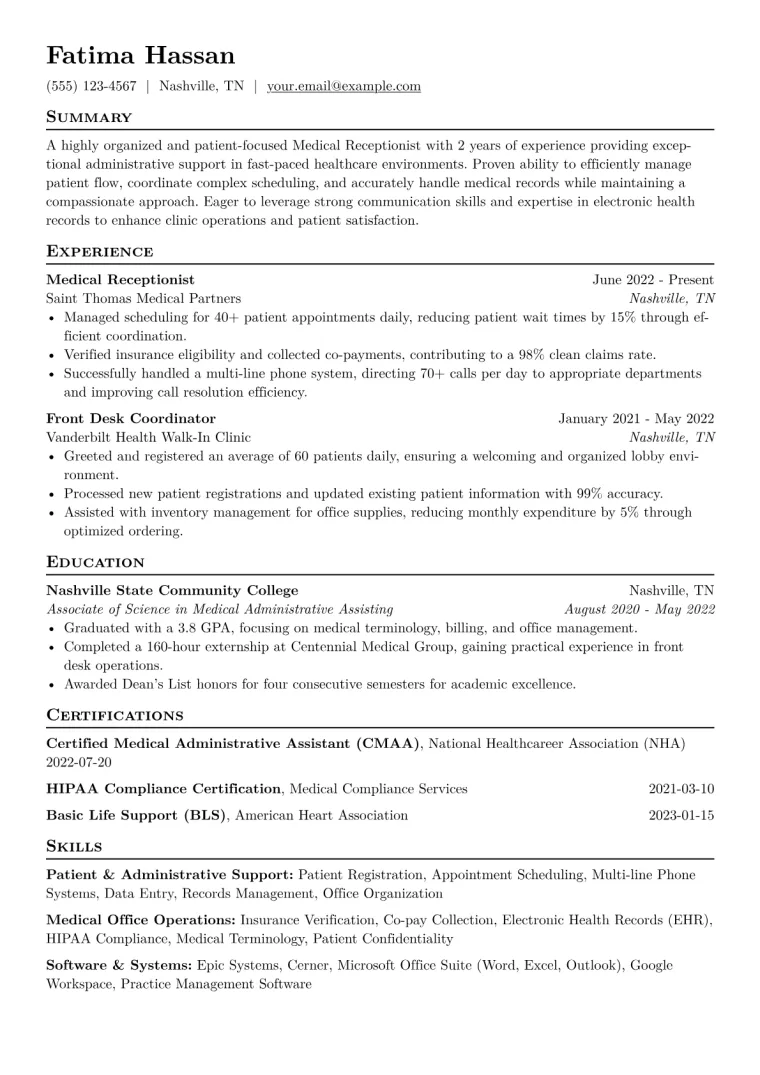
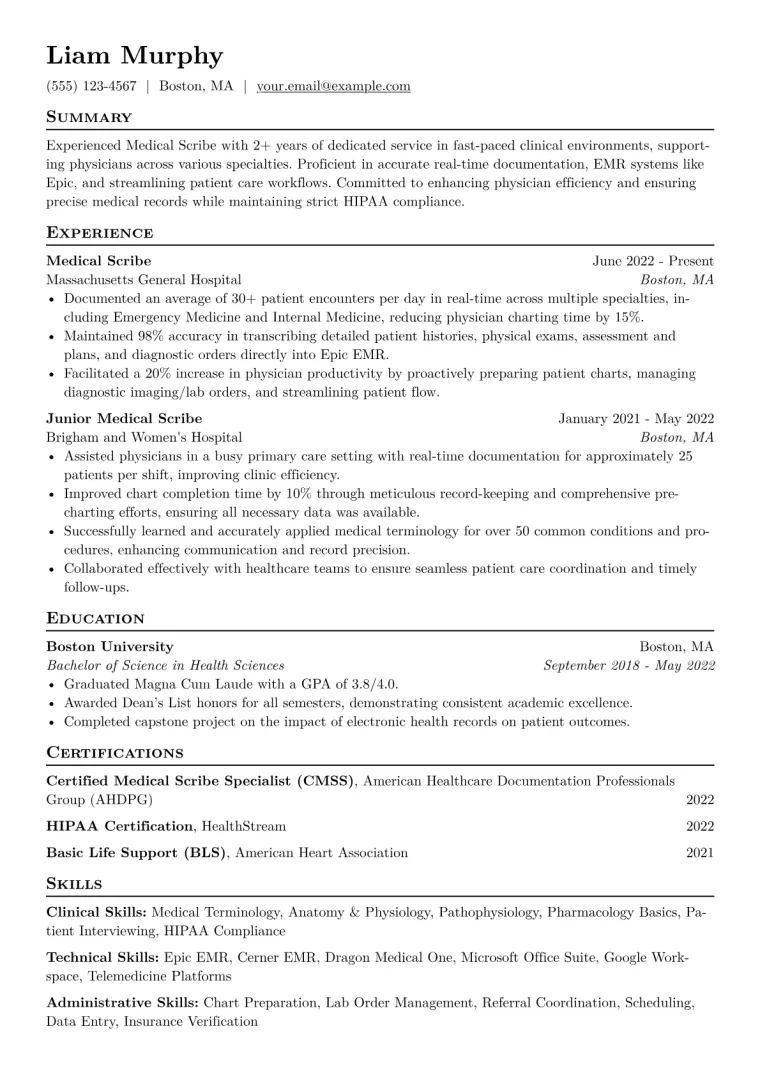
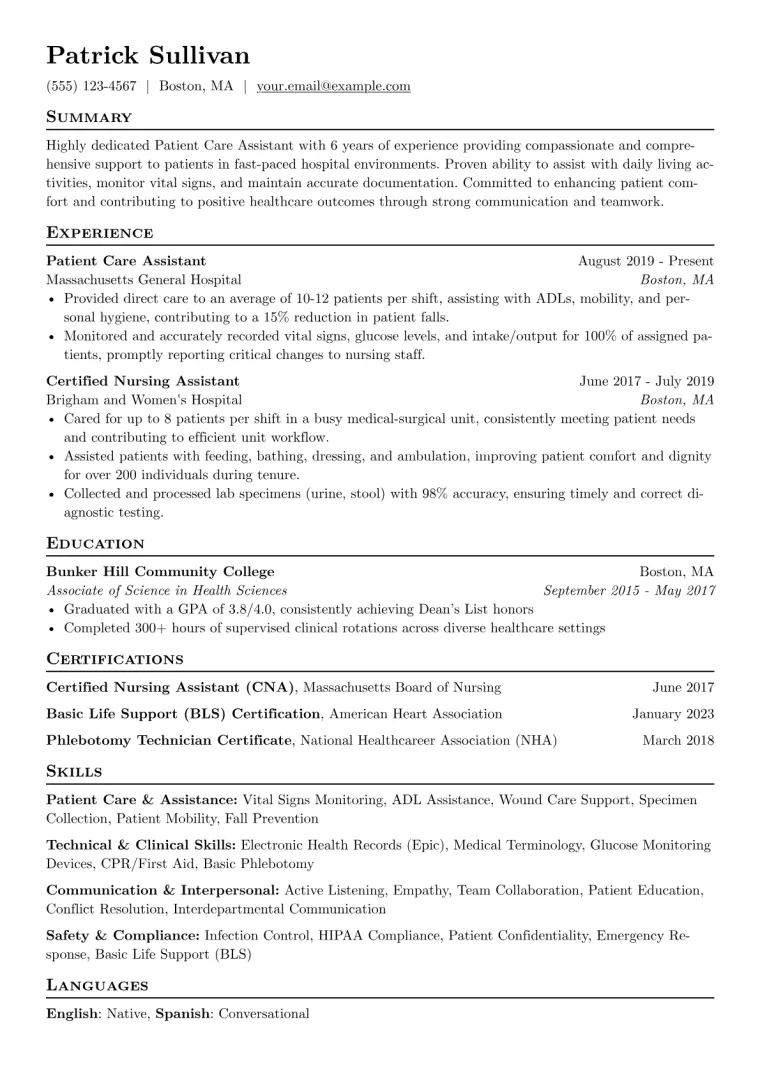
This guide covers everything you need to build a medical assistant resume that gets interviews in 2026, whether you are freshly certified or have years of experience in a specialised practice. If you want to see the finished shape first, read a medical receptionist CV, a medical scribe CV or a patient care assistant CV, all adjacent roles that hire from the same pool.
Medical assistant hiring is unique because the role sits at the intersection of clinical care and administrative operations. Practice managers and physicians reviewing resumes are looking for evidence that you can handle both sides.
Based on job posting analysis and healthcare recruiter feedback, here is what matters most:
Before anything else, hiring managers check for active certifications. A Certified Medical Assistant (CMA) or Registered Medical Assistant (RMA) credential signals that you have met a validated standard of competency. Many clinics will not consider uncertified candidates at all.
Generic descriptions like "performed clinical duties" tell a hiring manager nothing. They want to see the specific procedures you are trained in: phlebotomy, EKG administration, injection techniques, wound care, and specimen collection. The more specific, the better.
Medical assistants interact with electronic health records constantly. Listing the specific systems you have used (Epic, Cerner, Athenahealth, eClinicalWorks, NextGen) immediately establishes your technical readiness and reduces onboarding time.
Numbers make your experience tangible. How many patients did you process daily? What was your accuracy rate for coding or data entry? Did you help reduce patient wait times? These metrics separate strong resumes from average ones.
Healthcare is a regulated environment. Experience with HIPAA compliance, OSHA protocols, infection control procedures, and quality assurance demonstrates that you understand the non-negotiable aspects of clinical work.
For more on what makes healthcare resumes effective, see our guide to CVs for healthcare applications.
Here is a real medical assistant resume that shows what works for entry-level clinical roles.
Carlos's resume works because it immediately shows clinical volume. At Vanderbilt Health Clinic, he managed "30-40 patients daily" and "assisted with over 15 minor surgical procedures weekly." For medical assistant hiring, patient volume and procedural experience are the first things clinic managers check.
The skills section is split into Clinical Skills (vital signs, phlebotomy, ECG/EKG, injections, wound care), Administrative Skills (EMR systems like Epic and Cerner, medical coding with CPT/ICD-10, insurance verification), and Patient Care. This dual clinical/administrative coverage proves he can handle both sides of the MA role.
His CMA certification from AAMA is prominently featured, which is a requirement for most positions. Combined with his Associate's degree and 3.8 GPA, this gives clinics confidence in his training foundation.
His Vanderbilt role demonstrates both clinical and operational skills:
VANDERBILT HEALTH CLINIC (Medical Assistant, 2022 - Present)
- Managed patient intake for an average of 30-40 patients daily,
  accurately recording vital signs, medical history, and chief
  complaints
- Assisted physicians with over 15 minor surgical procedures
  weekly, ensuring sterile fields and proper instrument handling
- Streamlined appointment scheduling and managed patient calls,
  reducing no-show rates by 10%
Every bullet combines a clinical task with a volume metric.
Three categories: Clinical (vital signs, phlebotomy, ECG/EKG, medication administration, injections, wound care), Administrative (Epic, Cerner, patient scheduling, insurance verification, medical coding), and Patient Care. Listing specific EMR systems is essential for ATS filtering.
If you want to use this as your starting point, hit "Remix with AI" on the template above.
Your summary is the first thing a hiring manager reads after your name and credentials. It should be three to four sentences that answer: Who are you? What can you do? What have you accomplished?
Avoid vague language. Use specific numbers and name the tools, procedures, and settings you have worked in. For more guidance on writing effective summaries, see our resume summary examples guide.
Here are three summary examples for different experience levels:
Entry-Level Medical Assistant
Recently certified Medical Assistant (CMA) with hands-on clinical rotation experience at a high-volume urgent care centre. Trained in phlebotomy, EKG administration, vital signs monitoring, and patient intake. Completed 160-hour externship processing 25+ patients daily. Eager to contribute clinical skills and bilingual communication abilities to a patient-focused practice.
Experienced Medical Assistant
Certified Medical Assistant with 5 years of experience in multi-provider family medicine and internal medicine settings. Skilled in phlebotomy (3,500+ successful draws), EKG administration, and chronic disease management support for diabetic and hypertensive patient populations. Reduced referral processing time by 35% through implementation of a digital tracking system. Proficient in Epic and Athenahealth EHR platforms.
Certified and Specialised Medical Assistant
CMA (AAMA) and Certified Phlebotomy Technician with 7 years of progressive experience in paediatric and family medicine. Manage clinical workflows for a 6-provider practice seeing 80+ patients daily. Led implementation of a patient portal onboarding programme that increased portal adoption from 42% to 78% within six months. Trained and supervised a team of 4 medical assistants across two clinic locations.
Medical assistants perform a uniquely broad range of tasks. Splitting your skills into clinical and administrative categories makes it immediately clear that you can handle both sides of the role. Here is a comprehensive breakdown:
| Clinical Skills | Administrative Skills |
|---|---|
| Phlebotomy and venipuncture | Appointment scheduling and confirmation |
| EKG/ECG administration | Insurance verification and pre-authorisation |
| Vital signs (BP, temp, pulse, O2 sat) | Medical coding (ICD-10, CPT) |
| Injection administration (IM, SQ, ID) | Patient intake and registration |
| Wound care and dressing changes | Referral coordination |
| Suture and staple removal | Medical records management |
| Specimen collection and processing | Billing and claims submission |
| Point-of-care testing (glucose, strep, UA) | Inventory and supply ordering |
| Autoclave and sterilisation | HIPAA compliance documentation |
| Medication administration | EHR data entry and chart preparation |
| Patient education and discharge instructions | Telephone triage and message routing |
| Spirometry and pulmonary function testing | Prior authorisation follow-up |
When listing skills on your resume, prioritise based on the job posting. If the posting emphasises clinical duties, lead with your clinical skills. If it is for a front-office heavy role, lead with administrative capabilities.
For more on how to present skills effectively, check out our resume skills guide.
The experience section is where most medical assistant resumes fall flat. Listing duties is not enough. You need to show impact through metrics and specificity.
Here are 12 strong experience bullet examples with the metrics and details that hiring managers want to see:
Weak: Took patient vitals and updated charts. Strong: Recorded vital signs and updated Epic EHR documentation for 40-50 patients daily across family medicine and walk-in urgent care visits.
Weak: Drew blood for lab tests. Strong: Performed 2,400+ phlebotomy draws over 18 months with a 99.2% specimen labelling accuracy rate and a 97% first-stick success rate.
Weak: Helped reduce wait times. Strong: Reduced average patient wait time from 22 minutes to 18 minutes by restructuring the triage workflow and pre-loading intake forms into the EHR system.
Weak: Gave injections to patients. Strong: Administered 15-20 daily vaccinations and therapeutic injections (IM, SQ), maintaining 100% cold chain compliance and zero adverse event reports over 12 months.
Weak: Handled insurance paperwork. Strong: Processed 30+ specialist referrals and prior authorisations weekly, achieving a 96% first-submission approval rate that reduced patient follow-up calls by 40%.
Weak: Trained new employees. Strong: Trained and mentored 3 new medical assistants on clinical protocols, EHR documentation standards, and patient communication, reducing their onboarding period from 6 weeks to 4 weeks.
Weak: Managed medical supplies. Strong: Maintained inventory for a 4-physician practice, implementing a par-level reorder system that reduced supply shortages by 60% and saved an estimated £2,100 annually in emergency ordering costs.
Weak: Assisted with procedures. Strong: Assisted physicians with 500+ minor procedures including laceration repair, cyst excision, and joint injections, maintaining sterile field and documenting procedure notes in real time.
Weak: Handled patient check-in. Strong: Managed front-desk check-in and insurance verification for 45+ patients daily, reducing registration errors by 28% after implementing a dual-verification protocol.
Weak: Did lab work. Strong: Processed 800+ lab specimens over 16 months with zero contamination incidents, following strict chain-of-custody protocols for send-out testing.
Weak: Worked with electronic records. Strong: Documented patient histories, chief complaints, and medication reconciliations in Epic EHR, reducing physician documentation burden by approximately 10 minutes per encounter.
Weak: Handled patient calls. Strong: Managed 60-80 daily patient phone calls including appointment scheduling, prescription refill requests, and test result notifications, maintaining a 95% same-day response rate.
Notice the pattern: every strong bullet includes a number, a specific system or procedure, and a measurable outcome. Use strong action verbs to start each bullet and keep the language active and direct.
Certifications are essential for medical assistants. Many employers require at least one nationally recognised credential, and having multiple certifications significantly strengthens your candidacy. Place this section near the top of your resume, immediately after your summary.
| Certification | Abbreviation | Issuing Body | Typically Required? | Notes |
|---|---|---|---|---|
| Certified Medical Assistant | CMA | American Association of Medical Assistants (AAMA) | Yes, widely preferred | Most recognised credential; requires graduation from CAAHEP or ABHES accredited programme |
| Registered Medical Assistant | RMA | American Medical Technologists (AMT) | Yes, accepted alternative | Accepted at most practices; exam-based certification |
| National Certified Medical Assistant | NCMA | National Center for Competency Testing (NCCT) | Sometimes | Accepted at many clinics; less common than CMA or RMA |
| Clinical Certified Medical Assistant | CCMA | National Healthcareer Association (NHA) | Sometimes | Popular with career changers; clinical focus |
| CPR/BLS for Healthcare Providers | CPR/BLS | American Heart Association or Red Cross | Yes, universally required | Must be current; typically renewed every 2 years |
| Certified Phlebotomy Technician | CPT | NHA, ASCP, or AMT | No, but highly valued | Strengthens candidacy significantly for clinical roles |
| Certified EHR Specialist | CEHRS | NHA | No, but increasingly valued | Demonstrates EHR proficiency beyond basic use |
Formatting tips for certifications:
Medical assisting is not a one-size-fits-all role. The specific skills and experience you highlight should vary based on the type of practice you are applying to.
Clinical medical assistants spend most of their time in the exam room and lab. If you are targeting a clinical-heavy role, your resume should emphasise:
Example summary for clinical medical assistant:
CMA (AAMA) with 4 years of clinical experience in a high-volume internal medicine practice. Performed 4,000+ phlebotomy draws with a 98.5% first-stick success rate. Skilled in EKG administration, wound care, injection techniques, and point-of-care testing. Maintained zero infection control violations across 3 consecutive annual audits.
Administrative medical assistants focus on the operational side of healthcare. Your resume should highlight:
Example summary for administrative medical assistant:
Experienced Medical Assistant specialising in front-office operations for a multi-provider orthopaedic practice. Managed scheduling, insurance verification, and referral coordination for 60+ patients daily across 3 providers. Achieved 98% clean claims rate through meticulous coding review. Proficient in Athenahealth and eClinicalWorks EHR systems.
Different specialties require different skill sets. Here is what to emphasise for three of the most common specialisations:
Dermatology Medical Assistant
Example bullet: Assisted with 300+ dermatologic procedures monthly including biopsies, cryotherapy, and Mohs surgery prep, maintaining 100% specimen labelling accuracy and reducing pathology report turnaround by coordinating same-day specimen transport.
Paediatric Medical Assistant
Example bullet: Administered vaccinations following CDC immunisation schedules for 200+ paediatric patients monthly (ages 0-18), maintaining a calm and child-friendly environment that contributed to a 4.8/5.0 patient family satisfaction score.
Cardiology Medical Assistant
Example bullet: Administered 25+ EKGs daily in a busy cardiology practice, prepared rhythm strips for physician review, and managed Holter monitor application and retrieval for 40+ patients weekly with zero data loss incidents.
If you are writing your first medical assistant resume with little or no paid experience, here is how to build a competitive application:
Your CMA, RMA, or CCMA credential is your strongest asset as a new graduate. Place it prominently in your header and summary. Your clinical externship counts as legitimate experience, so detail it thoroughly.
Weak: Completed externship at local clinic. Strong: Completed 200-hour clinical externship at Willow Creek Family Medicine, performing patient intake, vital signs, phlebotomy, and EKG administration for 30+ patients daily under physician supervision.
Even without paid work experience, you have numbers to share:
If your experience section is thin, adding a "Relevant Coursework" subsection under education helps fill gaps:
If you worked in customer service, retail, or food service before entering healthcare, those roles developed skills that transfer directly:
Format your externship exactly like a job entry, with the facility name, dates, and bulleted accomplishments. Do not bury it under "Education." Treat it as professional experience.
These are the errors that most frequently lead to medical assistant resumes being rejected:
Your CMA, RMA, or equivalent should appear in your header (after your name) and in a dedicated certifications section near the top of the page. Burying it at the bottom of page two means some reviewers will never see it.
"Clinical skills: phlebotomy, vitals, injections" tells a hiring manager you know the vocabulary. It does not tell them you can actually perform these tasks competently. Always support skill claims with specific experience bullets that include volumes and outcomes.
"Proficient in electronic health records" is too vague. Name the specific systems: Epic, Cerner, Athenahealth, eClinicalWorks, NextGen, Practice Fusion. Hiring managers care because EHR training is expensive, and a candidate who already knows their system is immediately more valuable.
Many clinical medical assistants focus exclusively on their clinical skills and neglect to mention administrative capabilities. Even if you are targeting a clinical role, most positions involve some administrative tasks. Showing you can handle both makes you a more versatile candidate.
"Assisted with patient care" could describe anyone in any healthcare role. "Managed patient intake and vital signs for 45 patients daily in a 4-provider family medicine practice" is specific, credible, and tells a hiring manager exactly what you can handle.
Listing an expired CPR/BLS certification or a CMA that has lapsed raises immediate red flags. If a certification has expired, either renew it before applying or omit it entirely. Never list expired credentials without noting your plan for renewal.
A resume targeting a paediatric dermatology clinic should look different from one targeting a high-volume urgent care centre. Tailor your summary, skills order, and experience bullet emphasis to match the specific role. Using a tool like JobSprout can help you quickly tailor your resume to different job descriptions without starting from scratch each time.
Most healthcare organisations use applicant tracking systems to filter resumes before a human ever sees them. If your resume does not include the right keywords, it may be screened out automatically regardless of your qualifications.
For a thorough walkthrough of how ATS systems work and how to optimise for them, read our ATS-friendly resume guide.
Here are the most common keywords found in medical assistant job postings in 2026, organised by category:
How to use these keywords effectively:
Do not simply copy and paste a keyword list into your resume. ATS systems are increasingly sophisticated, and keyword stuffing can actually hurt your score. Instead:
Building a strong medical assistant resume comes down to specificity. Generic descriptions do not survive ATS screening or human review. Every line on your resume should include a concrete detail: a number, a system name, a procedure, or a measurable outcome.
Here is a quick checklist before you submit:
If you are looking for a faster way to build and customise your medical assistant resume, JobSprout offers healthcare-friendly templates that you can tailor to specific job postings with AI assistance.
The medical assistant field is growing, and that growth creates real opportunity for candidates who present themselves well on paper. Take the time to get your resume right, and the interviews will follow.