Aerospace Stress Engineer Resume Example
 Example by JobSprout
Free to use. No download fee.
Market Insights
Aerospace Stress Engineer
Salary Range
Salary Trend
Sep 2025 – Aug 2026
12-Month Trend
Based on advertised Engineering roles.
US market data · Source: Adzuna · Updated Sep 2026
How useful was this template?
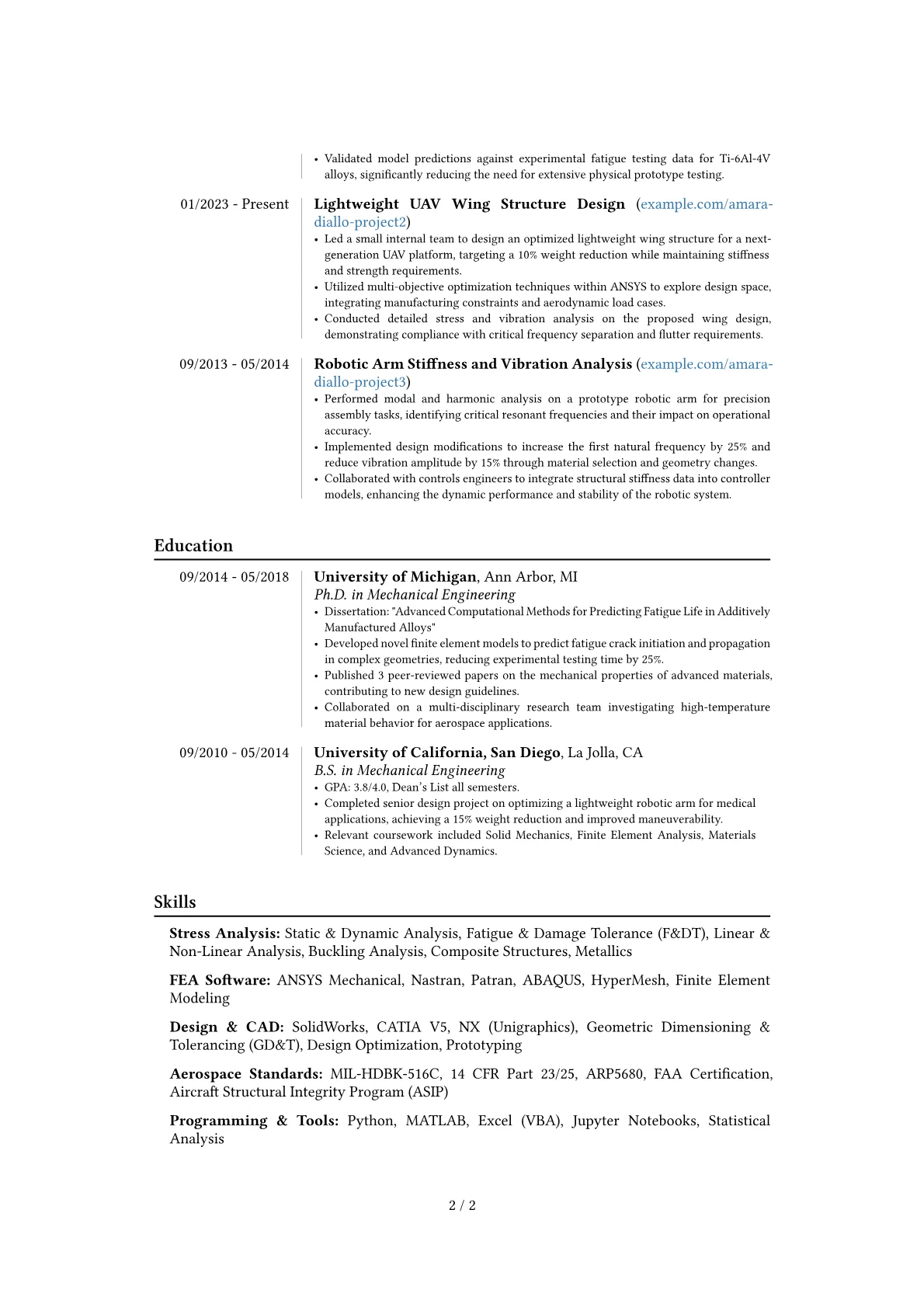
Aerospace Stress Engineer resume samples
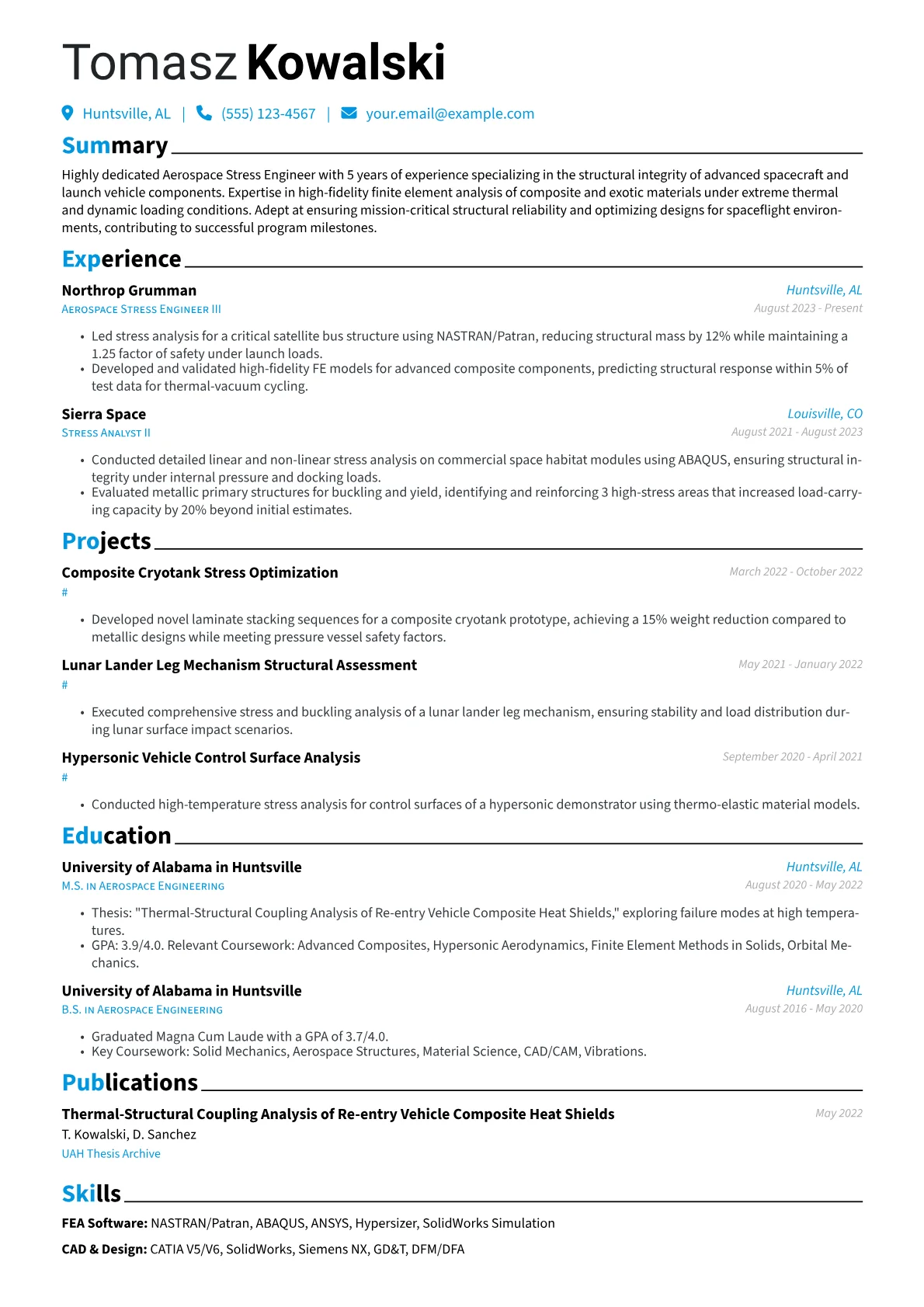
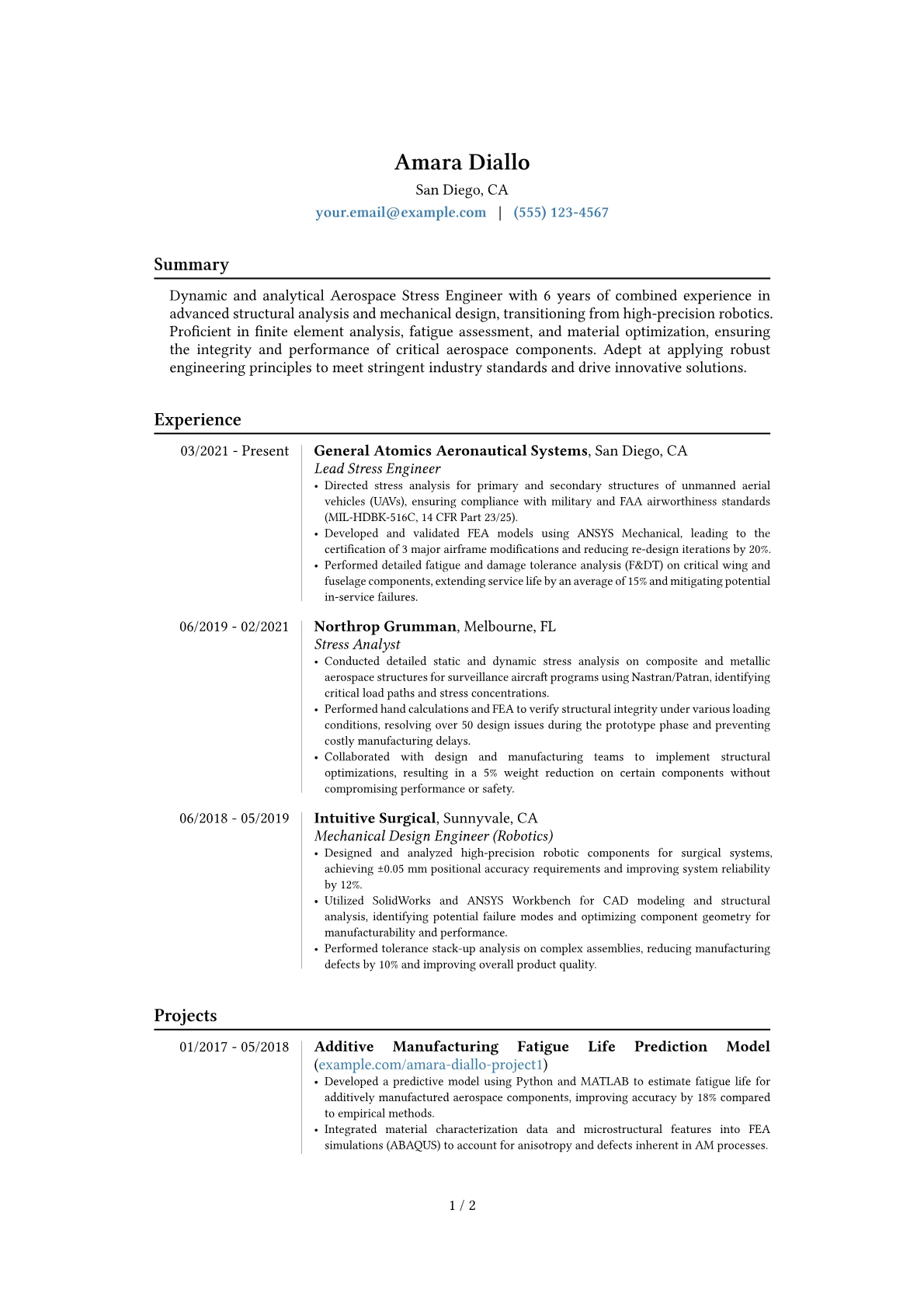
Three complete resumes, each in a different design.
Free to use. No download fee.
What makes a strong Aerospace Stress Engineer resume?
US median salary $137,143 ·
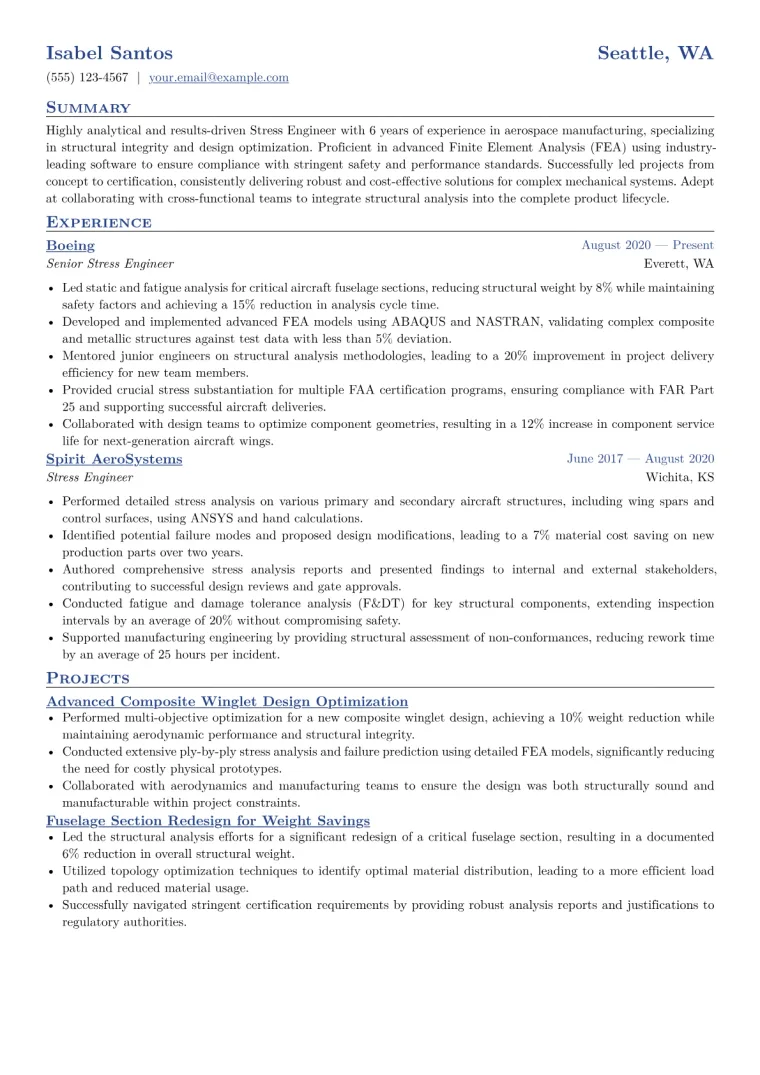
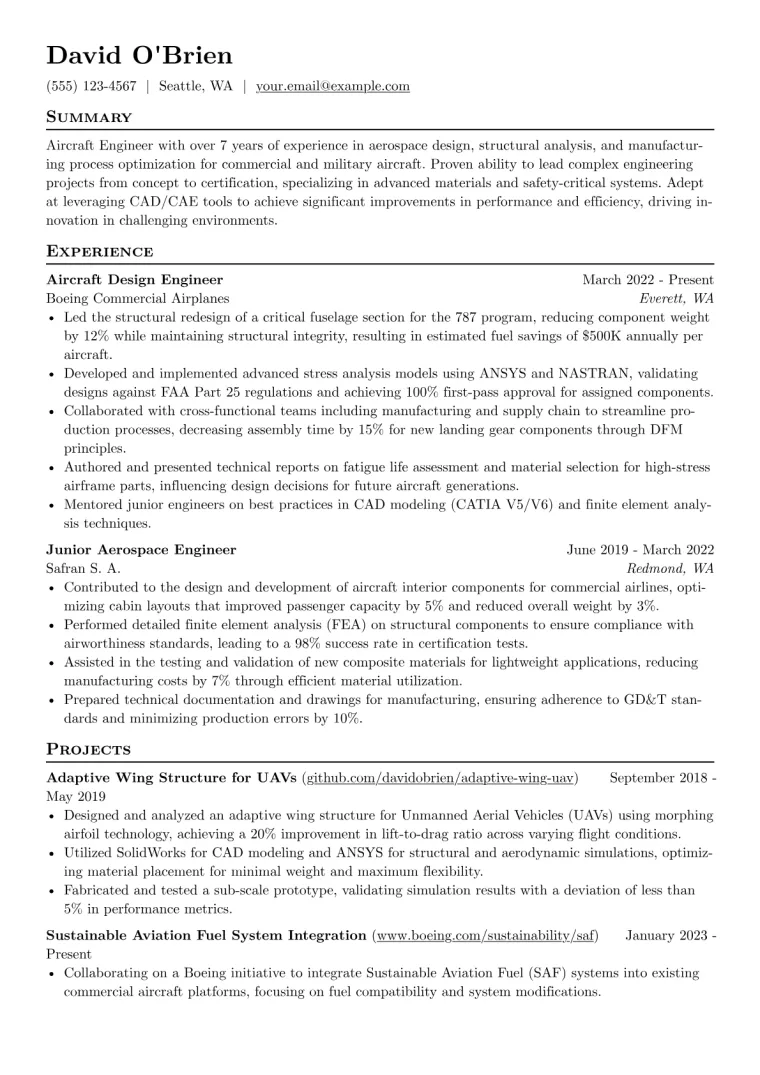
A compelling Aerospace Stress Engineer resume in the manufacturing sector emphasizes technical proficiency, adherence to rigorous standards, and quantifiable impact. Hiring managers prioritize candidates who can showcase deep knowledge of FEA software like Nastran and Patran, alongside programming skills in Python for automation. Crucially, achievements should reflect contributions to structural safety, weight reduction, and cost efficiency, often involving complex analysis techniques such as Fatigue & Damage Tolerance (F&DT) and compliance with industry standards like FAR Part 25 and AS9100. The ability to lead projects, mentor junior engineers, and present findings to certification bodies like the FAA is also highly valued.
Why this example works
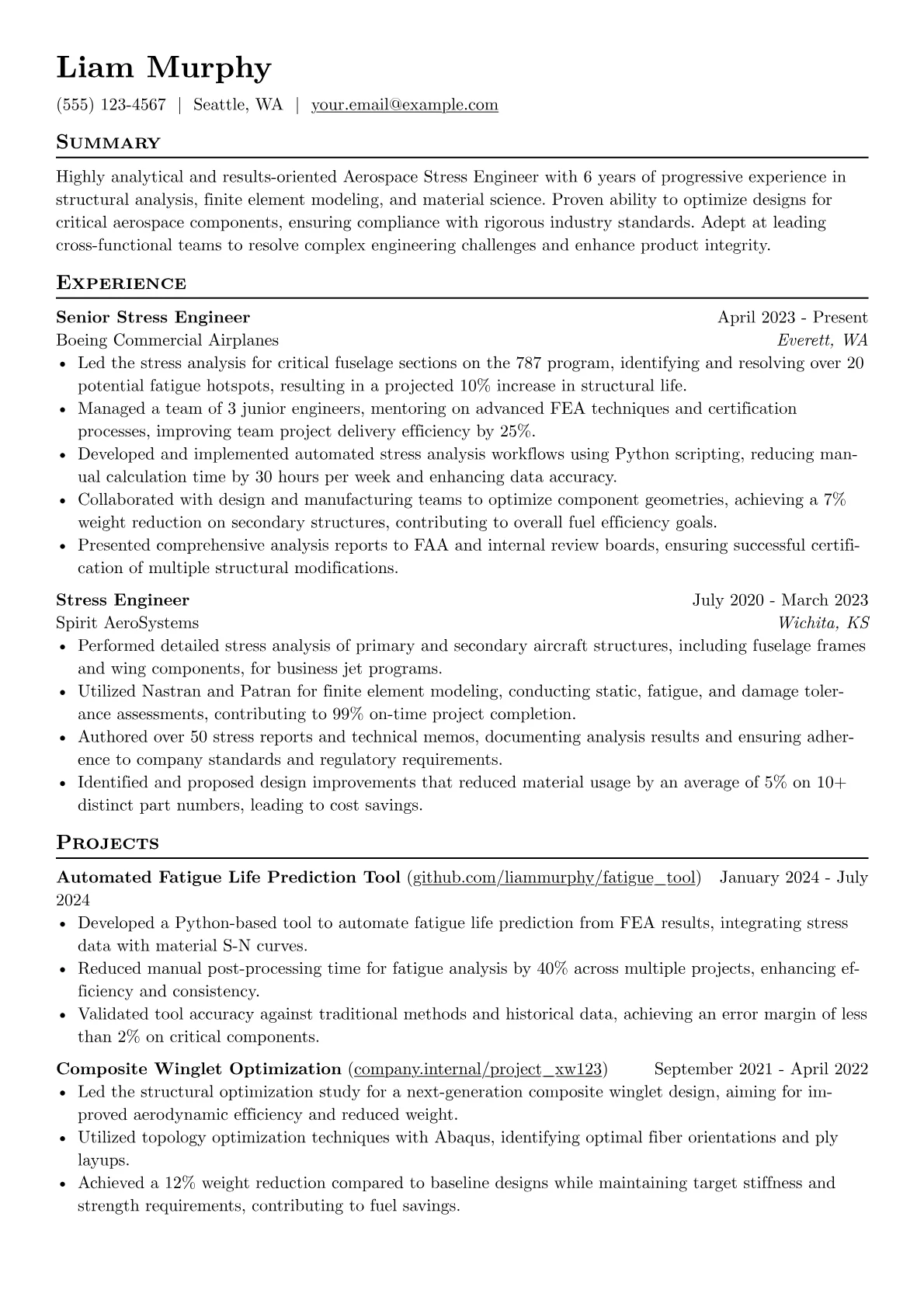
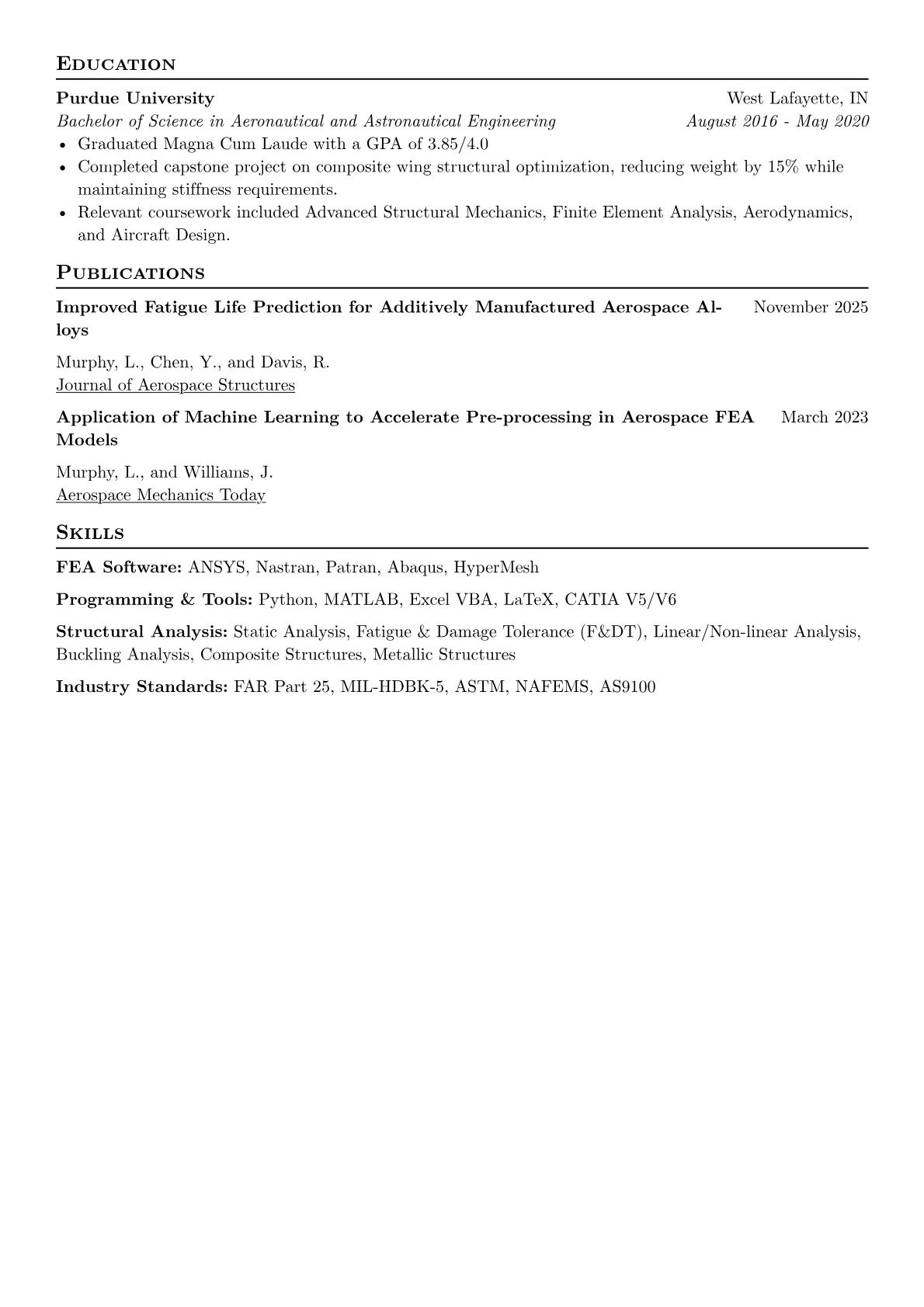
Liam Murphy's resume effectively highlights these critical aspects. His experience at Boeing Commercial Airplanes details leading stress analysis for 787 fuselage sections, identifying over 20 fatigue hotspots, and achieving a projected 10% increase in structural life. He further demonstrates leadership by managing a team of 3 junior engineers, improving their project delivery efficiency by 25%. His technical prowess is evident through developing automated analysis workflows using Python, reducing manual calculation time by 30 hours per week, and optimizing component geometries for a 7% weight reduction. His earlier role at Spirit AeroSystems showcases detailed analysis using Nastran and Patran, authoring over 50 stress reports, and identifying design improvements that reduced material usage by 5%. The “Skills” section clearly lists relevant FEA software, programming tools, structural analysis techniques, and industry standards, while “Publications” and “Projects” further underscore his specialized expertise.
How useful was this template?
Example by JobSproutAerospace Stress Engineer resume summary example
Highly analytical and results-oriented Aerospace Stress Engineer with 6 years of progressive experience in structural analysis, finite element modeling, and material science. Proven ability to optimize designs for critical aerospace components, ensuring compliance with rigorous industry standards. Adept at leading cross-functional teams to resolve complex engineering challenges and enhance product integrity.
Aerospace Stress Engineer salary by country
| Country | 25th percentile | Median | 75th percentile |
|---|---|---|---|
| US | $109,412 | $137,143 | $140,630 |
| UK | £55,625 | £71,585 | £78,320 |
| Canada | C$123,770 | C$147,540 | C$171,310 |
| India | ₹250,000 | ₹500,000 | ₹750,000 |
Annual salaries in local currency, aggregated from live job postings via Adzuna. Figures refresh continuously and reflect advertised pay, not negotiated offers.
Aerospace Stress Engineer resume skills and keywords
Recruiters and applicant tracking systems scan Aerospace Stress Engineer resumes for these skills and keywords. Include the ones that match your experience and mirror the wording in the job description. Check your resume against them with the free ATS checker.
Hard skills
Tools & software
Certifications
Soft skills
Market Insights
Aerospace Stress Engineer
Salary Range
Salary Trend
Sep 2025 – Aug 2026
12-Month Trend
Based on advertised Engineering roles.
US market data · Source: Adzuna · Updated Sep 2026
Frequently Asked Questions
What's the best resume structure for a mid-level Aerospace Stress Engineer?
Which technical and software skills should an Aerospace Stress Engineer highlight?
How should a mid-level Aerospace Stress Engineer write their resume summary and achievement bullets?
Are publications or projects important for a mid-level Aerospace Stress Engineer's resume?
How can JobSprout help me tailor my Aerospace Stress Engineer resume to different job descriptions?
The blank page is the hard part. Skip it.
Free to use. No download fee.
Related Articles

Mechanical Engineer Resume Examples and Template (2026)
Write a mechanical engineer resume that lands interviews. Resume examples, technical skills formatting, bullet point formulas with engineering metrics, and ATS tips for every experience level and specialisation.

How to Write a CV for Manufacturing Applications [2026 Guide]
Learn how to write a manufacturing or plant manager CV that gets interviews. Real template analysis, what hiring managers look for, and common mistakes to avoid.
Career moves from Aerospace Stress Engineer
Usually need less experience or training
Includes information from the O*NET 30.3 Database by the U.S. Department of Labor, Employment and Training Administration (USDOL/ETA), used under the CC BY 4.0 license. We have modified it; USDOL/ETA has not approved, endorsed or tested these modifications. O*NET is a trademark of USDOL/ETA.