PDF or DOCX · up to 2MB
Write a mechanical engineer resume that lands interviews. Resume examples, technical skills formatting, bullet point formulas with engineering metrics, and ATS tips for every experience level and specialisation.

Write a prompt engineer resume that gets interviews. Full resume example, summary templates, 10+ experience bullets, technical skills breakdown, and tips for career changers from software engineering, copywriting, data science, and UX research.
Learn how resume and CV formats differ across countries. Covers the US, UK, Germany, France, Australia, Japan, and the Middle East with comparison tables and practical tips.

Learn how to write a resume for an internal transfer. Includes a full example, summary templates for lateral moves, promotions and department changes, weak vs strong comparisons, and advice on navigating the politics.
Mechanical engineering is one of the broadest engineering disciplines in the world. From automotive powertrain development to aerospace structural analysis, from HVAC building services to advanced robotics, mechanical engineers design and build the physical systems that underpin modern life. The Bureau of Labor Statistics projects steady demand for mechanical engineers through 2032, with roughly 19,200 openings annually across the United States alone. In the UK, Engineering UK estimates the sector needs to recruit over 124,000 engineers and technicians each year to meet demand.
That demand is real, but so is the competition. Mechanical engineering remains one of the most popular undergraduate degrees globally, which means hiring managers for desirable roles at firms like Rolls-Royce, Dyson, Tesla, or Boeing are reviewing dozens (sometimes hundreds) of applications per position. Your resume has roughly 7 seconds to make an impression before a recruiter decides whether to keep reading.
The challenge specific to mechanical engineering is breadth. Unlike software engineers who can lean heavily on a GitHub profile, or data scientists who can point to Kaggle rankings, mechanical engineers need to convey a mix of design proficiency, analytical depth, manufacturing awareness, and project delivery on a single page. Most ME resumes I review lean too heavily on one dimension (usually listing CAD tools) while neglecting the others entirely.
This guide shows you how to write a mechanical engineer resume that covers all four dimensions. I'll walk through a complete example, bullet point formulas with real engineering metrics, and specific advice for different specialisations.
Before you write a single bullet point, it helps to understand what's actually being evaluated. Having reviewed engineering resumes and built JobSprout to help candidates present technical experience more effectively, I've seen the same patterns separate strong mechanical engineering candidates from weak ones.
Every mechanical engineer lists SolidWorks or AutoCAD on their resume. That tells a hiring manager nothing about your actual capability. What they want to see is evidence that you can use those tools to solve real engineering problems. Did your FEA analysis catch a failure mode before prototyping? Did your CFD simulation reduce the number of physical test iterations? The tool is the means; the engineering outcome is what matters.
Engineering is fundamentally about delivering measurable outcomes. Hiring managers want to see numbers: cost reductions in pounds or percentages, cycle time improvements, defect rate reductions, weight savings, efficiency gains, tolerances achieved, production volumes delivered. A bullet point without a metric is a missed opportunity.
This goes beyond listing software names. Managers want to understand the complexity of what you've modelled. There's a significant difference between creating simple bracket drawings and parametrically modelling a multi-component assembly with 200+ parts and full GD&T annotation. Be specific about what you've designed, the scale of the models, and the analyses you've run.
Engineering hiring managers are looking for structured thinking. Can you describe a problem, explain the constraints, walk through the approach, and quantify the result? This is the classic STAR format applied to engineering. The best ME resumes tell micro-stories: here was the challenge, here's what I did, here's the measurable result.
Modern mechanical engineering rarely happens in isolation. You'll work with electrical engineers, manufacturing teams, quality assurance, supply chain, and project managers. Evidence that you've collaborated across disciplines, managed design reviews, or led cross-functional teams adds significant weight to your application.
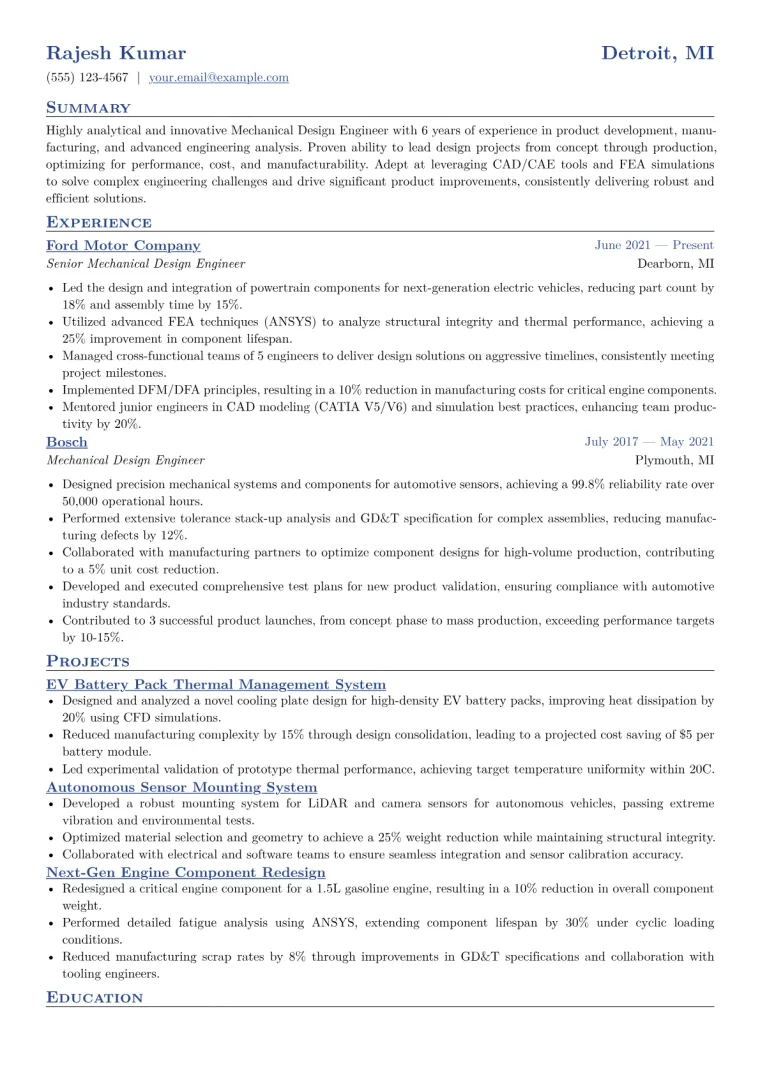
Let's look at a real mechanical engineering resume from the automotive sector.
Mei's resume leads with engineering impact that speaks to manufacturing leadership. At Ford, she "reduced part count by 15% and manufacturing costs by $1.2M annually" on next-generation EV components. These are the numbers that engineering managers care about: cost savings, weight reduction, and time-to-market improvements.
The skills section is organized into three categories that mirror how engineering teams evaluate candidates: CAD & Design Software (SolidWorks, CATIA, AutoCAD, PTC Creo, Fusion 360), Analysis & Simulation (ANSYS FEA/CFD, ABAQUS, MATLAB), and Manufacturing & Processes (Lean, Six Sigma, DFM/DFA, CNC Machining). Listing specific tools rather than generic "CAD proficiency" is critical for ATS parsing.
Her education is a differentiator: an MS in Mechanical Engineering from the University of Michigan with a thesis on additive manufacturing for lightweight alloys, plus a University Fellowship. This demonstrates both technical depth and research capability.
Here is what Mei's resume contains, drawn from the real template above.
Her Ford role combines design leadership with cost impact:
FORD MOTOR COMPANY (Lead Mechanical Design Engineer, 2021 - Present)
- Orchestrated the mechanical design of next-generation electric
  vehicle components, reducing part count by 15% and manufacturing
  costs by $1.2M annually
- Spearheaded FEA simulations to optimize structural integrity,
  resulting in a 20% increase in component lifespan and a 5%
  material weight reduction
- Managed a team of 3 junior engineers, providing technical
  guidance through the product development lifecycle
- Implemented Design for Manufacturability (DFM) principles,
  shortening design iteration cycles by 30%
Every bullet connects a technical action to a business outcome: cost savings, weight reduction, or cycle time improvement.
Three categories covering the full ME toolkit: CAD (SolidWorks, CATIA, AutoCAD, PTC Creo, Fusion 360, Solid Edge), Simulation (ANSYS FEA/CFD, ABAQUS, MATLAB, Python, Simulink), and Manufacturing (Lean, Six Sigma, DFM/DFA, Additive Manufacturing, CNC Machining, Injection Molding).
If you want to use this as your starting point, hit "Remix with AI" on the template above.
Your summary is the first thing a human reader sees after your name and contact details. It needs to communicate your level, specialisation, and strongest result in 3-4 sentences. For more examples across different fields, see our resume summary examples guide.
Mechanical engineering graduate (MEng, First Class Honours) from the University of Sheffield with internship experience in automotive NVH testing and a final-year project on composite material fatigue analysis. Developed a MATLAB-based vibration analysis tool during a 12-week placement at [Company] that automated modal frequency extraction and reduced test reporting time by 60%. Proficient in SolidWorks, ANSYS, and Python, with hands-on manufacturing experience from Formula Student. Seeking a graduate design or analysis role in the automotive or aerospace sector.
Chartered mechanical engineer with 6 years of experience specialising in thermal management and product design for consumer electronics. At [Company], led the thermal redesign of a flagship product enclosure that reduced internal operating temperature by 9°C, eliminating a field failure mode affecting 3.2% of units. Proficient in CATIA V5, ANSYS Icepak, and MATLAB/Simulink, with strong experience in DFM for injection moulding and die-casting. Track record of taking designs from concept through to volume production across 3 product launches.
Principal mechanical engineer with 12 years of experience leading structural and thermal design teams across aerospace and defence programmes. At [Company], directed the structural analysis workstream for a next-generation aircraft wing component, delivering a 15% weight reduction through topology optimisation while maintaining certification compliance to CS-25. Managed a team of 8 engineers and a £2.4M annual simulation budget. Expertise in CATIA, NASTRAN, HyperMesh, and MATLAB, with 3 patents granted and a track record of mentoring junior engineers through to chartership.
The most effective engineering bullet points follow a consistent structure: [Action verb] + [what you designed/analysed/built] + [tool or method] + [quantified result]. For a comprehensive list of strong opening verbs, see our action verbs guide.
Here are examples grouped by engineering activity, each with a weak and strong comparison.
Weak: Designed mechanical components using SolidWorks for various projects.
Strong: Designed a 120-part parametric assembly for an electric motor housing in SolidWorks, incorporating DFM feedback from 3 manufacturing suppliers and reducing part count by 18% through design consolidation.
Weak: Created 3D models and engineering drawings.
Strong: Created fully dimensioned production drawings with GD&T callouts (ASME Y14.5) for a precision valve assembly requiring positional tolerances of 0.025mm, enabling first-article inspection pass rate of 97%.
Weak: Used CATIA to design aerospace components.
Strong: Modelled a composite wing rib structure in CATIA V5 with 85 individual ply layups, coordinating with stress analysts to iterate through 4 design loops and achieve a 12% mass reduction against the weight target.
Weak: Supported manufacturing activities and improved production processes.
Strong: Implemented a design-for-manufacture review process for injection-moulded housings that identified 7 tooling risks pre-production, reducing first-off tooling modifications by 40% and saving £62,000 in rework costs.
Weak: Worked with CNC machining and manufacturing teams.
Strong: Optimised CNC machining toolpaths for a titanium bracket using Mastercam, reducing cycle time from 47 minutes to 31 minutes per part across an annual volume of 8,500 units while maintaining surface finish requirements of Ra 0.8.
Weak: Performed FEA analysis on various components.
Strong: Conducted non-linear FEA in ANSYS Mechanical on a safety-critical suspension knuckle under 14 load cases, identifying a fatigue hotspot that was resolved through a fillet radius change before prototype tooling commitment.
Weak: Carried out testing and analysis of mechanical systems.
Strong: Designed and executed a 2,000-hour accelerated life test programme for an industrial gearbox, correlating physical failure modes with FEA predictions to within 8% accuracy and informing a bearing selection change that extended warranty coverage from 3 to 5 years.
Weak: Used MATLAB for data analysis.
Strong: Developed a MATLAB/Simulink thermal model of a battery pack cooling system that predicted cell temperatures within 1.5°C of physical test data across 9 drive cycle scenarios, reducing the need for prototype iterations from 5 to 2.
Weak: Managed engineering projects and coordinated with teams.
Strong: Led a cross-functional team of 6 engineers (mechanical, electrical, software) through a 9-month product development programme from concept to pilot production, delivering on time and 4% under the £380,000 development budget.
Weak: Participated in design reviews and communicated with stakeholders.
Strong: Facilitated fortnightly design reviews with 4 tier-one automotive suppliers, resolving 23 open engineering change requests within a 6-week window to maintain the programme launch date.
Weak: Reduced costs through design improvements.
Strong: Redesigned a sheet metal bracket assembly from 5 welded components to a single progressive-stamped part, reducing unit cost by £4.20 (31%) across an annual production volume of 120,000 units, saving £504,000 per year.
Weak: Improved efficiency of existing products.
Strong: Optimised the airflow path in an industrial cooling unit through CFD analysis in ANSYS Fluent, improving thermal efficiency by 8.5% and reducing energy consumption by 1,200 kWh annually per installed unit across a fleet of 340 units.
Your technical skills section carries significant weight in mechanical engineering because it's the first thing both ATS systems and hiring managers scan for specific capabilities. A categorised format works far better than a single comma-separated list. For more guidance on structuring this section, see our resume skills guide.
| Category | Skills to Include |
|---|---|
| CAD & Modelling | SolidWorks, AutoCAD, CATIA V5/V6, Creo Parametric, Inventor, Siemens NX, Fusion 360 |
| Simulation & Analysis | ANSYS Mechanical, ANSYS Fluent, COMSOL Multiphysics, MATLAB/Simulink, Abaqus, NASTRAN, HyperMesh |
| Manufacturing | GD&T (ASME Y14.5 / ISO 1101), CNC programming, injection moulding DFM, sheet metal design, 3D printing (SLA/SLS/FDM), welding processes |
| Programming & Automation | Python, MATLAB, C/C++ (embedded), VBA, Excel automation, API scripting for CAD |
| Quality & Methods | Six Sigma (Green/Black Belt), lean manufacturing, DFMEA/PFMEA, 8D, APQP, PPAP, root cause analysis, DOE |
| Standards & Compliance | ISO 9001, IATF 16949, AS9100, ISO 14001, CE marking, ATEX, PED |
| Project Tools | Jira, Confluence, MS Project, SAP PLM, Windchill, Teamcenter |
| Skill Area | Graduate (0-2 years) | Mid-Level (3-6 years) | Senior (7+ years) |
|---|---|---|---|
| CAD | SolidWorks or Inventor, basic drawings | CATIA or Creo, complex assemblies, GD&T | Multi-platform, parametric design strategy |
| Simulation | Basic linear FEA, simple CFD | Non-linear FEA, transient thermal, fatigue | Multi-physics, correlation methodology |
| Manufacturing | Awareness of CNC, injection moulding | DFM reviews, tooling input, supplier liaison | Process optimisation, capital equipment selection |
| Programming | MATLAB basics, Excel VBA | Python scripting, MATLAB/Simulink | Automation strategy, custom tool development |
| Quality | Awareness of DFMEA, basic inspection | Green Belt, leading DFMEA sessions | Black Belt, quality system ownership |
Only include tools and methods you can confidently discuss in a technical interview. Listing ANSYS Fluent when you've only ever run a tutorial is a fast way to lose credibility during an interview when the hiring manager asks you to describe your meshing approach.
Applicant tracking systems are particularly relevant for engineering roles at large companies. For a deeper dive on beating ATS filters, see our ATS-friendly resume guide.
Key points for mechanical engineers:
Professional certifications carry real weight in mechanical engineering, particularly for senior roles and regulated industries. Here are the most impactful ones to pursue and list on your resume.
This is the gold standard for professional recognition. In the UK, chartership through the Institution of Mechanical Engineers (IMechE) signals that you've demonstrated competence to a nationally recognised standard. In the US, the Professional Engineer (PE) licence serves the same function. If you have either, list it prominently. If you're working towards it, include "CEng (in progress)" or "EIT (Engineer in Training)."
For roles where SolidWorks is the primary CAD platform, these certifications provide concrete evidence of proficiency beyond simply listing the software name. The CSWE in particular signals advanced capability in surfacing, simulation, and sheet metal.
Six Sigma certification demonstrates structured problem-solving and process improvement capability. Green Belt is expected for mid-career engineers in manufacturing environments. Black Belt is valuable for senior engineers or those moving into engineering management.
Relevant for senior engineers who lead programmes or manage engineering teams. These aren't essential for purely technical roles, but they add significant value when applying for engineering manager or principal engineer positions.
| Certification | Relevance |
|---|---|
| NEBOSH General Certificate | Health and safety awareness, valuable for manufacturing and site-based roles |
| AWS Certified Welding Inspector (CWI) | Specialist roles in fabrication and structural engineering |
| Certified Reliability Engineer (CRE) | Reliability engineering, aerospace, and defence |
| LEED AP | Sustainable building design, HVAC engineering |
| TUV Functional Safety (IEC 61508) | Automotive, process, and safety-critical industries |
Mechanical engineering is enormously broad. The emphasis of your resume should shift depending on your target sector. Here's what to prioritise for five common specialisations.
Automotive hiring managers are looking for experience with vehicle-level systems thinking, supplier management, and working within structured development processes like APQP and PPAP. The shift to electrification means battery thermal management, electric drive units, and lightweight materials are in particularly high demand.
Key skills to emphasise: CATIA V5/V6, IATF 16949, DFMEA/PFMEA, tolerance stack-up analysis, NVH, vehicle dynamics, battery thermal management, high-voltage safety
Example bullet:
Led the DFMEA and design validation plan for an EV battery enclosure, coordinating 3 tier-one suppliers through 4 PPAP stages and achieving production sign-off 2 weeks ahead of the programme milestone.
Aerospace demands rigorous analysis, traceability, and compliance with certification standards (CS-25, FAR Part 25, DO-178/254 for systems). Weight is everything. Hiring managers want to see that you understand structural margins, fatigue life, and the certification process.
Key skills to emphasise: CATIA V5, NASTRAN, HyperMesh, composite materials, fatigue and damage tolerance, AS9100, certification compliance, stress reports
Example bullet:
Authored 14 stress reports for a wing trailing-edge component programme, demonstrating compliance to CS-25 limit and ultimate load cases with positive margins across all 38 critical load conditions.
HVAC mechanical engineers work at the intersection of thermal comfort, energy efficiency, and building regulations. Hiring managers want to see load calculation proficiency, familiarity with building codes, and evidence that your designs deliver on energy targets.
Key skills to emphasise: IES VE, Hevacomp, AutoCAD MEP, psychrometric analysis, ASHRAE standards, Part L compliance, BREEAM, energy modelling, commissioning
Example bullet:
Designed the HVAC system for a 12,000m² commercial office building, achieving BREEAM Excellent certification and reducing predicted energy consumption by 22% against Part L 2021 baseline through optimised heat recovery and variable-flow chilled water systems.
Manufacturing-focused mechanical engineers bridge the gap between design and production. Hiring managers want to see process knowledge, continuous improvement credentials, and evidence that you've improved yield, reduced cycle times, or cut costs.
Key skills to emphasise: lean manufacturing, Six Sigma, CNC programming, injection moulding, die-casting, SPC, OEE, capital equipment specification, Kaizen
Example bullet:
Led a Kaizen event on an automotive stamping line that reduced changeover time from 45 minutes to 18 minutes, increasing overall equipment effectiveness (OEE) from 72% to 84% and adding £1.1M in annual production capacity.
Robotics is one of the fastest-growing areas for mechanical engineers. Hiring managers want to see a combination of mechanical design, control systems awareness, and sensor integration experience. Interdisciplinary breadth matters more here than in most ME specialisations. For more on positioning yourself for technical roles, see our guide on CVs for tech applications.
Key skills to emphasise: SolidWorks/Fusion 360, ROS/ROS2, Python, C++, servo/actuator selection, sensor integration, URDF/SDF, motion planning, 3D printing for prototyping
Example bullet:
Designed and integrated a 6-DOF robotic end-effector for automated quality inspection, combining pneumatic grippers with a structured-light 3D scanner to achieve part placement accuracy of 0.15mm and inspection cycle time of 12 seconds per unit.
Breaking into mechanical engineering without extensive experience is challenging, but graduates have more to work with than they typically realise. Here's how to make the most of what you have.
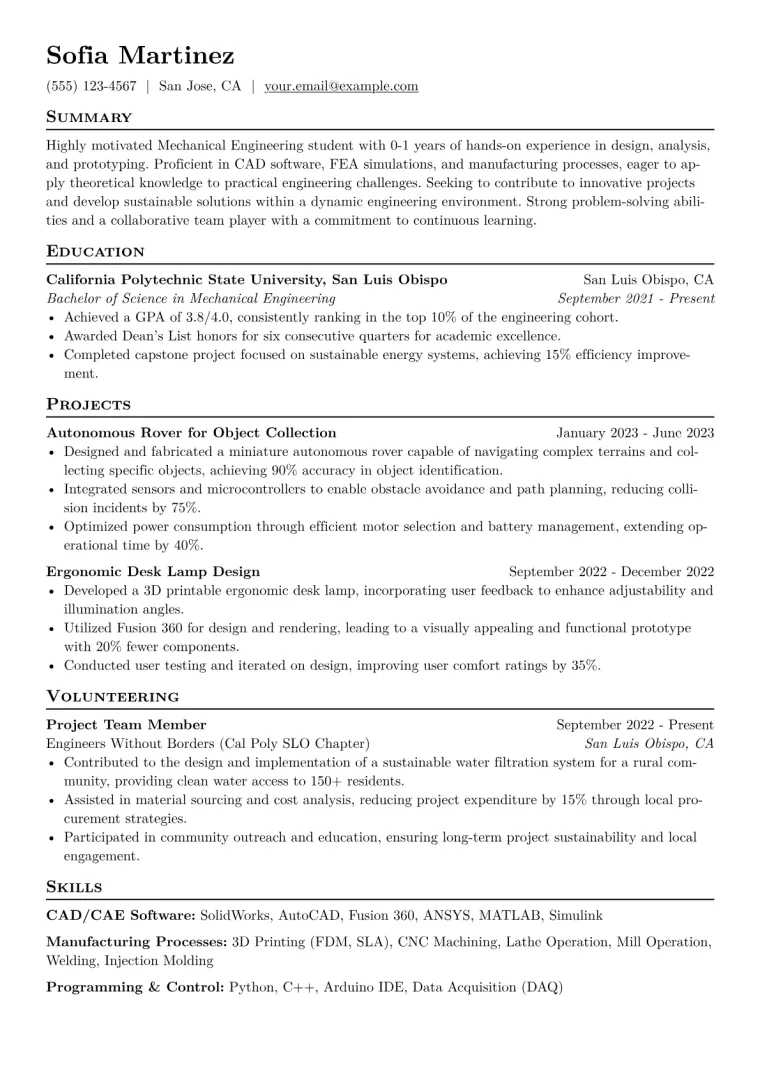
Your dissertation or final-year project is often the most substantial engineering work you've done. Treat it like a professional project: describe the problem, the method, the tools you used, and the result. Quantify wherever possible.
Weak: Completed a final-year project on wind turbine blade design.
Strong: Designed and optimised a 1.5m composite wind turbine blade using SolidWorks and ANSYS CFX, achieving a 9% improvement in power coefficient at rated wind speed compared to the baseline NACA 4412 aerofoil profile.
These are gold for graduate resumes. They demonstrate teamwork, manufacturing hands-on experience, time pressure, and real engineering trade-offs. Be specific about your contribution, not just your team's results.
Even a 10-week summer placement provides material. Focus on the specific engineering tasks you did, not general statements about "gaining exposure to the engineering environment."
If you've designed and fabricated your own projects, include them. A well-documented personal project that demonstrates CAD proficiency, manufacturing awareness, and problem-solving is more impressive than most graduates realise. Include links to portfolios, CAD repositories, or YouTube videos if you have them.
If you lack professional experience, certifications can help fill the gap:
One page. No exceptions. If you're a graduate with less than 2 years of experience and your resume is longer than one page, you're including too much. Cut the secondary school qualifications, remove the "interests" section unless it's genuinely relevant (rock climbing and football add nothing; restoring a classic car engine is legitimate), and tighten every bullet point.
After reviewing hundreds of engineering resumes, these are the mistakes I see most frequently. Avoiding them will immediately put you ahead of most applicants.
"Proficient in SolidWorks, CATIA, AutoCAD, Creo, Inventor, Siemens NX, Fusion 360" listed in a single line tells a hiring manager that you've probably opened all of them but mastered none. Be honest about your proficiency level and provide context. Which tool did you use daily for 3 years? Which did you use for a single university module?
Engineering is a quantitative discipline. If your resume has zero numbers, it reads as though you either didn't achieve anything measurable or you don't understand what matters. Every bullet point is an opportunity to include a cost saving, a time reduction, a performance improvement, or a volume. If you genuinely can't quantify a result, describe the scale: number of parts, number of load cases, number of suppliers, size of the team.
Weak: Responsible for the design and development of mechanical components.
Strong: Designed a sheet metal chassis assembly (42 parts) that passed first-article inspection with zero non-conformances and entered volume production at 15,000 units per month.
The first tells a manager what your job description said. The second tells them what you actually delivered.
Each application should be tailored. If the job posting emphasises thermal analysis and you have thermal analysis experience buried in your third bullet point under a manufacturing role, move it up. If they mention CATIA and you've listed only SolidWorks, consider whether you have any CATIA experience worth including. Tools like JobSprout can help you tailor your resume to specific job descriptions quickly.
Unless you have 15+ years of experience and are applying for a principal or chief engineer role, two pages is the maximum. Most mid-career engineers should target 1.5 pages. Graduates should target exactly one page. Every line should earn its place.
If you're a Chartered Engineer, Incorporated Engineer, or hold PE licensure, this should be visible immediately, ideally next to your name or in your summary. These credentials are hard-won and carry significant weight. Burying "CEng" in a certifications section at the bottom of page two is a missed opportunity.
"Highly motivated mechanical engineer seeking a challenging role" communicates nothing. Your summary should include your years of experience, your specialisation, your strongest quantified achievement, and the type of role you're targeting. If it could apply to any engineer in any sector, it's too generic.
Engineering resumes tend to be text-heavy. Use clear section headings, consistent bullet point formatting, and adequate white space. If your resume looks like a wall of text at first glance, a recruiter will move on. Categorise your skills section, use a readable font at 10-11pt, and ensure your layout survives ATS parsing by avoiding tables, columns, and graphics for critical content.
Mechanical engineering is a discipline built on precision, and your resume should reflect that same standard. Every bullet point should be specific. Every metric should be real. Every skill listed should be one you can defend in a technical interview.
The engineers who land the best roles aren't necessarily the most technically brilliant. They're the ones who can clearly communicate the impact of their work. Your resume is the first proof point that you can do that.
Start with the formula: what you did, how you did it, and what it achieved. Get the metrics right. Tailor to the role. And keep it tight.
Good luck with your applications.