PDF or DOCX · up to 2MB
Learn how to translate military experience into a civilian resume that recruiters understand. Includes a full translation table, resume examples, skills mapping, and tips for veterans entering the private sector.

A LinkedIn profile review to run before you apply, in the order a recruiter reads you, plus a free checker that shows what holds you back in search.

The right LinkedIn profile picture size (400 x 400 pixels or more, under 8MB), how to frame it for the circle crop, and what recruiters notice first.

What an ATS score actually measures, what counts as a good resume ATS score, and why the "ATS auto-rejects 75% of resumes" claim is a myth. Includes real score bands and a free checker.
Every year, roughly 200,000 service members in the United States alone transition out of the military. In the United Kingdom, around 15,000 leave the Armed Forces annually. These men and women bring exceptional skills to the civilian workforce: leadership under pressure, logistics expertise, security training, and the ability to perform in high-stakes environments.
Yet studies consistently show that veterans face a harder time landing their first civilian role than you might expect. A U.S. Department of Labor report found that many veterans are underemployed within their first year of leaving service, often taking roles well below their skill level. The problem is rarely a lack of capability. It is almost always a communication gap.
Military resumes are written in a language that civilian recruiters do not speak. Ranks, MOS codes, unit designations, and acronyms like OPSEC, SIGINT, and PCS mean nothing to a hiring manager at a logistics company or a tech firm. If your resume reads like an operational briefing, it will end up in the rejection pile no matter how impressive your service record is.
This guide will help you translate your military experience into a civilian resume that lands interviews. We will cover the exact language swaps you need to make, show you complete resume examples, and walk through skills mapping by category.
The core issue is not that military experience is irrelevant to civilian employers. It is deeply relevant. The issue is that most recruiters have no framework for interpreting it.
Consider these real problems:
Ranks do not map to job titles. A civilian hiring manager has no idea whether an E-7 or an O-3 is more senior. They do not know what a Sergeant First Class actually does day-to-day, or how a Lieutenant Commander's responsibilities compare to a Regional Manager's.
MOS/MOC/AFSC codes are meaningless outside the military. Your Military Occupational Specialty code might perfectly describe your role, but "11B Infantryman" or "25S Satellite Communication Systems Operator-Maintainer" tells a recruiter nothing about your transferable skills.
Acronyms create an instant barrier. When a recruiter sees "Maintained COMSEC equipment IAW AR 25-2," they stop reading. Even if the underlying skill (managing secure communications equipment in compliance with information security regulations) is exactly what the role requires.
Military culture emphasises the team, not the individual. Service members are trained to credit the unit, not themselves. Civilian resumes require the opposite: clear, personal ownership of achievements with quantified results.
The good news is that the translation process is straightforward once you know the patterns. Most military roles map cleanly to civilian equivalents. You just need to learn the language.
This table covers the most common military terms and their civilian equivalents. Use it as a reference when rewriting your resume. The goal is not to erase your service but to reframe it in terms that any recruiter can understand immediately.
| Military Term | Civilian Equivalent |
|---|---|
| Platoon Leader | Team Manager (30+ direct reports) |
| Squad Leader | Team Lead (8-12 direct reports) |
| Company Commander | Operations Director (100-200 personnel) |
| Battalion Commander | Senior Director / VP of Operations (500+ personnel) |
| Executive Officer (XO) | Deputy Director / Chief of Staff |
| First Sergeant / Sergeant Major | Senior Operations Manager |
| Non-Commissioned Officer (NCO) | Supervisor / Team Lead |
| Commissioned Officer | Senior Manager / Director |
| Warrant Officer | Technical Specialist / Subject Matter Expert |
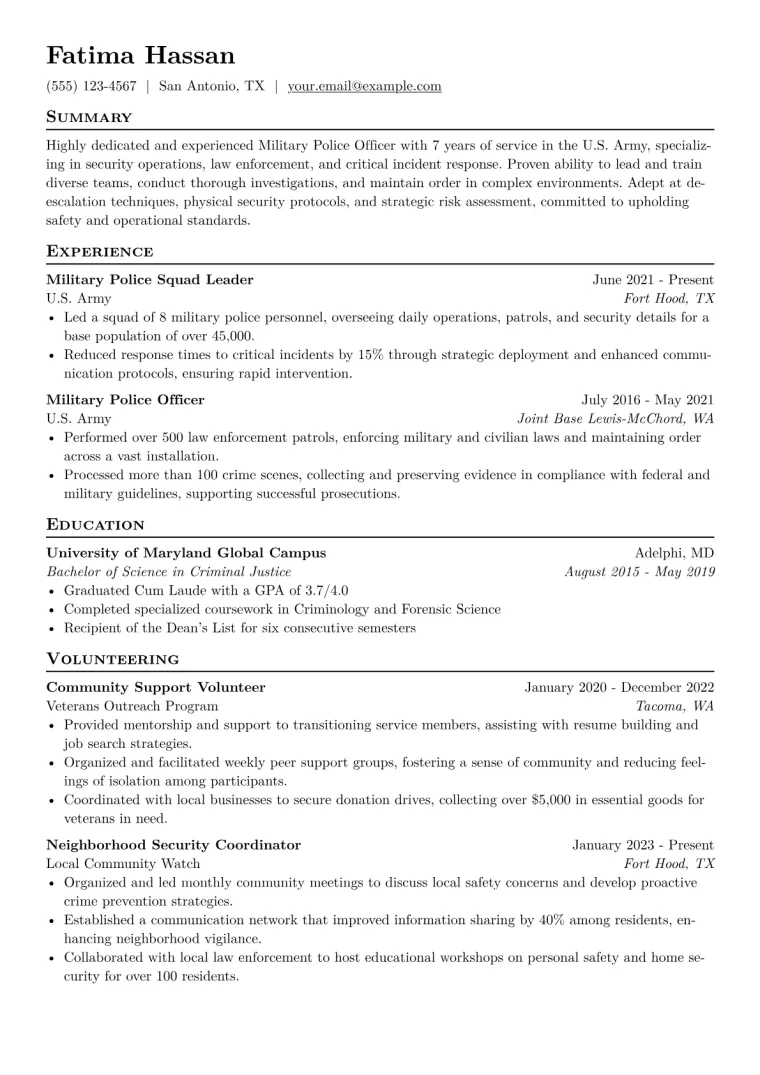
| Military Police | Security Management / Law Enforcement |
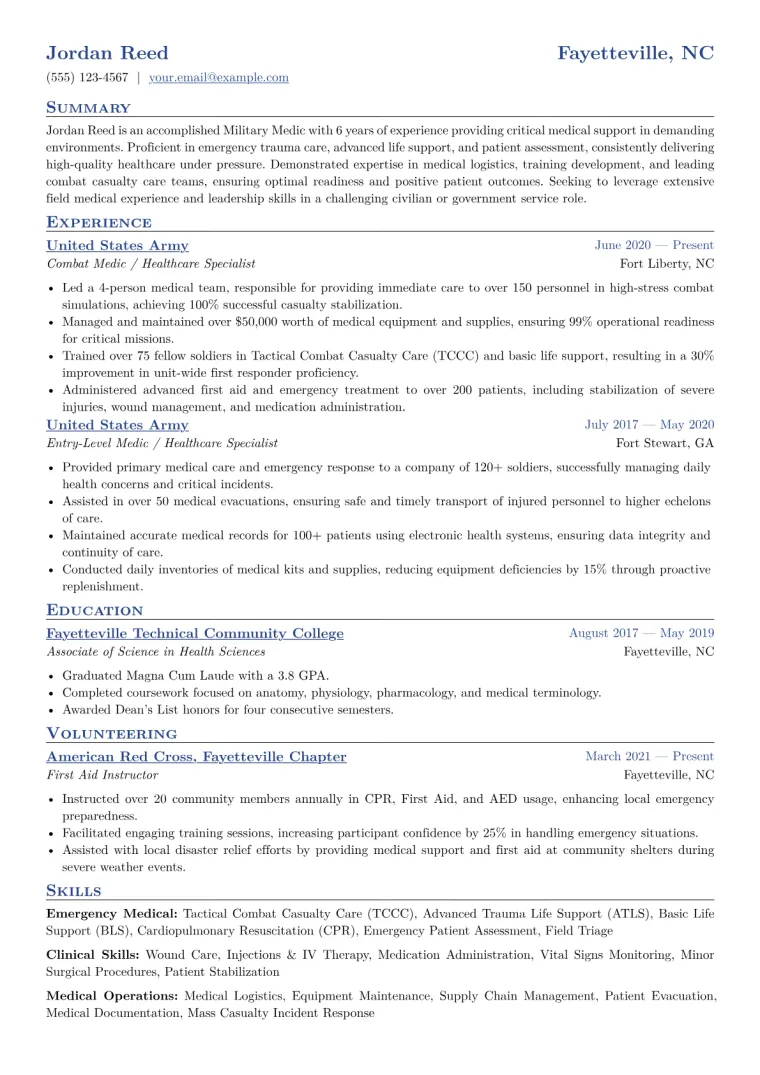
| Combat Medic / Medical Technician | Emergency Medical Technician / Healthcare Provider |
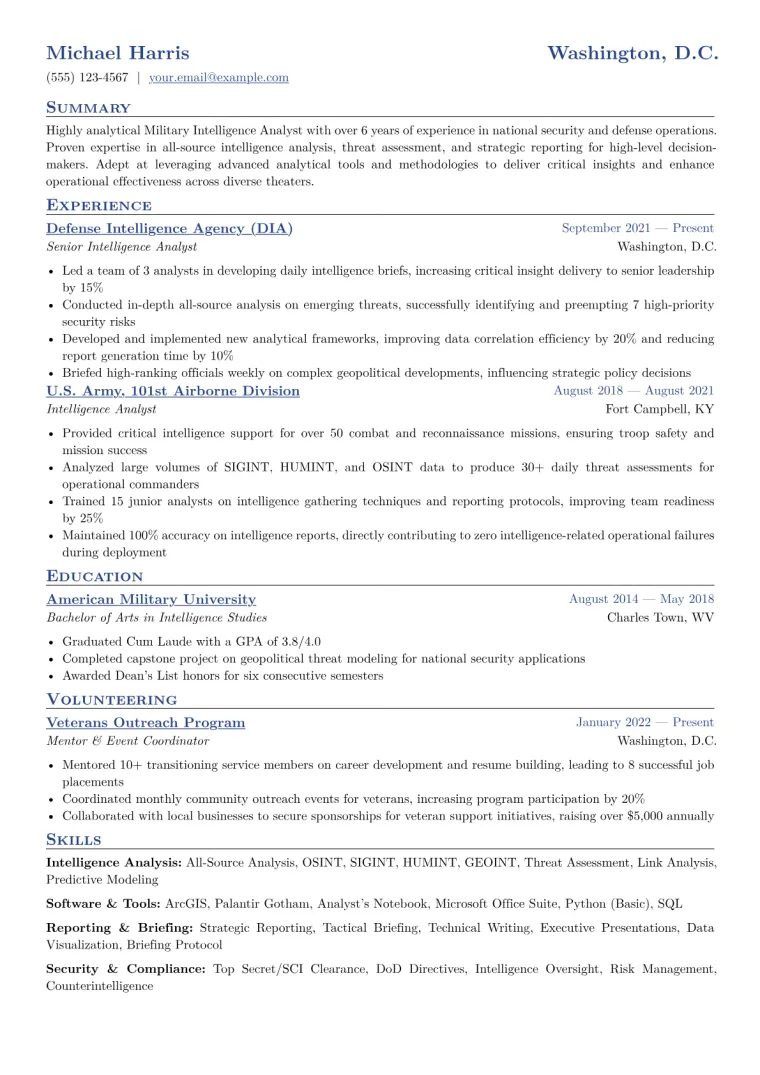
| Intelligence Analyst | Business Intelligence Analyst / Research Analyst |
| Logistics Specialist | Supply Chain Coordinator / Procurement Specialist |
| Military Term | Civilian Equivalent |
|---|---|
| Conducted reconnaissance | Performed market analysis / competitive intelligence gathering |
| Maintained OPSEC | Managed confidential information security protocols |
| Deployed to theatre of operations | Relocated to regional office / assigned to field operations |
| Executed mission planning | Led strategic project planning and execution |
| Briefed commanding officers | Presented findings and recommendations to senior leadership |
| Coordinated with allied forces | Managed cross-functional / multi-stakeholder collaboration |
| Managed supply chain operations | Oversaw procurement, inventory, and distribution logistics |
| Conducted after-action reviews | Led post-project analysis and continuous improvement sessions |
| Trained and mentored subordinates | Developed and coached team members |
| Maintained weapons systems | Managed technical equipment maintenance and calibration |
| Enforced standard operating procedures | Implemented and monitored compliance with operational policies |
| Led combat operations | Directed high-pressure, time-critical operations |
| Managed classified materials | Handled confidential documentation and sensitive data |
| Performed base security operations | Managed facility security and access control |
| Coordinated medical evacuation | Managed emergency response and personnel safety protocols |
| Military Term | Civilian Equivalent |
|---|---|
| Battalion / Regiment | Division / Business Unit |
| Company / Battery / Troop | Department / Team |
| Brigade / Group | Regional Office / Large Division |
| Garrison / Base / Installation | Corporate Campus / Facility |
| Theatre of Operations | Regional Market / Operational Territory |
Below is a complete example showing how a mid-career Army NCO might translate their experience into a civilian operations management resume.
JAMES MITCHELL
Operations Manager

Chicago, IL | james.mitchell@email.com | (312) 555-0142 | linkedin.com/in/jamesmitchell

PROFESSIONAL SUMMARY

Operations manager with 10 years of progressive leadership experience
overseeing teams of up to 120 personnel. Proven track record in logistics
coordination, process improvement, and high-pressure decision-making.
Managed $4.2M in equipment and inventory with zero loss. Holds an active
Secret security clearance.

EXPERIENCE

Senior Operations Manager
U.S. Army, Fort Campbell, KY | 2022 - 2026

- Directed daily operations for a 120-person organisation across three
  departments, achieving 98% operational readiness
- Managed procurement, maintenance, and distribution of $4.2M in
  equipment and supplies with zero inventory loss over 4 years
- Designed and implemented a new training programme that reduced
  onboarding time by 30% and improved team performance scores by 22%
- Led cross-functional teams through 3 major organisational
  restructurings, maintaining 100% productivity during transitions
- Presented weekly operational briefings and strategic recommendations
  to senior leadership (VP-equivalent and above)

Team Lead / Supervisor
U.S. Army, Joint Base Lewis-McChord, WA | 2018 - 2022

- Supervised a team of 35 personnel across two shifts, managing
  scheduling, performance reviews, and professional development
- Reduced equipment downtime by 40% by implementing a preventive
  maintenance tracking system
- Coordinated logistics for 6 large-scale operational deployments,
  each involving 200+ personnel and $2M+ in equipment
- Trained and mentored 12 junior team members, with 8 earning
  early promotions based on performance evaluations
- Maintained 100% compliance with information security and safety
  regulations across all operations

Operations Coordinator
U.S. Army, Fort Bragg, NC | 2016 - 2018

- Coordinated daily logistics operations for a 50-person department,
  including scheduling, supply management, and reporting
- Processed and tracked over 500 supply requests per quarter with
  a 99.2% accuracy rate
- Assisted in planning and executing 4 large-scale training exercises
  involving cross-departmental coordination

EDUCATION

Bachelor of Science in Business Administration
University of Maryland Global Campus | 2024

Associate of Applied Science in Logistics Management
Central Texas College | 2020

CERTIFICATIONS

- Project Management Professional (PMP) | PMI | 2025
- Six Sigma Green Belt | ASQ | 2024
- OSHA 30-Hour General Industry Safety | 2023
- Active Secret Security Clearance (transferable)

SKILLS

Project Management | Team Leadership | Logistics & Supply Chain |
Process Improvement | Budget Management | Risk Assessment |
Stakeholder Communication | Training & Development | Compliance |
Microsoft Office Suite | SAP (basic) | Data Analysis
Notice what this resume does not contain: no rank abbreviations, no MOS codes, no acronyms, no unit designations. Every bullet point uses language that any hiring manager in operations, logistics, or general management would immediately understand.
Your resume summary is often the first thing a recruiter reads. It needs to communicate your value in civilian terms within 3-4 sentences. Here are three examples at different career stages.
Weak: "E-4 SPC with 4 years in 92Y MOS. Performed supply operations at battalion level. Seeking civilian employment."
Strong: "Detail-oriented logistics coordinator with 4 years of experience managing inventory, procurement, and distribution operations for a 500-person organisation. Tracked and maintained $1.8M in supplies with 99.5% accuracy. Seeking an entry-level supply chain or warehouse management role where strong organisational skills and a proven track record of precision can drive operational efficiency."
Weak: "SSG with 8 years active duty. Led a squad in 3 deployments. Expert in CBRN operations and personnel management."
Strong: "Operations supervisor with 8 years of progressive leadership experience managing teams of 12-40 personnel in high-pressure, time-sensitive environments. Specialised in safety compliance, hazardous materials management, and emergency response planning. Delivered a 35% improvement in team readiness scores through structured training programmes and performance coaching."
Weak: "O-4 MAJ with 14 years commissioned service. Commanded a company of 180 Soldiers. Served as BN S-3. Multiple deployments to OEF/OIF."
Strong: "Senior operations leader with 14 years of experience directing organisations of 40-200 personnel with budgets exceeding $15M. Expert in strategic planning, organisational restructuring, and cross-functional team management. Led an operations directorate that achieved the highest readiness rating in a 3,000-person division. Proven ability to align team performance with organisational objectives in fast-paced, high-stakes environments."
The biggest challenge on most military resumes is the experience section. Below are 12 common military achievements rewritten for civilian audiences. Use these as templates, swapping in your own numbers and details.
Weak: "Led a platoon of 30 Soldiers in OEF." Strong: "Managed a 30-person team delivering operational objectives in a high-pressure, resource-constrained environment, achieving a 100% mission completion rate."
Weak: "Maintained 100% accountability of equipment valued at $3.5M." Strong: "Managed and maintained $3.5M in technical equipment and inventory with zero loss, implementing preventive maintenance schedules that reduced equipment downtime by 25%."
Weak: "Conducted route clearance operations in hostile territory." Strong: "Led risk assessment and hazard mitigation operations across multiple sites, developing safety protocols that reduced incidents by 40%."
Weak: "Served as the BN S-1, managing personnel actions for 800 Soldiers." Strong: "Directed human resources operations for an 800-person organisation, overseeing hiring, onboarding, performance evaluations, and workforce planning."
Weak: "Planned and executed battalion-level training exercises." Strong: "Designed and delivered large-scale training programmes for 500+ participants, coordinating logistics, scheduling, and performance assessment across 6 departments."
Weak: "Processed over 200 SIGACTS per month as the BDE Intelligence Analyst." Strong: "Analysed and reported on 200+ data points per month, producing actionable intelligence briefs that informed strategic decision-making for senior leadership."
Weak: "Qualified Expert on M4 and M9; maintained weapons for the platoon." Strong: "Achieved highest proficiency rating in technical equipment operation; managed maintenance and quality assurance for a 30-person team's equipment inventory."
Weak: "Served as Company Training NCO." Strong: "Designed and managed the professional development programme for a 150-person organisation, creating training curricula, tracking certifications, and conducting skills gap analyses."
Weak: "Managed the motor pool for a transportation company." Strong: "Oversaw fleet management operations for 45 vehicles valued at $12M, reducing maintenance costs by 18% through a data-driven preventive maintenance programme."
Weak: "Conducted PRT sessions 5 days a week for the platoon." Strong: "Led daily health and fitness programmes for a 30-person team, improving overall physical readiness assessment scores by 15% over 12 months."
Weak: "Served as CBRN NCO; conducted quarterly training." Strong: "Managed the hazardous materials safety and emergency response programme for a 200-person organisation, ensuring 100% regulatory compliance across 4 consecutive annual inspections."
Weak: "Coordinated medical support for a Forward Operating Base." Strong: "Managed emergency medical operations for a 300-person facility, coordinating staffing, supplies, and response protocols that maintained a 99% treatment effectiveness rate."
Military service develops a broad range of transferable skills, but listing "combat operations" on a civilian resume will not help. Here is how to translate your military skills into categories that civilian employers value.
| Military Skill | Civilian Translation |
|---|---|
| Unit command | Team / department management |
| Mission planning | Strategic planning and project management |
| Troop welfare | Employee engagement and wellbeing |
| Performance counselling | Performance reviews and coaching |
| Promotion board experience | Hiring and talent evaluation |
| Duty assignment management | Workforce planning and resource allocation |
Veterans often understate their leadership credentials. If you led a team of 10, you have more direct management experience than many civilian candidates applying for supervisor roles. Use specific numbers: "Managed a team of 35 across two shifts" is far more compelling than "leadership experience."
| Military Skill | Civilian Translation |
|---|---|
| Supply chain management (military) | Procurement, inventory, and distribution management |
| Convoy planning and execution | Route optimisation and fleet coordination |
| Base operations | Facility management |
| Equipment accountability | Asset tracking and inventory control |
| Movement planning | Transportation and distribution logistics |
| Ration and supply forecasting | Demand planning and procurement forecasting |
Logistics is one of the most directly transferable military skill sets. Companies like Amazon, FedEx, DHL, and Maersk actively recruit veterans because military logistics training maps almost perfectly to civilian supply chain roles.
| Military Skill | Civilian Translation |
|---|---|
| Radio/satellite communications | Telecommunications systems management |
| SIGINT / COMINT | Data analytics and signals processing |
| Cybersecurity operations | Information security and cyber defence |
| Network administration (military) | IT infrastructure management |
| GIS and mapping systems | Geospatial analysis and data visualisation |
| Equipment diagnostics | Technical troubleshooting and systems analysis |
If your MOS involved technology in any capacity, make sure your resume highlights the civilian equivalent clearly. A "25B Information Technology Specialist" should list specific platforms, certifications, and the scale of networks managed.
| Military Skill | Civilian Translation |
|---|---|
| Physical security operations | Facility security management |
| Information security (INFOSEC) | Data protection and cybersecurity compliance |
| Personnel vetting | Background investigation and security screening |
| Force protection | Risk management and threat assessment |
| Regulatory compliance (military) | Regulatory compliance and audit readiness |
| Classified material handling | Sensitive data management and access control |
Security skills are in extremely high demand. Defence contractors, government agencies, financial institutions, and healthcare organisations all need people who understand compliance, access control, and risk management at the level military personnel do.
| Military Skill | Civilian Translation |
|---|---|
| Drill instruction | Onboarding programme design and delivery |
| Battle drills / rehearsals | Emergency preparedness training |
| Individual development plans | Career development and succession planning |
| After-action reviews | Post-project analysis and lessons learned |
| Certification tracking | Professional development programme management |
| Mentoring junior personnel | Coaching and talent development |
If you have ever trained anyone in the military, you have training and development experience. Many veterans overlook this skill set, but it is highly valued in corporate environments where companies spend billions annually on employee learning.
Choosing the right resume format matters more for veterans than for most job seekers, because the challenge is not just listing your experience but reframing it.
Chronological lists your experience in reverse date order. This works well when your military roles have clear civilian equivalents (logistics, IT, healthcare, HR).
Functional (also called skills-based) groups your experience by skill category rather than by date. This can work if your military roles are very different from what you are targeting, but many recruiters are suspicious of functional resumes because they can obscure gaps. See our functional resume examples for more on this format.
Combination/Hybrid uses a strong skills section at the top followed by a brief chronological experience section. This is the best format for most veterans.
The combination format lets you lead with your transferable skills in civilian language, then back them up with your actual experience. This means:
The recruiter sees your value first. Before they encounter any military terminology, they already know you have project management, team leadership, and logistics skills.
Your experience section stays concise. You do not need to translate every single military achievement in the experience section because the skills section has already done the heavy lifting.
It handles career changes well. If you are moving from infantry to project management, leading with a skills section that highlights planning, coordination, and team leadership makes the transition logical.
1. Contact information
2. Professional summary (3-4 sentences, civilian language)
3. Key skills / core competencies (6-12 skills in civilian terms)
4. Professional experience (reverse chronological, translated)
5. Education (include military education with civilian equivalents)
6. Certifications and clearances
7. Optional: volunteer work, professional affiliations
If you are building your resume from scratch, tools like JobSprout can help you structure your experience and generate polished, ATS-friendly formatting without having to wrestle with templates manually.
Military training produces a long list of certifications, many of which have direct civilian value. Listing them correctly can set you apart from other candidates.
Security clearances are genuinely valuable in the civilian job market, particularly for defence contractors, government agencies, and financial institutions. List them clearly:
Good format:
What to know:
A current TS/SCI clearance can add significant value to your candidacy. Some estimates suggest it is worth $5,000-$15,000 in additional salary for roles that require one, simply because obtaining a new clearance is expensive and time-consuming for employers.
Many military courses and qualifications have civilian equivalents or are directly recognised by civilian employers:
| Military Training | Civilian Equivalent / Certification |
|---|---|
| Combat Lifesaver (CLS) | First Aid / Basic Life Support (BLS) |
| Army Logistics University | Supply Chain Management certification |
| NCO Professional Development | Leadership and Management training |
| Hazardous Materials Handling | HAZMAT certification |
| Military Police training | Security management / Law enforcement |
| Signals / Communications training | CompTIA, Cisco, or telecommunications certs |
| Nuclear / Chemical / Biological training | OSHA HAZWOPER certification |
| Defence Cyber Operations | CompTIA Security+, CISSP pathway |
| UK Military Driving Licences | Often convertible to civilian HGV/LGV licences |
| Joint Services Command and Staff College (UK) | Strategic leadership / MBA-equivalent |
Military education should be listed with civilian context:
Instead of: "Completed ANCOC, Fort Bliss, TX, 2021" Write: "Advanced Leadership and Management Course, U.S. Army (equivalent to mid-level management certification), 2021"
Instead of: "Junior Officers' Tactical Awareness Course (JOTAC), Warminster" Write: "Tactical Leadership Programme, British Army (equivalent to advanced project management training), 2022"
If you used military tuition benefits (GI Bill, Enhanced Learning Credits in the UK), include any degrees or professional certifications earned. These demonstrate initiative and a commitment to professional development.
Several programmes exist specifically to help veterans with the transition to civilian employment. A brief overview of the most useful ones:
United States:
United Kingdom:
These programmes are worth using, but they are supplements to your own preparation. The resume translation work described in this guide is something you will need to do yourself, because no programme can understand your specific experience as well as you can.
After reviewing hundreds of military-to-civilian resumes, these are the errors that come up most frequently.
This is the most common and most damaging mistake. Every acronym, rank, and MOS code that appears on your resume without a civilian explanation is a missed opportunity.
Fix: Read your resume from the perspective of someone who has never met a service member. If any term would require a Google search, translate it.
Military culture teaches you to credit the team. Civilian resumes require individual ownership. "The unit achieved..." needs to become "I led the team that achieved..."
Fix: Use first-person action verbs and take clear ownership of your contributions. "Directed," "managed," "designed," "implemented" are all strong choices.
"Responsible for maintaining vehicles" is a duty. "Reduced vehicle downtime by 40% through implementing a preventive maintenance tracking system" is an achievement.
Fix: For every bullet point, ask yourself: "What was the measurable result of this?" If there is no result, rewrite it until there is one.
Objective statements ("Seeking a challenging position where I can use my skills...") are outdated and waste valuable space. Use a professional summary that communicates your value immediately.
Fix: Replace objective statements with a 3-4 sentence summary highlighting your experience level, key skills, and target role.
A 20-year military career might include 8-10 duty stations. Listing all of them makes your resume too long and dilutes your strongest experience.
Fix: Focus on the 3-4 most relevant and most senior roles. Earlier assignments can be summarised in a single line if needed.
Many large employers use Applicant Tracking Systems that scan resumes for keywords before a human ever sees them. Military terminology rarely matches the keywords these systems look for.
Fix: Study the job description carefully. Use the exact words and phrases it contains. If the listing says "project management," use "project management" rather than "mission planning." JobSprout can help you tailor your resume to specific job descriptions and format it for ATS compatibility.
If you hold an active security clearance, it should be prominently displayed on your resume. Many veterans treat it as an afterthought, but it is a significant differentiator.
Fix: Include your clearance level and status in either your summary or a dedicated certifications section.
Using one generic resume for every application is a mistake anyone can make, but it is especially costly for veterans. The translation that works for a logistics role is different from what you need for a project management role.
Fix: Create a master resume with all your translated experience, then tailor a version for each application that emphasises the most relevant skills and achievements.
Military service develops exceptional soft skills: adaptability, communication under pressure, cultural awareness, resilience, and the ability to work in diverse teams. Many veterans leave these off their resumes entirely.
Fix: Weave soft skills into your achievement bullets. "Led a culturally diverse 30-person team through a 12-month project in a high-pressure environment" communicates adaptability, leadership, and cross-cultural skills without listing them as buzzwords.
A cover letter gives you space to tell the story of your transition in your own words. It is the one place where you can directly address why you are moving from military to civilian work and what unique perspective you bring.
Fix: Write a cover letter for every application. Use it to bridge the gap between your military experience and the specific role. If you are applying for government positions, a strong cover letter is especially important.
While much of this guide applies universally, veterans leaving the British Armed Forces face some unique considerations.
British military ranks are structured differently from their American counterparts, and the civilian equivalents can vary:
| British Rank | Approximate Civilian Equivalent |
|---|---|
| Lance Corporal / Corporal | Team Lead / Junior Supervisor |
| Sergeant / Staff Sergeant | Supervisor / Manager |
| Warrant Officer Class 2 | Senior Manager / Operations Manager |
| Warrant Officer Class 1 | Department Head / Senior Operations Manager |
| Lieutenant / Captain | Manager / Senior Manager |
| Major | Director / Senior Director |
| Lieutenant Colonel | VP / Regional Director |
| Colonel / Brigadier | Senior VP / General Manager |
In the UK, the document is typically called a CV rather than a resume, and the format conventions differ slightly. UK CVs tend to be 2 pages (sometimes longer for senior roles), include a personal profile rather than an objective statement, and do not typically include a photo. The translation principles remain the same.
The CTP is a valuable resource that provides career workshops, job fairs, and one-on-one career counselling. Make use of it, but supplement it with the specific translation work outlined in this guide. CTP advisors are generalists who help thousands of service leavers each year. The more translation work you do before meeting with them, the more useful the sessions will be.
Translating a military career into a civilian resume is not about downplaying your service. It is about presenting it in a language that civilian employers can understand and value.
The process comes down to three principles:
Translate everything. No acronyms, no jargon, no rank abbreviations without civilian equivalents. If a term would confuse someone who has never been near a military base, rewrite it.
Quantify everything. Numbers are universal. "Managed a team of 35" communicates scale. "$4.2M in equipment" communicates responsibility. "Reduced costs by 18%" communicates impact. These figures need no translation.
Focus on transferable outcomes. Civilian employers care about results. Every bullet point should answer the question: "What did you achieve, and how did it benefit the organisation?"
Your military experience gives you a genuine advantage in the job market. The discipline, leadership, and operational skills you developed during your service are exactly what many employers are looking for. The only barrier is language, and now you have the tools to overcome it.