Archaeologist Cover Letter Example

Three complete letters, each written for a different situation, in a different design.

Archaeologist cover letter example

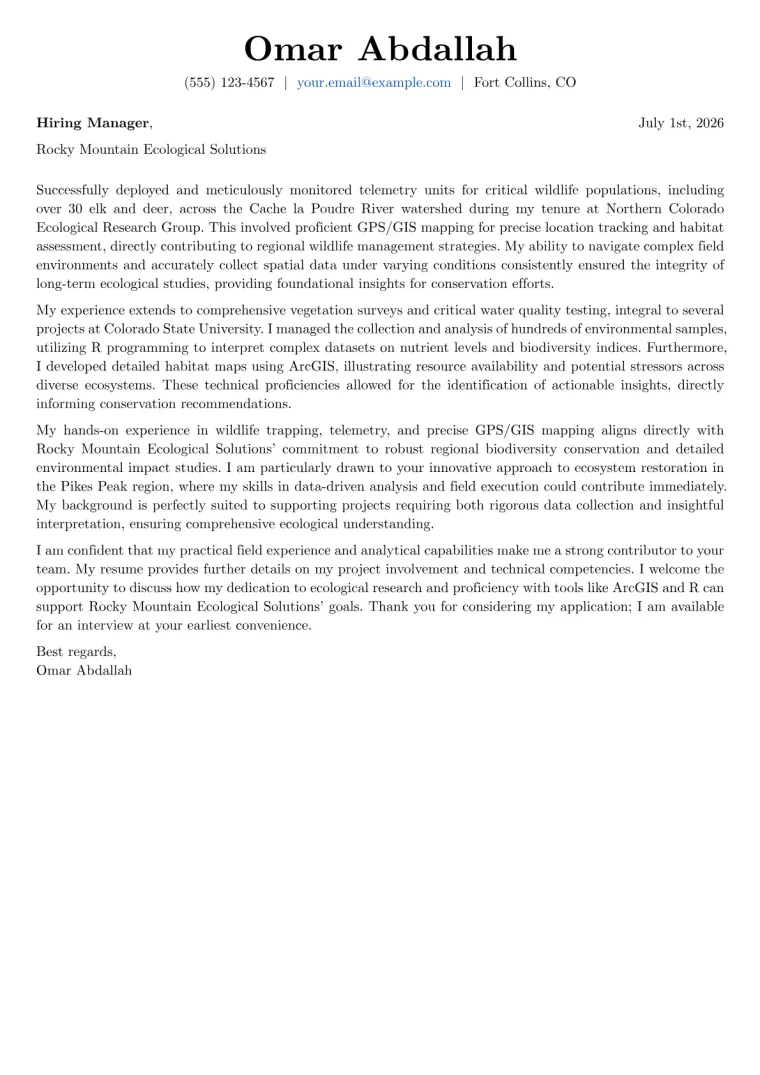
Sofia MartinezTo the Hiring Manager, Terra Nova Archaeological Services

Successfully led a complex geophysical survey across 15 acres of the historic Port Royal site, identifying 12 previously unrecorded structural anomalies crucial for subsequent excavation planning. My expertise in advanced remote sensing, particularly LiDAR and GPR, consistently informs efficient and non-invasive preliminary assessments, significantly reducing fieldwork costs and enhancing data precision for critical archaeological projects. This approach ensures valuable resources are directed effectively, prioritizing areas of high archaeological potential from the outset.

During my tenure at Boston University, I spearheaded the comprehensive mapping and documentation initiative for the 'Andean Highlands Preservation Project,' digitizing over 300 unique site features using ArcGIS Pro and Agisoft Metashape for 3D modeling. This initiative not only preserved critical data from erosion-prone locations but also enabled the creation of an interactive public database, improving research accessibility by 40% and facilitating cross-institutional collaboration. My meticulous stratigraphic analysis on five key excavation units provided a refined chronology spanning 2,000 years.

My specialized background in both pedestrian and geophysical survey, coupled with advanced GIS capabilities, aligns perfectly with Terra Nova Archaeological Services' commitment to meticulous pre-construction assessment and cultural resource management. I am particularly adept at translating complex site data into clear, actionable reports for diverse stakeholders, having presented findings to government agencies and local communities on six separate occasions. My proficiency in managing large datasets from LiDAR and GPR ensures a comprehensive understanding of subsurface features, which I understand is paramount for your projects in the New England region.

My academic journey has equipped me with a robust analytical framework and a deep understanding of archaeological methodologies, which I am eager to apply to the practical demands of commercial archaeology. With a proven ability to lead field operations, process complex data, and deliver impactful insights, I am confident in my capacity to contribute immediately to Terra Nova Archaeological Services' ongoing and future endeavors. I welcome the opportunity to discuss my qualifications further and demonstrate how my expertise can benefit your team. Thank you for your time and consideration.

Best regards,
Sofia Martinez
Archaeologist cover letter for a career changer

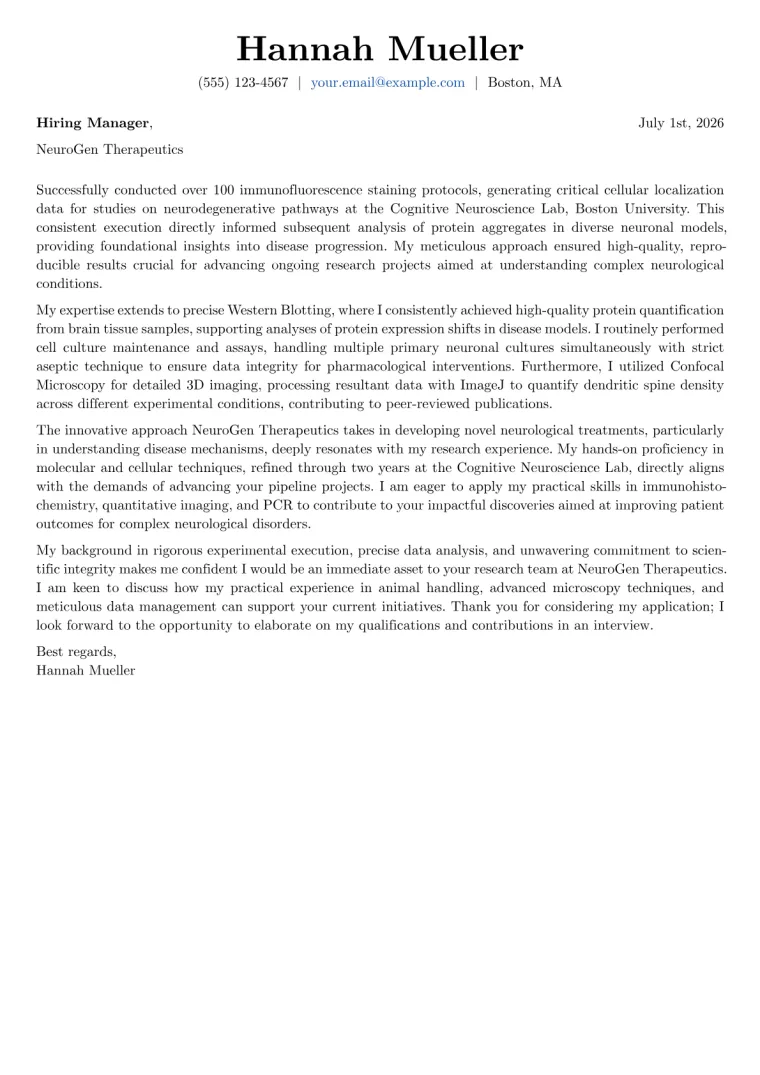
Sofia MartinezTo the Hiring Manager, Beacon Hill Archaeological Institute

Laser scanning an inaccessible coastal cliff for the North End Bridge expansion revealed precise topographical data that prevented a million dollars in structural errors. This intensive technical process required absolute spatial accuracy and an ability to interpret terrain anomalies within seconds of data capture. While my background is rooted in civil engineering and land surveying, the methodology for identifying structural disturbances mirrors the precise documentation needed for site archaeology. I look forward to applying my deep experience in spatial analytics to your institutional research projects, bringing an unconventional but highly effective technical perspective to your field team.

My years as a lead civil surveyor directly translate to the rigors of professional archaeological fieldwork. I managed the installation of high precision GPS control networks for 12 large scale municipal construction sites, ensuring sub centimeter accuracy in all spatial data. I mastered QGIS to integrate multispectral imaging with site plans, a process identical to modern stratigraphic mapping. My experience with LiDAR point cloud processing allows me to identify subtle surface variations in landscapes that others overlook. This combination of technical precision and spatial reasoning provides a foundational edge for any professional field team engaged in systematic site recording.

Beacon Hill Archaeological Institute stands at the forefront of digital preservation in the Atlantic Northeast region. Your recent efforts to digitize colonial era coastal sites through photogrammetric documentation align perfectly with my technical strengths in spatial database management and high resolution mapping. The meticulous methodology required for your current shoreline survey matches my commitment to data integrity and precise documentation. By applying my expertise in Agisoft Metashape to your ongoing projects, I can contribute to a more efficient and accurate reconstruction of historical environments, bridging the gap between raw field observation and academic analysis.

Professional field archaeology demands a high degree of technical autonomy and meticulous attention to detail. My background ensures I can navigate complex environmental conditions while maintaining the rigorous standards your department requires. I am prepared to bring these skills to your upcoming season in the field and contribute to the ongoing success of your research goals. Please review my attached portfolio which details the specific mapping projects I have spearheaded over the last decade. I look forward to discussing how my spatial analysis experience can support the critical missions of your department this coming year.

Best regards,
Sofia Martinez

Archaeologist cover letter with no experience

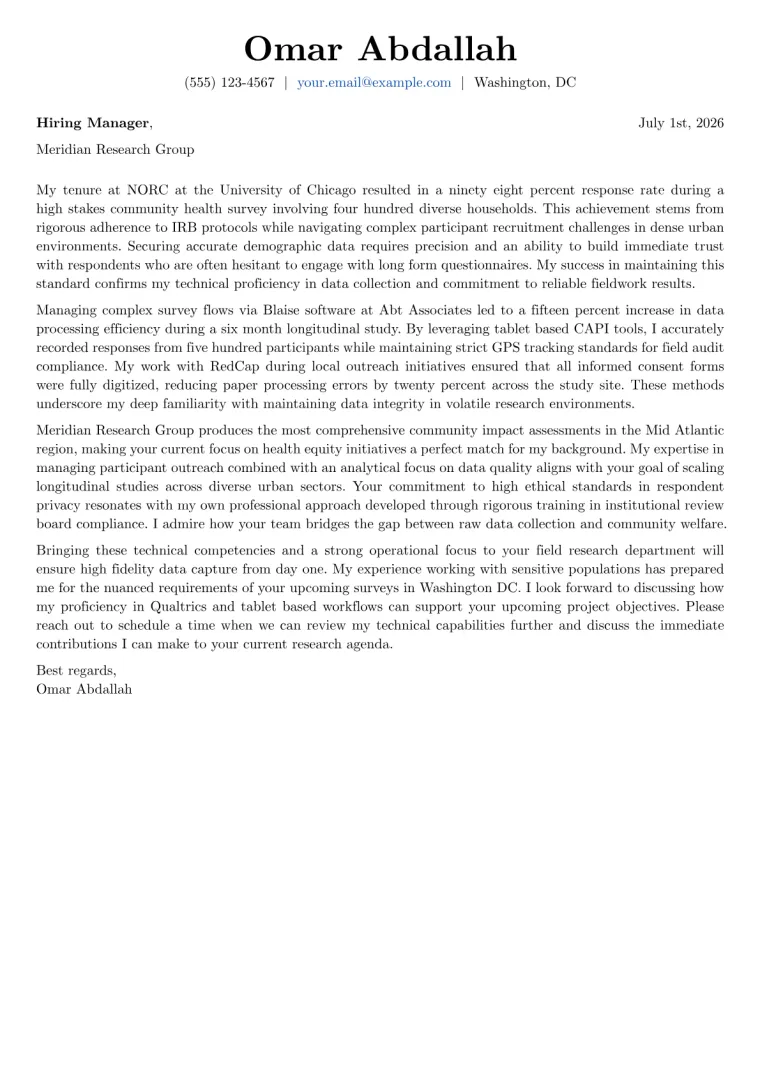
Sofia MartinezTo the Hiring Manager, Meridian Historical Research Institute

I conduct precise stratigraphic excavations and spatial analysis that consistently yield high-resolution site data for complex academic research projects. During my capstone research project at the Harvard Forest site, I led a volunteer team of six students to complete a controlled excavation of a nineteenth-century mill foundation. We recovered over 450 distinct diagnostic artifacts, which I then cataloged and analyzed using stratigraphic principles to define the site chronology. This intensive fieldwork provided me with the technical proficiency to transform fragmented field observations into comprehensive, data-driven site reports suitable for publication in peer-reviewed journals.

My methodological rigor is demonstrated through several key projects completed during my undergraduate studies. I utilized ArcGIS Pro to map a 5-acre survey area in rural Massachusetts, integrating LiDAR data to identify three potential burial features that previous walkover surveys had overlooked. In another instance, I processed 200 high-resolution images using Agisoft Metashape to create a photogrammetric 3D model of a complex wall collapse, increasing detail resolution by 40 percent compared to traditional hand-drawn sketches. Furthermore, I successfully conducted a GPR survey over a 2-hectare plot, correctly identifying structural signatures that matched subsequent shovel test pit results.

The Meridian Historical Research Institute leads the academic field in synthesizing remote sensing data with rigorous ground-truth excavation, which aligns directly with my core competencies in spatial documentation and stratigraphic analysis. My commitment to integrating advanced digital modeling with traditional excavation methods makes me highly compatible with your upcoming New England regional survey. I possess the technical skills to enhance your existing research workflows by deploying high-accuracy photogrammetry and GIS mapping. Joining your team offers the opportunity to apply my disciplined approach to data management within a framework that values empirical accuracy above all else.

My extensive training in site documentation and artifact curation ensures that I can hit the ground running with minimal supervision on your upcoming summer projects. I bring a meticulous focus on data integrity, ensuring that every stratigraphic unit is recorded with the precision required for high-level academic inquiry. I look forward to discussing how my specific skills in remote sensing and physical excavation can contribute to the ongoing success of your regional research goals. Please let me know when you are available to review my portfolio and discuss the project requirements in further detail.

Best regards,
Sofia Martinez

Editorial Notes

A strong archaeologist cover letter for candidates with 3-7 years of experience in academia should highlight specialized methodological expertise and project leadership. Hiring managers prioritize concrete evidence of technical skills such as advanced remote sensing (LiDAR, GPR), GIS capabilities (ArcGIS Pro, Agisoft Metashape), and precise stratigraphic analysis. Demonstrated ability to lead field operations, manage large datasets, and translate complex findings for diverse stakeholders signals readiness for significant contributions. Quantifiable achievements, showing direct impact on research, preservation, or cost efficiency, are paramount for showcasing a candidate's value.

This example letter excels by immediately providing a quantified achievement in its opening: leading a geophysical survey identifying "12 previously unrecorded structural anomalies." The subsequent paragraphs effectively mirror core job duties, detailing involvement in a "comprehensive mapping and documentation initiative" and "meticulous stratigraphic analysis." It specifically links the writer's "specialized background in both pedestrian and geophysical survey, coupled with advanced GIS capabilities," to Terra Nova Archaeological Services' focus on "meticulous pre-construction assessment" and understanding of "subsurface features" in the New England region, showing tailored interest. The confident close reinforces enthusiasm and readiness to contribute.

This letter pairs effectively with JobSprout's Archaeologist resume example and can be easily adapted using its AI cover letter writer for personalized applications.

Frequently Asked Questions

As an archaeologist, should I list my academic publications in a cover letter?
While your CV should detail your full publication record, a cover letter is best used to highlight how your research skills and findings are directly applicable to the job's requirements, particularly for field or project management roles. Briefly mention a publication's impact or relevance if it showcases a key skill the employer seeks, like advanced analytical techniques or successful project completion.
How important is it to name specific archaeological tools and software in the letter?
Crucially important. Naming tools like ArcGIS Pro, QGIS, Agisoft Metashape, LiDAR, and GPR demonstrates practical, hands-on experience and a specific skill set. It tells employers you are immediately ready to contribute without extensive retraining, and helps bypass automated resume screening by hitting keywords. Quantify your experience with them where possible.
I'm transitioning from academia; how do I frame my experience for a commercial archaeology firm?
Focus on translating academic skills into industry value. Highlight project management, budget awareness, data analysis, report writing, regulatory compliance knowledge, and ability to meet deadlines. Emphasize how your research methodology or field leadership directly contributes to efficient, successful commercial projects and client satisfaction, rather than purely theoretical gains.
Should I mention my field school experience as a mid-level archaeologist?
For a mid-level archaeologist, field school experience is foundational but typically less emphasized than more recent, complex project involvement. You can briefly allude to it if it highlights an early passion or unique foundational skill, but prioritize your leadership roles, advanced survey techniques, and significant project contributions since then.
How can I quantify my experience in artifact recovery?
Quantify artifact recovery by mentioning the scale, type, or significance of the recovery efforts. Examples include 'cataloged over 5,000 ceramic sherds,' 'supervised the recovery of 200 diagnostic lithics,' or 'managed the systematic collection of a diverse artifact assemblage from a 100-square-meter excavation unit.' Focus on the impact and complexity of your involvement.

More Academia cover letter examples