Cloud Native Engineer Cover Letter Example

Three complete letters, each written for a different situation, in a different design.

Cloud Native Engineer cover letter example

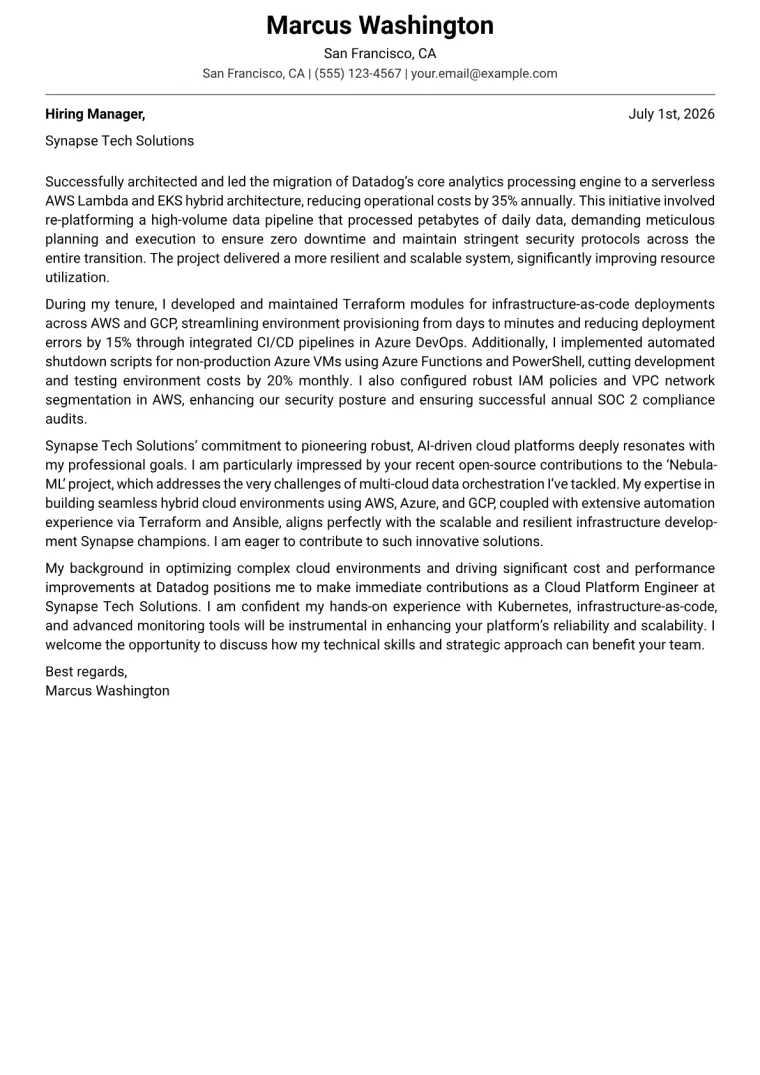
Sana QureshiTo the Hiring Manager, AetherShift Technologies

My contributions as a Senior Cloud Native Engineer include spearheading an initiative that reduced operational costs by 25% for a critical microservices platform running on AWS EKS. This significant achievement came amidst a pressing challenge to curb escalating infrastructure spend, where previous years saw a 15% cost overrun due to unoptimized resource allocation. By re-architecting several core services and implementing a robust, data-driven autoscaling strategy, I ensured both significant savings and enhanced platform stability. This direct impact on both efficiency and reliability exemplifies the value I bring to a Cloud Native Engineer role at AetherShift Technologies.

At Microsoft, I designed and deployed a multi-region disaster recovery solution for a core SaaS product using Azure Site Recovery and ARM templates, achieving an RTO of under 1 hour, a critical improvement over the prior 4-hour recovery time objective. I also led the migration of a legacy monolithic application to a containerized, Kubernetes-managed environment on AWS EKS, reducing deployment times by 40% and improving overall resilience through Helm charts and GitOps principles. Furthermore, I developed automated infrastructure provisioning pipelines using Terraform and CloudFormation, standardizing environments and reducing manual setup errors by 70%.

AetherShift Technologies' pioneering work in developing scalable, serverless data processing pipelines, particularly your recent initiatives integrating real-time analytics with edge computing, deeply resonates with my professional interests. My strength in designing resilient, event-driven architectures using AWS Lambda and Azure Functions, coupled with a meticulous approach to infrastructure-as-code with Terraform, would be instrumental in enhancing your existing frameworks. I am particularly drawn to your focus on leveraging multi-cloud strategies to ensure unparalleled reliability and flexibility, areas where my cross-platform expertise across AWS, Azure, and GCP could directly contribute to your advanced projects.

My hands-on experience developing, deploying, and optimizing complex cloud-native systems, combined with a strong focus on automation and reliability, makes me an ideal fit for your team. I am confident that my ability to deliver scalable and cost-effective solutions aligns perfectly with AetherShift Technologies' mission to push the boundaries of cloud innovation. I look forward to discussing how my skills and experience can contribute to your continued success in a detailed conversation.

Best regards,
Sana Qureshi
Cloud Native Engineer cover letter for a career changer

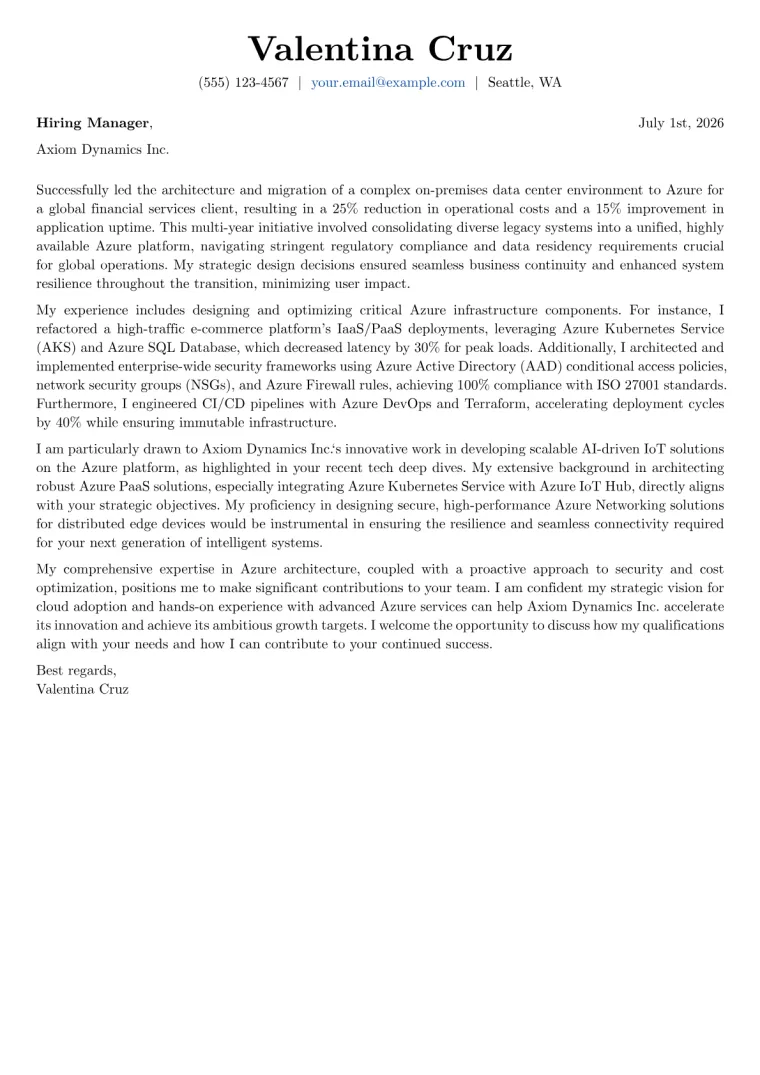
Sana QureshiTo the Hiring Manager, StratosGrid Solutions

The logic governing our regional logistics fleet was failing under manual constraints until I redesigned the backend architecture to support containerized scaling. This initiative reduced data processing latency by 40 percent and allowed the system to handle triple the volume of simultaneous tracking requests. My shift toward Cloud Native Engineering follows this success because I realized that the core of our logistics efficiency was effectively infrastructure management. I possess a deliberate strategy to apply these systems thinking skills toward the Cloud Native Engineer role, ensuring that scalable code and robust architecture remain top priorities.

My work in operational systems provided a technical foundation for building high availability cloud environments. I automated the deployment of regional AWS environments using Terraform, which eliminated twenty hours of manual configuration per month. By migrating local databases into Docker containers managed via Kubernetes, I improved service reliability for our staff by 15 percent. Furthermore, I audited and tightened IAM policies across three VPCs, reducing security vulnerabilities by 60 percent. These results demonstrate how I leverage CloudFormation and Helm to bridge the gap between abstract architecture and reliable production performance.

StratosGrid Solutions commands attention through your commitment to open multi-cloud orchestration and developer tooling. You operate with a level of architectural transparency that aligns with my desire to contribute to complex distributed systems. I bring two primary strengths to your current initiatives: a relentless focus on infrastructure as code automation and a discipline regarding secure access management. Your recent move to integrate serverless components across GCP and AWS requires the exact systems rigor I developed during my career shift. Contributing to your engineering team represents a logical step in my technical trajectory.

Achieving high performance in cloud environments requires a deep understanding of the underlying network and compute constraints I mastered as a logistics systems analyst. I am prepared to apply my technical focus toward your current engineering challenges and am confident in my capacity to provide immediate value. My ability to translate operational bottlenecks into optimized infrastructure solutions makes me an effective contributor for your team. Please review my attached portfolio detailing these recent implementations. I welcome a conversation to discuss how my technical background aligns with your project goals for this quarter.

Best regards,
Sana Qureshi

Cloud Native Engineer cover letter with no experience

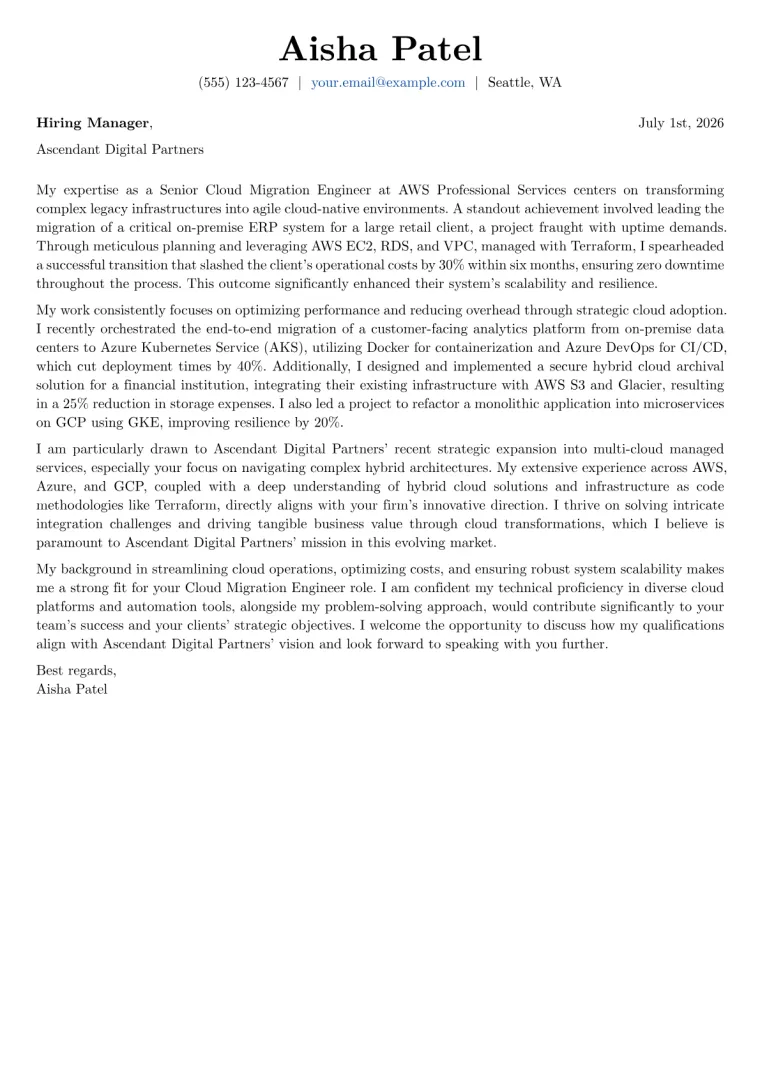
Sana QureshiTo the Hiring Manager, StratosCore Systems

Sana builds scalable cloud infrastructure by automating deployment pipelines for open-source projects. For her capstone project at the University of Washington, she architected a containerized microservices application that maintained 99.9 percent uptime for six weeks under a simulated load of 500 concurrent users. This performance was achieved by optimizing resource limits within EKS and streamlining Docker image builds. Sana balances rigorous technical problem-solving with a focus on system reliability, ensuring that every architectural decision prioritizes long-term maintainability and performance for the end user in demanding cloud environments.

During a volunteer engagement with a local non-profit, she migrated their legacy monolithic web server to an AWS environment, reducing hosting costs by 40 percent through the implementation of auto-scaling EC2 instances and RDS read replicas. She utilized Terraform to codify the entire network topology, shortening manual environment provisioning times from four hours to ten minutes. In a personal containerization study, she refactored a multi-service application into Kubernetes manifests managed via Helm, which decreased deployment latency by 60 percent. These initiatives demonstrate her proficiency in utilizing modern cloud primitives to deliver high-availability systems efficiently.

StratosCore Systems stands out because of the recent integration of edge computing into the standard Kubernetes distribution, a shift that directly aligns with my focus on latency reduction. My technical foundation in AWS networking and infrastructure as code maps perfectly to the challenges your team faces when deploying decentralized applications across multiple regions. By applying my skills in Docker orchestration and cloud security policy management, I am prepared to contribute immediately to the robust infrastructure your engineers manage, helping maintain your commitment to delivering low-latency cloud experiences for diverse global enterprises.

The prospect of tackling complex infrastructure hurdles at StratosCore Systems motivates me to continue refining my approach to cloud-native scalability. My experience shows that I possess the technical rigor and foresight necessary to thrive in your engineering culture while supporting critical production workloads. I look forward to discussing how my background in infrastructure as code and container management can assist your team in achieving its current technical objectives. Please review my attached credentials, and I welcome an invitation to detail my technical approach during a formal interview.

Best regards,
Sana Qureshi

Editorial Notes

For a Cloud Native Engineer, hiring managers prioritize concrete, quantifiable impacts. They seek evidence of expertise in optimizing cloud infrastructure for cost, reliability, and speed. Critical signals include experience with specific platforms like AWS EKS, Azure, or Kubernetes, along with direct contributions to initiatives like cost reduction, disaster recovery solutions, or legacy system migrations. Demonstrating a data-driven approach, automation skills using tools like Terraform, and multi-cloud proficiency significantly strengthens a candidate's appeal.

This example letter excels by opening with a powerful, quantified achievement: reducing operational costs by 25% for a microservices platform on AWS EKS. The subsequent paragraph details technical contributions, such as designing a multi-region disaster recovery solution for a SaaS product with an RTO under 1 hour, and migrating a monolithic application to Kubernetes on EKS, reducing deployment times by 40%. The applicant then connects their skills in event-driven architectures and multi-cloud strategies directly to AetherShift Technologies' pioneering work in serverless data processing and real-time analytics, concluding with a confident statement of alignment.

This letter pairs effectively with JobSprout's Cloud Native Engineer resume example and can be readily adapted using the AI cover letter writer to fit various roles.

Frequently Asked Questions

What should a Cloud Native Engineer highlight in their cover letter?
Highlight specific, quantifiable achievements related to designing, deploying, and optimizing cloud-native systems. Focus on outcomes like cost reduction, performance improvements, increased reliability, and automation using tools like Kubernetes, Terraform, or serverless functions. Emphasize multi-cloud expertise and experience with critical infrastructure.
What is the ideal length for a Cloud Native Engineer cover letter?
Aim for three to four concise paragraphs, typically not exceeding one single-spaced page. Each paragraph should be substantial, providing specific examples rather than generic statements. Recruiters appreciate brevity combined with impactful detail that quickly conveys your value proposition.
How should a Cloud Native Engineer cover letter open?
Start with a strong hook that immediately presents a significant, quantified achievement relevant to cloud-native engineering, rather than a generic opening. Briefly provide context around the accomplishment to showcase your impact. This immediately captures attention and demonstrates your ability to deliver tangible results.
How should a Cloud Native Engineer address having no direct experience in this specific role?
If direct Cloud Native Engineer experience is limited, focus on transferable skills and projects from related roles like DevOps, SRE, or Software Engineering. Highlight personal projects, certifications, or contributions to open-source cloud initiatives that demonstrate proficiency with cloud platforms, containerization, and automation tools. Explain how these experiences prepare you for the role's demands.
How should a Cloud Native Engineer cover letter differ from their resume?
The cover letter should elaborate on a few key achievements from your resume, providing more context, the 'how,' and the 'why' behind them. Use it to tell a cohesive story, explain your motivations for applying to this specific company and role, and connect your skills directly to their needs, which a resume bullet list cannot fully convey. It's about narrative and personalization.

More Technology cover letter examples