Cover Letter Examples

Disaster Recovery Engineer Cover Letter Example

A complete Disaster Recovery Engineer cover letter with a matching resume example.

Omar AbdallahTo the Hiring Manager, Resilient Cloud Solutions

Successfully led a critical DR exercise for a global CRM platform, reducing estimated recovery time by 35% (from 8 hours to 5.2 hours) through optimized AWS CloudFormation templates and Zerto replication. This initiative directly mitigated potential multi-million dollar revenue losses during major outages for high-volume enterprise clients. This achievement exemplifies my proactive approach to ensuring robust business continuity, a core capability I bring to the Disaster Recovery Engineer role at Resilient Cloud Solutions.

My expertise spans architecting and implementing resilient systems across diverse cloud environments. I designed a multi-cloud DR solution spanning AWS (EC2, RDS) and Azure (VMs, Blob Storage) for a complex 500+ microservice architecture, utilizing Azure Site Recovery and AWS RDS snapshots to achieve 99.9% data availability while reducing recovery costs by 15%. Furthermore, I orchestrated comprehensive failover testing for over 20 critical applications on VMware ESXi, leveraging Veeam Backup & Replication, ensuring compliance with strict RTO/RPO objectives and identifying 10+ critical pre-production vulnerabilities.

My deep experience in architecting multi-cloud disaster recovery strategies across AWS, Azure, and GCP, coupled with a focus on automation, aligns perfectly with Resilient Cloud Solutions’ commitment to next-generation resilience for complex enterprise environments. I am particularly drawn to your pioneering work in AI-driven predictive failure analysis, which presents an exciting challenge for refining proactive DR postures. My ability to translate complex technical requirements into actionable, resilient solutions would contribute directly to your mission of ensuring unparalleled business continuity for your clients.

My background at Salesforce, particularly in safeguarding high-availability services and optimizing recovery protocols, directly translates to the demands of this Disaster Recovery Engineer role at Resilient Cloud Solutions. I am confident in my capacity to enhance your existing frameworks, introduce innovative resilience strategies, and contribute immediately to your success. I look forward to discussing how my skills in cloud DR architecture and incident response can benefit your team and clients. Please consider my application for an interview.

Best regards,
Omar Abdallah
Editorial Notes

For a Disaster Recovery Engineer, a strong cover letter highlights quantifiable impact on business continuity and specific technical expertise. Hiring managers in the technology industry prioritize clear evidence of reducing recovery times (RTO) and minimizing data loss (RPO), often directly linking these to preventing financial losses. Demonstrating proficiency in cloud platforms like AWS, Azure, and GCP, alongside automation tools and experience with DR-specific solutions, signals a candidate's readiness to tackle complex resilience challenges. Proactive problem-solving and incident response leadership are also crucial signals.

This example letter excels by immediately grabbing attention with a quantified achievement: "reducing estimated recovery time by 35% (from 8 hours to 5.2 hours) through optimized AWS CloudFormation templates and Zerto replication." The subsequent paragraph provides concrete evidence of architecting multi-cloud DR solutions, citing specific technologies like Azure Site Recovery and AWS RDS snapshots, and detailing results like "99.9% data availability while reducing recovery costs by 15%." The letter skillfully aligns the candidate's skills with Resilient Cloud Solutions' "AI-driven predictive failure analysis," showing genuine interest. It concludes with a confident statement of immediate contribution.

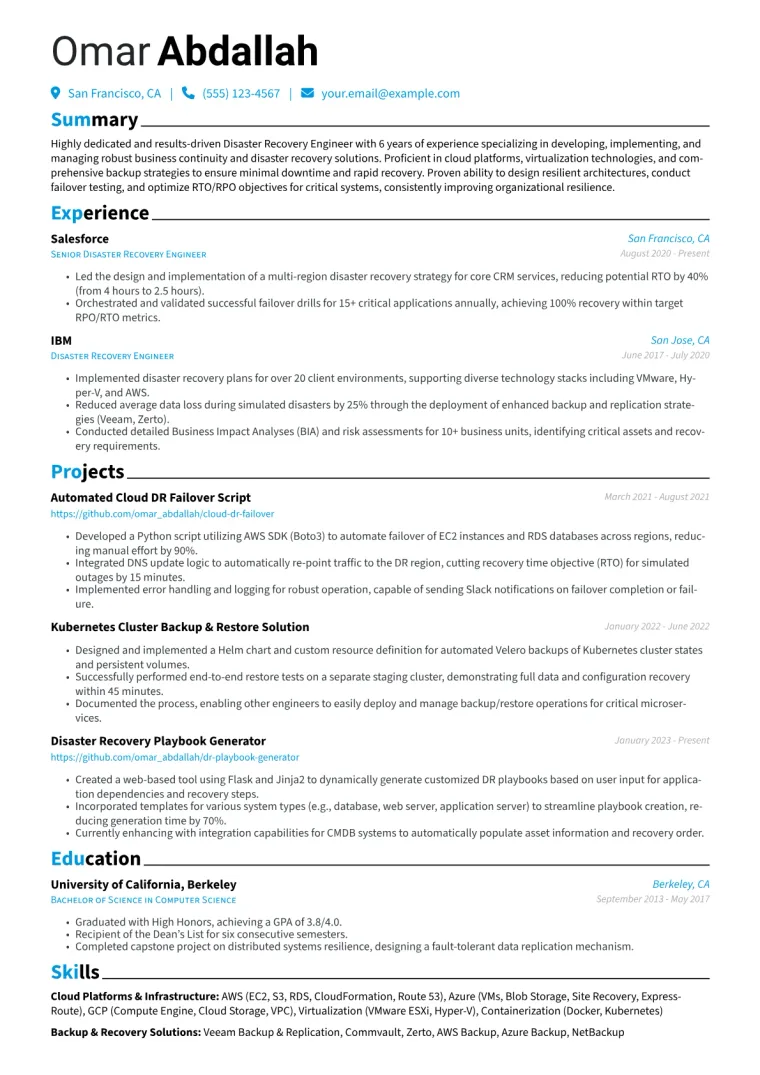
This letter pairs effectively with JobSprout's Disaster Recovery Engineer resume example. Users can adapt this framework with the AI cover letter writer, customizing it with their unique achievements and target company details.

Disaster Recovery Engineer Resume Example
Matching resume

Disaster Recovery Engineer Resume Example

The resume this letter was written to accompany, same person and experience.

See the resume example

Frequently Asked Questions

What should I highlight in a Disaster Recovery Engineer cover letter?
Focus on quantifiable achievements related to reducing RTO/RPO, improving system availability, and successful DR plan executions. Emphasize your multi-cloud expertise (AWS, Azure, GCP) and specific tools (Veeam, Zerto, CloudFormation). Highlight your ability to anticipate and mitigate potential failures, showing a proactive rather than reactive approach.
What is the ideal length for a Disaster Recovery Engineer cover letter?
Aim for a concise, single-page letter, typically consisting of three to four paragraphs. Each paragraph should be substantial, delivering specific examples and outcomes without unnecessary jargon or fluff. Recruiters often scan these, so brevity combined with impact is key.
How should I open my cover letter for this role?
Begin with a strong, impactful statement immediately highlighting a significant, quantified achievement relevant to disaster recovery, such as a major RTO reduction or a successful enterprise-level DR drill. This instantly demonstrates your value and sets a professional tone, immediately grabbing the reader's attention.
How do I address a lack of direct Disaster Recovery Engineer experience?
If you lack direct DR experience, focus on transferable skills from roles like DevOps, Cloud Engineering, or Systems Administration. Highlight experiences with high-availability systems, backup solutions, infrastructure as code for recovery, and any involvement in incident response or business continuity planning. Frame these experiences with a DR mindset.
How should this cover letter differ from my resume?
While your resume lists accomplishments concisely, the cover letter provides context and narrative. Elaborate on 2-3 key achievements from your resume, detailing the challenge, your specific actions, the tools used (e.g., Zerto, AWS Site Recovery), and the quantified impact. Use it to connect your unique skills to the specific needs and mission of the company.

More Technology cover letter examples