Summary
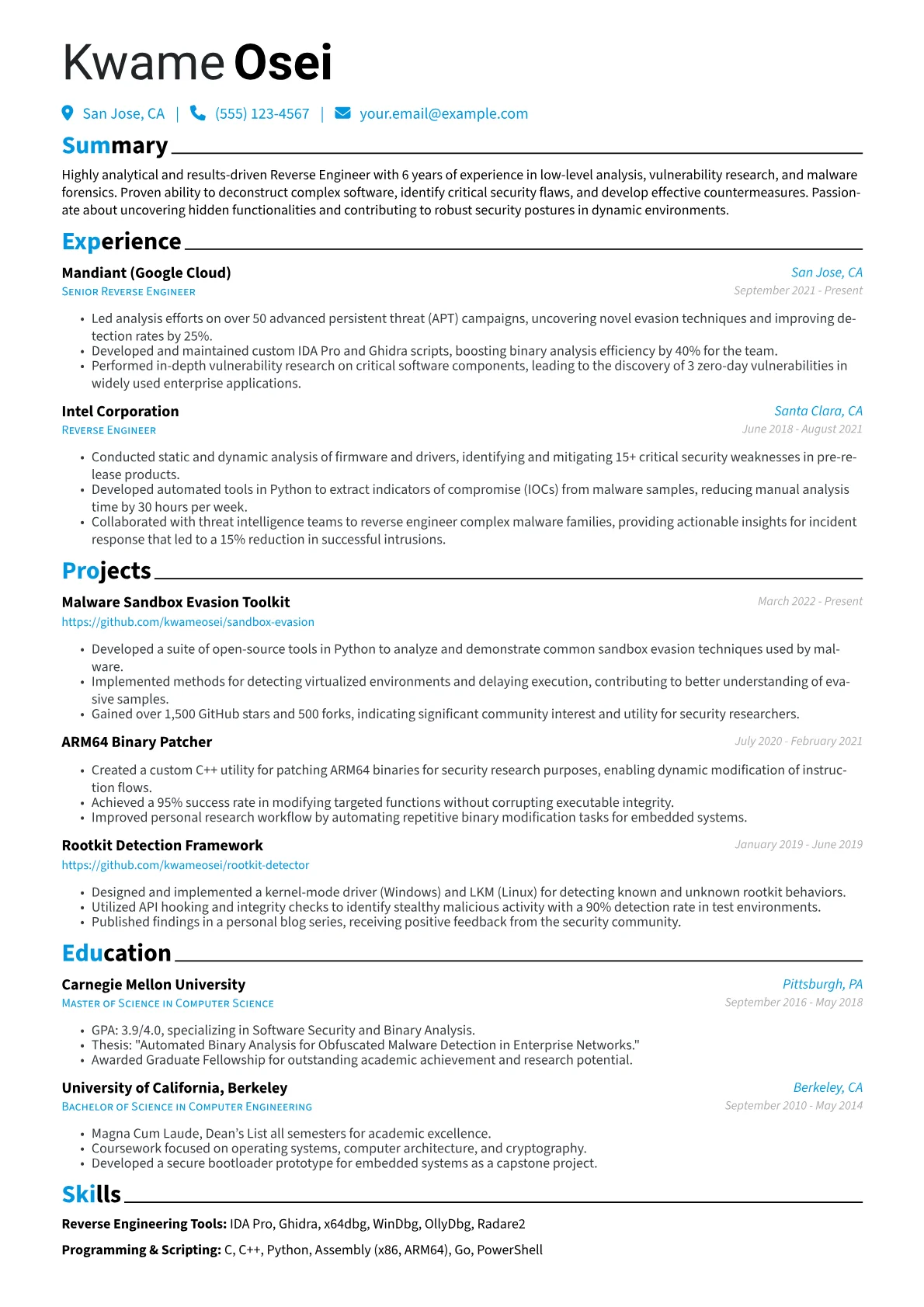
Highly analytical and results-driven Reverse Engineer with 6 years of experience in low-level analysis, vulnerability research, and malware forensics. Proven ability to deconstruct complex software, identify critical security flaws, and develop effective countermeasures. Passionate about uncovering hidden functionalities and contributing to robust security postures in dynamic environments.
Experience
Senior Reverse EngineerMandiant (Google Cloud)
- Led analysis efforts on over 50 advanced persistent threat (APT) campaigns, uncovering novel evasion techniques and improving detection rates by 25%.
- Developed and maintained custom IDA Pro and Ghidra scripts, boosting binary analysis efficiency by 40% for the team.
- Performed in-depth vulnerability research on critical software components, leading to the discovery of 3 zero-day vulnerabilities in widely used enterprise applications.
Reverse EngineerIntel Corporation
- Conducted static and dynamic analysis of firmware and drivers, identifying and mitigating 15+ critical security weaknesses in pre-release products.
- Developed automated tools in Python to extract indicators of compromise (IOCs) from malware samples, reducing manual analysis time by 30 hours per week.
- Collaborated with threat intelligence teams to reverse engineer complex malware families, providing actionable insights for incident response that led to a 15% reduction in successful intrusions.
Projects
Malware Sandbox Evasion Toolkit
- Developed a suite of open-source tools in Python to analyze and demonstrate common sandbox evasion techniques used by malware.
- Implemented methods for detecting virtualized environments and delaying execution, contributing to better understanding of evasive samples.
- Gained over 1,500 GitHub stars and 500 forks, indicating significant community interest and utility for security researchers.
ARM64 Binary Patcher
- Created a custom C++ utility for patching ARM64 binaries for security research purposes, enabling dynamic modification of instruction flows.
- Achieved a 95% success rate in modifying targeted functions without corrupting executable integrity.
- Improved personal research workflow by automating repetitive binary modification tasks for embedded systems.
Rootkit Detection Framework
- Designed and implemented a kernel-mode driver (Windows) and LKM (Linux) for detecting known and unknown rootkit behaviors.
- Utilized API hooking and integrity checks to identify stealthy malicious activity with a 90% detection rate in test environments.
- Published findings in a personal blog series, receiving positive feedback from the security community.
Education
Carnegie Mellon UniversityMaster of Science in Computer Science
- GPA: 3.9/4.0, specializing in Software Security and Binary Analysis.
- Thesis: "Automated Binary Analysis for Obfuscated Malware Detection in Enterprise Networks."
- Awarded Graduate Fellowship for outstanding academic achievement and research potential.
University of California, BerkeleyBachelor of Science in Computer Engineering
- Magna Cum Laude, Dean's List all semesters for academic excellence.
- Coursework focused on operating systems, computer architecture, and cryptography.
- Developed a secure bootloader prototype for embedded systems as a capstone project.
Skills
Reverse Engineering Tools
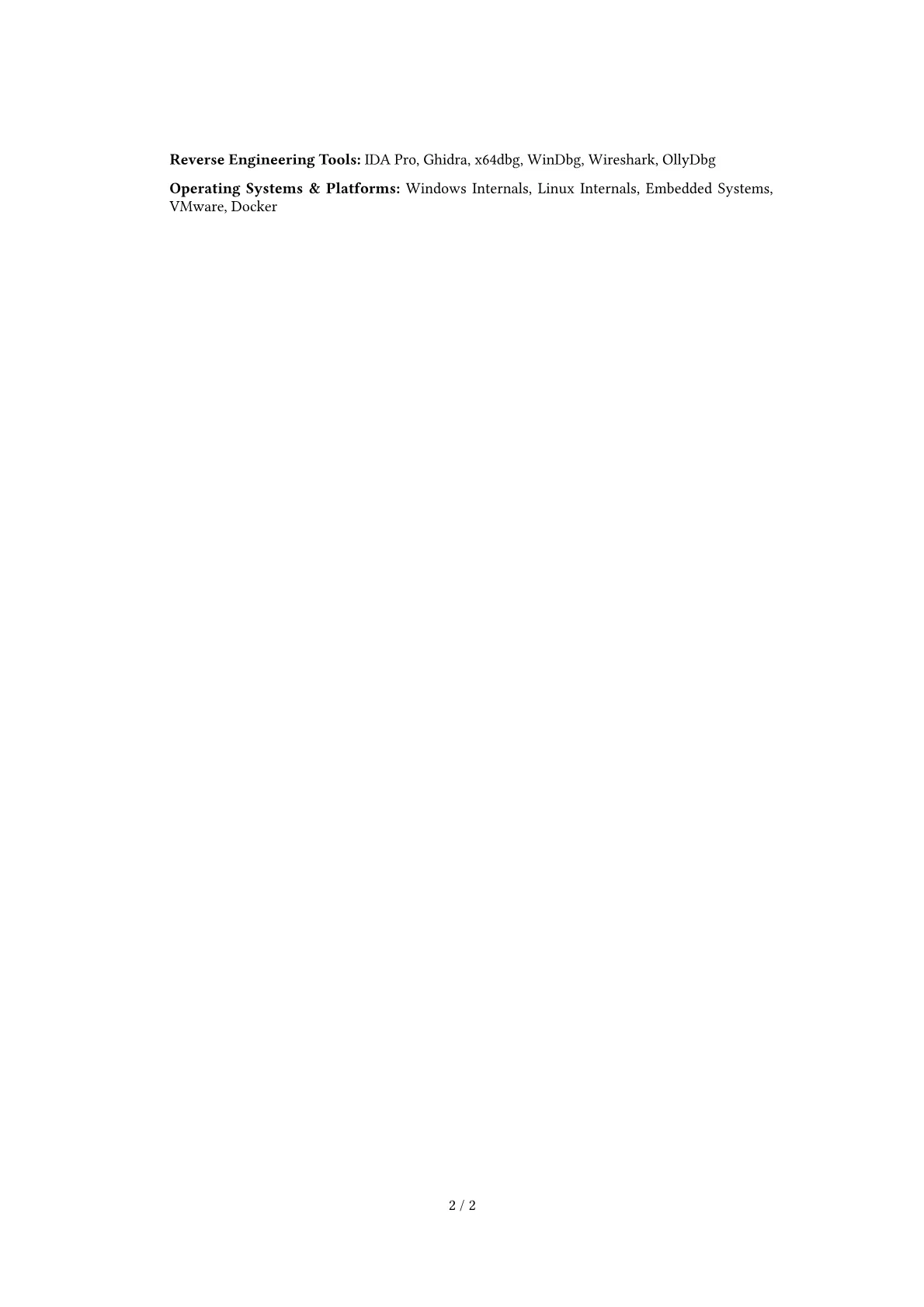
IDA ProGhidrax64dbgWinDbgOllyDbgRadare2
Programming & Scripting
CC++PythonAssembly (x86, ARM64)GoPowerShell
Operating Systems
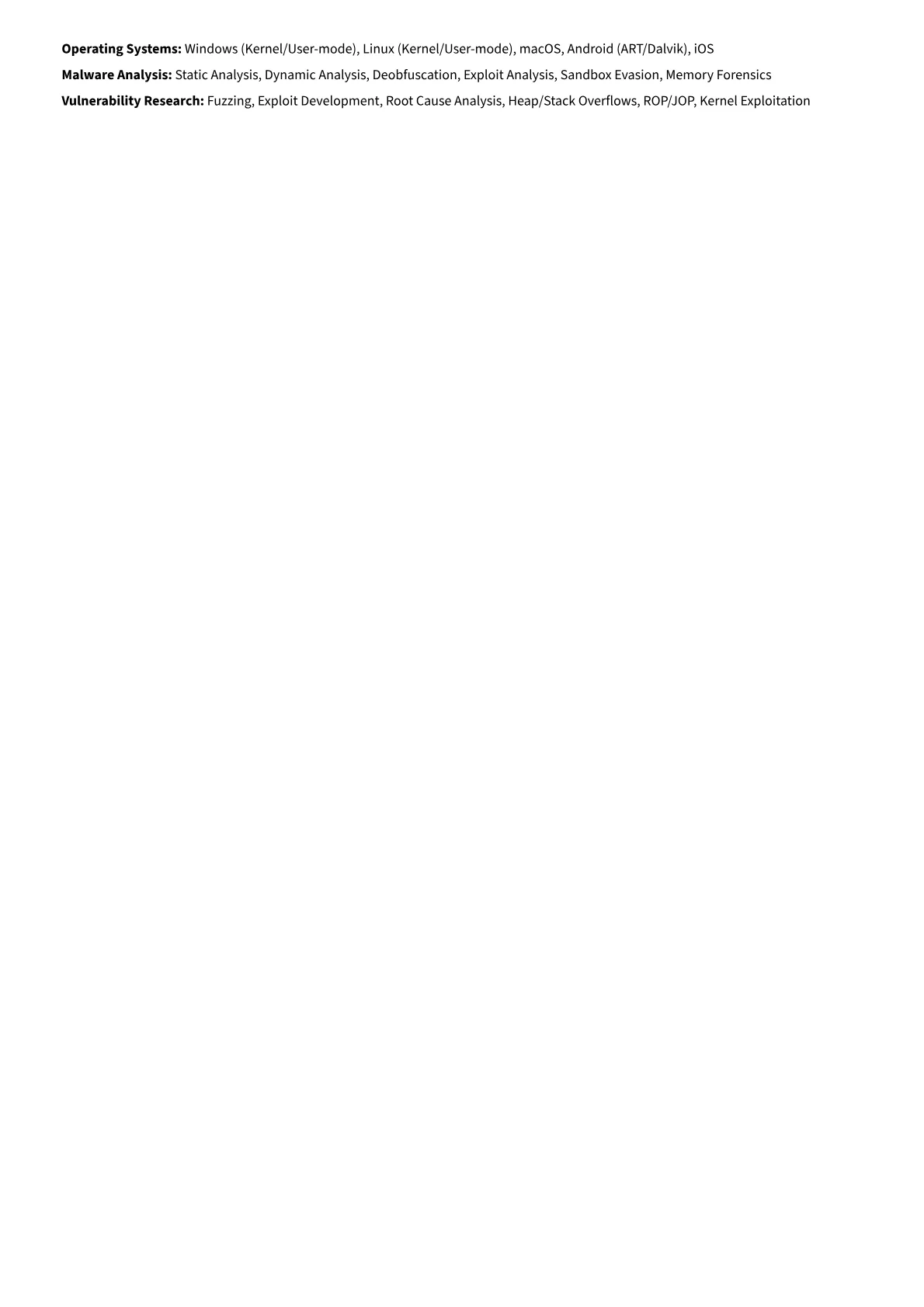
Windows (Kernel/User-mode)Linux (Kernel/User-mode)macOSAndroid (ART/Dalvik)iOS
Malware Analysis
Static AnalysisDynamic AnalysisDeobfuscationExploit AnalysisSandbox EvasionMemory Forensics
Vulnerability Research
FuzzingExploit DevelopmentRoot Cause AnalysisHeap/Stack OverflowsROP/JOPKernel Exploitation
![How to Write a CV for Tech Applications [2026 Guide]](/thumbnails/cv-for-tech-applications.webp)
![How to Write a CV That Shows Startup Experience [2026 Guide]](/thumbnails/cv-for-startup-engineers.webp)