
Summary
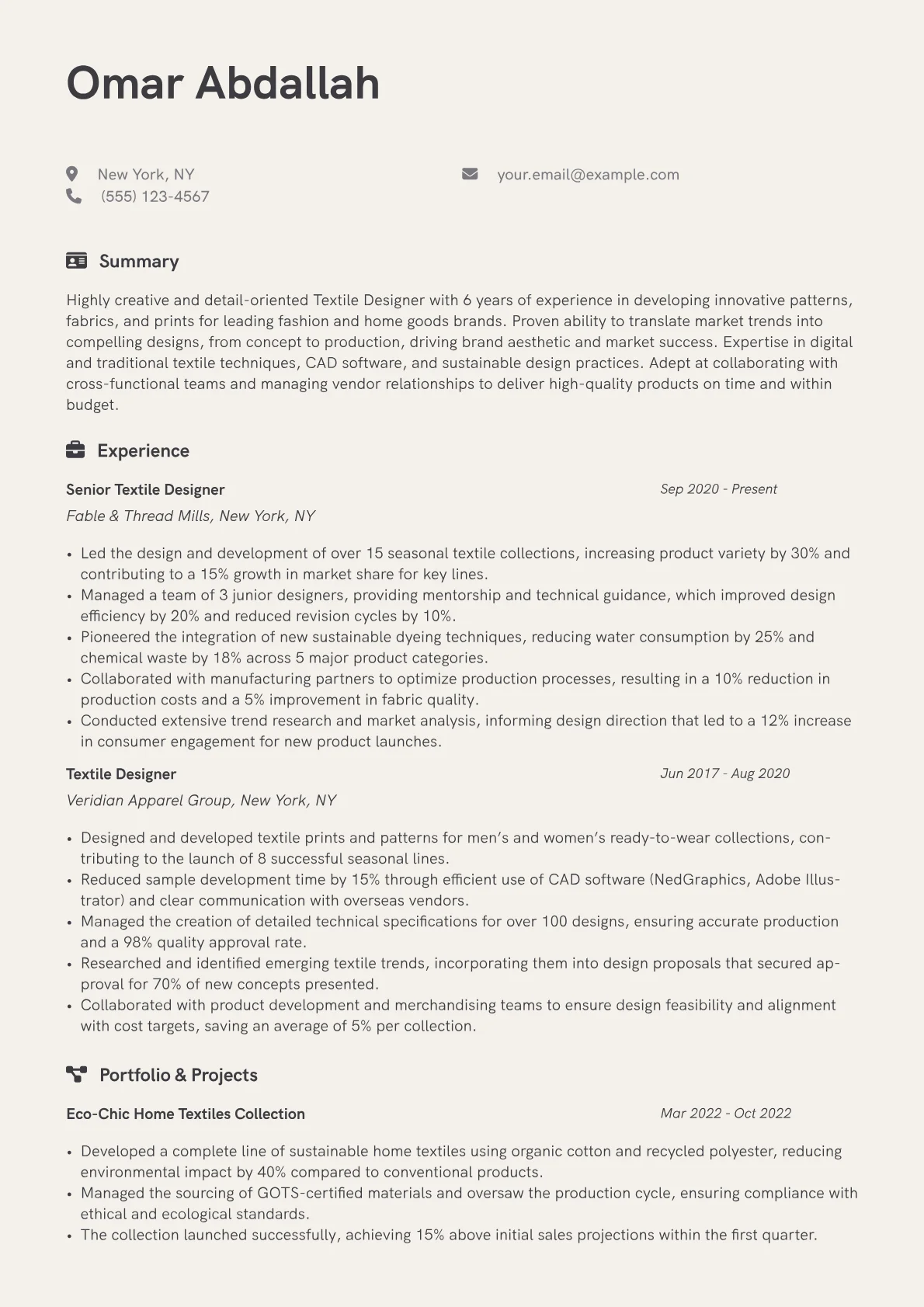
Highly creative and detail-oriented Textile Designer with 6 years of experience in developing innovative patterns, fabrics, and prints for leading fashion and home goods brands. Proven ability to translate market trends into compelling designs, from concept to production, driving brand aesthetic and market success. Expertise in digital and traditional textile techniques, CAD software, and sustainable design practices. Adept at collaborating with cross-functional teams and managing vendor relationships to deliver high-quality products on time and within budget.
Experience
Senior Textile DesignerFable & Thread Mills
- Led the design and development of over 15 seasonal textile collections, increasing product variety by 30% and contributing to a 15% growth in market share for key lines.
- Managed a team of 3 junior designers, providing mentorship and technical guidance, which improved design efficiency by 20% and reduced revision cycles by 10%.
- Pioneered the integration of new sustainable dyeing techniques, reducing water consumption by 25% and chemical waste by 18% across 5 major product categories.
- Collaborated with manufacturing partners to optimize production processes, resulting in a 10% reduction in production costs and a 5% improvement in fabric quality.
- Conducted extensive trend research and market analysis, informing design direction that led to a 12% increase in consumer engagement for new product launches.
Textile DesignerVeridian Apparel Group
- Designed and developed textile prints and patterns for men's and women's ready-to-wear collections, contributing to the launch of 8 successful seasonal lines.
- Reduced sample development time by 15% through efficient use of CAD software (NedGraphics, Adobe Illustrator) and clear communication with overseas vendors.
- Managed the creation of detailed technical specifications for over 100 designs, ensuring accurate production and a 98% quality approval rate.
- Researched and identified emerging textile trends, incorporating them into design proposals that secured approval for 70% of new concepts presented.
- Collaborated with product development and merchandising teams to ensure design feasibility and alignment with cost targets, saving an average of 5% per collection.
Portfolio & Projects
Eco-Chic Home Textiles Collection
- Developed a complete line of sustainable home textiles using organic cotton and recycled polyester, reducing environmental impact by 40% compared to conventional products.
- Managed the sourcing of GOTS-certified materials and oversaw the production cycle, ensuring compliance with ethical and ecological standards.
- The collection launched successfully, achieving 15% above initial sales projections within the first quarter.
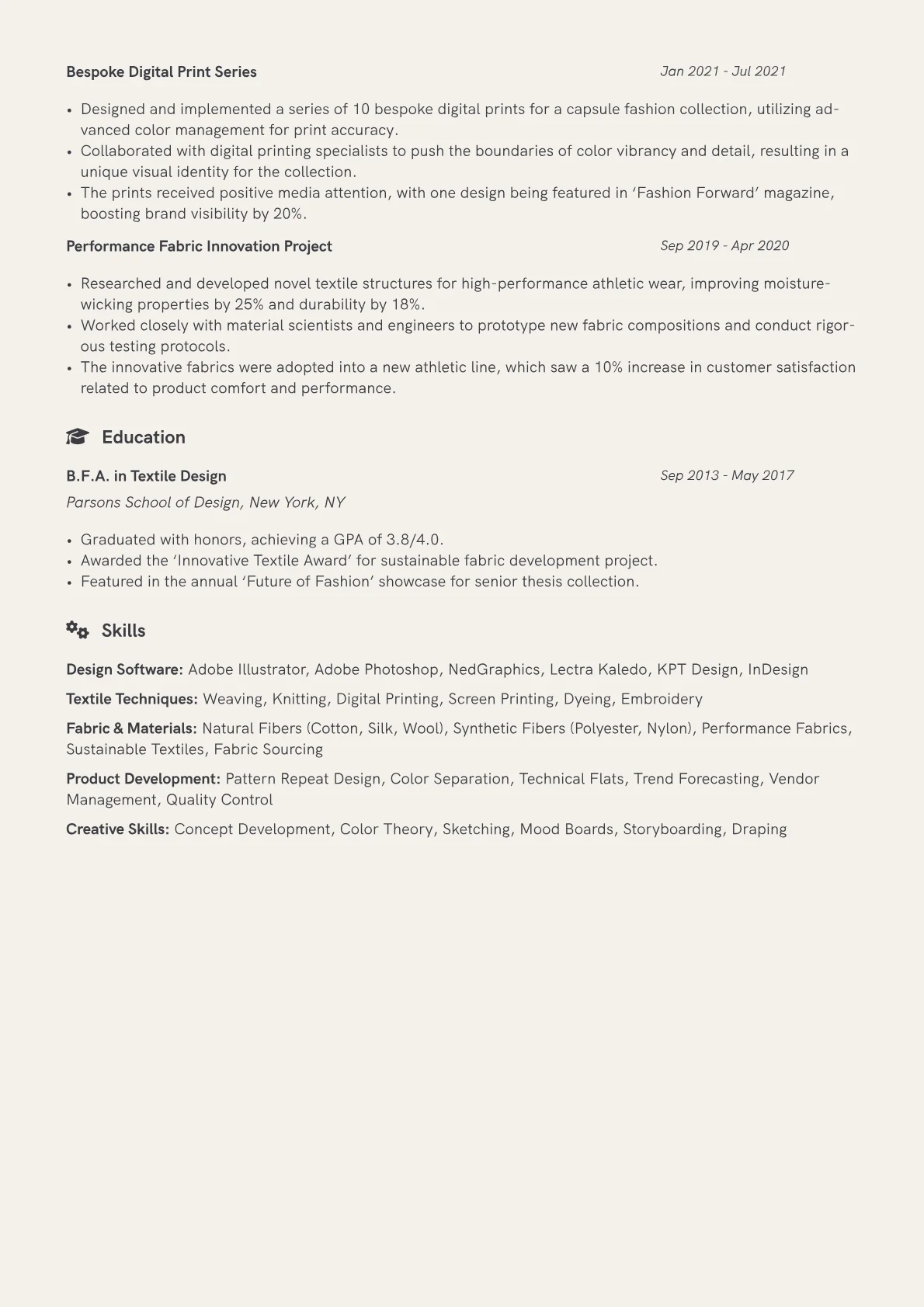
Bespoke Digital Print Series
- Designed and implemented a series of 10 bespoke digital prints for a capsule fashion collection, utilizing advanced color management for print accuracy.
- Collaborated with digital printing specialists to push the boundaries of color vibrancy and detail, resulting in a unique visual identity for the collection.
- The prints received positive media attention, with one design being featured in 'Fashion Forward' magazine, boosting brand visibility by 20%.
Performance Fabric Innovation Project
- Researched and developed novel textile structures for high-performance athletic wear, improving moisture-wicking properties by 25% and durability by 18%.
- Worked closely with material scientists and engineers to prototype new fabric compositions and conduct rigorous testing protocols.
- The innovative fabrics were adopted into a new athletic line, which saw a 10% increase in customer satisfaction related to product comfort and performance.
Education
Parsons School of DesignB.F.A. in Textile Design
- Graduated with honors, achieving a GPA of 3.8/4.0.
- Awarded the 'Innovative Textile Award' for sustainable fabric development project.
- Featured in the annual 'Future of Fashion' showcase for senior thesis collection.
Skills
Design Software
Adobe IllustratorAdobe PhotoshopNedGraphicsLectra KaledoKPT DesignInDesign
Textile Techniques
WeavingKnittingDigital PrintingScreen PrintingDyeingEmbroidery
Fabric & Materials
Natural Fibers (Cotton, Silk, Wool)Synthetic Fibers (Polyester, Nylon)Performance FabricsSustainable TextilesFabric Sourcing
Product Development
Pattern Repeat DesignColor SeparationTechnical FlatsTrend ForecastingVendor ManagementQuality Control
Creative Skills
Concept DevelopmentColor TheorySketchingMood BoardsStoryboardingDraping
![How to Write a CV for UX Design Applications [2026 Guide]](/thumbnails/cv-for-design-applications.webp)
![How to Write a CV for Manufacturing Applications [2026 Guide]](/thumbnails/cv-for-manufacturing-applications.webp)