Read the job ad before you choose. A German vacancy may say near the end which documents to send and how. More and more employers take applications only by email or through their own online form, and a form can settle the format for you. If the ad or the programme asks for a Europass CV, send one. If it names no format, a tabular Lebenslauf is the conventional German choice.
Neither format is wrong in Germany. EURES, the EU's job mobility portal, describes the tabular Lebenslauf and also recommends the Europass format in its guide to working in Germany. Make it in Germany, the federal government's portal for international professionals, adds that companies there usually appreciate an individual design, and suggests using the Europass CV as a guide that you adapt to your own style.
| Shown designs | German Lebenslauf | Europass-style resume |
|---|---|---|
| Use it when | The ad asks for a Lebenslauf or names no format | The ad or programme asks for Europass |
| Layout | Dates in a column beside each entry | Dates above each entry, languages on a CEFR grid |
| Photo | Optional, top right | Optional, in the top panel |
| Language | As the application asks, usually German | As the application asks |
| What you send | A PDF | A PDF, or one shared from the Europass site if asked |
What a tabular Lebenslauf looks like
A tabular Lebenslauf (tabellarischer Lebenslauf) puts dates on the left and each period's details on the right. The IHK Pfalz guide calls it "links die Daten, rechts die Fakten".
The Bundesagentur für Arbeit's guidance for international applicants recommends two pages at most. Use clear sections, newest entries first, and give a month and year for each start and end date.
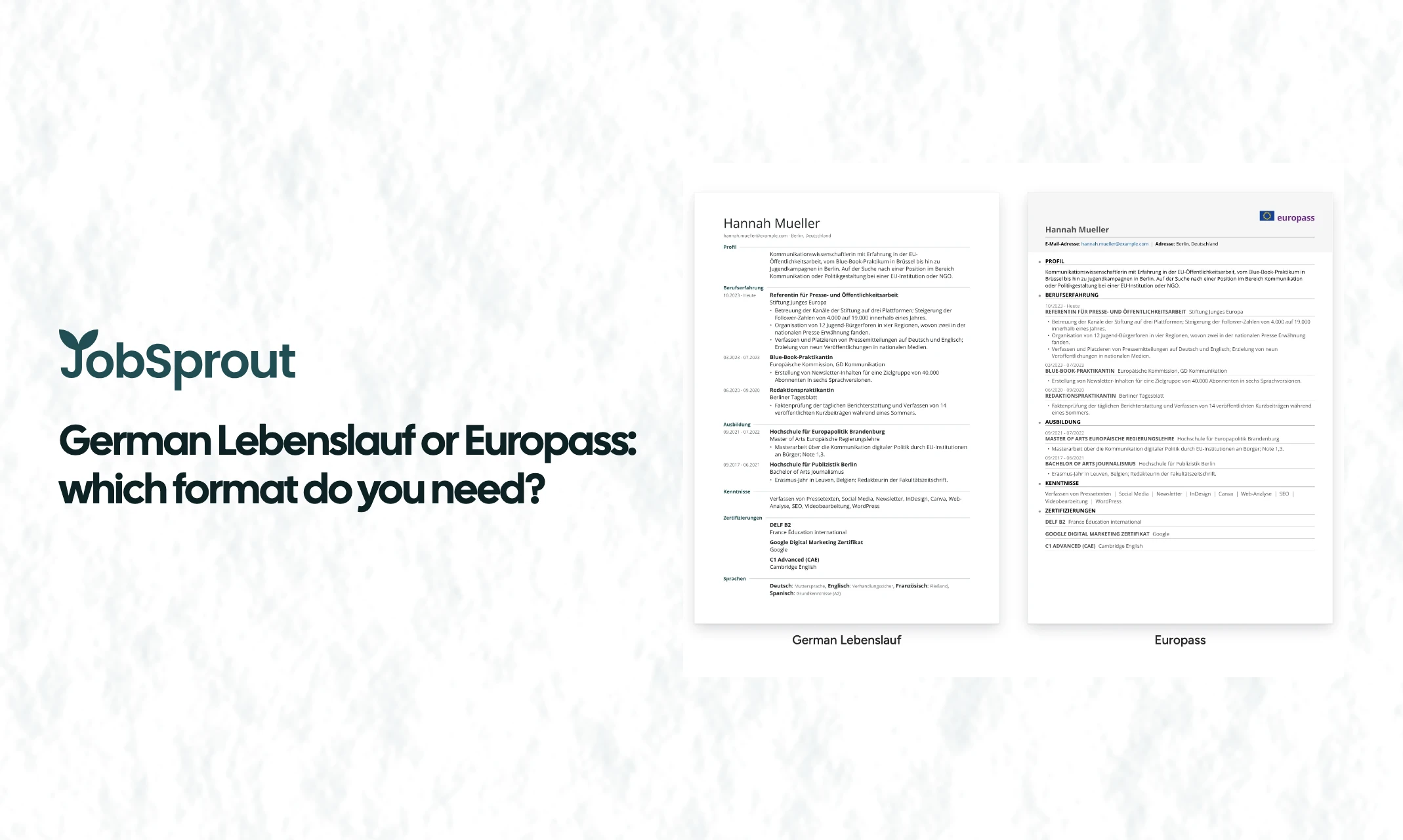
You can see all of that in the example further down, a fictional resume for Hannah Mueller. Her current job reads 10.2023 - Heute (today), with her role, employer and three results beside it. Her sections run from Profil to Sprachen (languages), but the order is yours to set: a recent graduate can put Ausbildung (education) first.
When Europass is the useful choice
Only the first of these is a rule; the other two are your call.
- The application asks for it. Then it's the right document wherever the job is, Germany included.
- You're applying in several countries. The official editor keeps your details in a Europass profile, and once you complete it you can make as many Europass CVs from it as you need. That saves retyping the same facts for each country.
- The layout suits you. Europass has you rate your own languages on the CEFR scale, skill by skill. Make it in Germany already suggests CEFR levels for languages, such as "English: C1", and the grid lays them out for you.
The official editor has you choose the information to include and a design, so Europass CVs vary in look. Ours is an independent version, with the personal panel and the CEFR grid shown below.
Compare the same experience in both layouts
Hannah is a fictional communications professional in Berlin. Her resume is written in German and rendered in both designs from exactly the same details: the same roles, dates, degrees, certificates and languages.
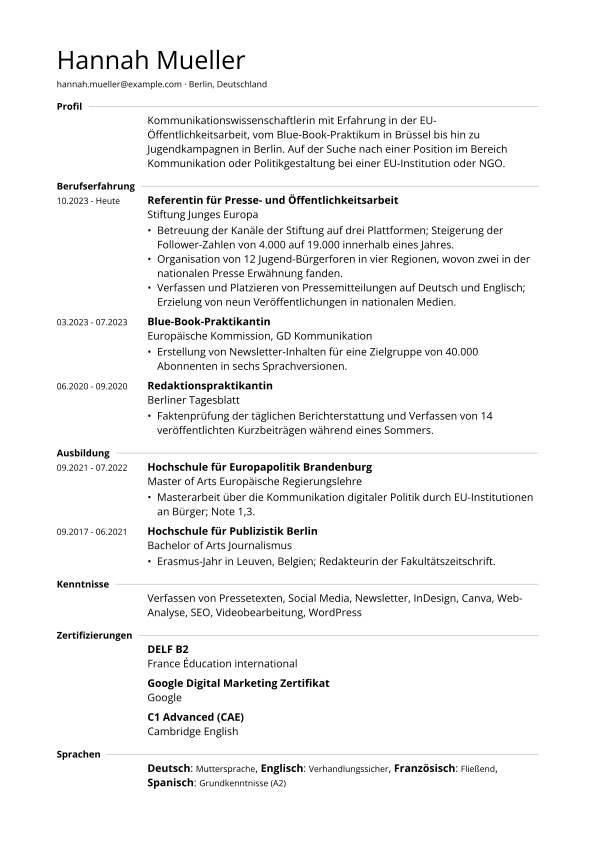
German Lebenslauf, one page. A fictional example: Hannah Mueller's German-language communications resume.
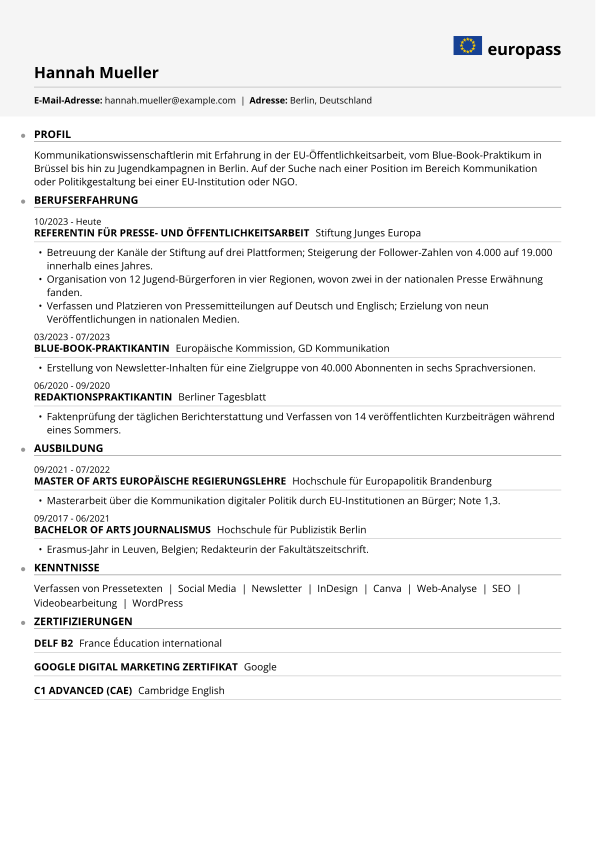
Europass, page 1 of 2: the same fictional German-language communications resume.
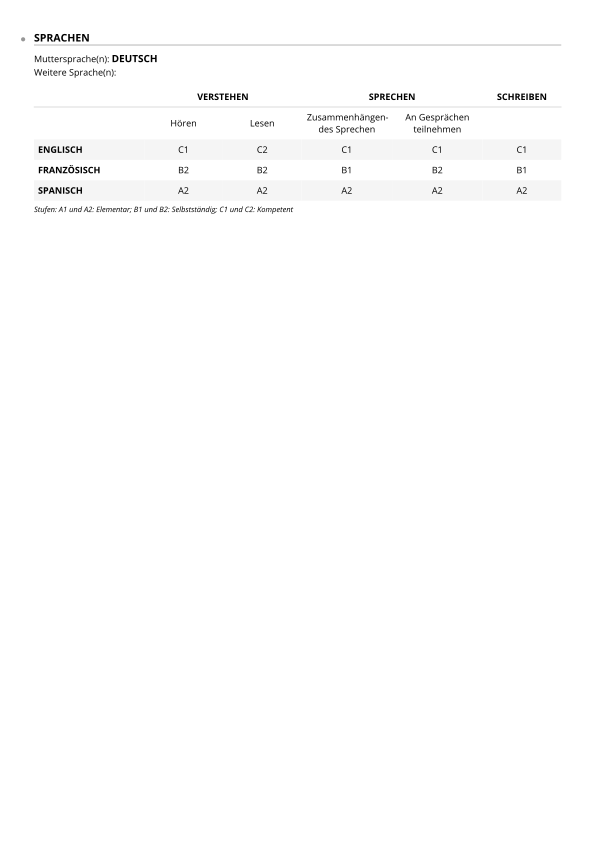
Europass, page 2 of 2: Hannah's foreign languages on the CEFR grid.
Two differences matter when you choose.
- Dates. The Lebenslauf keeps every date in its own column, so a reader can run down the left edge and follow the career. Europass prints each date on a line above its entry, with the job title in capitals.
- Languages. The Lebenslauf prints Hannah's levels as she wrote them, such as "Englisch: Verhandlungssicher" (business fluent). Europass shows her foreign languages on a grid with five skills each, rated from A1 to C2, which here moves the languages onto a second page.
Decide which personal details belong in this application
- Photo. The Bundesagentur's applicant guide says a photo is no longer a must, its international guidance adds that most employers still expect one, and Make it in Germany notes big differences between industries. Follow the vacancy.
- Date of birth. Both Bundesagentur guides list it among the personal details to include.
- Family, nationality and religion. The same applicant guide calls family details and nationality voluntary, and says to give your religion only if the employer asks for it.
If the employer runs an anonymised application, leave the photo and date of birth off. Our designs work with or without either, and the page closes up around whatever you leave out.
Choose the output language and file
Two language settings are easy to confuse. The document has its own language setting: you can use the app in English and set the resume itself to German, and the section headings and date words follow the document, as in Berufserfahrung, Ausbildung and Heute.
If you're translating your resume into German, read every line before you send it, and keep the official names of your degrees, certificates and employers exactly as they are. In Hannah's example, DELF B2 and C1 Advanced (CAE) stay as they appear on the certificates.
Make it in Germany says documents usually go as a PDF by email or through the employer's careers site. For email applications, EURES suggests one combined PDF no larger than 2 MB.
Keep the editable resume in JobSprout and download a PDF for each application. Our Europass-style PDF contains no structured Europass profile data. Use the official editor if the application requires a CV created there.
Create the document you need
Start from the German-language Lebenslauf page for a Lebenslauf, or use the Europass CV builder if the application asks for Europass. Our gallery has an English overview of the Lebenslauf design.