PDF or DOCX · up to 2MB
Whether to put a photo on your CV depends on the country. Where it is expected, where to leave it off, the usual sizes, and what makes a good one.

Your LinkedIn About holds 2,600 characters, but desktop shows about four lines before "see more". Where LinkedIn folds each section, and what to put first.
How to take a professional headshot at home with your phone: the lens, the light, the distance and the crop, plus when an AI headshot does a better job.

A LinkedIn profile review to run before you apply, in the order a recruiter reads you, plus a free checker that shows what holds you back in search.
In New York, a photo on your CV can get your application set aside before anyone reads it. In Munich or Tokyo, leaving it off can look like you did not know the rules.
The short version:
And one rule beats every country: if the job ad or application form asks for a photo, include one, and if it asks you not to, don't.
For everything else that changes between countries, such as length, personal details and date formats, see our international resume format guide. If you are not sure whether you need a CV or a resume in the first place, start with CV vs resume.
| Country | Photo? | Usual format |
|---|---|---|
| United Kingdom | No | None |
| Ireland | No | None |
| United States | No | None |
| Canada | No | None |
| Australia and New Zealand | No | None |
| Germany | Common | Portrait, roughly 4.5 x 6 cm, top right of the CV or on a cover page |
| Austria and Switzerland | Common | As Germany |
| France | Optional, often included | Small, top corner |
| Spain and Italy | Common | Small, top corner |
| Portugal | Optional, often included | Small, top corner |
| Netherlands and Belgium | Optional | Small, top corner |
| Nordic countries | Optional | Small, top corner |
| Poland | Common | Small, top corner |
| Japan (rirekisho) | Required | 3 x 4 cm, in the form's photo box |
| South Korea | Follow the form | 3 x 4 cm when asked for |
| China | Common | Small ID-style photo, top right |
| UAE, Saudi Arabia, Qatar | Common | Small, top corner |
| India | Optional | Usually left off for multinationals |
Treat this as a starting point. The posting's own instructions outrank the table.
United States. No law bans a photo on a resume, but US employers work hard not to see anything that could suggest a hiring decision was based on race, age, sex or appearance. The US Equal Employment Opportunity Commission tells employers not to ask applicants for photographs, and to collect one only after an offer is made and accepted, if they need it for identification. Many recruiters remove resumes with photos rather than take the risk.
United Kingdom and Ireland. The UK Equality Act 2010 and Ireland's Employment Equality Acts make the same concern real for employers. A photo adds nothing a UK recruiter wants and gives them something they would rather not see. Leave it off, along with date of birth and marital status.
Canada, Australia and New Zealand. Same convention. A photo marks the CV as written for a different market.
The exceptions in these countries are jobs where appearance is part of the work, such as acting, modelling and some presenting roles. Even then the photo usually goes in a separate headshot or portfolio, not on the CV itself.
German law (the General Equal Treatment Act of 2006) bars hiring decisions based on age, ethnic origin, sex and other protected characteristics. Asking for a photo is not banned, but it is a legal risk, so many employers no longer ask, and a growing number, especially international ones and startups, are happy without one. Even so, most German, Austrian and Swiss CVs still carry one, and many recruiters there expect it.
The usual format:
Many Germans have a proper application photo (Bewerbungsfoto) taken at a studio. It is a normal expense there, and studios sell them in sets for this purpose.
The Japanese rirekisho, the standardised CV form, has a fixed box for a photo, and you are expected to fill it.
The second document in a Japanese application, the shokumu keirekisho (a detailed work history), has no photo. If a Japanese employer asks foreign applicants for an English resume in Western style, it usually has no photo either. Speed photo booths that print rirekisho-sized photos are common across Japan, and many applicants use them.
Chinese CVs commonly carry a small ID-style photo in the top right corner, with a plain background and business clothes. Multinationals hiring in English are less likely to expect one, so follow the posting.
In the UAE, Saudi Arabia, Qatar and neighbouring countries, a photo is common, along with nationality and visa status. Keep it formal: plain background, business clothes, small and in a top corner.
In Spain, Italy and Poland a photo is common and often expected, and in Portugal it is common without being expected. A small, formal head-and-shoulders photo in a top corner is the norm. If the employer asks for a Europass CV, its photo field is optional, and our Europass CV guide covers that format.
France. French CVs have traditionally included a photo, and it is still the norm at many employers. No law requires one, and larger and international employers are less likely to expect it. If you include one, keep it small and formal.
Netherlands and Belgium. Optional. Plenty of Dutch and Belgian CVs have a photo and plenty do not. It will rarely count against you either way.
Nordic countries. Optional. A photo is not unusual on a Swedish or Danish CV, and many people leave it off.
India. A photo used to be common and some Indian CVs still have one. For multinationals and most private-sector roles, leave it off unless asked.
Korean CVs traditionally carried a 3 x 4 cm photo. Public-sector hiring has been "blind" since 2017, and since 2019 the law has barred employers with 30 or more staff from asking for physical details such as appearance, height and weight. Many large companies now use application forms with no photo field. Smaller firms and some industries still ask, and when they do, the 3 x 4 cm size is standard. If the form has no photo field, do not add one.
A good CV photo looks like a slightly more formal version of the person who will turn up to the interview.
Framing. Head and shoulders, facing the camera or turned slightly, with your face filling most of the frame. Leave a little space above your head. Portrait orientation for European and Asian formats.
Background. Plain and light: white, light grey or a soft blue. A softly blurred office background works in Germany. A kitchen, a holiday beach or a car interior does not work anywhere.
Light. Even light on your face, no harsh shadows. Daylight from a window in front of you is the easiest good light you have.
Clothes. What you would wear to the interview. In Japan and Korea that means a dark suit. Elsewhere, match the industry.
Expression. A natural, closed-mouth smile reads well in most of Europe. Japanese and Korean formats lean neutral.
Recency. It should look like you now. A photo from ten years and two haircuts ago creates an awkward first minute in the interview.
What to avoid: selfies at arm's length, sunglasses, filters, a crop from a group or wedding photo, and harsh overhead light that washes out your skin and shadows your eyes.
A photo that looks sharp on your screen can print blurry. If an employer prints your CV, aim for about 300 pixels per inch at the printed size:
| Printed size | Pixels for a sharp print |
|---|---|
| 3 x 4 cm (Japan, Korea) | about 354 x 472 |
| 4.5 x 6 cm (Germany) | about 531 x 709 |
Larger is fine. Do keep the final PDF a reasonable size, though: some application portals reject files over 2 to 5 MB, and a full-resolution phone photo can push you past that on its own.
Applicant tracking systems read the text of your CV and ignore images. A photo will not help you rank, and it rarely breaks parsing as long as it sits in the body of the page beside your name. Never put information only inside an image, such as a contact card as a graphic. Our ATS-friendly resume guide covers the rest.
A studio or photographer. The standard in Germany, Austria and Switzerland, and the safest choice for a formal market. Ask for an application photo, and say which country you are applying in.
A photo booth. Common in Japan, where booths print rirekisho-sized photos directly. Fine for formats that expect a plain ID-style photo.
A good phone photo. Stand facing a window, put the phone at eye level with the back camera (it is sharper than the front one), stand a metre or so from a plain wall, and have someone else take it. Take twenty and pick one.
If all you have is a clear selfie, our free AI headshot generator can turn it into a professional headshot. It keeps your face, hair, skin tone and glasses, and changes the background and the light, plus your clothes if you pick an outfit. You get a 1024 pixel square image, which you can crop to a 3:4 portrait for a German or Japanese photo slot with plenty of resolution to spare.
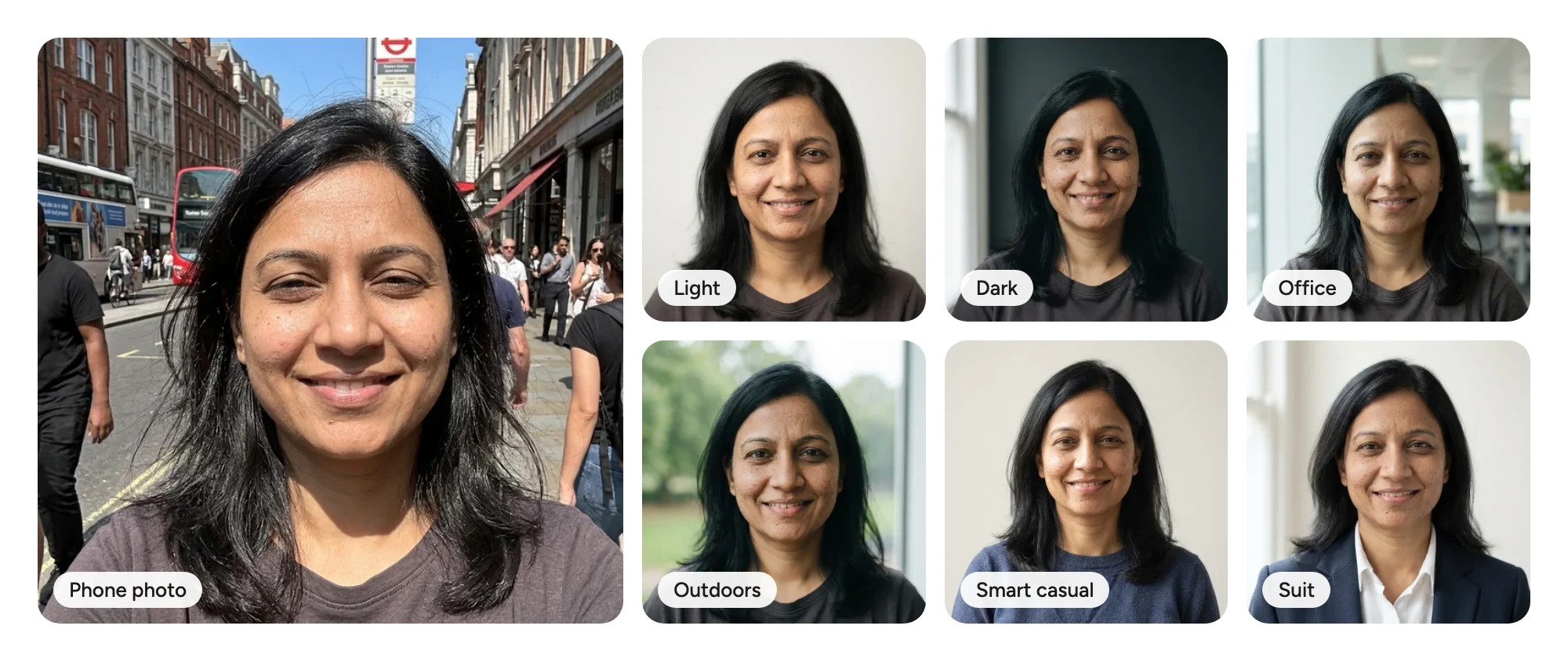
Every headshot here was made from the phone photo on the left. The person is AI-generated.
Pick a background and an outfit, and keep your own face, hair and glasses. Free once a day, no account.
Even in countries where a CV photo is a mistake, a LinkedIn profile photo is expected. A UK recruiter who would rather not see a photo on your CV will still look for your face on LinkedIn.
The two photos can be the same picture with different crops: a portrait rectangle for a CV, a square for LinkedIn, which then shows it in a circle. Our guide to the LinkedIn profile picture covers the circle crop and sizes. You can also try a headshot on your actual profile with our LinkedIn profile checker before you upload it.
No. UK recruiters do not expect one, and many remove CVs with photos to avoid any suggestion of bias.
No, it is not illegal for you to include one. US employers avoid them because a photo can expose them to discrimination claims, so leave it off and send any headshot separately when a role asks for one.
In Germany, portrait format around 4.5 x 6 cm is typical. A Japanese rirekisho photo is 3 cm wide by 4 cm tall.
A natural, closed-mouth smile works in most of Europe. Japanese and Korean formats lean towards a neutral expression.
Yes, if it still looks like you and the employer has not asked for a studio photo. In Japan, check first, because some employers expect a recent booth or studio photo for the rirekisho.