PDF or DOCX · up to 2MB
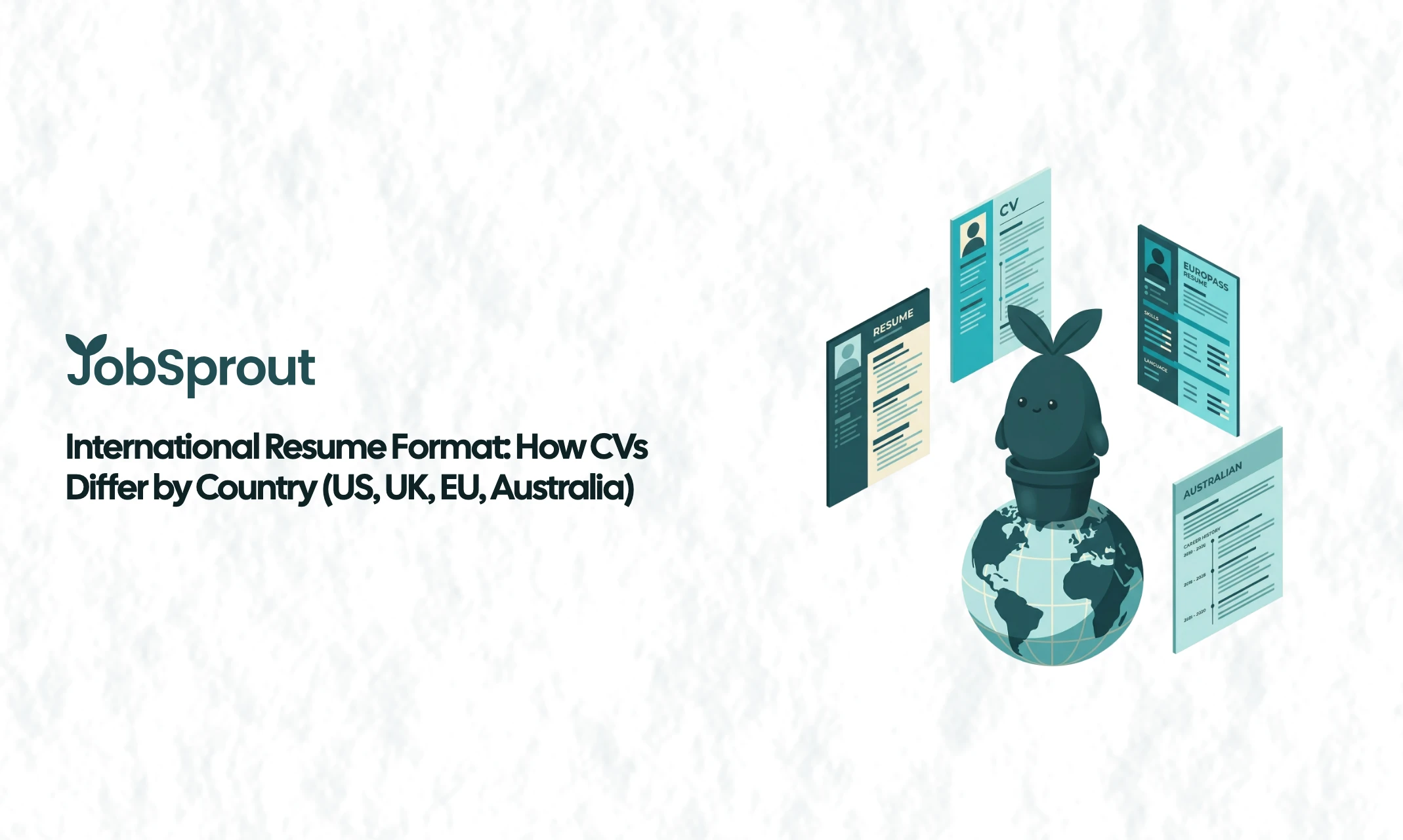
Learn how resume and CV formats differ across countries. Covers the US, UK, Germany, France, Australia, Japan, and the Middle East with comparison tables and practical tips.

Learn the STAR method for interview answers with a clear framework and 25 worked examples covering conflict, failure, leadership, and more.
The best fonts for a resume, ranked with real typographic reasoning: what each one signals, how it parses through an ATS, and the size and spacing that make it work.

A practical guide to the AI interview: what it actually assesses, the three formats you'll meet, and how to prepare so an algorithm doesn't cost you a job you'd otherwise win.
Applying for a job abroad is exciting. It can also be deeply confusing the moment you sit down to write your application. The resume format that served you well at home might be completely wrong for the country you're targeting. In some places, a professional headshot on your CV is expected. In others, it could lead to your application being discarded before anyone reads a word. Some countries want your date of birth and marital status. Others consider that information legally irrelevant and culturally inappropriate.
These are not minor details. They are the difference between looking like a serious, well-prepared candidate and looking like someone who did not bother to research local norms.
This guide covers resume and CV conventions for seven major regions: the United States, the United Kingdom, Germany, France, Australia, Japan, and the Middle East. Whether you are relocating, applying remotely, or simply exploring opportunities in a new market, understanding these differences will give you a real advantage.
If you are still unclear on when to use the term "CV" versus "resume," start with our guide on CV vs resume. For a broader overview of document structure, see how to write a resume.
Before diving into each country, here is a high-level overview of the key differences. This table is your quick reference for the most important formatting decisions.
| Element | US | UK | Germany | France | Australia | Japan | UAE / Middle East |
|---|---|---|---|---|---|---|---|
| Common term | Resume | CV | Lebenslauf | CV | Resume or CV | Rirekisho / Shokumu-keirekisho | CV |
| Typical length | 1-2 pages | 2 pages | 1-2 pages | 1-2 pages | 2-3 pages | 1-2 pages (rirekisho is 1 page) | 2-3 pages |
| Photo | No | No | Yes (expected) | Yes (common) | No | Yes (required) | Yes (common) |
| Date of birth | No | No | Yes (common) | Yes (common) | No | Yes (required) | Yes (common) |
| Marital status | No | No | Sometimes | Sometimes | No | Yes (required) | Sometimes |
| Nationality | No | No | Sometimes | Sometimes | No | Yes | Yes (often expected) |
| Date format | MM/DD/YYYY | DD/MM/YYYY | DD.MM.YYYY | DD/MM/YYYY | DD/MM/YYYY | YYYY/MM/DD | DD/MM/YYYY |
| Language | English | English | German (usually) | French (usually) | English | Japanese | English or Arabic |
| Personal profile / summary | Optional | Standard | Less common | Less common | Standard | Not typical | Common |
| References | "Available upon request" or omit | Available upon request | Certificates attached | Available upon request | Often included on page | Not included | Available upon request |
| Key difference | Concise, achievement-focused | Personal profile expected | Formal, photo and personal details | Personal details, sometimes handwritten cover letter | Referees listed, relaxed tone | Rigid standardised format | Visa status and nationality expected |
This table covers the broad strokes, but the details matter. Let's go country by country.
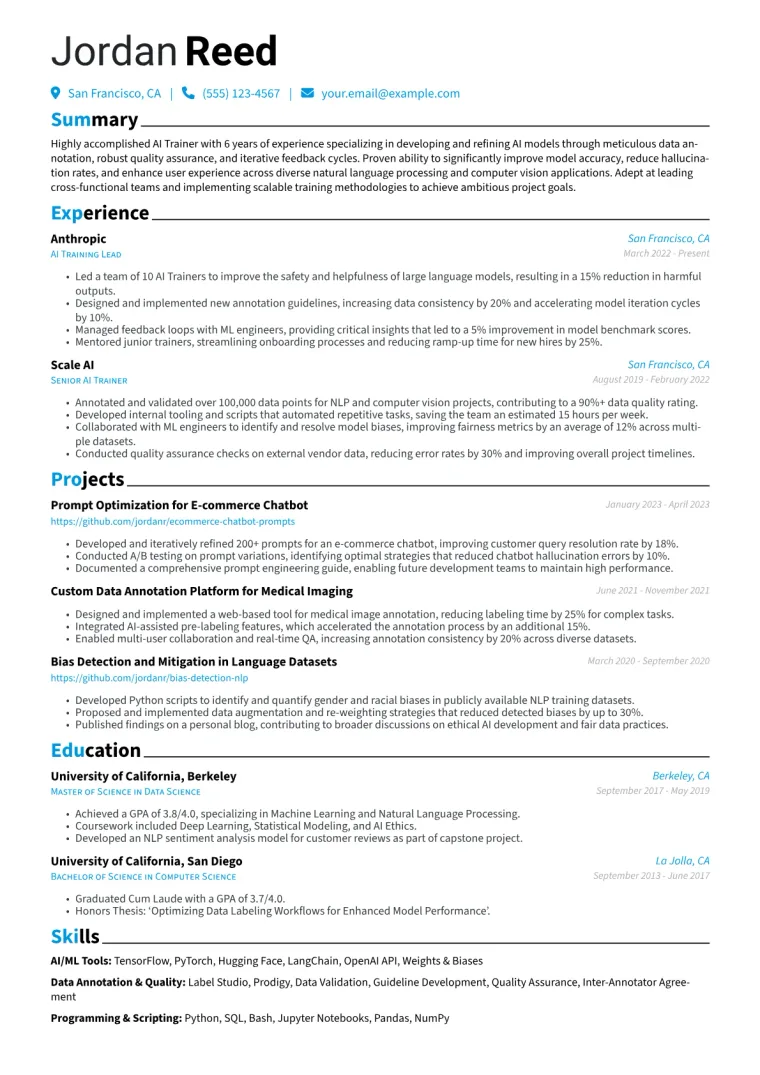
Resume. In the US, the term "CV" is reserved almost exclusively for academic, research, and medical positions. For corporate, government, and general business roles, the document is called a resume.
The standard US resume is one to two pages. For most professionals with fewer than ten years of experience, one page is preferred. Senior professionals and executives may use two pages. Going beyond two pages for a non-academic role is generally considered excessive.
The best resume format for US applications is reverse-chronological, with your most recent role listed first.
| Section | Required? | Notes |
|---|---|---|
| Contact information | Yes | Name, phone, email, LinkedIn, city/state (full address no longer standard) |
| Professional summary | Recommended | 2-3 sentences summarising your value proposition |
| Work experience | Yes | Reverse-chronological, achievement-focused bullet points |
| Education | Yes | Degree, institution, graduation year |
| Skills | Recommended | Technical skills, tools, certifications |
| Photo | No | Never include a photo |
| Date of birth | No | Never include |
| Marital status | No | Never include |
| Nationality | No | Never include |
Achievement-focused language is essential. US recruiters expect quantified accomplishments, not just job descriptions. "Managed a team" is weak. "Led a 12-person team that increased quarterly revenue by 23%" is strong.
Anti-discrimination laws shape the format. US employers are legally prohibited from making hiring decisions based on age, race, gender, marital status, or appearance. Including a photo, date of birth, or marital status can actually make recruiters uncomfortable because it introduces information they are not supposed to consider.
ATS (Applicant Tracking Systems) dominate. The majority of large US employers use ATS software to screen resumes before a human ever sees them. This means clean formatting, standard section headings, and keyword optimisation are critical. Avoid tables, columns, headers/footers, and graphics that ATS systems struggle to parse.
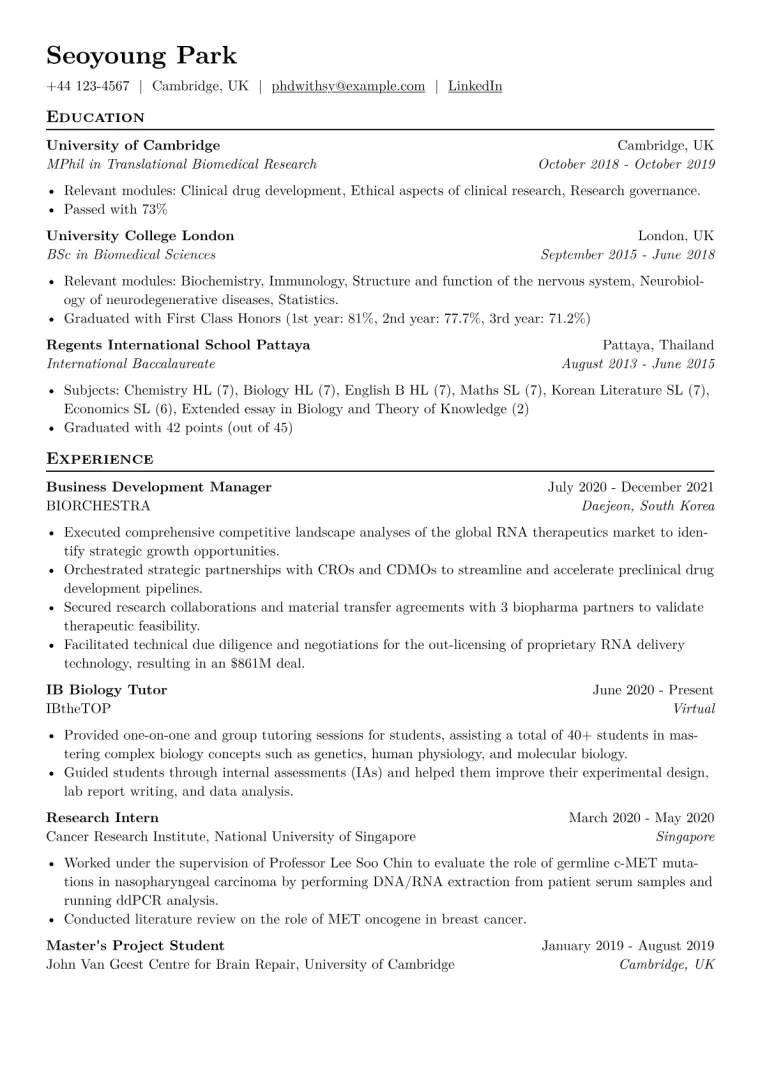
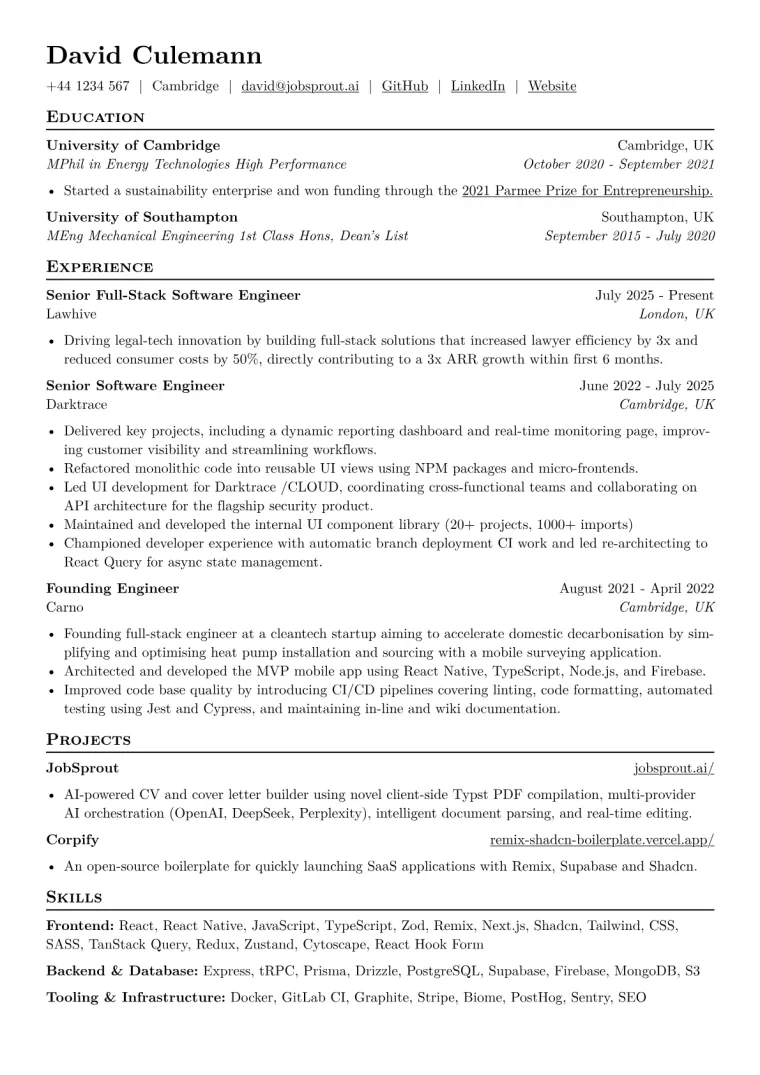
CV (curriculum vitae). In the UK, "CV" is the standard term for the document you submit with job applications. It refers to the same 1-2 page professional document that Americans call a "resume." The term "resume" is understood but rarely used.
The standard UK CV is two pages. One page is acceptable for very junior candidates, but most UK recruiters expect a full two-page document. Going beyond two pages is discouraged for most roles.
| Section | Required? | Notes |
|---|---|---|
| Contact information | Yes | Name, phone, email, LinkedIn, city (full address declining) |
| Personal profile | Standard | A short paragraph at the top summarising who you are and what you offer |
| Work experience | Yes | Reverse-chronological |
| Education | Yes | Most recent first |
| Skills | Recommended | Especially technical or language skills |
| References | Optional | "Available upon request" is standard; some include two referees |
| Photo | No | Not expected and generally not recommended |
| Date of birth | No | Not expected |
| Nationality | No | Not expected |
The personal profile is a UK convention. Unlike the US, where a summary statement is optional, UK CVs almost always open with a personal profile: a 3-5 sentence paragraph that introduces the candidate. Think of it as your elevator pitch in written form.
Spelling matters more than you think. If you are an American applying to UK roles, use British spelling throughout your CV: "organised" not "organized," "behaviour" not "behavior," "centre" not "center." It signals that you have taken the time to adapt.
UK recruiters care about your education section. A-levels, GCSEs, and university classifications (First, 2:1, 2:2) are commonly listed, especially for graduates and early-career professionals. As you gain experience, education can move lower on the page but should not be omitted.
Less emphasis on ATS than the US, but growing. ATS adoption is increasing in the UK, particularly among large employers and recruitment agencies. Keep your formatting clean.
Lebenslauf (literally "life course"). The cover letter is called an Anschreiben. Together with certificates and references, these form the Bewerbungsmappe (application folder).
The German Lebenslauf is typically one to two pages. It follows a tabular or semi-tabular format, which is quite different from the prose-heavy style used in the US and UK. Information is presented in a structured, grid-like layout with dates on the left and details on the right.
| Section | Required? | Notes |
|---|---|---|
| Contact information | Yes | Full name, address, phone, email |
| Photo | Expected | Professional headshot, typically in the upper right corner |
| Date of birth | Common | Still widely included |
| Place of birth | Sometimes | Less common than it used to be |
| Marital status | Sometimes | Declining but still seen |
| Nationality | Sometimes | Relevant for work permit context |
| Work experience | Yes | Reverse-chronological, concise |
| Education | Yes | Including school-leaving qualifications |
| Skills | Yes | Languages, IT skills, driving licence |
| Certificates / Zeugnisse | Expected | Attached as separate documents |
| Signature and date | Traditional | Signing and dating the CV is a traditional practice |
The photo is still expected. Despite EU anti-discrimination guidelines, German employers overwhelmingly expect a professional photo on your Lebenslauf. This should be a high-quality headshot taken by a professional photographer, not a casual selfie. Dress formally, use a neutral background, and look directly at the camera. If a studio session isn't possible before your deadline, a free AI headshot generator can turn a clear photo of you into a formal headshot on a neutral background.
Zeugnisse (work certificates) are critical. Germany has a unique system where employers issue formal reference letters when an employee leaves. These Arbeitszeugnisse are expected to accompany your application. If you are coming from abroad and do not have them, explain this in your cover letter and offer alternative references.
The tabular format is standard. German CVs favour a structured, table-like layout rather than flowing paragraphs. Dates are typically in the DD.MM.YYYY format, placed in a left column with corresponding details on the right.
Language proficiency matters. Germany values language skills highly, especially German proficiency for non-native speakers. Include your language levels using the Common European Framework (A1 through C2). See our guide on how to list languages on a resume for best practices.
Gaps are noticed. German recruiters pay close attention to chronological gaps. Account for every period in your timeline, even if it was spent travelling, studying, or in a career break.
CV (curriculum vitae). The cover letter is called a lettre de motivation.
The French CV is typically one page for junior candidates and two pages for experienced professionals. Brevity is valued, and the layout tends to be clean and structured.
| Section | Required? | Notes |
|---|---|---|
| Contact information | Yes | Full name, address, phone, email |
| Photo | Common | Not legally required but widely included |
| Date of birth | Common | Still widely included |
| Nationality | Sometimes | Especially relevant for non-EU candidates |
| Marital status | Declining | Less common than it used to be |
| Title / headline | Standard | A professional title or objective at the top |
| Work experience | Yes | Reverse-chronological |
| Education | Yes | French employers place significant weight on educational credentials |
| Skills | Yes | Languages, technical skills |
| Hobbies / interests | Common | More commonly included than in anglophone countries |
| References | Optional | "Available upon request" |
Education prestige matters enormously. France has a deeply hierarchical educational system. Graduating from a Grande Ecole (elite institution like HEC, Polytechnique, or Sciences Po) carries significant weight and should be prominently listed. The institution often matters more than the degree subject.
The handwritten cover letter is almost dead. For decades, some French employers asked for handwritten cover letters, sometimes for graphology analysis. This practice has largely disappeared, especially in multinational companies and tech firms. Unless specifically requested, type your lettre de motivation.
Including hobbies is expected. Unlike the US, where hobbies are often seen as filler, French employers view the "Centres d'interet" section as a way to assess cultural fit and personality. Be specific: "competitive tennis (regional level)" is better than "sports."
Language of application. If the job posting is in French, your CV and cover letter should be in French. If the posting is in English (common in multinational companies), submit in English. When in doubt, check the company's working language.
The photo debate. While French law technically prohibits discrimination based on appearance, including a photo remains the norm. If you choose to include one, follow the same professional standards as Germany: formal dress, neutral background, high quality.
Both "resume" and "CV" are used interchangeably in Australia. There is no meaningful distinction between the two terms for standard job applications. Academic roles may use the longer-form CV, similar to the US convention.
Australian resumes tend to be two to three pages. This is longer than the US standard, and Australian recruiters are generally comfortable with a more detailed document, especially for experienced professionals.
| Section | Required? | Notes |
|---|---|---|
| Contact information | Yes | Name, phone, email, city/state, LinkedIn |
| Career summary / profile | Standard | Similar to the UK personal profile |
| Work experience | Yes | Reverse-chronological, achievement-focused |
| Education | Yes | Including relevant coursework for graduates |
| Skills | Recommended | Technical and soft skills |
| Referees | Common | Often included directly on the resume (2-3 referees with contact details) |
| Photo | No | Not expected |
| Date of birth | No | Not expected |
| Nationality | No | Not expected (but visa status may be relevant) |
Referees on the page are common. Unlike the US and UK, where "references available upon request" is standard, Australian resumes frequently include two to three referees with their names, job titles, and contact details listed directly on the document. Ask your referees for permission before listing them.
The tone can be slightly less formal. Australian workplace culture tends to be more relaxed and egalitarian than many other markets. Your resume should still be professional, but an overly stiff or corporate tone can feel out of place. Write naturally and clearly.
Visa status matters. If you are not an Australian citizen or permanent resident, it is helpful to note your visa status or work rights near the top of your resume. Employers need to know whether you can legally work in the country.
Key selection criteria. Government and public sector roles in Australia often require you to address specific key selection criteria in a separate document. This is a uniquely Australian convention where you write a detailed response to each criterion listed in the job advertisement.
There are two main formats:
Most applications require both documents.
The rirekisho is a single-page standardised form with fixed fields. The shokumu-keirekisho is typically one to two pages in a more flexible format.
| Field | Required? | Notes |
|---|---|---|
| Photo | Yes | 3cm x 4cm, formal, taken within the last 3 months |
| Full name | Yes | In kanji and furigana (pronunciation guide) |
| Date of birth | Yes | Including age |
| Gender | Yes | Standard field on the form |
| Address | Yes | Full current address |
| Phone and email | Yes | |
| Education history | Yes | Listed chronologically (oldest first), including elementary school for some formats |
| Work history | Yes | Chronological, with specific months of joining and leaving |
| Licences and qualifications | Yes | Formal certifications |
| Hobbies and special skills | Standard | A fixed field on the form |
| Commute time | Sometimes | Some forms include this |
| Desired salary | Sometimes | Some forms include this |
| Reason for leaving previous job | Common | Often expected in the shokumu-keirekisho |
| Marital status | Yes | Standard field |
| Number of dependents | Yes | Standard field |
The format is extremely rigid. The rirekisho is not a document you design yourself. It is a standardised template available at convenience stores, bookshops, and online. You fill in the prescribed fields in the prescribed order. Creativity in layout is not expected or appreciated.
Historically handwritten, now transitioning. For decades, rirekisho were expected to be handwritten in black ink, as handwriting was considered a reflection of character and diligence. While handwritten forms are still valued by some traditional employers, digital/typed submissions are increasingly accepted, especially in tech companies and international firms.
Chronological order (oldest first). Unlike Western resumes, Japanese CVs list education and work history in chronological order, starting from the oldest entry. This is the opposite of the reverse-chronological format used in most other countries.
The photo is mandatory. A formal passport-style photo is required. It should be recent (within three months), taken against a plain background, and show you in formal business attire. Photo booths designed specifically for rirekisho photos are common throughout Japan.
Gaps are highly scrutinised. Japanese employers expect a complete, unbroken timeline. Any gap between positions needs to be explained. The cultural expectation of lifelong employment (though declining) means that frequent job changes can also raise concerns.
Foreign applicants may use a different format. If you are applying to a Japanese company as a foreign national, particularly for roles at international firms or startups, you may be asked to submit a Western-style resume in English alongside or instead of the rirekisho. Always check the job posting for specific instructions.
CV (curriculum vitae). The term "resume" is understood but "CV" is far more commonly used across the Gulf Cooperation Council (GCC) countries: the UAE, Saudi Arabia, Qatar, Bahrain, Kuwait, and Oman.
CVs in the Middle East tend to be two to three pages, sometimes longer. There is less pressure to be concise than in the US, and detailed descriptions of responsibilities and achievements are expected.
| Section | Required? | Notes |
|---|---|---|
| Contact information | Yes | Full name, phone, email, address |
| Photo | Common | Widely included, especially in the UAE |
| Date of birth | Common | Often expected |
| Nationality | Expected | Critical for visa and sponsorship purposes |
| Visa status | Expected | Current visa type, whether you need sponsorship |
| Gender | Sometimes | Included in some formats |
| Marital status | Sometimes | More common than in Western countries |
| Religion | Sometimes | Occasionally included, though not universally expected |
| Work experience | Yes | Detailed, reverse-chronological |
| Education | Yes | Including certifications and professional development |
| Skills | Yes | Languages are particularly valued |
| References | Optional | "Available upon request" is acceptable |
Nationality and visa status are essential. This is the single biggest difference from Western CVs. Employers in the Gulf states need to know your nationality and visa status upfront because sponsorship, visa allocation, and hiring quotas are tied to nationality. Omitting this information will slow down your application.
Longer CVs are acceptable. While the US prizes brevity, Middle Eastern employers expect more detail. Two to three pages is normal, and senior professionals may go to four pages without raising eyebrows. Include thorough descriptions of your roles, responsibilities, and achievements.
Language skills are highly valued. The Middle East is a multilingual business environment. Arabic, English, Hindi, Urdu, and French are all commonly spoken. Listing your language proficiencies prominently is important.
Photographs are common. Including a professional photo is standard practice in the region. Follow the same guidelines as for Germany and France: formal, high-quality, professional background.
Adapt to the specific country. The Middle East is not monolithic. Expectations in Dubai (highly international, English-dominant business environment) differ from those in Riyadh (Arabic more prevalent, more conservative culture). Research the specific country and even the specific company.
Recruitment agencies are influential. A significant portion of hiring in the Gulf states goes through recruitment agencies, especially for expatriate positions. These agencies often have their own CV format preferences, so ask if they have a template before submitting.
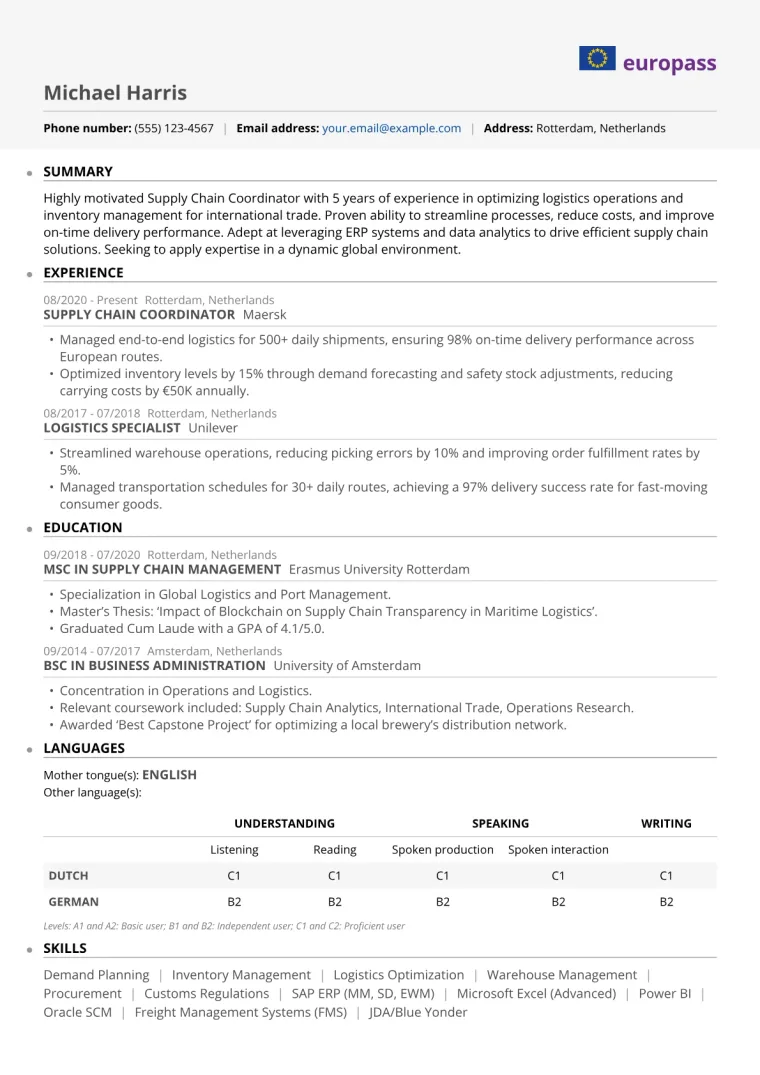
The Europass CV is a standardised CV format created by the European Union. It provides a common template that is recognised across all EU and EEA member states. You can create one for free at europass.cedefop.europa.eu, or build one on our Europass CV page.
| Element | Details |
|---|---|
| Structure | Fixed sections in a set order |
| Length | Typically 2-3 pages |
| Photo | Optional |
| Language skills | Uses the Common European Framework (A1-C2) |
| Digital skills | Dedicated section |
| Cost | Free |
| Recognition | All EU/EEA countries |
The Europass CV is useful in specific situations:
The Europass CV has significant limitations:
The general rule: if you are applying to a private sector role in a specific country, use that country's standard format. If you are applying to EU institutions or casting a wide net across multiple European countries, Europass is a reasonable choice.
Regardless of which country you are targeting, these principles apply everywhere.
Country-level conventions are a starting point, not a rigid rulebook. A German startup with an international team may prefer an English-language CV without a photo. A Japanese branch of an American tech company may accept Western-format resumes. Always check the job posting, the company's careers page, and any application instructions before assuming.
If the job requires a CV in a language you do not speak fluently, invest in a professional translation. Machine translation tools have improved dramatically, but they still produce awkward phrasing, miss cultural nuances, and can introduce errors that a native speaker would immediately notice. A badly translated CV suggests carelessness.
For roles where you need to demonstrate language proficiency, having a native speaker review your CV is non-negotiable.
This is a small detail that makes a big difference. Using MM/DD/YYYY in a country that expects DD/MM/YYYY creates confusion. Is "03/04/2024" the 3rd of April or the 4th of March? Use the format standard for your target country, or use an unambiguous format like "March 2024" or "Apr 2024" for months in work experience.
| Region | Standard format | Example |
|---|---|---|
| US | MM/DD/YYYY | 03/15/2024 |
| UK, Australia, France | DD/MM/YYYY | 15/03/2024 |
| Germany | DD.MM.YYYY | 15.03.2024 |
| Japan | YYYY/MM/DD | 2024/03/15 |
| International (safe) | Month YYYY | March 2024 |
ATS software is not universal. While US and UK employers rely heavily on automated screening, many employers in Southern Europe, the Middle East, and parts of Asia still review applications manually. This affects how much you need to optimise for keyword matching versus visual presentation.
That said, the trend is clearly towards greater ATS adoption worldwide. When in doubt, keep your formatting clean and avoid graphics, tables, columns, and unusual fonts that can confuse parsing software.
Localisation goes beyond language. It means adapting your content to resonate with local expectations:
If you need a work visa or sponsorship, address this early in your application, either in your CV header or cover letter. Many employers will not consider international candidates if they cannot quickly determine your right to work. Being upfront saves everyone time and shows professionalism.
Building separate CVs for different countries can be tedious. Tools like JobSprout let you maintain a single CV profile and generate tailored documents for different markets, making it easier to create different versions for different applications without starting from scratch each time.
These are the errors I see most frequently from candidates applying across borders.
This is the most common mistake by far. A candidate creates a strong US-style resume and sends it unchanged to employers in Germany, Japan, and the UAE. Each of those countries has different expectations around photos, personal information, length, and structure. One size does not fit all.
The reverse problem is also common: a candidate applying to a US or UK role includes their date of birth, marital status, nationality, and a photo because that is what they are used to. In the US, this information is not only unnecessary but can create legal complications for the employer.
Quick reference for personal information by region:
| Information | US | UK | Germany | France | Australia | Japan | UAE |
|---|---|---|---|---|---|---|---|
| Photo | Never | No | Yes | Yes | No | Yes | Yes |
| Date of birth | Never | No | Yes | Yes | No | Yes | Yes |
| Marital status | Never | No | Sometimes | Sometimes | No | Yes | Sometimes |
| Nationality | Never | No | Sometimes | Sometimes | No | Yes | Yes |
| Full address | No (city only) | No (city only) | Yes | Yes | No (city only) | Yes | Yes |
In some countries, the cover letter is as important as the CV itself. In Germany, the Anschreiben is a critical component of your application. In Japan, specific formalities and phrases are expected. In the US, cover letters are increasingly optional for many roles. Research what is expected.
If a German company posts a job in German, they expect a German-language application. If a French company posts in English, you can apply in English. Mismatching the language of your application to the language of the posting is an immediate red flag.
As mentioned above, date format confusion is a real problem. "01/02/2024" means completely different things in the US and UK. Either use the local standard or switch to an unambiguous format like "January 2024."
A "2:1 from the University of Manchester" means nothing to a US recruiter. A "3.8 GPA from UCLA" means nothing to a German employer. When applying internationally, add context: "equivalent to a First Class Honours" or "top 10% of graduating class." Help the reader understand your achievements in their frame of reference.
Many countries have dominant job platforms that differ from what you might be used to. In Germany, Xing is as important as LinkedIn. In Japan, Rikunabi and MyNavi are the primary platforms for job seekers. In the UAE, Bayt and GulfTalent are widely used. Research where employers in your target country actually post their openings.
International job applications require more preparation than domestic ones, but the effort pays off. Taking the time to understand local conventions signals respect, attention to detail, and genuine interest in the market you are entering. Those qualities matter to employers everywhere.
Here is a simple checklist for your next international application:
The job market is increasingly global, and the candidates who succeed are the ones who can adapt their presentation to meet local expectations while maintaining the substance that makes them stand out.
For more guidance on structuring your CV, explore our guides on how to write a resume and best resume format. If you are listing multilingual skills, do not miss our advice on how to list languages on a resume.