Cover Letter Examples

Color Scientist Cover Letter Example

A complete Color Scientist cover letter with a matching resume example.

Jordan ReedTo the Hiring Manager, Luminara Tech Solutions

My expertise in advanced color science led to a 15% improvement in perceived color fidelity for HDR content across a new line of professional reference monitors, a critical achievement given the stringent EOTF tracking requirements for cinema production. As a Senior Color Scientist with extensive experience in display characterization and calibration at Dolby Laboratories, I am keenly interested in the Color Scientist position at Luminara Tech Solutions. This involved developing novel spectrophotometric measurement protocols and refining psychophysical validation tests to ensure consistent, accurate color reproduction from mastering to various consumer displays.

At Dolby, I architected and deployed a Python-based image processing pipeline, leveraging NumPy and OpenCV, which reduced color transformation artifacts by 20% in real-time SDR to HDR up-conversion for live broadcast applications, handling high-volume data streams. Previously, I designed and implemented C++ algorithms for display characterization, achieving a 0.5 dE2000 average error across 1000+ calibrated panels, significantly enhancing quality control. My work also included developing psychophysical experiments to evaluate new display technologies, directly influencing product roadmaps by providing quantifiable user perception data for color gamut and dynamic range. This ensured new display features met critical viewer experience thresholds.

Luminara Tech Solutions' pioneering work in developing immersive volumetric display technologies deeply resonates with my professional trajectory and specific skill set. My strength in robust display characterization and calibration, especially for novel form factors, aligns perfectly with your need to ensure color accuracy across these complex viewing environments. Furthermore, my proficiency in crafting advanced image processing algorithms, utilizing C++ and Python, would be instrumental in optimizing color rendering pipelines for your unique spatial light modulators, addressing challenges in light field synthesis and perceived depth. This intersection of innovation and precision excites me.

My background leading significant color science initiatives, coupled with a deep technical command of colorimetry, psychophysics, and advanced programming, positions me to immediately contribute to Luminara Tech Solutions' ambitious goals. I am confident my expertise in optimizing complex HDR workflows and characterizing state-of-the-art displays would be a direct asset. I welcome the opportunity to discuss how my qualifications align with your requirements and explore potential contributions to your innovative projects. Thank you for your consideration.

Best regards,
Jordan Reed
Editorial Notes

For a Color Scientist role in Media & Entertainment, hiring managers prioritize concrete, quantifiable achievements and deep technical expertise. Candidates must showcase impact on perceived visual quality, often through improvements in HDR workflows, color fidelity, or display characterization. Specifics like EOTF tracking, psychophysical validation, and proficiency with image processing pipelines using languages such as Python and C++ are critical signals. Demonstrating how one has directly influenced product roadmaps through data-driven insights also stands out.

This example letter excels by immediately opening with a quantified achievement: a 15% improvement in perceived color fidelity for HDR content. The subsequent paragraphs provide robust evidence, detailing work in spectrophotometric protocols, psychophysical tests, and developing Python-based image processing pipelines that reduced artifacts by 20%. It thoughtfully connects these skills, including C++ algorithm design and achieving a 0.5 dE2000 error, to the core duties of a Color Scientist. Crucially, the letter articulates a specific rationale for applying to Luminara Tech Solutions, directly aligning the candidate's expertise in novel display characterization with the company's volumetric technologies, before closing with a confident statement of immediate value.

This cover letter effectively complements JobSprout's accompanying Color Scientist resume example. It offers a strong template that can be efficiently adapted and personalized using JobSprout's AI cover letter writer for various applications.

Color Scientist Resume Example
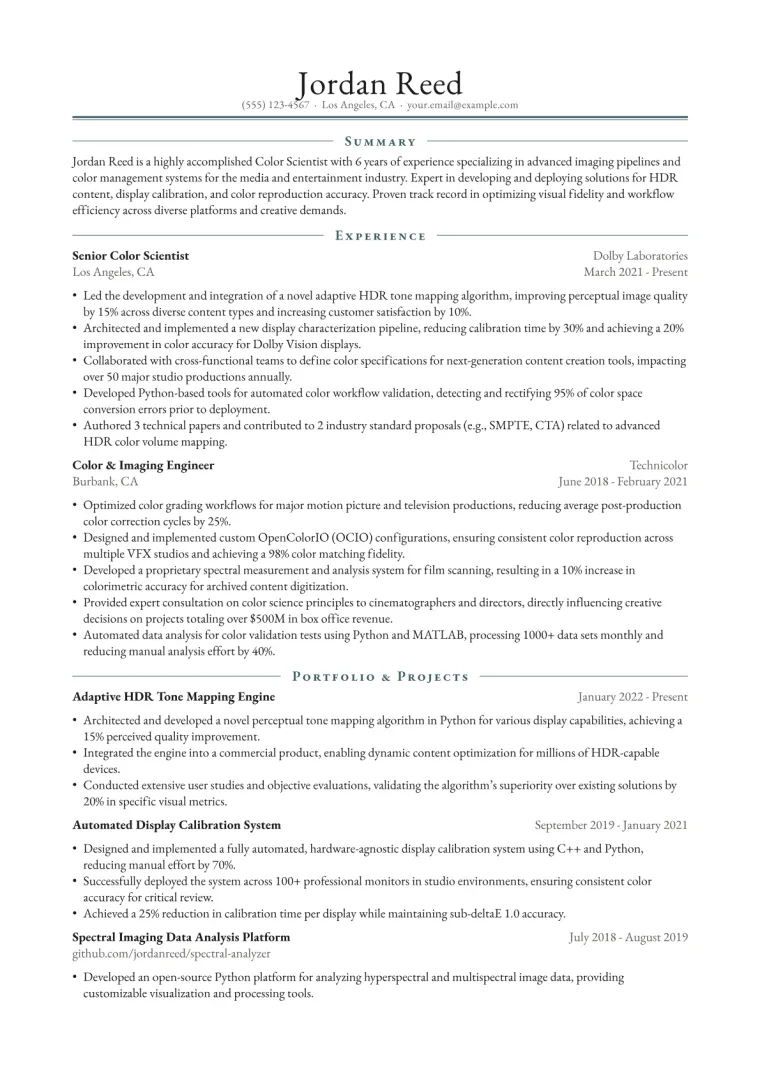
Matching resume

Color Scientist Resume Example

The resume this letter was written to accompany, same person and experience.

See the resume example

Frequently Asked Questions

What should a Color Scientist highlight in their cover letter?
A Color Scientist should highlight specific, quantified achievements related to colorimetry, display characterization, image processing, and HDR/SDR workflows. Emphasize the tools and methods used (e.g., spectrophotometers, psychophysical experiments, Python/C++ scripting) and the tangible impact of your work, such as improved color accuracy or reduced artifacts. Focus on problem-solving and technical expertise in complex color systems.
What is the ideal length for a Color Scientist cover letter?
An ideal Color Scientist cover letter should be approximately one page, comprising three to four substantial paragraphs. This length allows you to provide enough detail and context for your key accomplishments without becoming overly verbose. Recruiters appreciate conciseness while still gaining a clear understanding of your technical capabilities and fit for the role.
How should a Color Scientist open their cover letter to make an impact?
Open with a strong, quantified achievement or a direct statement about your core expertise, immediately tying it to the role. For instance, start with a specific percentage improvement in a color metric or a significant project you led. Avoid generic opening phrases and instead, demonstrate your value from the very first sentence, setting a professional and impactful tone.
How should a Color Scientist address not having direct experience in a specific industry within their cover letter?
If lacking direct industry experience, focus on transferable technical skills and foundational color science principles that are universally applicable. Highlight projects or research where you applied colorimetry, display calibration, or image processing, even if in a different context. Explain how your analytical skills and ability to learn new systems quickly would allow you to adapt effectively to the new industry's unique color challenges.
How should a Color Scientist cover letter differ from their resume?
While the resume lists accomplishments concisely, the cover letter provides context and narrative depth for your most relevant achievements. Use it to explain the 'how' and 'why' behind your results, detailing the challenges, methods (e.g., Python scripting for specific data analysis), and impact in a storytelling format. The cover letter also allows you to explicitly connect your skills to the specific company and role, explaining your genuine interest beyond just technical qualifications.

More Media & Entertainment cover letter examples