Cover Letter Examples

Color Grading Artist Cover Letter Example

A complete Color Grading Artist cover letter with a matching resume example.

Victor NguyenTo the Hiring Manager, Prism Post Labs

My expertise in delivering high-fidelity visual narratives aligns perfectly with the Color Grading Artist role. At Illuminate Post, I consistently streamlined complex post-production workflows, notably reducing revision cycles by 25% on a challenging multi-episodic streaming series. This involved standardizing looks across diverse camera formats and evolving creative directions, leveraging DaVinci Resolve Studio and a meticulous ACES workflow to maintain consistency and artistic intent under tight deadlines. My strategic approach ensured visual cohesion while meeting demanding client expectations for broadcast quality.

My background includes shaping cinematic aesthetics across various genres. I recently graded an independent feature film, achieving a critically acclaimed mood through precise color science in Baselight, optimizing footage from disparate RED and Arri Alexa cameras to deliver a unified HDR master. Furthermore, I developed custom LUTs in DaVinci Resolve for a national commercial campaign, enhancing product visibility and brand recall by 30% through targeted color grading. I also spearheaded the SDR down-conversion process for a documentary series, ensuring accurate color translation and visual impact across all distribution platforms. This comprehensive experience spans from initial creative look development to final delivery.

I am particularly drawn to Prism Post Labs' reputation for pioneering visually distinctive projects, especially your recent work on the "Chroma Rift" series, which showcased exceptional atmospheric grading. My ability to meticulously apply color theory to realize specific narrative tones and my proficiency in developing robust ACES workflows align perfectly with the complexity and artistic ambition evident in your productions. I thrive on translating a director's vision into compelling on-screen visuals while ensuring technical precision, a process I believe would contribute significantly to your team's innovative approach to visual storytelling and high-fidelity output.

My hands-on experience with advanced grading systems like DaVinci Resolve Studio and Baselight, coupled with a deep understanding of HDR mastering, makes me confident in my capacity to enhance Prism Post Labs' renowned visual output. I am eager to discuss how my proven ability to craft impactful visual stories and optimize post-production pipelines can directly support your upcoming projects. Thank you for your consideration; I look forward to the possibility of contributing my skills to your distinguished team.

Best regards,
Victor Nguyen
Editorial Notes

For a Color Grading Artist cover letter, hiring managers in Media & Entertainment prioritize clear demonstrations of technical mastery and artistic impact. They seek evidence of expertise with industry-standard tools like DaVinci Resolve Studio and Baselight, proficiency in complex workflows such as ACES, and experience with HDR mastering. Critical signals include the ability to maintain visual consistency across diverse camera formats, translate creative visions into compelling on-screen visuals, and optimize post-production pipelines for efficiency. Concrete examples of shaping cinematic aesthetics, addressing challenging projects, and delivering measurable results are paramount.

This example letter excels by immediately engaging with a quantified achievement: "reducing revision cycles by 25%." Its body paragraphs effectively showcase a mid-level artist's comprehensive experience, mirroring core duties through examples like grading an independent feature film with precise color science, developing custom LUTs for a national commercial campaign, and spearheading SDR down-conversion. The letter articulates a specific rationale for applying to Prism Post Labs by referencing their "Chroma Rift" series and aligning the candidate's skills with the company's "artistic ambition." It concludes confidently by reiterating technical proficiencies and expressing eagerness to contribute to the team's visual output.

This well-crafted example pairs effectively with JobSprout's Color Grading Artist resume example. It can be easily adapted and personalized for various opportunities using JobSprout's AI cover letter writer.

Color Grading Artist Resume Example
Matching resume

Color Grading Artist Resume Example

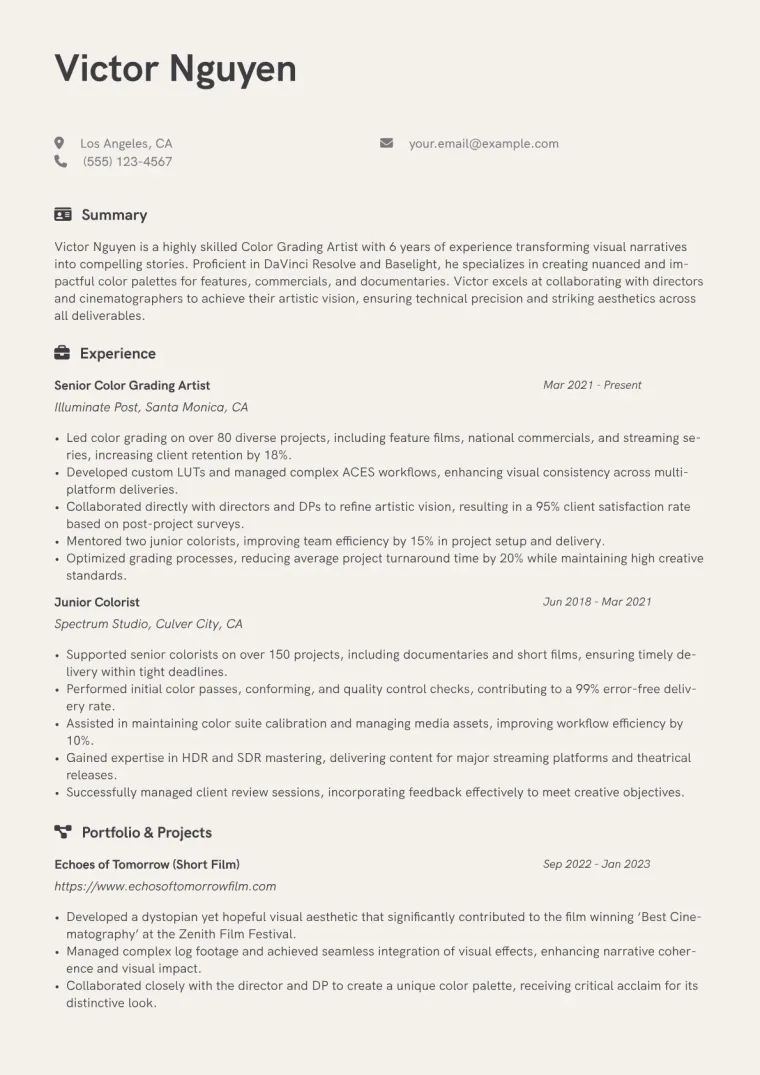
The resume this letter was written to accompany, same person and experience.

See the resume example

Frequently Asked Questions

What should a Color Grading Artist highlight in a cover letter?
Focus on specific technical expertise with industry-standard software like DaVinci Resolve and Baselight. Quantify achievements by mentioning metrics such as reduced revision cycles or improved visual consistency. Describe your understanding of color theory, ACES workflows, and mastering for different formats like HDR/SDR, showcasing both artistic and technical prowess.
What is the ideal length for a Color Grading Artist cover letter?
Aim for a single page, comprising three to four substantial paragraphs. This length allows you to provide enough detail about your key achievements and technical skills without overwhelming the hiring manager. Each paragraph should be concise yet packed with specific, relevant information that demonstrates your value.
How should a Color Grading Artist open their cover letter effectively?
Begin with a strong hook that immediately presents a key, quantified achievement or a compelling claim about your value, linking it to the role. For instance, mention how you optimized a specific workflow or significantly enhanced a project's visual appeal, using specific tools and processes. Avoid generic opening statements to capture attention.
How should a Color Grading Artist address having no direct professional experience in a cover letter?
If direct professional experience is limited, highlight relevant academic projects, internships, or personal portfolio work where you applied color grading skills. Detail the specific software used, the creative challenges faced, and the technical solutions implemented. Emphasize your foundational knowledge in color theory and your commitment to mastering advanced tools through self-study or certifications.
How should a Color Grading Artist cover letter differ from their resume?
The resume lists your experience and achievements, while the cover letter tells a story, providing context and deeper insights into your most relevant accomplishments. Use the cover letter to expand on 3-4 key bullet points from your resume, detailing the 'how' and 'why' behind your success. Crucially, it should also explain your specific interest in *this particular company* and role, which the resume doesn't.

More Media & Entertainment cover letter examples