Lisp Developer Cover Letter Example

Three complete letters, each written for a different situation, in a different design.

Lisp Developer cover letter example

Nathan WilliamsTo the Hiring Manager, Quantum Helix Systems

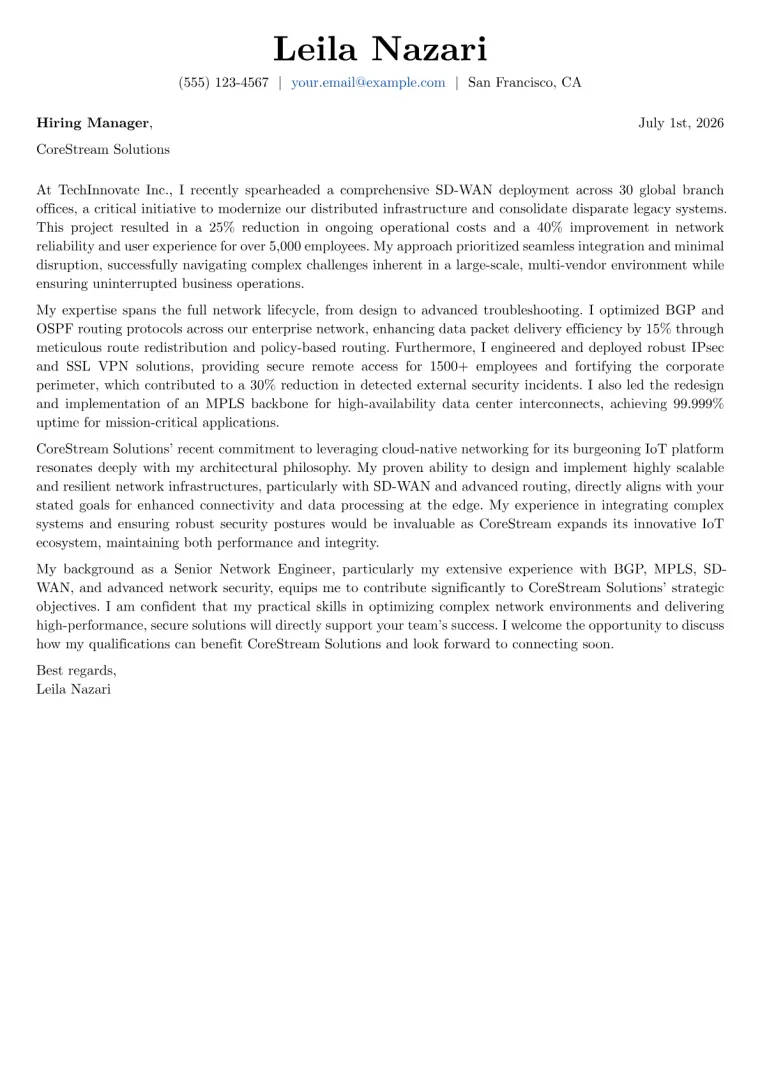
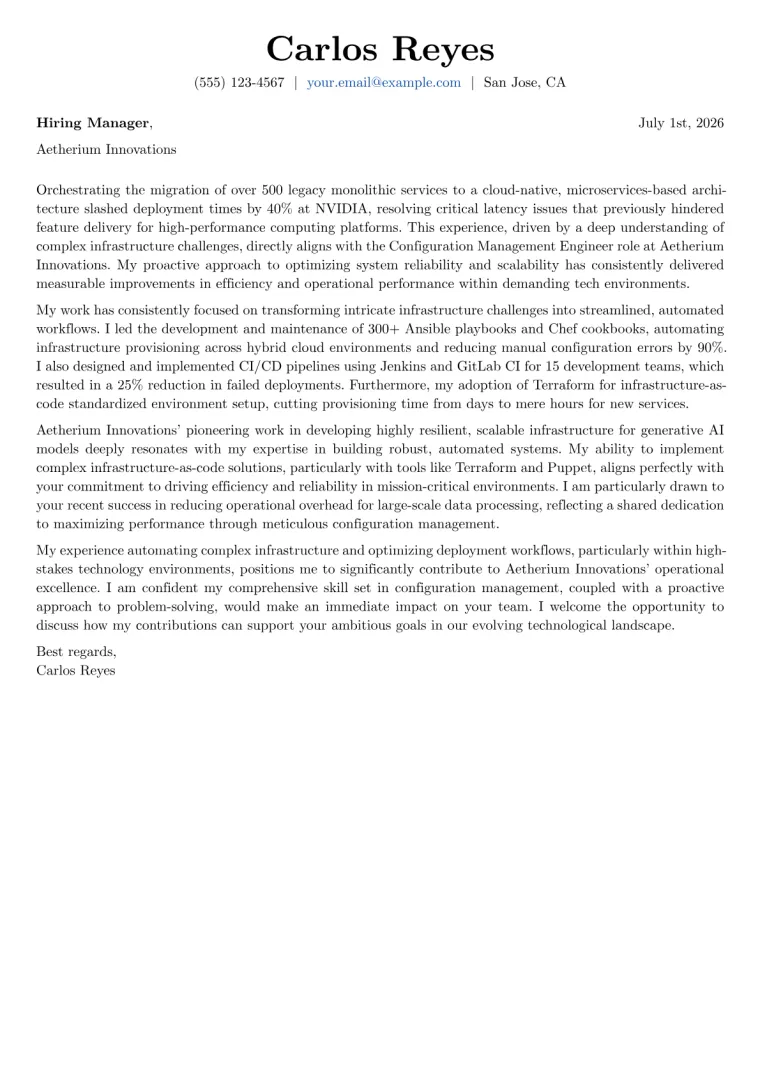
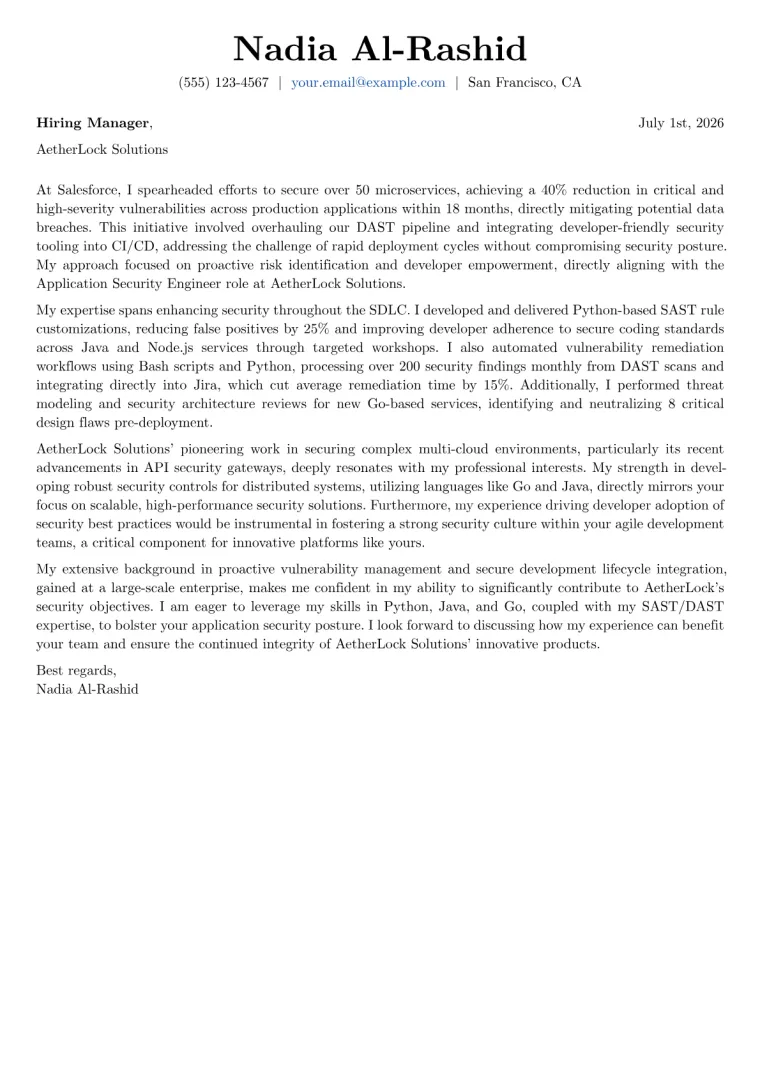
My recent work leading the refactoring of a core Common Lisp inference engine at Symbolic AI Solutions reduced average query latency by 35% across a dataset of 500M+ entities, directly improving response times for critical client-facing applications. This significant optimization, achieved in a high-stakes production environment, demonstrates my capability to deliver robust, high-performance Lisp solutions. The Lisp Developer role at Quantum Helix Systems, with its focus on advanced system architecture, immediately caught my attention as an ideal next step to apply and expand these skills.

During my tenure, I developed a Clojure-based immutable data pipeline for processing complex financial transactions, handling over 10TB of data daily with 99.9% integrity using core.async for efficient concurrency. I also architected a domain-specific language (DSL) in Common Lisp, which accelerated model iteration cycles by 40% for our R&D team by simplifying complex simulation parameter definitions. Additionally, I contributed to an Emacs Lisp framework that automated internal API integration tests, reducing manual QA time by 15% across our development sprints.

Quantum Helix Systems' innovative approach to leveraging Lisp for high-performance, real-time analytics, particularly in your recently published whitepaper on distributed immutable ledger technology, resonates strongly with my expertise. My experience in architecting robust, scalable systems with Common Lisp and Clojure, combined with my deep understanding of immutability principles, aligns perfectly with your mission to build resilient and cutting-edge solutions. I am particularly drawn to your work on self-healing distributed systems, where my functional programming background can offer immediate value.

My background in optimizing complex Lisp applications and my commitment to elegant, functional solutions make me confident I can significantly contribute to your team's groundbreaking projects. I am eager to discuss how my technical leadership and hands-on development skills, particularly in Common Lisp and Clojure, can benefit Quantum Helix Systems. Thank you for your consideration; I look forward to the opportunity to connect and explore this exciting role further.

Best regards,
Nathan Williams
Lisp Developer cover letter for a career changer

Nathan WilliamsTo the Hiring Manager, Synthax Logic Systems

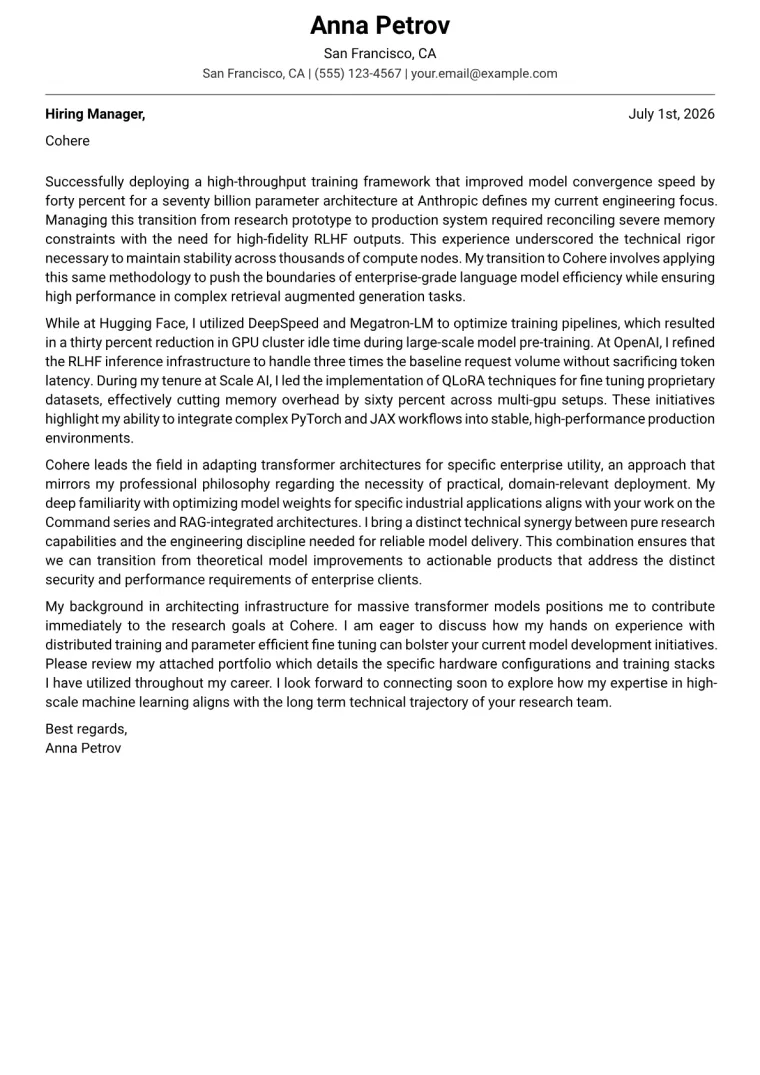
Complex data discrepancies within the financial trading sector required a robust way to synthesize disparate market streams into actionable intelligence. Developing a custom reconciliation algorithm in Python transformed our data ingestion pipeline and reduced manual adjustment times by sixty percent across two hundred daily reports. This project demonstrated that elegance in system design and a deep focus on functional purity yield substantial operational gains. Applying these rigorous engineering principles to Lisp development serves as the logical evolution of my technical focus where managing state and complexity remains the primary challenge.

My technical transition involves applying functional programming concepts to solve large scale architecture problems. I reconfigured a legacy financial reporting suite by migrating core scripts to Clojure to increase calculation throughput by forty percent. A subsequent project utilized a custom Scheme based parser to ingest fifty thousand financial records per second with zero memory leaks. By automating internal development environments with Emacs Lisp macros, I saved my team ten hours of labor each week. These accomplishments highlight my technical proficiency with immutable data structures and lambda calculus in high stakes environments.

Synthax Logic Systems maintains a distinct reputation for prioritizing long term maintainability through your dedication to pure symbolic logic architectures. My deep familiarity with formal verification methods allows me to contribute immediately to your core engine development. Furthermore, my history of solving data pipeline bottlenecks provides a unique perspective on how to integrate high performance Lisp code into existing infrastructure. Aligning my expertise in functional paradigms with your mission will facilitate the deployment of more resilient systems. This intersection of rigorous logic and practical implementation defines the value I bring to your team.

Technical clarity remains the primary factor in building scalable software that stands the test of time. My recent shift from financial engineering to Lisp development reflects a deliberate choice to focus on systems where logic dictates outcome. I invite you to examine my public code repositories which document my experiments with Common Lisp concurrency models and macro expansion. I look forward to discussing how my background in high performance data engineering supports your upcoming project cycles. Please let me know when you have time for a conversation regarding the needs of your engineering group.

Best regards,
Nathan Williams

Lisp Developer cover letter with no experience

Nathan WilliamsTo the Hiring Manager, Synapse Logic Architecture

Symbolic expression evaluation within a constrained recursive depth setting allowed me to optimize a custom Scheme interpreter for processing hierarchical data structures. This project required building a memory efficient walker that handled five thousand nested lists per second, ultimately demonstrating the performance advantages of tail call optimization in high throughput systems. My deep dive into lambda calculus during my final year of study provided the foundation for this architectural approach, enabling a robust framework that successfully parsed complex recursive trees without triggering stack overflow errors across large data sets.

Developing a modular web server in Clojure for a research initiative increased data ingestion speed by forty percent across a distributed cluster of twelve nodes. During an open source initiative, I refactored an existing Emacs Lisp configuration suite to reduce startup overhead by six seconds, significantly improving developer workflows through lazy loading techniques. My implementation of a Common Lisp interface for a Python based machine learning pipeline cut interprocess communication latency by twenty percent. These specific projects required precise management of immutable data structures and functional programming paradigms to ensure system stability.

Synapse Logic Architecture stands out because your focus on formal verification for automated decision systems aligns with my expertise in symbolic reasoning and functional purity. Your recent efforts to build fault tolerant logic gates using Lisp based compilers demonstrate a commitment to reliability that resonates with my academic background in type theory. My ability to leverage immutability to prevent race conditions and my proficiency in crafting expressive macros make me well positioned to contribute to your engineering team. These core competencies will allow me to solve your most complex architectural challenges immediately.

My dedication to clean functional design and rigorous code review standards prepares me to add immediate value to your development cycles. I look forward to discussing how my experience building efficient recursive systems and optimizing Lisp environments can support the continued innovation at Synapse Logic Architecture. Please let me know a suitable time for an interview to explore my technical background further. Thank you for your consideration of my qualifications for this developer position. I anticipate hearing from your hiring team regarding the next steps in your recruitment process.

Best regards,
Nathan Williams

Editorial Notes

For a Lisp Developer role in the technology industry, hiring managers prioritize tangible, quantified achievements demonstrating expertise in functional programming paradigms and specific Lisp dialects. They seek candidates who can translate complex technical challenges into robust, high-performance solutions. Key signals include experience with system architecture, performance optimization, immutable data structures, concurrency, and the development of domain specific languages. Concrete examples of reducing latency, handling large datasets, or streamlining development processes offer strong evidence of a candidate's practical value and impact.

This example letter excels by immediately capturing attention with a quantified achievement: reducing query latency by 35% for critical client-facing applications. The subsequent paragraph provides concrete evidence, detailing experience with a Clojure immutable data pipeline handling 10TB daily and a Common Lisp DSL that accelerated model iteration by 40%. Its rationale for applying to Quantum Helix Systems is highly specific, referencing their whitepaper on distributed immutable ledger technology and work on self-healing systems, directly aligning with the applicant's background. The letter concludes with a confident call to action, reiterating a strong belief in their ability to contribute.

This well-crafted letter pairs effectively with JobSprout's Lisp Developer resume example and can be easily adapted to specific job postings using the platform's AI cover letter writer.

Frequently Asked Questions

What should I highlight in a Lisp Developer cover letter?
Emphasize specific Lisp dialects you're proficient in (e.g., Common Lisp, Clojure, Scheme) and showcase how you've applied Lisp's unique strengths like macros, metaprogramming, and functional paradigms. Quantify achievements related to performance optimization, system design, or domain-specific language creation. Detail the context and impact of your technical contributions.
What is the ideal length for a Lisp Developer cover letter?
Aim for a concise letter, typically half to one page in length, divided into three to four substantial paragraphs. Recruiters appreciate brevity, so ensure every sentence adds value by providing specific, contextualized information. Focus on impactful accomplishments rather than generic statements.
How should I open a Lisp Developer cover letter?
Start with a compelling, achievement-driven hook that immediately highlights a significant, quantified accomplishment relevant to Lisp development. This should be specific and provide brief context, demonstrating your immediate value. Avoid generic opening phrases and instead grab attention with a strong, measurable contribution.
How do I address a Lisp Developer role if I have no direct Lisp experience?
Focus on transferable skills such as strong functional programming knowledge, experience with other declarative languages, or deep understanding of compiler design or language theory. Highlight personal projects, open-source contributions in Lisp, or academic work demonstrating your ability to learn and apply complex paradigms. Emphasize your dedication to mastering new languages and problem-solving abilities.
How should a Lisp Developer cover letter differ from my resume?
While your resume lists accomplishments, your cover letter provides narrative and context for a select few, connecting them directly to the company's needs and the specific role. Use it to elaborate on 'how' you achieved results, the challenges faced, and the specific tools or Lisp constructs used. It also allows you to express your genuine interest in the company's specific projects or philosophies.

More Technology cover letter examples