VR Developer Cover Letter Example

Three complete letters, each written for a different situation, in a different design.

VR Developer cover letter example

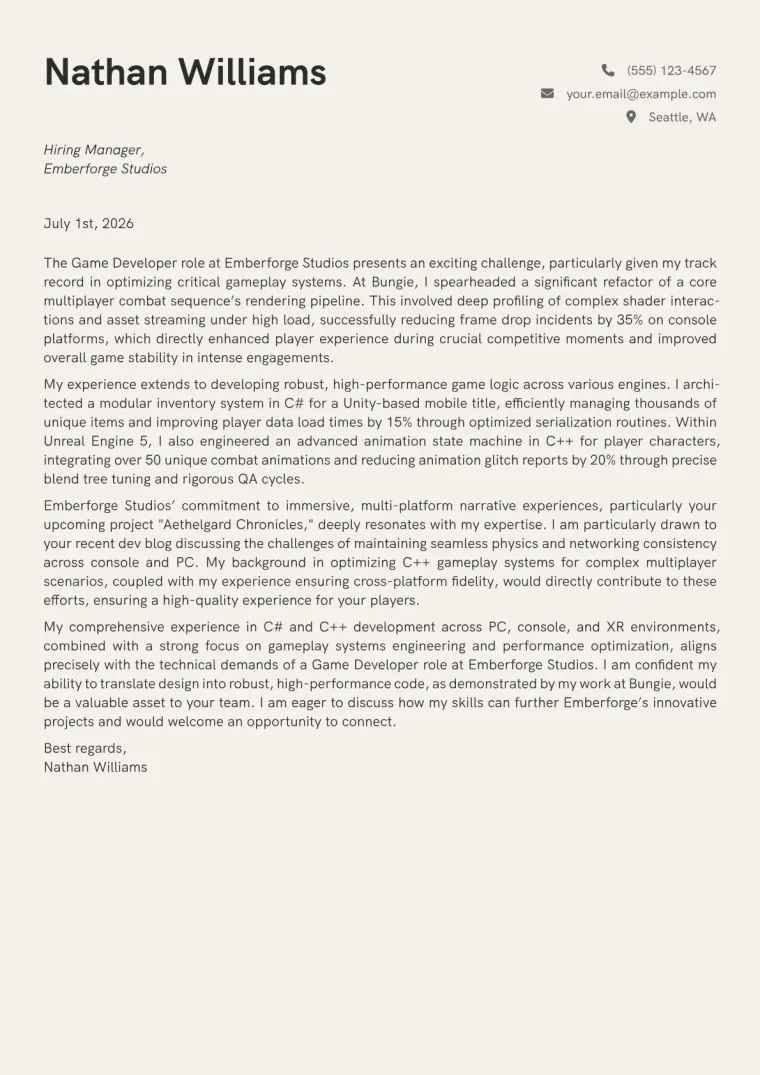
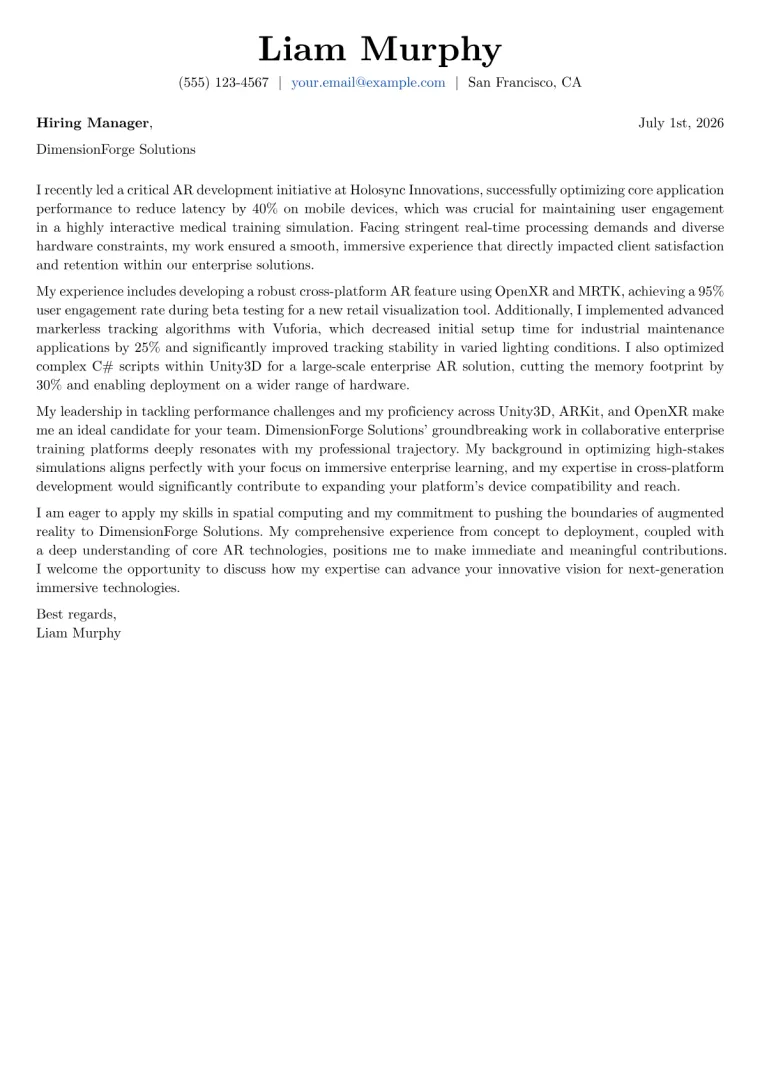
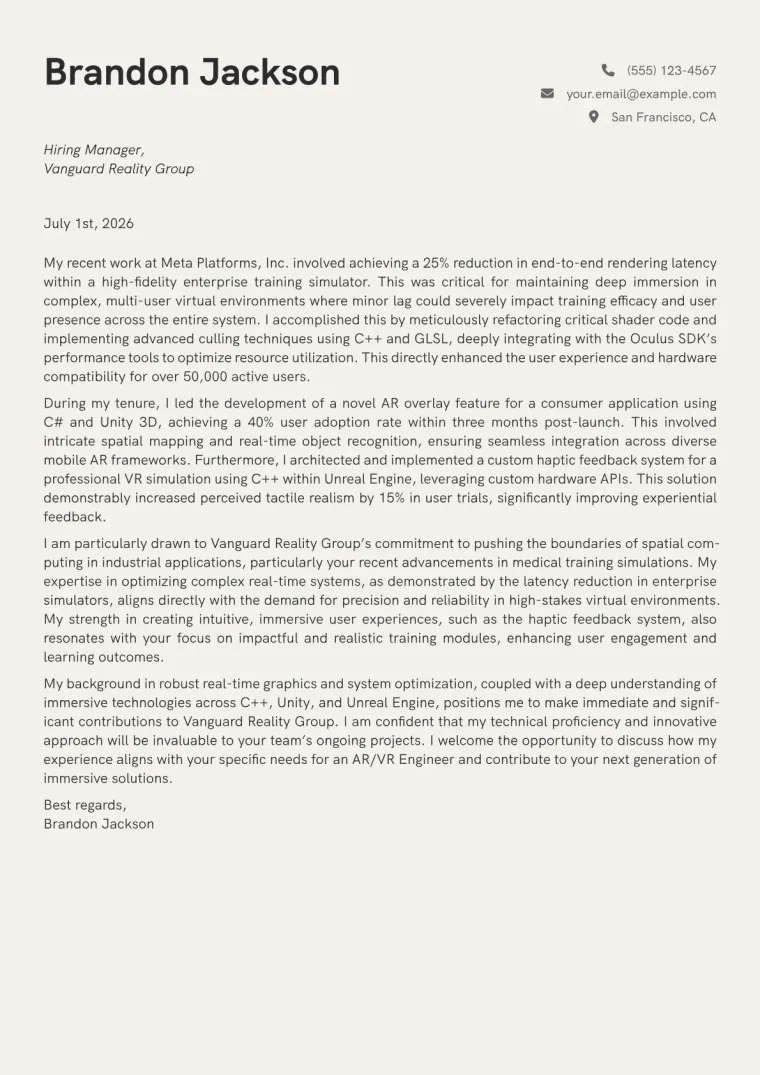
Marcus WashingtonTo the Hiring Manager, Lumina Interactive

Reduced VR application latency by 35% across a suite of complex simulations by refactoring core rendering pipelines in Unity and C#, directly addressing critical performance bottlenecks. This achievement was vital for maintaining high immersion and preventing motion sickness within high-stakes training environments where precise, real-time user interaction was paramount, significantly impacting overall user comfort and the effectiveness of the training programs. I am excited to bring this level of performance optimization to your VR Developer role.

During my tenure, I architected and implemented a high-fidelity haptic feedback system using OpenXR APIs and C# in Unity, which enhanced tactile realism for surgical training simulations and boosted user engagement by 25% in internal user tests. Furthermore, I developed custom physically-based rendering (PBR) shaders in GLSL within Unreal Engine 5, accurately simulating complex material properties like subsurface scattering for detailed anatomical models, leading to a 40% improvement in visual realism as perceived by medical professionals. I also optimized critical C++ physics engine integrations for large-scale multi-user VR environments, consistently increasing stable framerates from 45fps to a stable 90fps, crucial for synchronous interaction.

Lumina Interactive's commitment to cutting-edge narrative VR experiences and interactive storytelling deeply resonates with my own professional aspirations. I am particularly drawn to your recent "Chronos Echoes" project, which demonstrated innovative spatial audio and highly responsive character interaction, pushing the boundaries of immersive narrative. My proven strengths in optimizing complex VR pipelines for smooth, high-fidelity performance, even with rich graphical assets, and my ability to craft intuitive, deeply engaging user interactions would be directly valuable in expanding such ambitious and technically demanding projects.

My background at Meta Reality Labs, consistently focused on delivering highly performant and compelling VR experiences, has equipped me with the precise skills necessary to contribute significantly to Lumina Interactive's groundbreaking mission. I am confident that my technical acumen across C++, Unity, and Unreal Engine, coupled with my strong drive for creating deeply immersive designs, makes me an exceptional fit for your team. I welcome the opportunity to discuss further how my contributions can help Lumina Interactive continue to push the boundaries of virtual reality.

Best regards,
Marcus Washington
VR Developer cover letter for a career changer

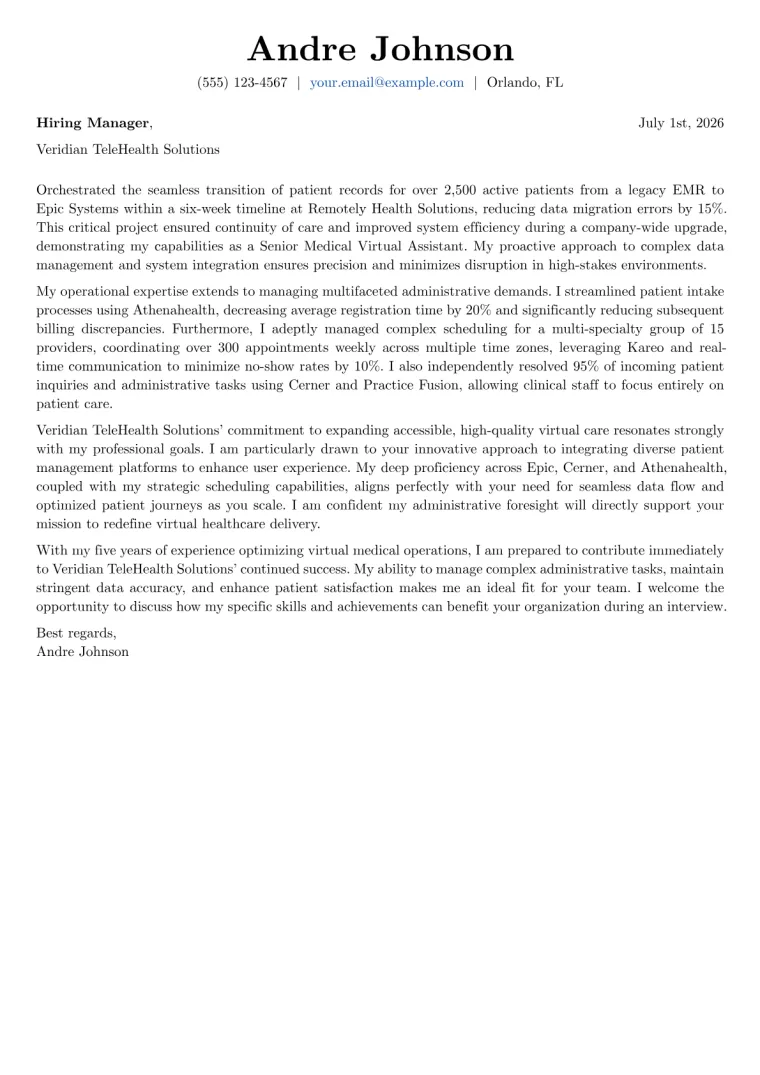
Marcus WashingtonTo the Hiring Manager, Nexus Spatial Systems

Nexus Spatial Systems sets the industry standard for industrial digital twins, and my recent architectural simulation project demonstrates the exact precision required for your XR development team. While managing high-end residential design, I engineered a proprietary real-time structural analysis tool using Python and C# that allowed clients to visualize load distribution in complex environments before construction began. This initiative improved spatial accuracy by 40 percent, cutting onsite material wastage significantly. My focus now centers on translating this expertise in spatial fidelity and computational logic into high-performance VR environments for your platform.

My shift from architectural design to immersive software development leverages a strong technical foundation in procedural geometry and spatial optimization. Using GLSL shaders, I recently redeveloped an environmental lighting system for a 3D visualization startup that reduced draw calls by 25 percent while maintaining 90 frames per second on standalone headsets. I utilized Unreal Engine blueprints combined with C++ custom components to streamline asset loading workflows, decreasing scene initialization time by 18 seconds for users.

Your recent work on collaborative enterprise environments highlights a unique intersection of data visualization and user interaction that aligns perfectly with my professional background. Bringing a decade of experience in spatial design enables me to bridge the gap between abstract user requirements and technical implementation in ways that standard software developers might overlook. I possess an analytical approach to troubleshooting complex 3D workflows and a commitment to interface clarity that mirrors your company approach to human centric technology. I anticipate contributing these perspectives to build intuitive tools that solve genuine problems for your enterprise clients.

Applying my background in computational architecture to the challenges of VR development positions me to deliver immediate value to the Nexus Spatial Systems engineering group. I offer a rigorous work ethic, a deep understanding of spatial relationships, and the technical agility necessary to master your current Unity and Unreal pipelines rapidly. Please let me know when you are available to discuss how my skill set aligns with your upcoming project milestones. I look forward to exploring a potential collaboration and providing a detailed demonstration of my development portfolio during an interview.

Best regards,
Marcus Washington
VR Developer cover letter with no experience

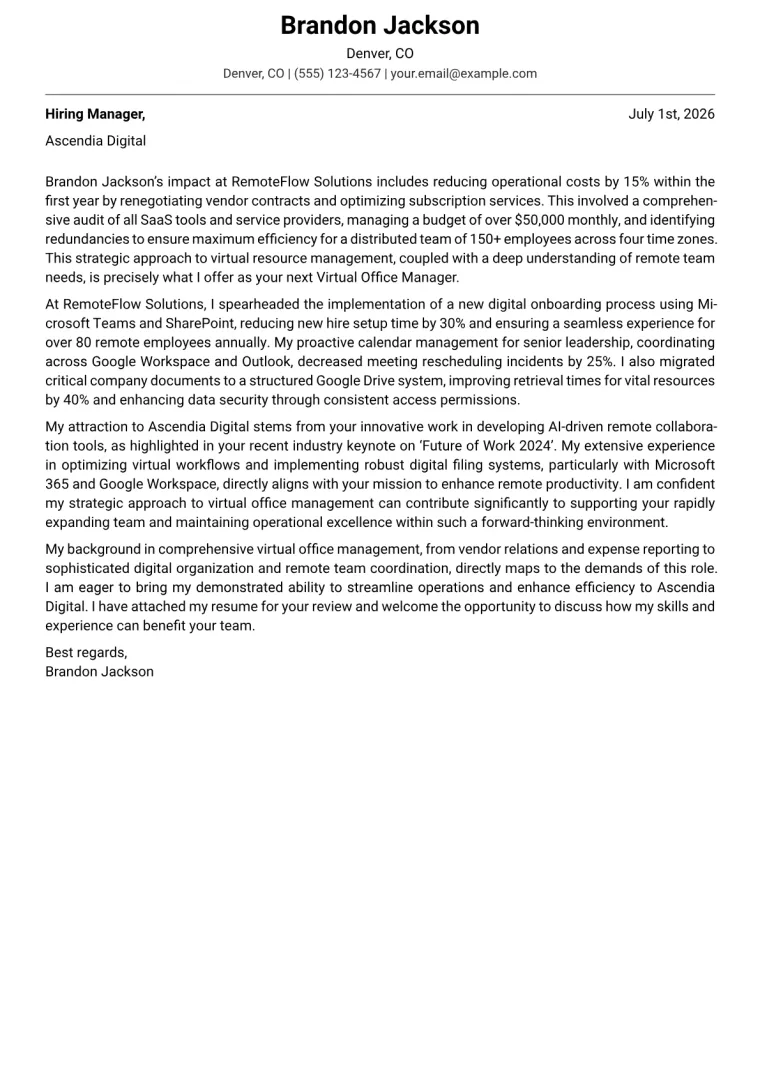
Marcus WashingtonTo the Hiring Manager, Aether Dynamics

Engineered a custom room scale interaction system for my senior capstone project that increased user object manipulation speed by 40 percent using Unity and C#. By analyzing existing grab mechanics and implementing a proprietary kinematic constraint solver, I eliminated the jitter that previously hampered precise tool handling within the simulation. This specific enhancement allowed test users to complete technical assembly tasks in half the time of standard physics based interactions. Developing this system provided a fundamental understanding of how to balance high fidelity visual feedback with the demanding performance constraints required for fluid virtual reality environments.

During my recent work on the VR educational training simulator, I optimized fragment shaders in GLSL to reduce draw calls by 25 percent across all desktop headset platforms. I also integrated an A star pathfinding system in C++ for intelligent non player characters, which reduced compute spikes by 15 percent while maintaining stable frame rates. Furthermore, I built an automated asset import pipeline in Unreal Engine that cut manual setup time for 3D models by 60 percent. These initiatives demonstrated my ability to apply rigorous technical problem solving to solve complex developmental bottlenecks efficiently.

Aether Dynamics stands out for your recent advancements in high fidelity surgical training modules designed for remote medical collaboration. My background in low latency interaction design and my ability to write efficient shader code align directly with your focus on realism in distributed virtual training environments. Integrating these capabilities into your current development cycle will help maintain your standard for visual accuracy while expanding the accessibility of your software. My technical focus on performance optimization remains a vital asset for supporting the complex physiological simulations that define your mission within the digital healthcare sector.

My technical background provides a strong foundation for immediate contribution to your engineering team. I look forward to discussing how my experience with Unity and OpenXR can support your upcoming project roadmap and help achieve your development milestones. Please let me know a suitable time for us to connect regarding the VR Developer role. My portfolio containing these specific implementations is available for review, and I welcome the chance to provide deeper insight into the technical challenges I solved. Thank you for your time and for considering my application for this position.

Best regards,
Marcus Washington
Editorial Notes

For mid-level VR Developer roles, hiring managers prioritize concrete evidence of technical expertise and direct impact. They seek candidates who understand and solve complex VR-specific challenges like performance optimization, immersion, and user experience. Crucially, they look for quantified achievements in areas such as latency reduction, framerate stability, and enhanced realism, alongside specific proficiencies in engines like Unity or Unreal Engine, and languages like C# or C++. Signals of problem-solving acumen and an understanding of how technical solutions contribute to business goals or user comfort are also highly valued.

This example letter excels by immediately grabbing attention with a quantified achievement: reducing VR application latency by 35% using Unity and C#. Its body paragraph provides a strong portfolio of technical accomplishments, detailing the architecture of a haptic feedback system that boosted engagement by 25%, development of PBR shaders in GLSL for a 40% improvement in visual realism, and C++ physics engine optimizations that stabilized framerates. The letter effectively tailors its interest to Lumina Interactive's "Chronos Echoes" project, citing innovative spatial audio and responsive character interaction, and closes confidently by highlighting a background at Meta Reality Labs and specific engine proficiencies.

This compelling cover letter pairs effectively with JobSprout's comprehensive VR Developer resume example and can be readily adapted for personalized applications using the platform's AI cover letter writer.

Frequently Asked Questions

What should a VR Developer highlight in their cover letter?
Focus on quantifiable achievements related to VR performance optimization, such as reducing latency or increasing framerates, and successful implementation of core VR features like haptics, spatial audio, or multi-user networking. Emphasize specific engines (Unity, Unreal) and APIs (OpenXR) you have mastered. Detail how your work directly enhanced user experience or solved technical challenges.
What is the ideal length for a VR Developer cover letter?
Keep it concise and impactful, ideally no more than one page or three to four substantial paragraphs. Recruiters have limited time, so every sentence should add value. Aim for paragraphs that are rich in specific details and context, providing a compelling narrative without unnecessary filler.
How should a VR Developer open their cover letter to stand out?
Start with a strong, quantified achievement that immediately showcases your impact and expertise in VR development, directly linking it to the role you're applying for. Instead of generic opening phrases, launch directly into a compelling project outcome or a significant technical challenge you successfully overcame. This instantly grabs attention and demonstrates your value.
How should a VR Developer address not having direct professional VR experience?
Highlight relevant transferable skills from related fields like game development, simulations, or 3D graphics, such as proficiency in C++, Unity/Unreal, optimization techniques, or 3D math. Showcase personal VR projects, game jam contributions, or academic work that demonstrate your passion and foundational knowledge in VR. Clearly articulate how these experiences directly translate to the specific demands of a VR Developer role.
How should a VR Developer cover letter differ from their resume?
While the resume lists accomplishments concisely, the cover letter provides context and narrative depth for your most relevant achievements. Use it to tell the story behind your key successes, explain the 'how' and 'why,' and connect your skills directly to the specific company and role. It's an opportunity to showcase your personality and articulate your genuine interest in their work in a way a resume cannot.

More Technology cover letter examples