History Major Resume Example
 Example by JobSprout
How useful was this template?
History Major resume samples
Three complete resumes, each in a different design.
Editorial Notes
For history majors pursuing entry-level roles within academia or research, hiring managers prioritize resumes that clearly demonstrate core disciplinary competencies. Essential skills include "Archival Research," "Source Criticism," "Data Synthesis," and "Historical Methodology." Strong "Academic Writing," "Editing & Proofreading," and "Report Generation" are critical, reflecting the output demanded in these fields. Practical experience with research tools like Zotero, JSTOR, and ProQuest is highly valued, as it signals immediate readiness to engage with scholarly resources. Concrete achievements often involve contributions to research projects, digital humanities initiatives, or scholarly publications.
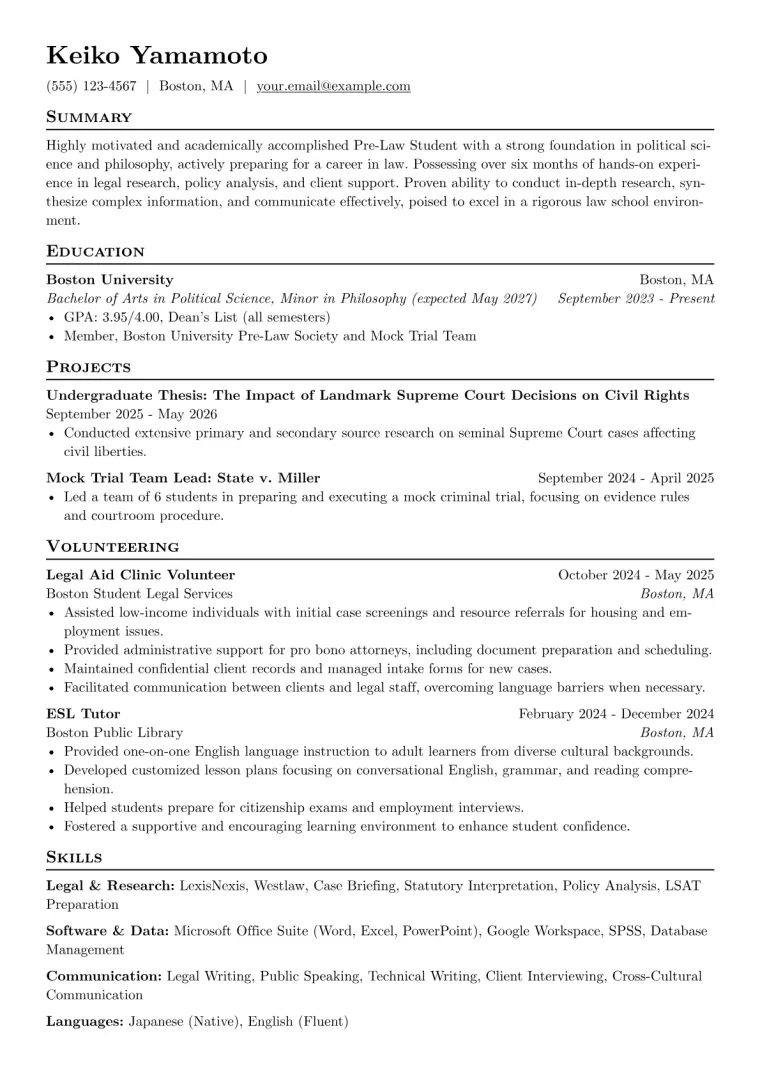
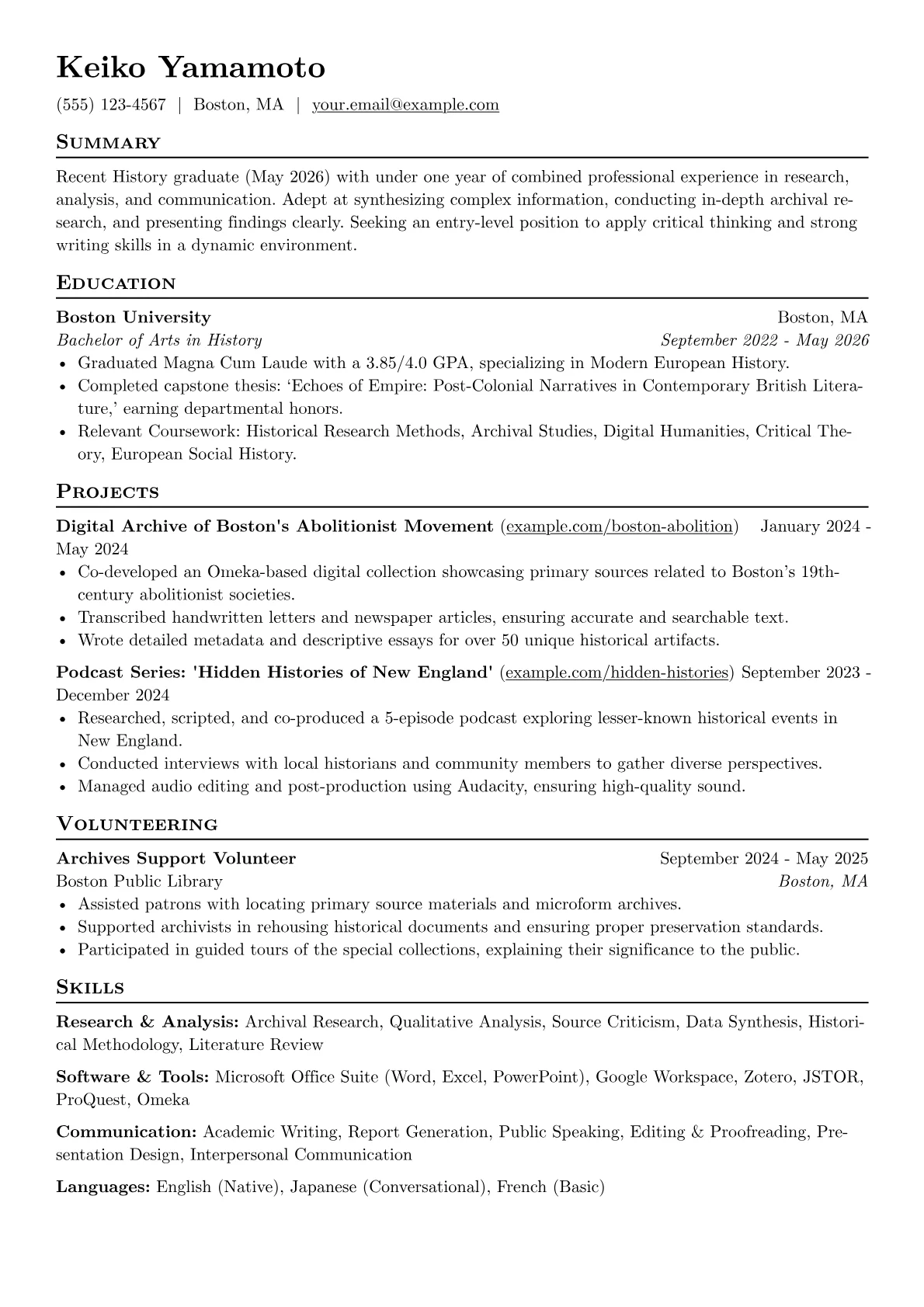
The Keiko Yamamoto example effectively highlights these vital qualifications. Under "Experience," the "Research & Editorial Intern" role showcases practical application through "Conducting in-depth research for upcoming exhibitions" and "Assisting with editing and fact-checking historical articles." Similarly, the "Research Assistant" position at Boston University demonstrates direct involvement in scholarly work, noting "meticulously organizing and digitizing primary source materials" and "Conducting extensive bibliographic searches." The "Skills" section is well-categorized, listing "Research & Analysis" competencies like "Qualitative Analysis" and "Software & Tools" such as Zotero and JSTOR. Additionally, the "Projects" section, featuring "Digital Archive of Boston's Abolitionist Movement," underscores initiative and tangible output.
This template was built with JobSprout and effectively showcases essential skills and experiences for History majors. It can be easily remixed to create your own tailored resume, highlighting your unique qualifications.
How useful was this template?
Example by JobSproutHistory Major resume summary example
Recent History graduate (May 2026) with under one year of combined professional experience in research, analysis, and communication. Adept at synthesizing complex information, conducting in-depth archival research, and presenting findings clearly. Seeking an entry-level position to apply critical thinking and strong writing skills in a dynamic environment.
History Major resume skills and keywords
Recruiters and applicant tracking systems scan History Major resumes for these skills and keywords. Include the ones that match your experience and mirror the wording in the job description. Check your resume against them with the free ATS checker.
Hard skills
Tools & software
Certifications
Soft skills
Frequently Asked Questions
What is the best resume format for a History Major seeking a professional role?
Which skills should a History Major emphasize on their resume for professional jobs outside of academia?
How do I write a compelling summary and achievement bullets for a History Major's resume?
What optional sections are important for a History Major's resume, especially as a student or recent graduate?
How can JobSprout's "Remix with AI" help a History Major tailor their resume to different job postings?
Related Articles
![Academic CV for PhD Applications: How to Write One [2026]](/thumbnails/cv-for-academic-applications.webp)
Academic CV for PhD Applications: How to Write One [2026]
Learn how to write an academic CV for PhD applications. Real template analysis, what research committees look for, and common mistakes to avoid.

How to Apply for a PhD in the UK: 2027 Entry Guide
Rejected by Cambridge, Oxford, UCL and Imperial, then three funded offers and a Gates Cambridge Scholarship. The UK PhD application process, step by step.