Neuroscience Student Resume Example
 Example by JobSprout
Free to use. No download fee.
How useful was this template?
Neuroscience Student resume samples
Three complete resumes, each in a different design.
Free to use. No download fee.
Editorial Notes
A compelling Neuroscience Student resume emphasizes practical research experience and technical proficiency, crucial for entry-level roles in academic labs or industry. Hiring managers seek candidates who demonstrate familiarity with experimental design, data analysis, and scientific communication. Specific achievements, such as contributions to data collection efficiency or successful analysis of datasets, are highly valued. Knowledge of specialized software (e.g., Python, MATLAB, SPM) and neuroscience techniques like electrophysiology or fMRI showcases immediate utility. Strong candidates also highlight their ability to contribute to literature reviews and manuscript preparation, signaling their readiness for collaborative research environments.
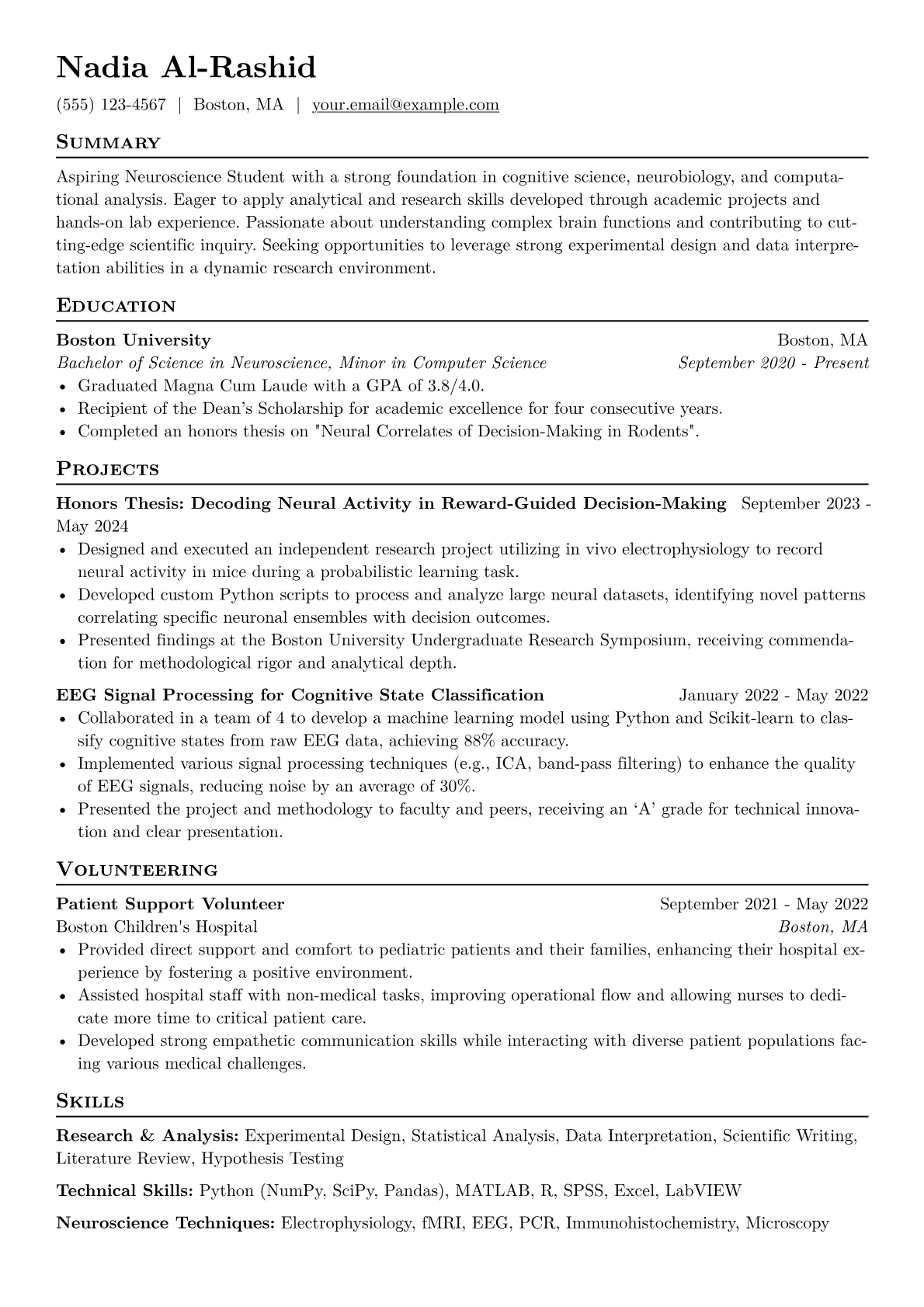
This example resume for Nadia Al-Rashid effectively showcases these essential qualities. It highlights diverse experience, from assisting in electrophysiological experiments at Boston University's Computational Neuroscience Lab to recruiting human participants for fMRI studies at Northeastern University. Quantifiable accomplishments, such as contributing to a "15% increase in weekly data collection efficiency" and achieving a "90% participant retention rate," provide concrete evidence of impact. The resume also details proficiency in key tools and methods, including "Python (NumPy, SciPy)," "MATLAB," and specific neuroscience techniques like "Electrophysiology" and "fMRI." The inclusion of projects like an "Honors Thesis: Decoding Neural Activity in Reward-Guided Decision-Making" further reinforces a strong research orientation.
This template was built with JobSprout and can be remixed to create your own tailored Neuroscience Student resume.
How useful was this template?
Example by JobSproutNeuroscience Student resume summary example
Aspiring Neuroscience Student with a strong foundation in cognitive science, neurobiology, and computational analysis. Eager to apply analytical and research skills developed through academic projects and hands-on lab experience. Passionate about understanding complex brain functions and contributing to cutting-edge scientific inquiry. Seeking opportunities to leverage strong experimental design and data interpretation abilities in a dynamic research environment.
Neuroscience Student resume skills and keywords
Recruiters and applicant tracking systems scan Neuroscience Student resumes for these skills and keywords. Include the ones that match your experience and mirror the wording in the job description. Check your resume against them with the free ATS checker.
Hard skills
Tools & software
Certifications
Soft skills
Frequently Asked Questions
What's the best resume structure for a Neuroscience Student who is a student or recent graduate?
Which key skills and qualifications should I highlight as a Neuroscience Student?
How can I write strong achievement bullets or a professional summary for my Neuroscience Student resume?
What optional sections should a Neuroscience Student include on their resume?
How can I tailor my Neuroscience Student resume for a specific job posting?
The blank page is the hard part. Skip it.
Free to use. No download fee.