Templates

Neuroscience Resume Example

HealthcareResearchStudent / InternStudentBiology
Use this example

Free to use. No download fee.

Neuroscience resume samples

Three complete resumes, each in a different design.
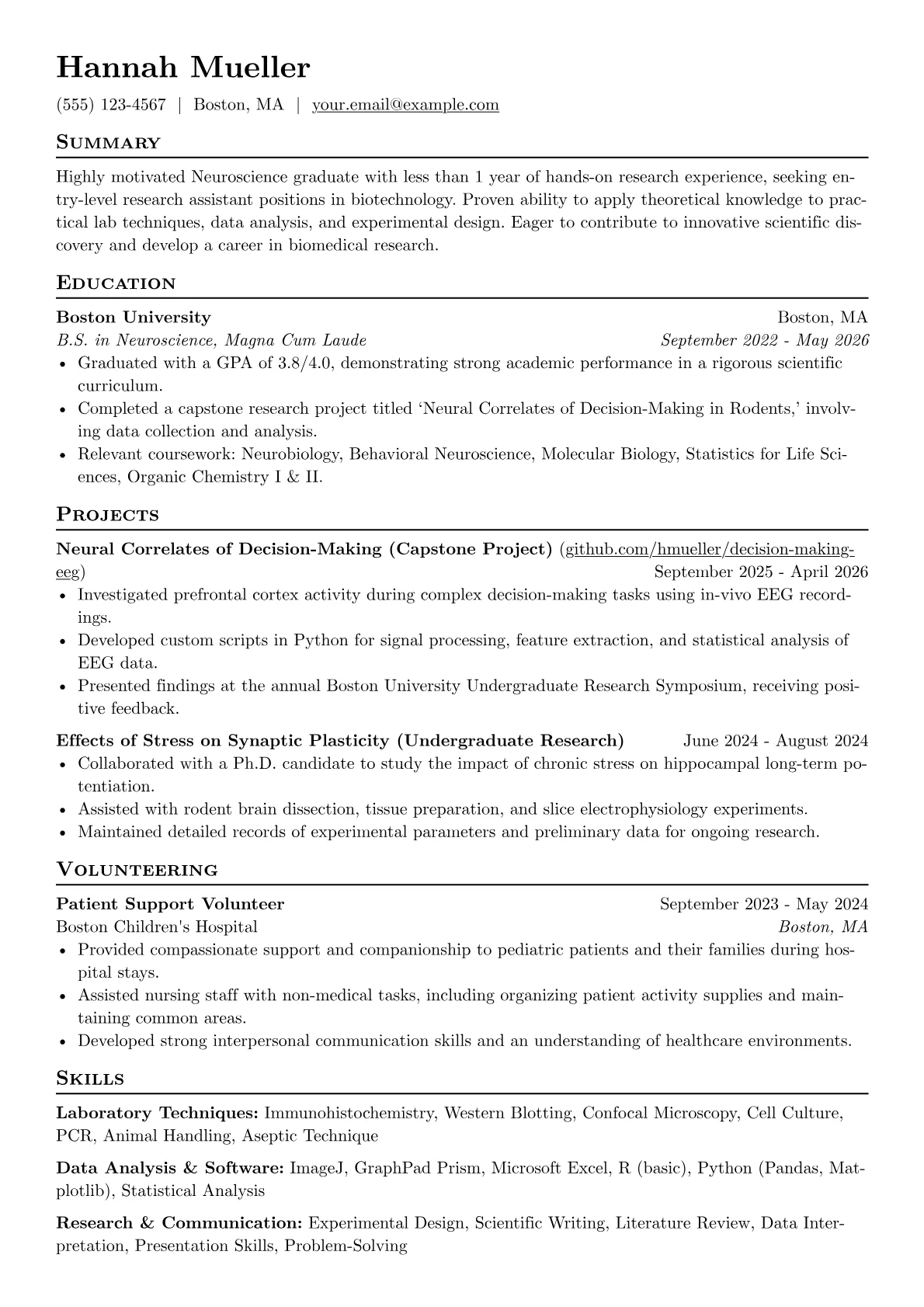
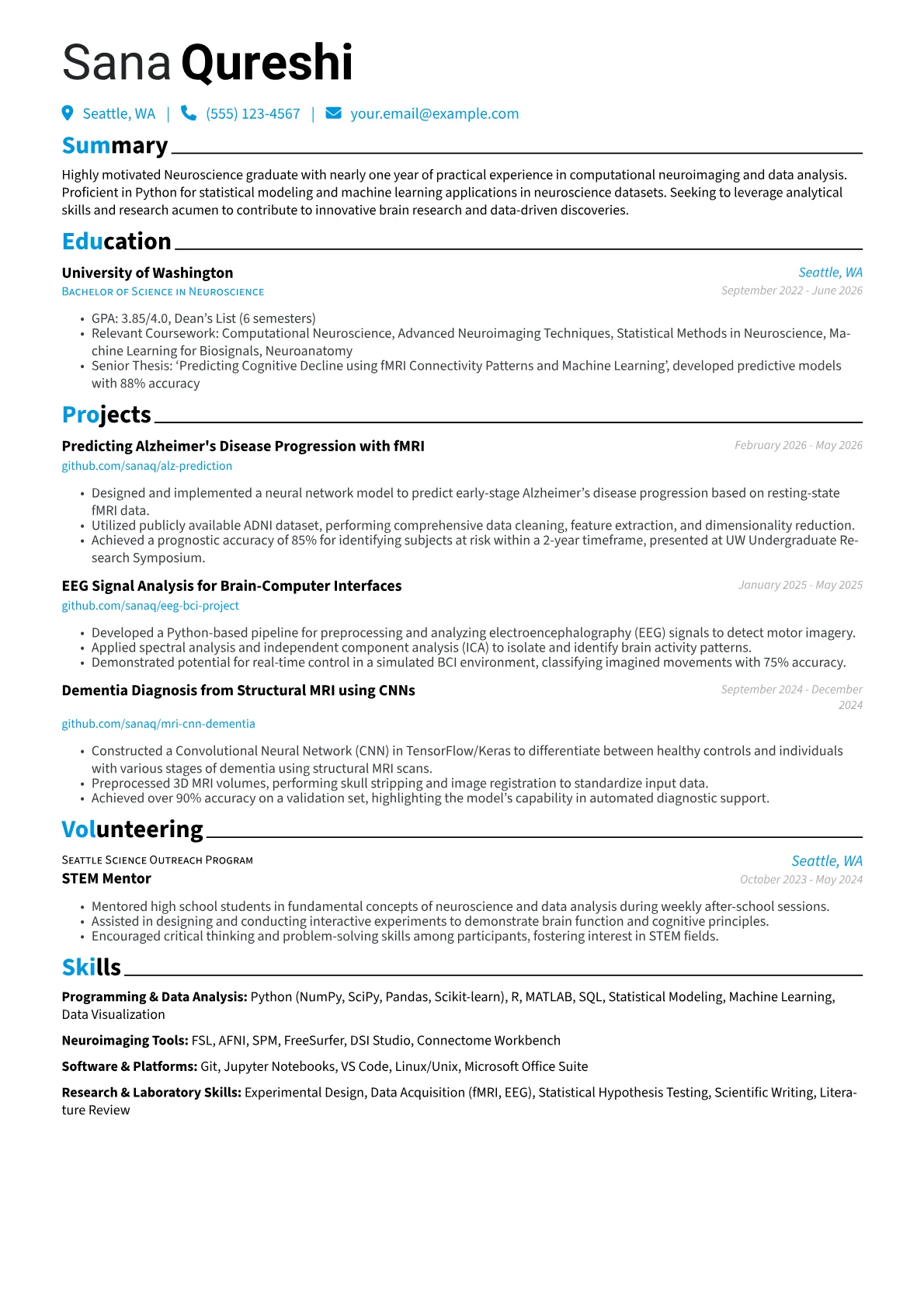
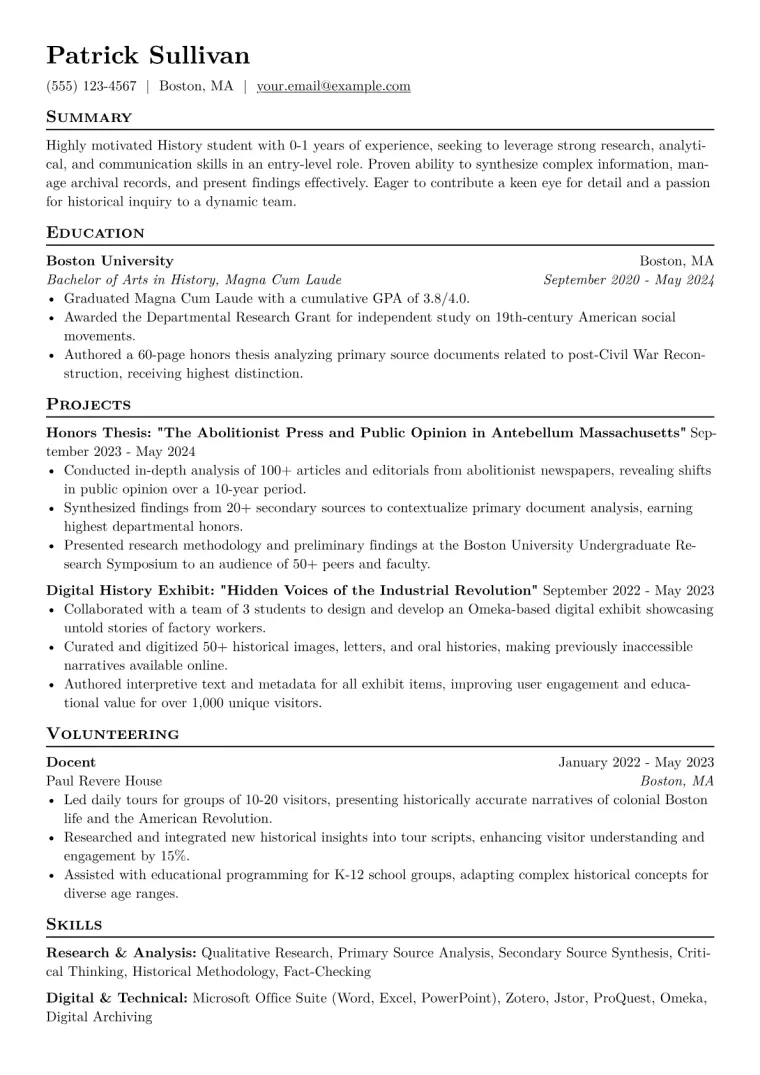
Neuroscience resume example, page 1
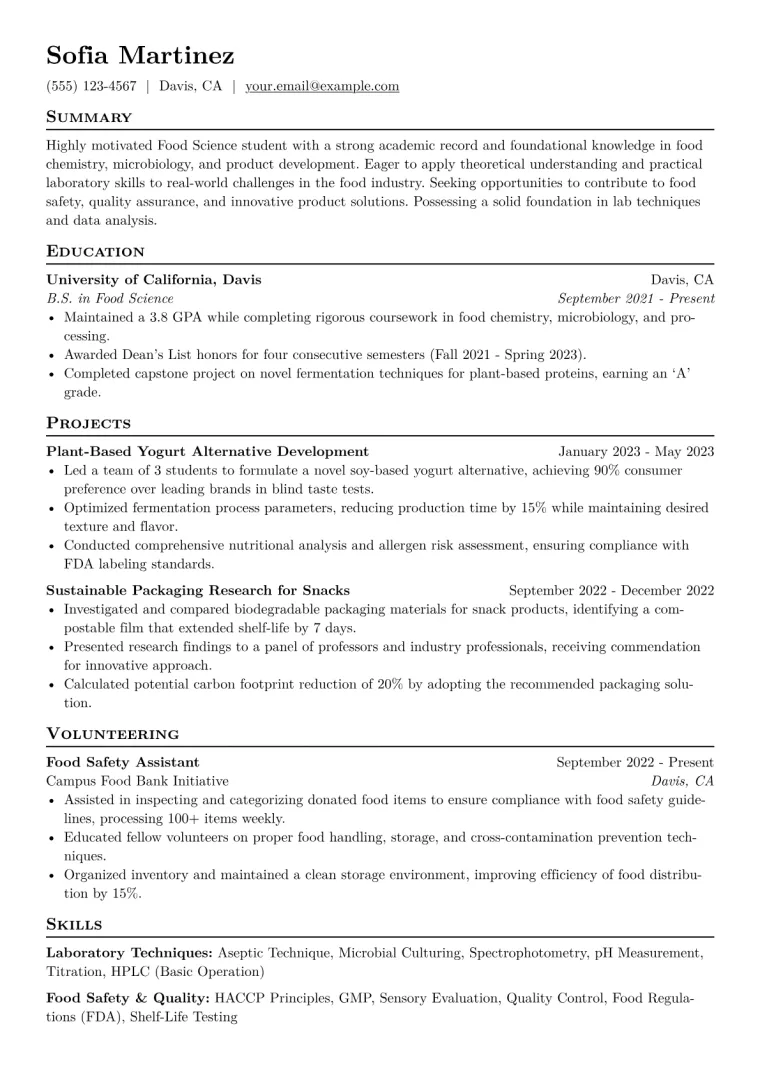
Neuroscience resume example, Neuroscience, page 1
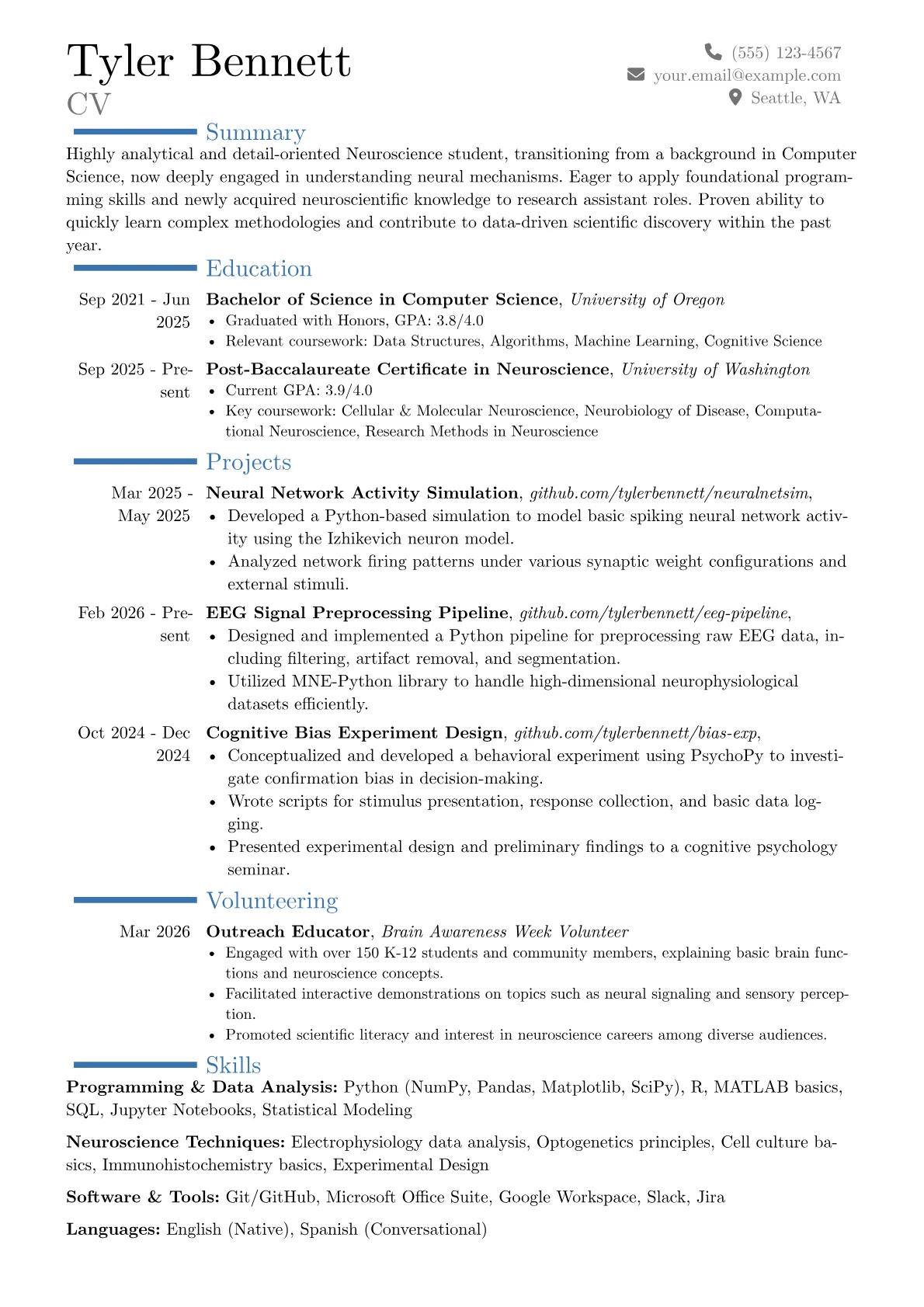
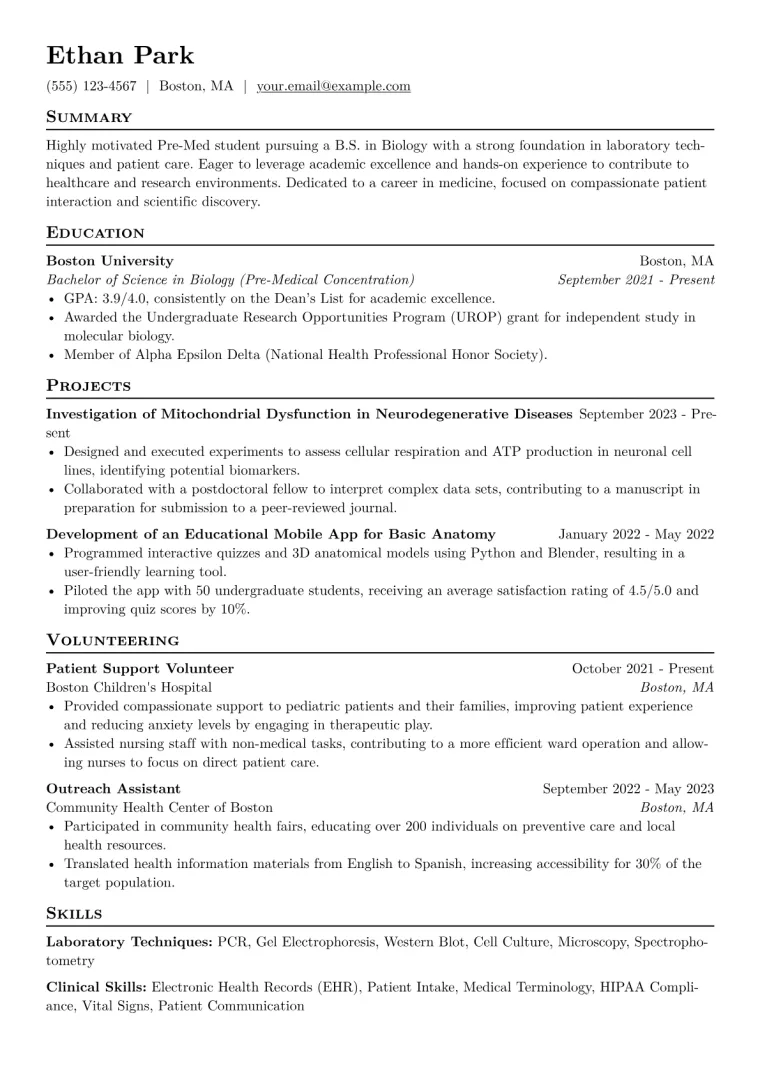
Neuroscience resume example, Career changer, page 1
Use this example

Free to use. No download fee.

Editorial Notes

Hiring managers in neuroscience research, particularly for student or recent graduate roles, prioritize concrete demonstrations of technical proficiency and active research involvement. They seek candidates who can immediately contribute to laboratory work, understanding the nuances of experimental design and data interpretation. Key achievements include hands-on experience with specific laboratory techniques, competence in data analysis software, and the ability to maintain precise experimental records. Terminology like electrophysiology, neural circuits, and synaptic plasticity indicates a strong foundational understanding crucial for entry into healthcare research or biotech roles.

This example CV effectively highlights Hannah Mueller's qualifications. As a Research Assistant at the Cognitive Neuroscience Lab at Boston University, Hannah clearly articulates contributions such as assisting in the "design and execution of experiments investigating neural circuits involved in learning and memory." The resume precisely lists relevant skills, including "Immunohistochemistry, Western Blotting, and Confocal Microscopy" under Laboratory Techniques, and "ImageJ, GraphPad Prism, R (basic), Python" for Data Analysis. Furthermore, showcasing projects like "Neural Correlates of Decision-Making (Capstone Project)" and "Effects of Stress on Synaptic Plasticity (Undergraduate Research)" provides tangible evidence of research experience and application of theoretical knowledge.

This template was built with JobSprout and can be remixed to create your own tailored Neuroscience resume, ensuring you showcase relevant skills and experience effectively.

How useful was this template?

JobSprout logoExample by JobSprout

Neuroscience resume summary example

Highly motivated Neuroscience graduate with less than 1 year of hands-on research experience, seeking entry-level research assistant positions in biotechnology. Proven ability to apply theoretical knowledge to practical lab techniques, data analysis, and experimental design. Eager to contribute to innovative scientific discovery and develop a career in biomedical research.

Neuroscience resume skills and keywords

Recruiters and applicant tracking systems scan Neuroscience resumes for these skills and keywords. Include the ones that match your experience and mirror the wording in the job description. Check your resume against them with the free ATS checker.

Hard skills

ElectrophysiologyfMRI Data AnalysisEEG InterpretationImmunohistochemistryCell Culture TechniquesAnimal HandlingBehavioral NeuroscienceMolecular BiologyExperimental DesignStatistical AnalysisLiterature ReviewNeuroanatomyPCRWestern Blot

Tools & software

MATLABR ProgrammingPythonSPSSGraphPad PrismImageJLabChartEndNote

Certifications

CITI Program CertificationIACUC Protocol TrainingHIPAA ComplianceBLS Certification

Soft skills

Critical ThinkingProblem SolvingAttention to DetailScientific CommunicationData InterpretationTeamwork

Frequently Asked Questions

What's the best resume format for a Neuroscience student or recent grad?
For a Neuroscience student or recent graduate, a reverse-chronological format highlighting education, research experience, and relevant coursework is highly effective. Place your education and any significant lab or research sections prominently at the top. If you have clinical shadowing or volunteer experience, ensure it shows your exposure to healthcare or research environments. Keep it concise, ideally one page.
Which skills should a Neuroscience student highlight on their resume?
Emphasize research methodologies, data collection and analysis (e.g., Python, R, MATLAB), statistical analysis, laboratory techniques (e.g., cell culture, microscopy, neurophysiology), and scientific writing. Include critical thinking, problem-solving, and attention to detail. If you have experience with specific neuroscience tools or software, be sure to list them. Communication and teamwork are also important.
How should a Neuroscience student write their resume summary and achievement bullets?
A focused career objective or a brief professional summary highlighting your passion for neuroscience and specific research interests or career goals works well. For achievement bullets, detail your contributions to research projects. Instead of 'Assisted with lab experiments,' try 'Conducted electrophysiological recordings, contributing to data set for X study.' Quantify results or impact when possible.
What optional sections are important for a Neuroscience student's resume?
'Research Experience' with details of labs, projects, and techniques is crucial. A 'Laboratory Skills' section listing specific instruments and procedures you are proficient with is highly valued. 'Publications' or 'Presentations' for any academic work. 'Volunteer Experience' in clinics or research settings demonstrates commitment. List relevant software or programming proficiencies.
How can JobSprout's 'Remix with AI' help a Neuroscience student tailor their resume?
JobSprout's 'Remix with AI' can help Neuroscience students align their extensive research and academic experience with specific job descriptions. By pasting the job details, the AI identifies key research techniques, required analytical skills, and relevant scientific terminology. This allows you to optimize your resume's language to resonate with hiring managers in research, biotech, or clinical roles, highlighting your specific contributions.