PDF or DOCX · up to 2MB
Write a prompt engineer resume that gets interviews. Full resume example, summary templates, 10+ experience bullets, technical skills breakdown, and tips for career changers from software engineering, copywriting, data science, and UX research.
Learn how resume and CV formats differ across countries. Covers the US, UK, Germany, France, Australia, Japan, and the Middle East with comparison tables and practical tips.

Learn how to write a resume for an internal transfer. Includes a full example, summary templates for lateral moves, promotions and department changes, weak vs strong comparisons, and advice on navigating the politics.

Declining a job offer is awkward, but doing it well is a career skill. Use these 7 email templates to say no gracefully, preserve the relationship, and keep the door open for future opportunities.
Prompt engineering is one of the fastest-growing roles in tech. What started as an informal skill, the art of getting useful outputs from large language models, has become a dedicated career path with salaries ranging from £60,000 to well over £200,000 at major AI companies. Demand for prompt engineering skills has surged, with job postings for the role growing rapidly across major platforms since 2023, and the role now appears across industries from finance and healthcare to e-commerce and legal tech.
The challenge for candidates is that this is still a relatively new field with no established resume template. Most prompt engineer resumes I review fall into one of two traps: they either read like a generic list of AI tools ("proficient in ChatGPT, Claude, and Gemini") or they bury genuinely impressive systematic work under vague descriptions. Neither approach survives the 7-second scan that most recruiters give your application.
This guide shows you how to write a prompt engineer resume that demonstrates real, measurable impact. I will walk through a full resume example, summary templates for different backgrounds, 10+ experience bullet formulas, the technical skills that actually matter, and how to position yourself whether you are coming from software engineering, copywriting, data science, or UX research.
Before writing anything, you need to understand what sets prompt engineering apart from other AI-adjacent roles. Having helped candidates craft technical resumes through JobSprout and reviewed hiring patterns across dozens of AI teams, I have seen four consistent themes in what separates strong prompt engineering candidates from the rest.
Hiring managers want to see that you understand how language models actually work, not just how to use them. This means demonstrating familiarity with tokenisation, attention mechanisms, context windows, temperature and sampling parameters, and how different model architectures produce different outputs. You do not need a PhD in machine learning, but you do need to show that your prompt design decisions are grounded in an understanding of model behaviour rather than trial and error.
The difference between a hobbyist and a professional prompt engineer is evaluation. Companies want candidates who can build repeatable evaluation frameworks, define quality metrics, run A/B tests on prompt variants, and quantify improvements. If your resume cannot point to specific evaluation methodologies you have used, it will read as "I played with ChatGPT" rather than "I engineered production-grade prompts."
Prompt engineering does not exist in a vacuum. The most valuable prompt engineers bring deep knowledge of a specific domain: legal document analysis, medical triage, financial modelling, customer support automation, or content generation at scale. Your resume should make it clear what problems you solve and for whom, not just which models you have used.
Prompt engineers sit at the intersection of engineering, product, and domain expertise. You will work with software engineers on integration, product managers on requirements, and subject matter experts on quality. Your resume needs to show that you can translate between technical and non-technical stakeholders, document your work clearly, and operate within cross-functional teams.
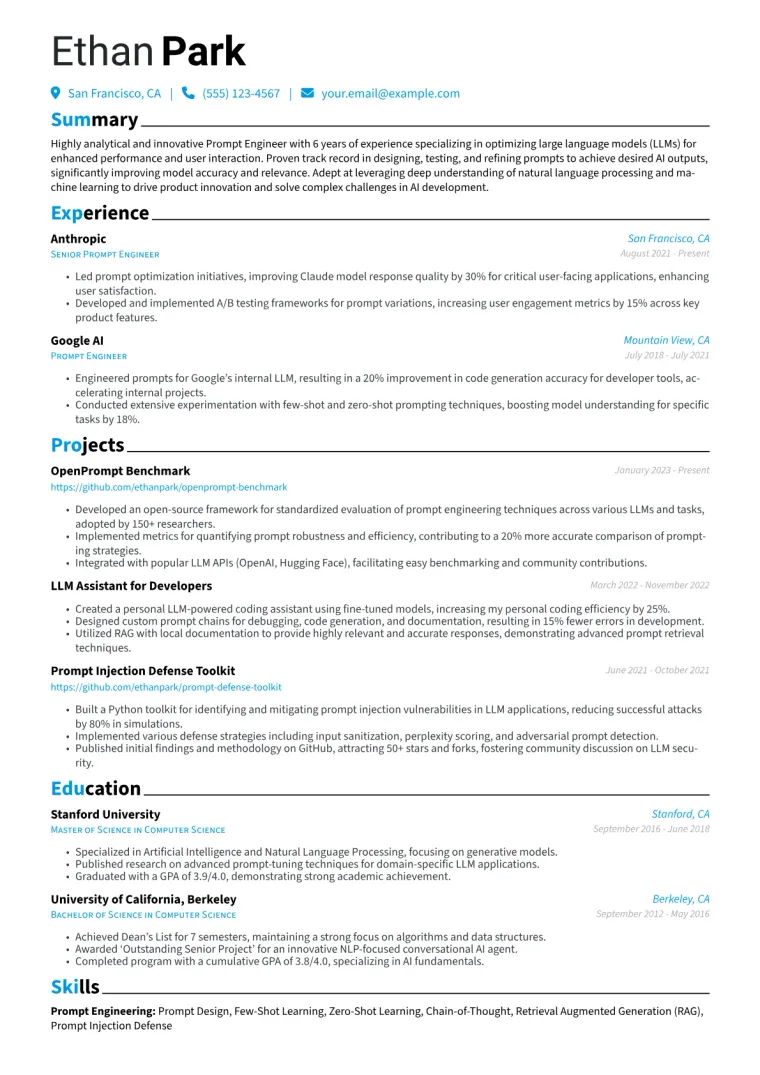
Here is a real prompt engineer resume that shows how to demonstrate AI/ML impact.
Ethan's resume leads with measurable model improvements. At Anthropic, he "improved Claude model response quality by 30% for critical user-facing applications" and "reduced hallucination rates by 25% across multiple complex domains." These are the exact metrics AI companies hire for: output quality, safety, and reliability.
The skills section is organized into three highly specific categories: Prompt Engineering (prompt design, few-shot/zero-shot learning, chain-of-thought, RAG, prompt injection defense), Programming & Tools (Python, PyTorch, TensorFlow, Hugging Face), and AI/ML Concepts (LLMs, NLP, fine-tuning, RLHF). This level of specificity signals deep expertise, not surface-level familiarity.
His education is a strong foundation: MS in Computer Science from Stanford with a specialization in AI and NLP, plus published research on prompt-tuning techniques. For prompt engineering roles, this academic depth combined with production experience at Anthropic is a compelling combination.
His Anthropic role demonstrates production-grade prompt work:
ANTHROPIC (Senior Prompt Engineer, Current)
- Led prompt optimization initiatives, improving Claude model
  response quality by 30% for critical user-facing applications
- Developed A/B testing frameworks for prompt variations,
  increasing user engagement metrics by 15% across key features
- Collaborated with ML engineers to fine-tune generative AI
  models, reducing hallucination rates by 25%
- Designed prompt injection defenses, securing proprietary
  models against 90% of identified adversarial attacks
Every bullet connects a prompt engineering technique to a measurable product outcome.
Three categories: Prompt Engineering (design, few-shot, zero-shot, chain-of-thought, RAG, injection defense), Programming (Python, PyTorch, TensorFlow, Hugging Face, Jupyter, Git), and AI/ML Concepts (LLMs, NLP, fine-tuning, RLHF, model evaluation).
If you want to use this as your starting point, hit "Remix with AI" on the template above.
Your summary is the first thing a recruiter reads after your name. It needs to establish your experience level, your specific focus within prompt engineering, and at least one quantifiable achievement. Here are three examples for different backgrounds.
Prompt engineer with 2 years of dedicated LLM experience and 5 years of prior software engineering in Python and NLP. Designed production prompt systems handling 1.5M+ daily API calls for an e-commerce personalisation engine. Built automated evaluation pipelines that reduced prompt regression incidents by 73%. Strong foundation in software architecture, testing methodology, and deployment workflows.
This summary works because it bridges the candidate's engineering background with their prompt engineering focus. The software engineering experience is framed as an asset, not a separate career.
Prompt engineer specialising in enterprise knowledge management and RAG architectures. Built and maintained prompt libraries serving 40+ internal teams across a Fortune 500 financial services firm. Developed custom evaluation frameworks combining automated metrics and human review that improved output accuracy from 76% to 94% over 8 months. Experienced in cross-functional collaboration with legal, compliance, and product teams.
This example highlights domain expertise (financial services), scale (Fortune 500, 40+ teams), and a clear improvement trajectory with numbers.
AI researcher transitioning to applied prompt engineering with 3 publications on in-context learning and LLM evaluation methodology. Developed novel few-shot prompting techniques that improved zero-shot baseline performance by 28% across 6 NLP benchmarks. Experienced in building evaluation datasets, designing human annotation protocols, and conducting systematic ablation studies. Seeking to apply research expertise to production LLM systems.
For researchers, the summary emphasises publications and methodology while signalling a clear intent to move into applied work. The phrase "seeking to apply research expertise to production LLM systems" tells the hiring manager exactly what they need to hear.
The experience section is where most prompt engineer resumes fall apart. Candidates either describe their work in vague terms ("optimised prompts for better results") or list tools without context ("used LangChain and OpenAI API"). Every bullet should follow this formula: what you did + the context or scale + the measurable result.
Here are 12 bullets covering the key areas hiring managers evaluate, each with a weak and strong version.
Weak: Developed prompts for the company chatbot.
Strong: Designed and maintained a 150+ prompt library powering an enterprise customer support chatbot handling 1.8M monthly conversations, with a 92% user satisfaction score on AI-assisted resolutions.
Weak: Tested different AI models to find the best one.
Strong: Led a 6-week evaluation programme comparing GPT-4o, Claude 3.5 Sonnet, and Gemini 1.5 Pro across 4,000 test cases for a legal document summarisation use case, ultimately recommending Claude 3.5 Sonnet based on a 23% improvement in faithfulness scores and 40% lower inference costs.
Weak: Worked on reducing AI hallucinations.
Strong: Developed a multi-stage verification prompting architecture that reduced hallucination rates from 15% to 4.2% on factual customer queries, validated across a 10,000-example test suite with weekly regression monitoring.
Weak: Ran A/B tests on prompts.
Strong: Designed and executed a 12-variant A/B testing programme for product description generation, identifying a chain-of-thought approach that improved conversion-relevant quality scores by 31% while reducing token usage by 18%.
Weak: Implemented RAG for the knowledge base.
Strong: Built a retrieval-augmented generation pipeline integrating 50,000+ internal documents, using hybrid search (BM25 + dense embeddings) and prompt-based re-ranking that improved answer accuracy from 67% to 91% on domain-specific queries.
Weak: Reduced AI costs for the team.
Strong: Reduced monthly LLM inference costs by 58% (£45K/month saving) through prompt compression, strategic model routing between GPT-4 and GPT-3.5 Turbo, and caching frequently requested prompt-response pairs.
Weak: Fine-tuned models for better performance.
Strong: Led fine-tuning of Llama 3 70B using LoRA on a curated dataset of 12,000 domain-specific examples, achieving parity with GPT-4 on internal benchmarks at 75% lower inference cost, enabling fully on-premise deployment for sensitive financial data.
Weak: Created evaluation metrics for prompts.
Strong: Built an automated prompt evaluation framework combining ROUGE-L, BERTScore, and custom faithfulness metrics with human evaluation calibration, processing 5,000+ test cases nightly and feeding results into a Weights & Biases dashboard used by 3 engineering teams.
Weak: Improved the quality of AI outputs.
Strong: Redesigned the content generation prompt architecture using structured output schemas and self-consistency techniques, improving editorial team acceptance rate from 34% to 78% and reducing average revision cycles from 4.2 to 1.3 per piece.
Weak: Worked with different teams on AI projects.
Strong: Partnered with legal counsel and compliance officers to develop a regulatory guardrail prompt system for financial advice outputs, achieving 99.7% compliance with FCA guidelines across 50,000+ monthly generated responses.
Weak: Documented prompts for the team.
Strong: Established the organisation's first prompt engineering style guide and version control workflow, adopted by 25+ engineers across 4 product teams, reducing prompt-related production incidents by 62% in the first quarter.
Weak: Created prompts that work in multiple languages.
Strong: Designed multilingual prompt templates supporting 12 languages for a global customer support platform, achieving within 5% quality parity with English-language outputs as measured by native-speaker evaluation panels across 3,600 test cases.
For more guidance on writing impact-driven bullets, see the action verbs for resume guide.
The skills section of a prompt engineer resume needs to be specific and well-organised. Listing "AI" or "machine learning" as a skill tells a hiring manager nothing. Here is a comprehensive breakdown of the technical skills that matter, organised by category.
| Skill | What It Demonstrates | Priority |
|---|---|---|
| Prompt engineering (zero-shot, few-shot, chain-of-thought) | Core competency | Essential |
| Retrieval-augmented generation (RAG) | Production architecture knowledge | Essential |
| LLM evaluation and benchmarking | Quality assurance capability | Essential |
| Fine-tuning (LoRA, QLoRA, full fine-tune) | Model customisation depth | High |
| RLHF / preference optimisation | Advanced alignment knowledge | Medium |
| Embedding models and vector search | RAG infrastructure understanding | High |
| Agentic workflows and tool use | Emerging architecture patterns | High |
| Prompt compression and optimisation | Cost and efficiency awareness | Medium |
| Metric | Use Case | When to List |
|---|---|---|
| ROUGE (ROUGE-1, ROUGE-L) | Summarisation quality | If you have built summarisation systems |
| BLEU | Translation and structured generation | If you have worked on multilingual or template outputs |
| BERTScore | Semantic similarity evaluation | If you have built evaluation pipelines |
| Faithfulness / groundedness metrics | Hallucination detection | Always list if you have measured this |
| Human evaluation frameworks | Quality calibration | If you have designed annotation protocols |
| Perplexity | Model quality assessment | If you have done model comparison work |
| Pass@k | Code generation evaluation | If you have worked on coding assistants |
| Tool / Language | Context | Priority |
|---|---|---|
| Python | Primary language for LLM work | Essential |
| LangChain | Prompt chaining and agent frameworks | High |
| LlamaIndex | RAG and data indexing | High |
| TypeScript / JavaScript | API integration and web tooling | Medium |
| SQL | Data extraction for evaluation datasets | Medium |
| Semantic Kernel | Microsoft ecosystem integration | Situational |
| Haystack | Open-source RAG framework | Situational |
| Tool | Purpose | Priority |
|---|---|---|
| OpenAI API (GPT-4, GPT-4o) | Primary model access | Essential |
| Anthropic API (Claude) | Alternative model access | High |
| Google AI Studio / Vertex AI | Google model ecosystem | High |
| Hugging Face (Hub, Transformers, Datasets) | Open-source models and datasets | High |
| Weights & Biases | Experiment tracking and evaluation | High |
| AWS Bedrock / Azure OpenAI / GCP Vertex | Cloud AI infrastructure | Medium |
| Pinecone / Weaviate / Chroma | Vector databases for RAG | Medium |
| Prompt management tools (PromptLayer, Humanloop) | Prompt versioning and monitoring | Medium |
A common mistake is listing every model you have ever used. Focus on the models and tools you have used in production or serious project contexts, and group them logically. For a broader look at how to present technical skills effectively, check out the resume skills guide.
Prompt engineering attracts candidates from diverse backgrounds. The key is not to hide your previous career but to frame it as a foundation that makes you a stronger prompt engineer. Here is how to position yourself depending on where you are coming from.
Software engineers have the strongest natural transition path into prompt engineering. You already understand APIs, testing, deployment, and system design. The key is to reframe your engineering experience as directly relevant.
What to emphasise:
Summary example:
Prompt engineer with 2 years of LLM experience built on 6 years of backend software engineering. Designed prompt evaluation pipelines using the same testing rigour applied to traditional software: automated regression suites, staging environments for prompt variants, and monitoring dashboards tracking quality metrics in production. Built systems serving 3M+ monthly API calls.
Experience reframing:
Weak: Built REST APIs using Python and Flask.
Strong: Developed API infrastructure now serving as the backbone for LLM-powered features, including rate limiting, response caching, and model routing logic handling 2M+ monthly prompt completions.
For more on positioning your tech background, see the CV for tech applications guide.
Content professionals bring an underrated advantage to prompt engineering: deep understanding of language, tone, audience, and what "good output" looks like. Many of the best prompt engineers I have encountered came from editorial backgrounds.
What to emphasise:
Summary example:
Prompt engineer combining 3 years of LLM experience with 5 years as a senior content strategist. Specialises in prompt design for content generation systems where quality, tone, and brand consistency are critical. Developed prompt architectures that increased editorial acceptance rates from 28% to 74%, reducing content production costs by 60% while maintaining brand voice across 8 product lines.
Experience reframing:
Weak: Wrote blog posts and marketing copy for a SaaS company.
Strong: Developed editorial quality frameworks and style documentation now used as evaluation criteria for AI-generated content, defining the quality benchmarks that prompt engineering efforts are measured against across 4 content verticals.
Data scientists bring statistical rigour, evaluation methodology, and Python expertise. The transition is about shifting from model building to model interaction and output optimisation.
What to emphasise:
Summary example:
Prompt engineer and former data scientist with expertise in systematic evaluation of LLM outputs. Built evaluation frameworks combining automated metrics (ROUGE, BERTScore) with statistically rigorous human evaluation protocols. Designed and curated evaluation datasets totalling 25,000+ annotated examples. Brings 4 years of production ML experience including NLP pipelines processing 1M+ documents daily.
Experience reframing:
Weak: Built machine learning models using Python and scikit-learn.
Strong: Developed NLP classification pipelines processing 800K documents daily, providing the foundational text understanding expertise now applied to designing and evaluating LLM prompt systems for the same document analysis workflows.
UX researchers bring a surprisingly strong skill set for prompt engineering: user testing methodology, qualitative evaluation, conversation design, and deep empathy for end-user experience.
What to emphasise:
Summary example:
Prompt engineer with a UX research foundation, specialising in conversational AI and chatbot prompt design. Applies user research methodology to prompt evaluation, including think-aloud protocols adapted for AI output assessment. Redesigned a customer support chatbot's prompt architecture based on 200+ user testing sessions, improving task completion rates by 43% and user satisfaction scores by 29%.
Experience reframing:
Weak: Conducted user research for a mobile app.
Strong: Designed and executed user evaluation protocols for AI-assisted features, including 150+ think-aloud sessions assessing chatbot interaction quality, directly informing prompt architecture decisions that improved task completion rates by 38%.
Prompt engineering is one of those fields where a portfolio can be more valuable than credentials. Because the role is new and hiring managers cannot rely on degree programmes or established career paths, demonstrable work carries enormous weight.
Evaluation frameworks and tooling. If you have built any kind of automated evaluation system, even a simple one, document it thoroughly. Show the metrics you chose, why you chose them, and how you validated them against human judgement. Open-source tools are particularly impressive.
Before/after case studies. Document a prompt engineering project from problem statement to measurable result. Include the initial prompt, your iteration process, the evaluation methodology, and the final metrics. Redact sensitive details but keep the structure and numbers real.
Benchmark contributions. If you have created or contributed to evaluation datasets or benchmarks, highlight this. The field desperately needs good evaluation resources, and candidates who create them demonstrate both technical skill and community awareness.
Technical writing. Blog posts, tutorials, or documentation about prompt engineering techniques show that you can communicate complex ideas clearly, which is a core part of the job.
Keep project descriptions on your resume brief and impact-focused. Save the detailed walkthroughs for your portfolio site or GitHub. Each project entry should follow this format:
Project Name (Open Source / Personal / Freelance)
Avoid listing projects that are simply "I used ChatGPT to do X." The bar is systematic, repeatable work that demonstrates engineering thinking.
For prompt engineers, a well-organised GitHub profile can substitute for years of "official" experience. Consider maintaining:
The key is documentation quality. A simple project with excellent documentation and clear evaluation results is worth more than a complex project with no README.
Certifications in prompt engineering are still evolving, but several carry genuine weight with hiring managers. Here are the most respected options as of 2026.
| Certification | Provider | Why It Matters |
|---|---|---|
| ChatGPT Prompt Engineering for Developers | DeepLearning.AI | Taught by Andrew Ng and Isa Fulford; covers systematic prompting principles |
| Generative AI with Large Language Models | Coursera (AWS) | Covers the full LLM lifecycle from architecture to deployment |
| Prompt Engineering Certification | Anthropic | Directly from a leading model provider; covers constitutional AI and safety |
| Building Systems with the ChatGPT API | DeepLearning.AI | Focuses on production system design, not just prompt writing |
| LangChain for LLM Application Development | DeepLearning.AI | Practical framework knowledge for production prompt systems |
| Google Cloud Generative AI Learning Path | Google Cloud | Broad coverage of Google's AI ecosystem and best practices |
Avoid listing generic "AI fundamentals" or "introduction to machine learning" certificates unless you have no other credentials. Hiring managers for prompt engineering roles expect knowledge beyond introductory material. Similarly, certificates from unrecognised platforms or those that simply require watching videos without assessment carry little weight.
Place certifications after education, using this format:
CERTIFICATIONS
- Anthropic: Prompt Engineering Certification (2025)
- DeepLearning.AI: ChatGPT Prompt Engineering for Developers (2024)
- Coursera: Generative AI with Large Language Models (2024)
List the most recent and most relevant first. If you have more than four or five, only include those directly relevant to prompt engineering. You can list additional certifications on your LinkedIn profile.
After reviewing hundreds of AI-related resumes, these are the mistakes I see most often on prompt engineering applications.
Writing "Proficient in GPT-4, Claude, Gemini, LangChain, and Hugging Face" is the prompt engineering equivalent of writing "Proficient in Microsoft Word." Every candidate lists these tools. What differentiates you is how you used them, at what scale, and with what results.
Fix: Every tool mention should be tied to a specific outcome. "Used LangChain to build a multi-agent RAG pipeline serving 500K monthly queries with 94% accuracy" is infinitely better than "experienced with LangChain."
If your resume does not mention how you measured prompt quality, hiring managers will assume you did not measure it. This is the single biggest red flag on a prompt engineering resume.
Fix: Include at least one evaluation metric in every experience entry. ROUGE, BLEU, BERTScore, accuracy, faithfulness rate, user satisfaction score, acceptance rate, or even "manual review by domain experts" is better than nothing.
Using ChatGPT to draft emails is not prompt engineering. Building a systematic, evaluated, production-grade prompt system is. Many candidates blur this line, and hiring managers spot it immediately.
Fix: Focus your resume on systematic work: evaluation frameworks, testing pipelines, production deployments, version control, and measurable improvements over time.
Technical metrics are important, but hiring managers ultimately care about business outcomes. Did your work save money? Reduce manual labour? Increase conversion rates? Improve customer satisfaction?
Fix: Connect every technical achievement to a business outcome. "Reduced hallucination rates by 34%" becomes "Reduced hallucination rates by 34%, eliminating the need for 3 full-time manual reviewers and saving £180K annually."
Terms like "leveraged cutting-edge AI" or "utilised state-of-the-art LLMs" add zero information. They actually hurt your credibility because they suggest you are padding rather than demonstrating real expertise.
Fix: Replace every buzzword with a specific detail. Instead of "cutting-edge AI techniques," write "chain-of-thought prompting with self-consistency verification." For more on choosing impactful language, see the action verbs for resume guide.
AI safety is increasingly important to employers. If you have experience with content filtering, bias testing, regulatory compliance, or safety guardrails, make sure it is on your resume.
Fix: Include at least one bullet about responsible AI practices, whether that is bias evaluation, safety testing, compliance frameworks, or content moderation prompt design.
"Passionate AI enthusiast seeking to leverage my skills in a dynamic prompt engineering role" tells the hiring manager nothing about your capabilities or experience level.
Fix: Your summary should include years of relevant experience, your specific focus area, at least one quantified achievement, and the type of role or domain you are targeting. See the summary examples earlier in this guide.
In a field this new, demonstrated work matters more than credentials. A resume without links to a portfolio, GitHub, or published work is missing a major opportunity.
Fix: Include links to relevant projects in your header and dedicate a projects section to your most impressive work. Even one well-documented project can make a significant difference.
For a deeper look at AI-related skills and how to present them, check out the AI skills for resume guide.
Prompt engineering is a field where the resume itself is, in some ways, a test of your communication skills. If you cannot present your own experience in a clear, structured, and compelling way, hiring managers will question whether you can design clear, structured, and compelling prompts.
Focus on three things: specificity (name the models, the metrics, and the scale), evaluation (show that you measure and improve systematically), and impact (connect everything to business outcomes). If your resume demonstrates those three qualities consistently, you will stand out from the flood of "I know how to use ChatGPT" applications.
Tools like JobSprout can help you structure your experience and tailor your resume to specific prompt engineering job descriptions, ensuring you highlight the most relevant skills and achievements for each application. But the foundation has to be real, measurable work. Start building your evaluation frameworks, document your projects, and quantify everything you can. The field is new enough that a strong portfolio and a well-crafted resume can open doors regardless of your formal background.