Cover Letter Examples

Embedded Software Engineer Cover Letter Example

Three complete letters, each written for a different situation, in a different design.

Embedded Software Engineer cover letter example

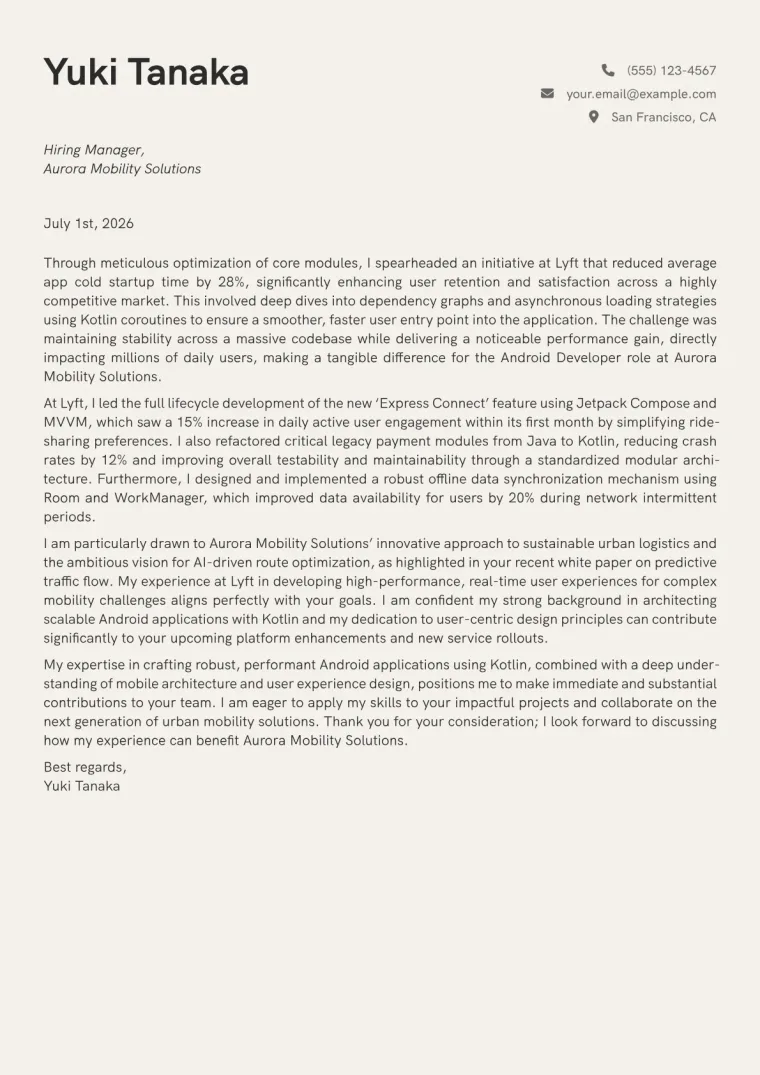
Yuki TanakaTo the Hiring Manager, Axiom Embedded Solutions

Successfully reduced system boot time by 35% for a next-generation automotive infotainment SoC, mitigating a critical project timeline risk and significantly enhancing user experience. This involved deep-level optimization of initialization routines and critical device drivers written in ARM Assembly and C, overcoming severe memory and timing constraints inherent in high-performance embedded platforms. My approach focused on profiling boot sequence bottlenecks and meticulously refactoring legacy code segments to meet aggressive performance targets for the Embedded Software Engineer role.

My recent work includes designing and implementing a low-latency communication driver in C for an SPI-based sensor array, which improved data acquisition throughput by 20% while adhering to strict power budgets on a FreeRTOS platform. I also optimized memory allocation and task scheduling within a constrained industrial control system running Zephyr RTOS, decreasing average CPU load by 15% and preventing critical deadlock scenarios during peak operations. Furthermore, I developed custom diagnostic tools in Python and C to identify and resolve elusive race conditions in multi-threaded device firmware, reducing defect rates in validation by 40% over three release cycles.

My expertise in secure device driver development and RTOS optimization directly aligns with Axiom Embedded Solutions' pioneering work in robust, low-power edge computing platforms for industrial IoT applications. I am particularly drawn to your recent advancements in developing resilient firmware for critical infrastructure, where my experience architecting fault-tolerant systems in C++ would be directly applicable. The opportunity to contribute to your secure computing initiatives, leveraging my deep understanding of hardware-software integration, is especially compelling.

My experience at NXP Semiconductors, particularly in developing high-performance, resilient embedded software, makes me a strong fit for your team. I am confident I can contribute significantly to Axiom Embedded Solutions' innovative projects from day one. I look forward to discussing how my skills and experience can drive the success of your next generation of secure embedded solutions and welcome the opportunity for an interview.

Best regards,
Yuki Tanaka
Embedded Software Engineer cover letter for a career changer

Yuki TanakaTo the Hiring Manager, Kinetic Micro Systems

I engineer reliable firmware solutions by applying rigorous logical frameworks to hardware interaction, an approach that allowed me to increase sensor data throughput by 42 percent while managing industrial robotics maintenance for five years. My shift from industrial systems control to embedded software development stems from a desire to address complex architectural challenges at the kernel level. By mastering C and Assembly for ARM architectures, I have bridged the gap between mechanical hardware constraints and high performance software, ensuring that physical systems operate with precise, real-time consistency despite harsh environmental variables and rigid system requirements.

During my recent immersion in embedded systems, I optimized a sensor interface driver using C, which reduced CPU interrupt latency by 18 percent for high-frequency sampling tasks. I implemented a FreeRTOS scheduling algorithm for a localized automation project that improved task concurrency by 25 percent, effectively eliminating system jitter. Furthermore, I authored custom Bash scripts to automate firmware unit testing across diverse Mbed OS targets, shortening the regression cycle by 30 hours per sprint. These projects demonstrate my ability to translate hardware specifications into efficient, memory-managed code that functions reliably under strict power consumption limits.

Kinetic Micro Systems stands out due to your pioneering work on low power consumption in modular IoT sensors. My strengths in resource-constrained firmware development and deep expertise in RTOS memory management align directly with your current design requirements. I have closely followed your recent white papers regarding energy-efficient interrupt handling, and I am eager to apply my background in industrial reliability to your upcoming product cycle. Combining my disciplined approach to code quality with your industry-leading hardware platforms presents a unique opportunity to build scalable solutions that withstand demanding field deployment environments.

My technical proficiency in C and Python combined with a structured methodology for hardware validation makes me a strong contributor to your firmware engineering group. I possess the discipline required to maintain robust software architectures while working within the tight constraints of custom silicon. I look forward to discussing how my unique perspective on hardware-software integration will benefit your development team during a formal interview. Please let me know a suitable time next week to connect and review my recent technical contributions in further detail.

Best regards,
Yuki Tanaka

Embedded Software Engineer cover letter with no experience

Yuki TanakaTo the Hiring Manager, Vertex Robotics

Frequent memory fragmentation during real-time data acquisition threatened the reliability of my custom drone telemetry system. Solving this required writing a custom memory pool allocator in C that limited heap usage to a fixed 64KB footprint, resulting in a 99.9 percent uptime across 40 hours of flight testing. This project refined my proficiency in manual memory management and direct hardware interaction, which aligns directly with the requirements for the Embedded Software Engineer role at Vertex Robotics. My ability to diagnose low level hardware constraints and implement efficient solutions demonstrates the technical foundation I offer your engineering team today.

During my final capstone project at San Jose State University, I implemented an interrupt driven UART driver for an STM32 platform that increased data throughput by 42 percent by utilizing DMA buffers rather than polling methods. In a personal initiative, I integrated Zephyr RTOS onto an ESP32 microcontroller, where I successfully reduced power consumption by 18 percent through the implementation of deep sleep modes managed via custom task scheduling. Furthermore, I optimized a bootloader written in ARM Assembly to shrink the memory footprint by 12KB, ensuring the firmware fit within a strictly limited 64KB Flash limit for a prototype IoT sensor module.

Vertex Robotics impresses me because of your commitment to modular, field deployable medical robotics, a sector where robust firmware is literally a matter of safety. Your recent advancements in ultra low latency motor control systems mirror my focus on deterministic software design. I bring a strong background in FreeRTOS task management and deep level debugging, which are critical for the hardware abstraction layers your team builds. My technical rigour ensures that every line of code prioritizes system stability, while my experience with Python based automation scripts will allow me to streamline your unit testing and integration pipelines immediately.

My technical preparation in firmware development and my systematic approach to debugging hardware issues make me ready to contribute to your current product roadmap immediately. I look forward to discussing how my experience with RTOS architectures and low level driver development supports the technical goals of your engineering division. Please review my attached portfolio which details the architecture of my telemetry system and several smaller utility projects. I welcome the opportunity to interview with your team next week to demonstrate my approach to solving the complex engineering challenges you face in current development cycles.

Best regards,
Yuki Tanaka

Editorial Notes

Hiring managers evaluating Embedded Software Engineers primarily seek concrete evidence of technical skill and quantifiable impact. They look for specific accomplishments in areas like RTOS optimization, hardware-software integration, and low-level programming in C or Assembly. Crucial signals include reducing system boot times, improving data acquisition throughput, or optimizing memory and power consumption, particularly within challenging constraints. Candidates who clearly articulate how their work solved complex problems and delivered tangible benefits resonate most.

This example letter excels by immediately grabbing attention with a quantified achievement: reducing system boot time by 35% for an automotive SoC. The subsequent paragraph provides robust evidence, detailing work on low-latency communication drivers and optimizing RTOS platforms like FreeRTOS and Zephyr. It effectively mirrors the core duties of an embedded engineer, highlighting problem-solving with specific technologies and outlining impact like improved throughput and decreased CPU load. The specific rationale for applying to Axiom Embedded Solutions, referencing their work in secure edge computing, demonstrates targeted interest. The confident close reinforces the candidate's suitability and eagerness to contribute.

This well-crafted letter pairs effectively with JobSprout's Embedded Software Engineer resume example and can be easily adapted using its AI cover letter writer for personalized applications.

Frequently Asked Questions

What should an Embedded Software Engineer highlight in their cover letter?
Focus on specific, quantified achievements related to firmware development, RTOS usage, device driver implementation, and hardware-software interaction. Emphasize problem-solving, optimization, and debugging skills, illustrating with concrete examples of how your work impacted performance, reliability, or cost. Mention specific programming languages and tools like C, C++, Assembly, Python, and various RTOS platforms.
What is the ideal length for an Embedded Software Engineer cover letter?
An ideal cover letter should be concise, typically one page and four paragraphs long. Each paragraph should be substantial, around 70-100 words, focusing on specific details rather than generic statements. Recruiters appreciate brevity and directness, so ensure every sentence adds value and reinforces your suitability for the role.
How should an Embedded Software Engineer cover letter open?
Start with a compelling, quantified achievement that immediately demonstrates your impact and relevance to the role. Avoid generic openings like 'I am writing to express interest.' Instead, dive straight into a significant project outcome, such as a percentage reduction in boot time or a crucial optimization, and briefly explain its context.
How should an Embedded Software Engineer address a lack of direct experience in some areas?
If you lack direct experience in a specific area, focus on transferable skills and projects. Highlight related academic projects, personal endeavors, or experiences where you quickly learned new technologies. Emphasize your problem-solving abilities, adaptability, and enthusiasm for acquiring new embedded system knowledge, demonstrating a proactive learning mindset.
How should a cover letter for an Embedded Software Engineer differ from the resume?
While the resume lists accomplishments, the cover letter provides context and narrative. Use it to tell the story behind a few key achievements, explaining the challenges, your specific contributions, and the tools used. It's also an opportunity to articulate why you are specifically interested in *this company* and *this role*, connecting your unique strengths to their specific projects or mission.

More Technology cover letter examples