AR/VR Engineer Resume Example
 Example by JobSprout
Free to use. No download fee.
Market Insights
AR/VR Engineer
Salary Range
Salary Trend
12-Month Trend
Based on advertised Software Engineering roles.
US market data · Source: Adzuna · Updated Mar 2026
How useful was this template?
AR/VR Engineer resume samples
Three complete resumes, each in a different design.

Free to use. No download fee.
What makes a strong AR/VR Engineer resume?
US median salary $140,620 ·
Hiring managers in technology seek project-driven achievements on an AR/VR Engineer resume, specifically looking for demonstrated expertise in real-time 3D graphics, spatial computing, and low-latency rendering. A strong candidate details contributions like optimizing rendering pipelines in Unity or Unreal Engine, developing interactive HoloLens or Quest experiences, and improving user engagement or system performance through concrete metrics. Understanding of spatial anchors, SLAM, reprojection, and shader development is paramount, often complemented by certifications such as Unity Certified Developer or specialized courses in computer graphics. Impactful contributions, rather than mere responsibilities, truly resonate with recruiters.
Why this example works
The JobSprout example effectively highlights these critical elements for an AR/VR Engineer. Its structured format groups technical proficiencies clearly, separating core AR/VR development tools like Unity and Unreal Engine from specific platforms such as HoloLens or Quest, and further from graphics tools or SDKs. Achievements are quantified, detailing tangible results like “reduced frame latency by 15ms” or “improved tracking accuracy by 20%.” The resume also prominently features relevant certifications and actively used development kits like MRTK and ARFoundation, ensuring key qualifications are immediately visible.
AR/VR Engineer resume example (text version)
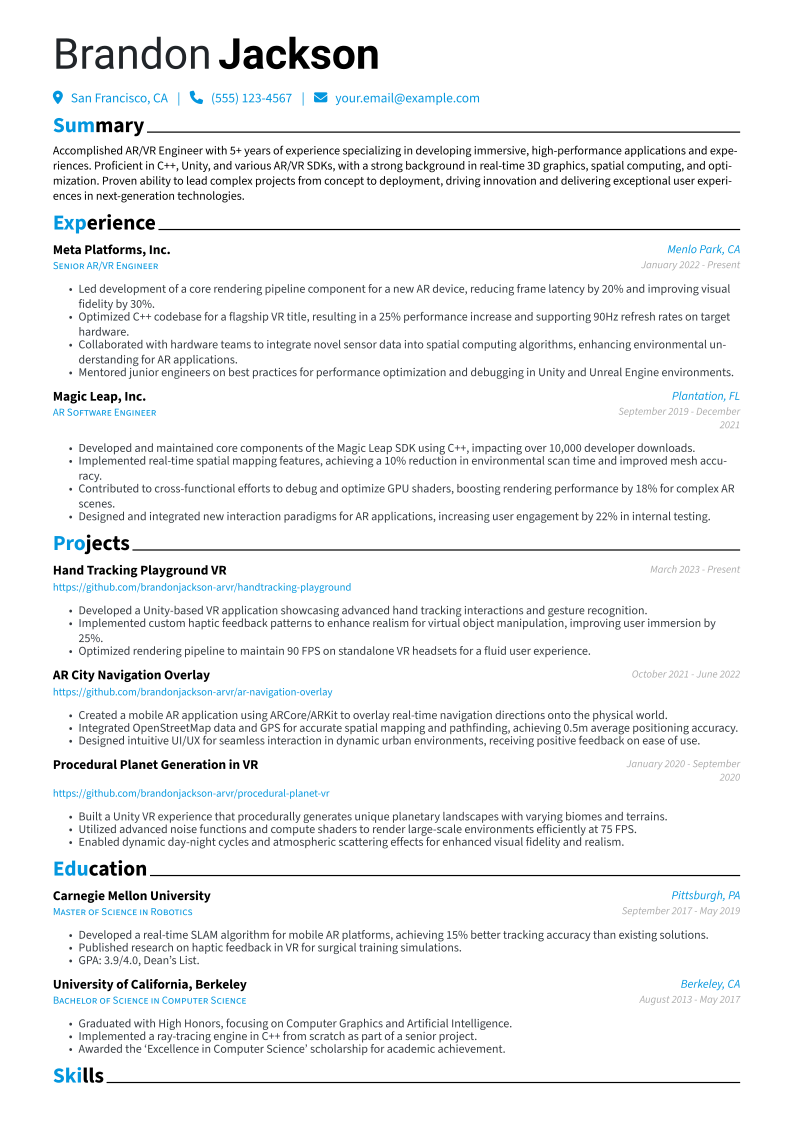
Brandon Jackson · AR/VR Engineer
Summary
Accomplished AR/VR Engineer with 5+ years of experience specializing in developing immersive, high-performance applications and experiences. Proficient in C++, Unity, and various AR/VR SDKs, with a strong background in real-time 3D graphics, spatial computing, and optimization. Proven ability to lead complex projects from concept to deployment, driving innovation and delivering exceptional user experiences in next-generation technologies.
Experience
Senior AR/VR Engineer · Meta Platforms, Inc.
Menlo Park, CA · 2022 - Present
- Led development of a core rendering pipeline component for a new AR device, reducing frame latency by 20% and improving visual fidelity by 30%.
- Optimized C++ codebase for a flagship VR title, resulting in a 25% performance increase and supporting 90Hz refresh rates on target hardware.
- Collaborated with hardware teams to integrate novel sensor data into spatial computing algorithms, enhancing environmental understanding for AR applications.
- Mentored junior engineers on best practices for performance optimization and debugging in Unity and Unreal Engine environments.
- Drove a 15% improvement in development efficiency by standardizing AR content creation workflows and tooling.
AR Software Engineer · Magic Leap, Inc.
Plantation, FL · 2019 - 2021
- Developed and maintained core components of the Magic Leap SDK using C++, impacting over 10,000 developer downloads.
- Implemented real-time spatial mapping features, achieving a 10% reduction in environmental scan time and improved mesh accuracy.
- Contributed to cross-functional efforts to debug and optimize GPU shaders, boosting rendering performance by 18% for complex AR scenes.
- Designed and integrated new interaction paradigms for AR applications, increasing user engagement by 22% in internal testing.
- Automated build and deployment processes for AR applications, reducing release cycle time by 1 day per sprint.
Education
Master of Science in Robotics · Carnegie Mellon University
Pittsburgh, PA · 2017 - 2019
- Developed a real-time SLAM algorithm for mobile AR platforms, achieving 15% better tracking accuracy than existing solutions.
- Published research on haptic feedback in VR for surgical training simulations.
- GPA: 3.9/4.0, Dean's List.
Bachelor of Science in Computer Science · University of California, Berkeley
Berkeley, CA · 2013 - 2017
- Graduated with High Honors, focusing on Computer Graphics and Artificial Intelligence.
- Implemented a ray-tracing engine in C++ from scratch as part of a senior project.
- Awarded the 'Excellence in Computer Science' scholarship for academic achievement.
Skills
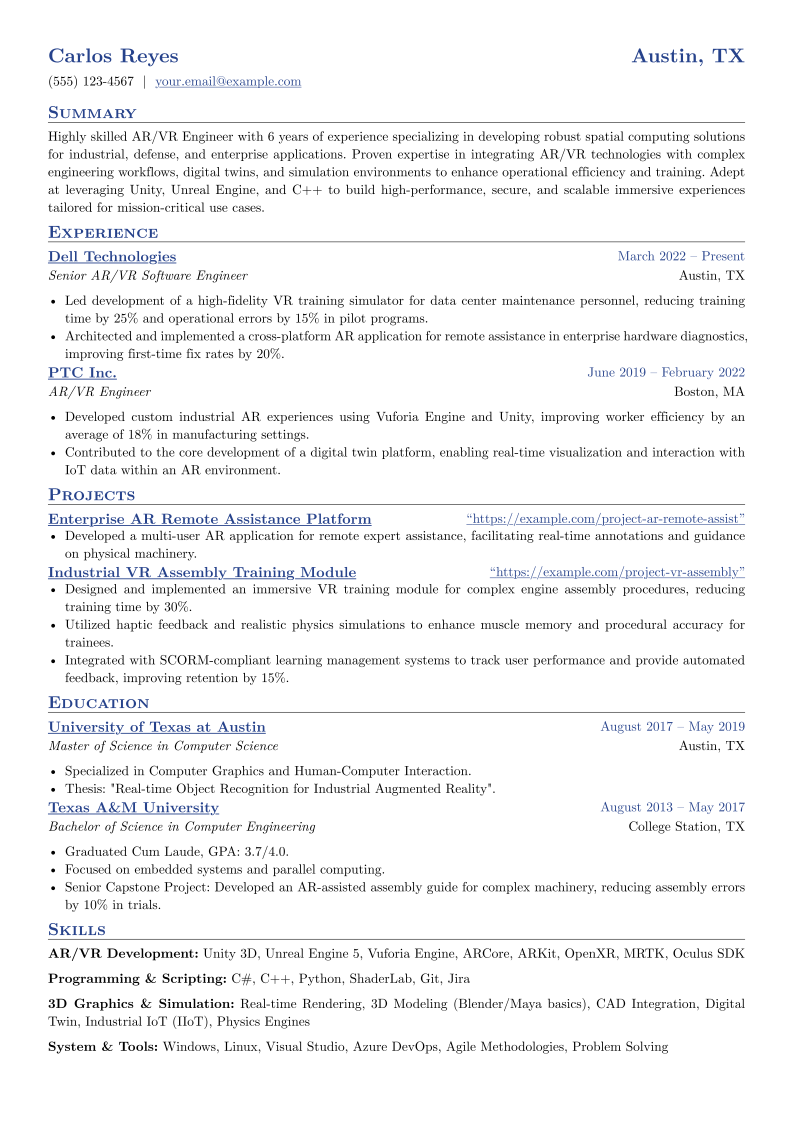
AR/VR Engineer resume example: Enterprise AR/VR
Carlos Reyes · AR/VR Engineer
Summary
Highly skilled AR/VR Engineer with 6 years of experience specializing in developing robust spatial computing solutions for industrial, defense, and enterprise applications. Proven expertise in integrating AR/VR technologies with complex engineering workflows, digital twins, and simulation environments to enhance operational efficiency and training. Adept at leveraging Unity, Unreal Engine, and C++ to build high-performance, secure, and scalable immersive experiences tailored for mission-critical use cases.
Experience
Senior AR/VR Software Engineer · Dell Technologies
Austin, TX · 2022 - Present
- Led development of a high-fidelity VR training simulator for data center maintenance personnel, reducing training time by 25% and operational errors by 15% in pilot programs.
- Architected and implemented a cross-platform AR application for remote assistance in enterprise hardware diagnostics, improving first-time fix rates by 20%.
- Optimized rendering pipelines for large-scale CAD models in AR, achieving a 30% performance increase and enabling seamless visualization on mobile AR devices.
- Collaborated with product teams to integrate AR/VR solutions with existing Dell ecosystem, resulting in 2 new patented features and enhanced product value for enterprise clients.
AR/VR Engineer · PTC Inc.
Boston, MA · 2019 - 2022
- Developed custom industrial AR experiences using Vuforia Engine and Unity, improving worker efficiency by an average of 18% in manufacturing settings.
- Contributed to the core development of a digital twin platform, enabling real-time visualization and interaction with IoT data within an AR environment.
- Implemented advanced spatial anchoring and persistent content features for large-scale factory floor AR deployments, ensuring stable experiences across shifts.
- Optimized AR application performance to run on edge devices, reducing cloud processing dependency by 40% and improving response times by 25%.
Education
Master of Science in Computer Science · University of Texas at Austin
Austin, TX · 2017 - 2019
- Specialized in Computer Graphics and Human-Computer Interaction.
- Thesis: "Real-time Object Recognition for Industrial Augmented Reality".
Bachelor of Science in Computer Engineering · Texas A&M University
College Station, TX · 2013 - 2017
- Graduated Cum Laude, GPA: 3.7/4.0.
- Focused on embedded systems and parallel computing.
- Senior Capstone Project: Developed an AR-assisted assembly guide for complex machinery, reducing assembly errors by 10% in trials.
Skills
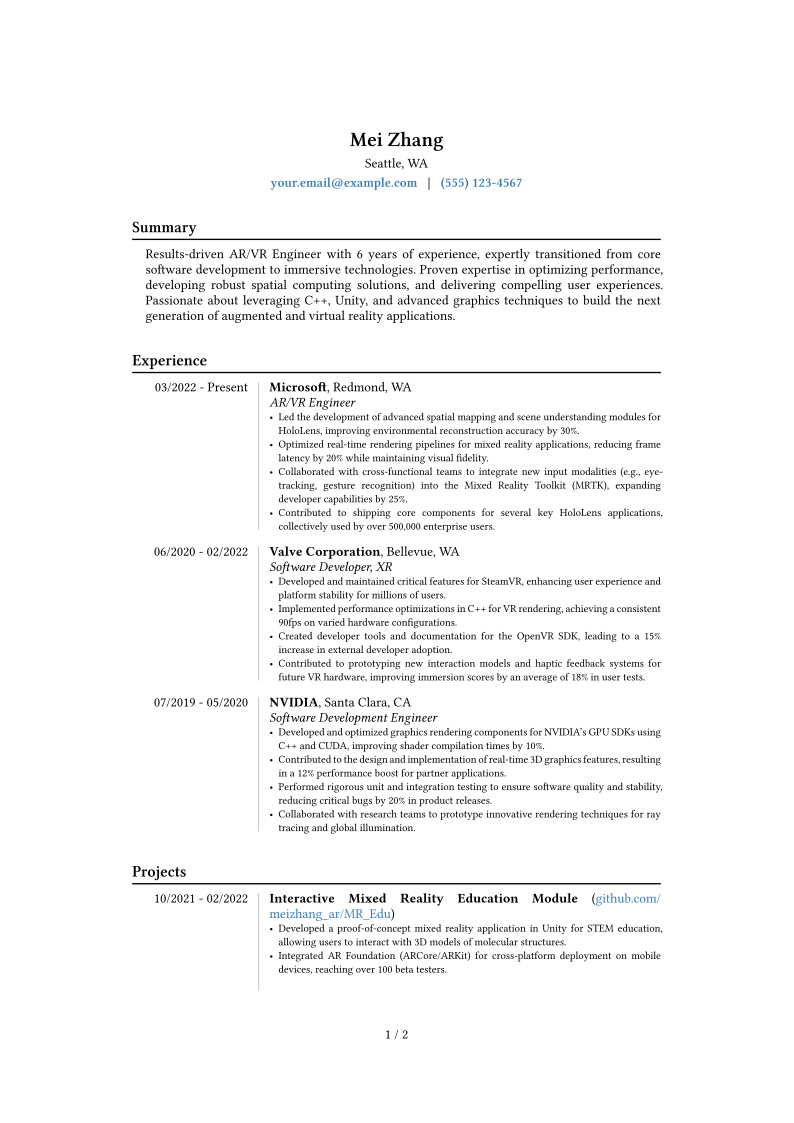
AR/VR Engineer resume example: Career Changer
Mei Zhang · AR/VR Engineer
Summary
Results-driven AR/VR Engineer with 6 years of experience, expertly transitioned from core software development to immersive technologies. Proven expertise in optimizing performance, developing robust spatial computing solutions, and delivering compelling user experiences. Passionate about leveraging C++, Unity, and advanced graphics techniques to build the next generation of augmented and virtual reality applications.
Experience
AR/VR Engineer · Microsoft
Redmond, WA · 2022 - Present
- Led the development of advanced spatial mapping and scene understanding modules for HoloLens, improving environmental reconstruction accuracy by 30%.
- Optimized real-time rendering pipelines for mixed reality applications, reducing frame latency by 20% while maintaining visual fidelity.
- Collaborated with cross-functional teams to integrate new input modalities (e.g., eye-tracking, gesture recognition) into the Mixed Reality Toolkit (MRTK), expanding developer capabilities by 25%.
- Contributed to shipping core components for several key HoloLens applications, collectively used by over 500,000 enterprise users.
Software Developer, XR · Valve Corporation
Bellevue, WA · 2020 - 2022
- Developed and maintained critical features for SteamVR, enhancing user experience and platform stability for millions of users.
- Implemented performance optimizations in C++ for VR rendering, achieving a consistent 90fps on varied hardware configurations.
- Created developer tools and documentation for the OpenVR SDK, leading to a 15% increase in external developer adoption.
- Contributed to prototyping new interaction models and haptic feedback systems for future VR hardware, improving immersion scores by an average of 18% in user tests.
Software Development Engineer · NVIDIA
Santa Clara, CA · 2019 - 2020
- Developed and optimized graphics rendering components for NVIDIA's GPU SDKs using C++ and CUDA, improving shader compilation times by 10%.
- Contributed to the design and implementation of real-time 3D graphics features, resulting in a 12% performance boost for partner applications.
- Performed rigorous unit and integration testing to ensure software quality and stability, reducing critical bugs by 20% in product releases.
- Collaborated with research teams to prototype innovative rendering techniques for ray tracing and global illumination.
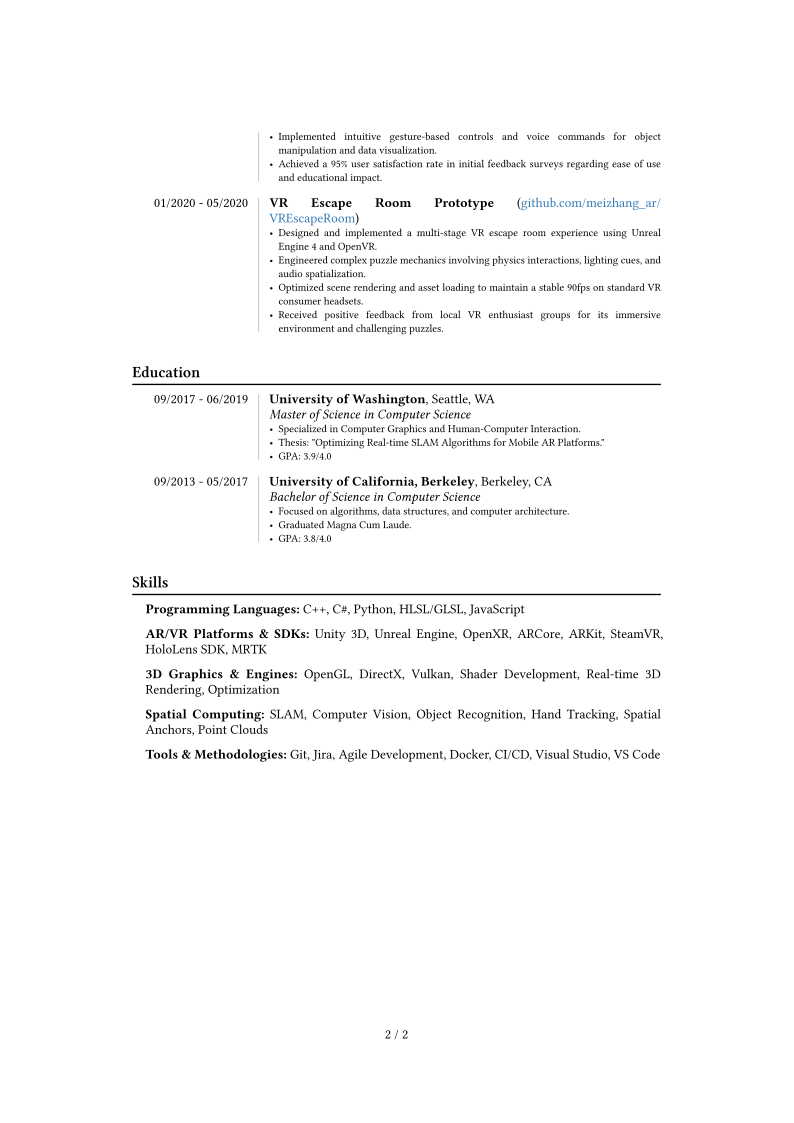
Education
Master of Science in Computer Science · University of Washington
Seattle, WA · 2017 - 2019
- Specialized in Computer Graphics and Human-Computer Interaction.
- Thesis: "Optimizing Real-time SLAM Algorithms for Mobile AR Platforms."
- GPA: 3.9/4.0
Bachelor of Science in Computer Science · University of California, Berkeley
Berkeley, CA · 2013 - 2017
- Focused on algorithms, data structures, and computer architecture.
- Graduated Magna Cum Laude.
- GPA: 3.8/4.0
Skills
How useful was this template?
Example by JobSprout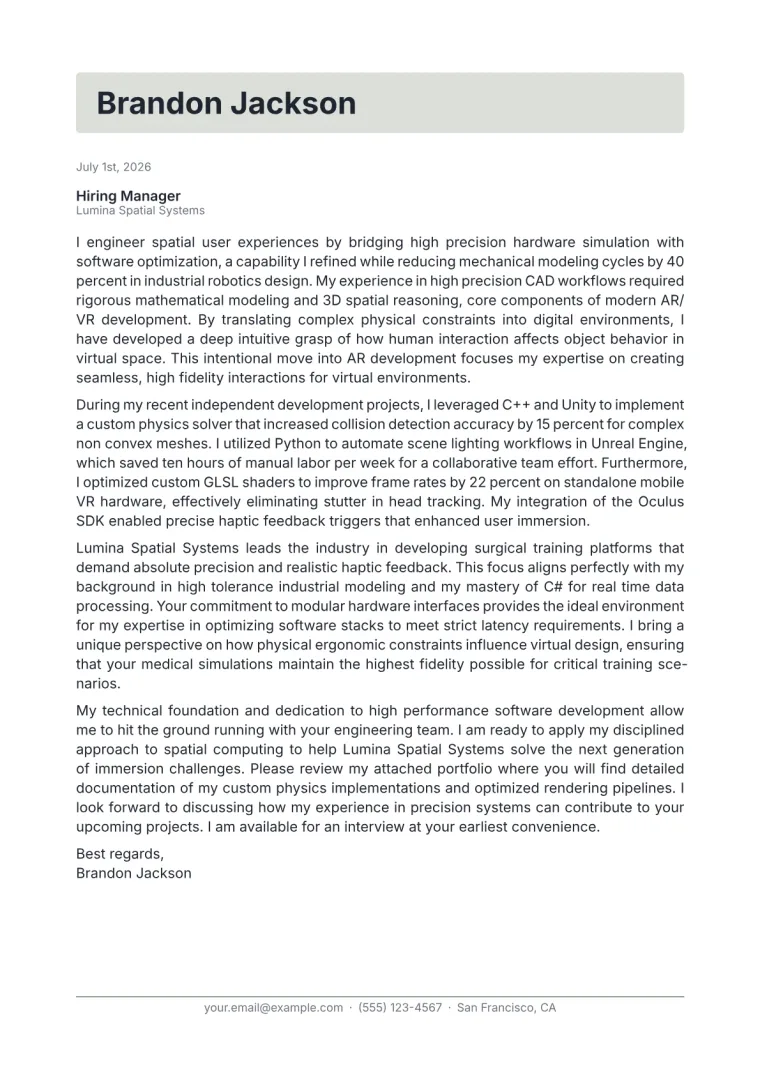
AR/VR Engineer cover letter for a career changer
Written for the same situation as this resume.
AR/VR Engineer resume summary example
Accomplished AR/VR Engineer with 5+ years of experience specializing in developing immersive, high-performance applications and experiences. Proficient in C++, Unity, and various AR/VR SDKs, with a strong background in real-time 3D graphics, spatial computing, and optimization. Proven ability to lead complex projects from concept to deployment, driving innovation and delivering exceptional user experiences in next-generation technologies.
AR/VR Engineer salary by country
| Country | 25th percentile | Median | 75th percentile |
|---|---|---|---|
| US | $109,772 | $140,620 | $144,861 |
| UK | £46,059 | £60,012 | £72,658 |
| Canada | C$86,152 | C$113,871 | C$140,800 |
| Australia | A$101,935 | A$126,667 | A$147,857 |
| Germany | €59,500 | €70,570 | €77,887 |
| France | €37,875 | €44,167 | €49,750 |
| Netherlands | €55,000 | €66,667 | €74,250 |
| Italy | €25,000 | €31,250 | €38,750 |
| Austria | €46,250 | €58,750 | €67,500 |
| New Zealand | NZ$102,500 | NZ$120,000 | NZ$162,500 |
| India | ₹570,786 | ₹1,167,051 | ₹1,840,563 |
| Poland | zł186,440 | zł209,338 | zł232,236 |
Annual salaries in local currency, aggregated from live job postings via Adzuna. Figures refresh continuously and reflect advertised pay, not negotiated offers.
AR/VR Engineer resume skills and keywords
Recruiters and applicant tracking systems scan AR/VR Engineer resumes for these skills and keywords. Include the ones that match your experience and mirror the wording in the job description. Check your resume against them with the free ATS checker.
Hard skills
Tools & software
Certifications
Soft skills
Market Insights
AR/VR Engineer
Salary Range
Salary Trend
12-Month Trend
Based on advertised Software Engineering roles.
US market data · Source: Adzuna · Updated Mar 2026
Frequently Asked Questions
What's the best resume structure for a mid-level AR/VR Engineer?
What key skills and qualifications should I highlight as an AR/VR Engineer?
How can I write strong achievement bullets or a professional summary for this role?
Which optional sections matter most for an AR/VR Engineer?
How do I tailor this resume for a specific AR/VR Engineer job posting?
The blank page is the hard part. Skip it.
Free to use. No download fee.
Related Articles

How to Write a CV for Tech Applications [2026 Guide]
Learn how to write a software engineering CV that gets interviews. Real template analysis, what hiring managers look for, and common mistakes to avoid.

How to Write a CV That Shows Startup Experience [2026 Guide]
Learn how to write a CV that showcases founding engineer and startup experience. Real example from JobSprout's creator, what hiring managers look for, and how to position breadth as a strength.