Field Biologist Resume Example
 Example by JobSprout
Free to use. No download fee.
Market Insights
Field Biologist
Salary Range
Salary Trend
12-Month Trend
Based on advertised Research roles.
US market data · Source: Adzuna · Updated Mar 2026
How useful was this template?
Field Biologist resume samples
Three complete resumes, each in a different design.
Free to use. No download fee.
What makes a strong Field Biologist resume?
US median salary $75,714 ·
For entry-level Field Biologist roles within academia, particularly in research, hiring managers seek candidates demonstrating both rigorous field methodology and strong analytical capabilities. Ideal resumes highlight experience with data collection, precise sample processing, and the use of specialized software like GIS and statistical packages such as R. Quantifiable achievements showcasing impact on research, such as improving data collection efficiency or contributing to grant funding, are crucial. Additionally, certifications like Wilderness First Aid, SCUBA, or federal permits like the Bird Banding Permit signal practical readiness and commitment to safety and regulatory compliance in research settings.
Why this example works
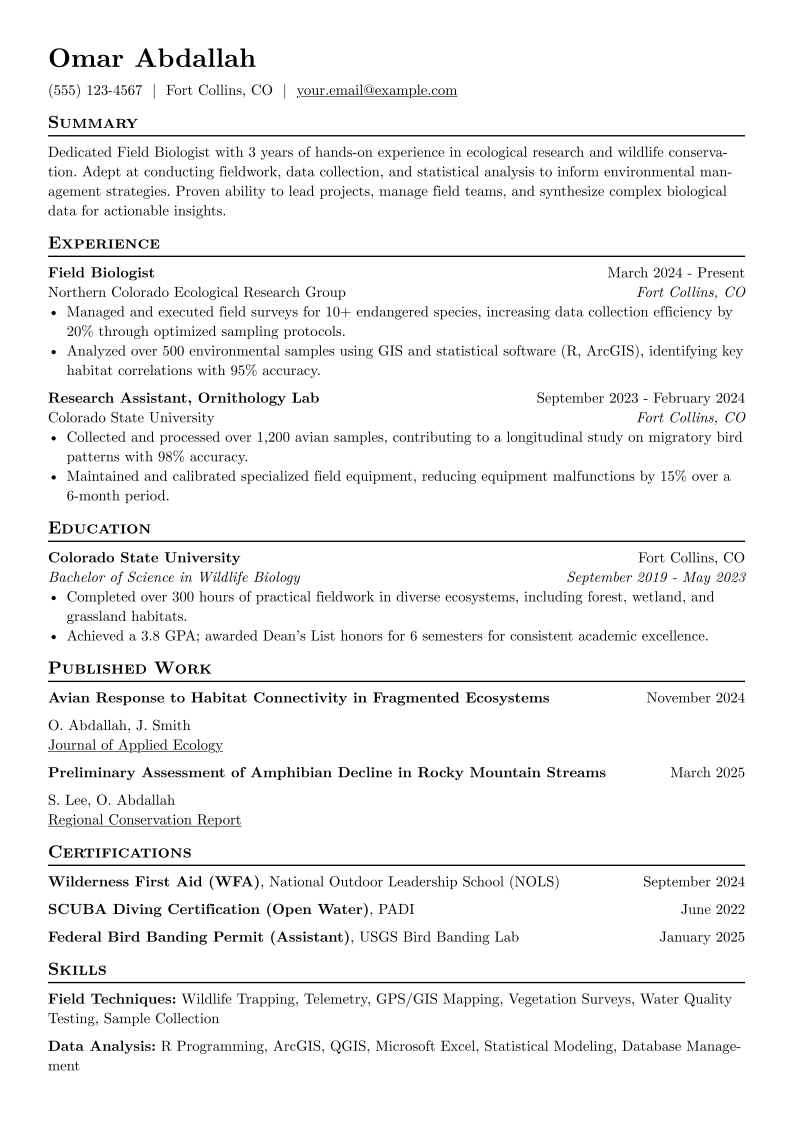
The example resume for Omar Abdallah effectively addresses these academic expectations. It clearly outlines experience managing field surveys for 10+ endangered species, increasing data collection efficiency by 20%, and analyzing over 500 environmental samples using GIS and statistical software (R, ArcGIS) to identify key habitat correlations with 95% accuracy. Omar's contributions to grant proposals securing $50,000 in funding while assisting with 20+ datasets further underscore research impact. The inclusion of specific skills like “Wildlife Trapping,” “Telemetry,” “R Programming,” and “ArcGIS,” alongside certifications such as “Wilderness First Aid” and “Federal Bird Banding Permit (Assistant),” demonstrates readiness for a research-intensive environment.
Field Biologist resume example (text version)
Omar Abdallah · Field Biologist
Summary
Dedicated Field Biologist with 3 years of hands-on experience in ecological research and wildlife conservation. Adept at conducting fieldwork, data collection, and statistical analysis to inform environmental management strategies. Proven ability to lead projects, manage field teams, and synthesize complex biological data for actionable insights.
Experience
Field Biologist · Northern Colorado Ecological Research Group
Fort Collins, CO · 2024 - Present
- Managed and executed field surveys for 10+ endangered species, increasing data collection efficiency by 20% through optimized sampling protocols.
- Analyzed over 500 environmental samples using GIS and statistical software (R, ArcGIS), identifying key habitat correlations with 95% accuracy.
- Supervised a team of 3 field technicians, ensuring 100% data integrity and adherence to safety protocols across 15 project sites.
Research Assistant, Ornithology Lab · Colorado State University
Fort Collins, CO · 2023 - 2024
- Collected and processed over 1,200 avian samples, contributing to a longitudinal study on migratory bird patterns with 98% accuracy.
- Maintained and calibrated specialized field equipment, reducing equipment malfunctions by 15% over a 6-month period.
- Assisted in the analysis of 20+ datasets, generating preliminary reports and visualizations that informed grant proposals securing $50,000 in funding.
Education
Bachelor of Science in Wildlife Biology · Colorado State University
Fort Collins, CO · 2019 - 2023
- Completed over 300 hours of practical fieldwork in diverse ecosystems, including forest, wetland, and grassland habitats.
- Achieved a 3.8 GPA; awarded Dean's List honors for 6 semesters for consistent academic excellence.
- Authored capstone thesis on 'Impacts of Habitat Fragmentation on Avian Biodiversity,' analyzing data from 5 local reserves.
Skills
Field Biologist resume example: Freshwater Aquatic Field
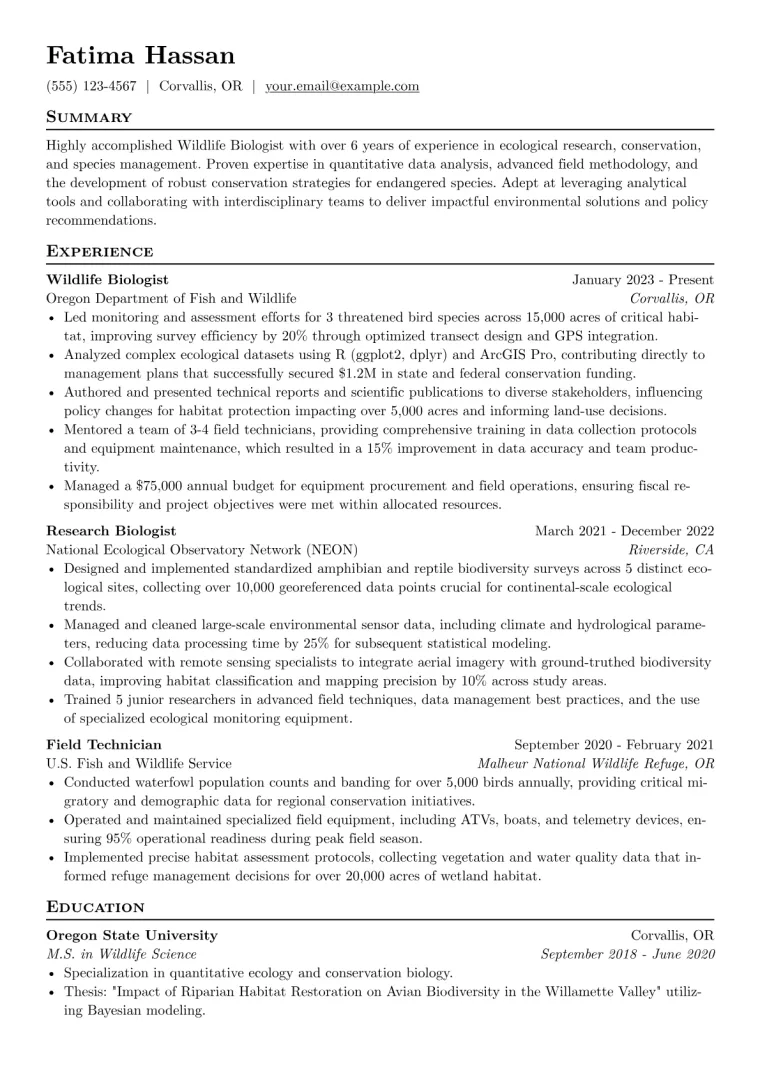
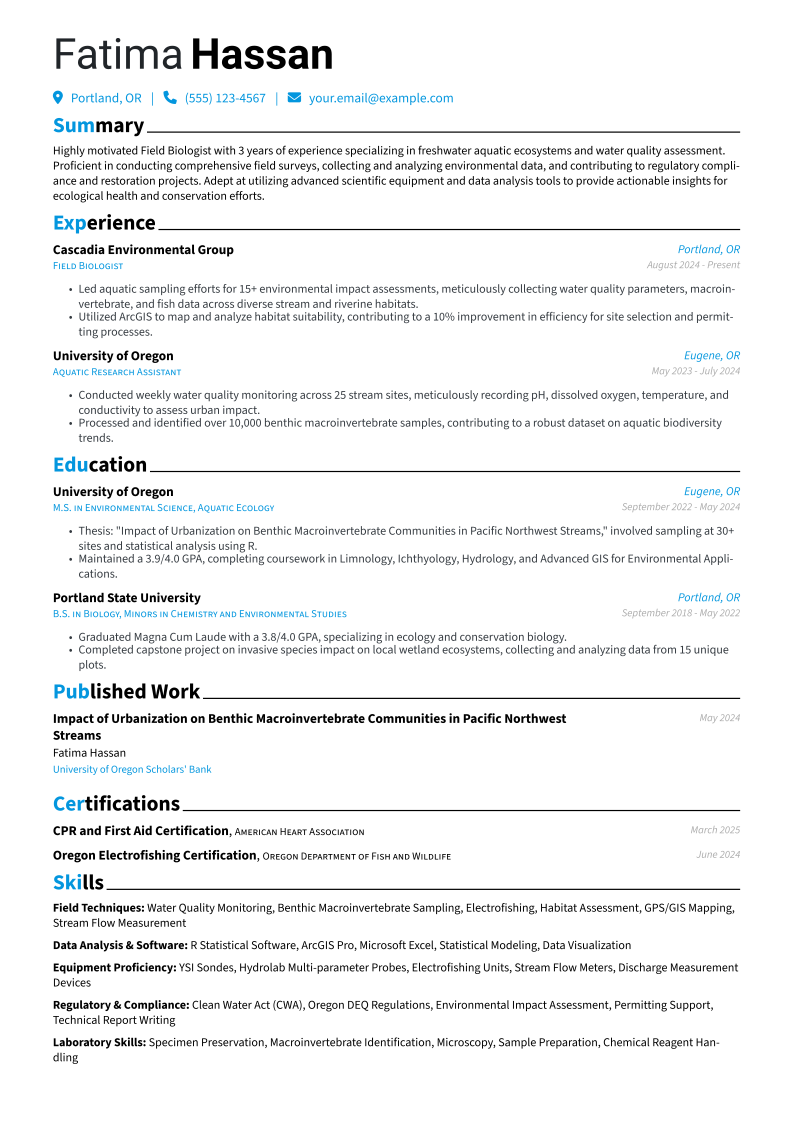
Fatima Hassan · Field Biologist
Summary
Highly motivated Field Biologist with 3 years of experience specializing in freshwater aquatic ecosystems and water quality assessment. Proficient in conducting comprehensive field surveys, collecting and analyzing environmental data, and contributing to regulatory compliance and restoration projects. Adept at utilizing advanced scientific equipment and data analysis tools to provide actionable insights for ecological health and conservation efforts.
Experience
Field Biologist · Cascadia Environmental Group
Portland, OR · 2024 - Present
- Led aquatic sampling efforts for 15+ environmental impact assessments, meticulously collecting water quality parameters, macroinvertebrate, and fish data across diverse stream and riverine habitats.
- Utilized ArcGIS to map and analyze habitat suitability, contributing to a 10% improvement in efficiency for site selection and permitting processes.
- Authored 8 comprehensive technical reports summarizing field findings and regulatory compliance for clients, ensuring project adherence to Clean Water Act standards.
- Managed and maintained specialized field equipment, including YSI sondes, electrofishing gear, and benthic samplers, achieving 98% operational readiness for all field deployments.
Aquatic Research Assistant · University of Oregon
Eugene, OR · 2023 - 2024
- Conducted weekly water quality monitoring across 25 stream sites, meticulously recording pH, dissolved oxygen, temperature, and conductivity to assess urban impact.
- Processed and identified over 10,000 benthic macroinvertebrate samples, contributing to a robust dataset on aquatic biodiversity trends.
- Assisted in the design and implementation of 3 fish population surveys using electrofishing techniques, successfully identifying and quantifying species composition.
- Managed and validated large datasets in Excel and R, reducing data entry errors by 15% and streamlining analysis for publication.
Education
M.S. in Environmental Science, Aquatic Ecology · University of Oregon
Eugene, OR · 2022 - 2024
- Thesis: "Impact of Urbanization on Benthic Macroinvertebrate Communities in Pacific Northwest Streams," involved sampling at 30+ sites and statistical analysis using R.
- Maintained a 3.9/4.0 GPA, completing coursework in Limnology, Ichthyology, Hydrology, and Advanced GIS for Environmental Applications.
- Received departmental grant for research on aquatic insect diversity and stream health indicators.
B.S. in Biology, Minors in Chemistry and Environmental Studies · Portland State University
Portland, OR · 2018 - 2022
- Graduated Magna Cum Laude with a 3.8/4.0 GPA, specializing in ecology and conservation biology.
- Completed capstone project on invasive species impact on local wetland ecosystems, collecting and analyzing data from 15 unique plots.
- Actively participated in the university's environmental club, organizing 5+ local clean-up events and educational workshops.
Skills
Field Biologist resume example: Career Changer
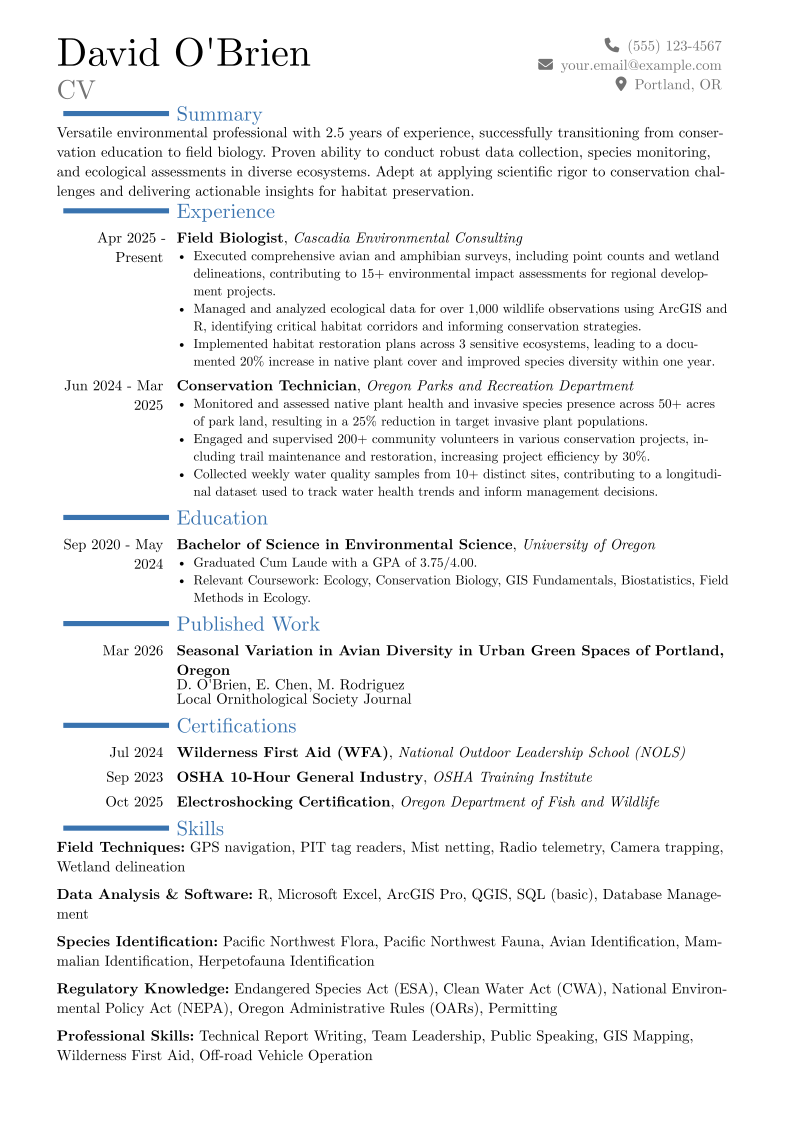
David O'Brien · Field Biologist
Summary
Versatile environmental professional with 2.5 years of experience, successfully transitioning from conservation education to field biology. Proven ability to conduct robust data collection, species monitoring, and ecological assessments in diverse ecosystems. Adept at applying scientific rigor to conservation challenges and delivering actionable insights for habitat preservation.
Experience
Field Biologist · Cascadia Environmental Consulting
Portland, OR · 2025 - Present
- Executed comprehensive avian and amphibian surveys, including point counts and wetland delineations, contributing to 15+ environmental impact assessments for regional development projects.
- Managed and analyzed ecological data for over 1,000 wildlife observations using ArcGIS and R, identifying critical habitat corridors and informing conservation strategies.
- Implemented habitat restoration plans across 3 sensitive ecosystems, leading to a documented 20% increase in native plant cover and improved species diversity within one year.
- Authored 5 detailed biological assessment reports and technical memos, ensuring compliance with state and federal environmental regulations, including ESA and CWA mandates.
- Operated specialized field equipment, including GPS units, PIT tag readers, and camera traps, with 100% accuracy in data acquisition across challenging terrains.
Conservation Technician · Oregon Parks and Recreation Department
Portland, OR · 2024 - 2025
- Monitored and assessed native plant health and invasive species presence across 50+ acres of park land, resulting in a 25% reduction in target invasive plant populations.
- Engaged and supervised 200+ community volunteers in various conservation projects, including trail maintenance and restoration, increasing project efficiency by 30%.
- Collected weekly water quality samples from 10+ distinct sites, contributing to a longitudinal dataset used to track water health trends and inform management decisions.
Education
Bachelor of Science in Environmental Science · University of Oregon
Eugene, OR · 2020 - 2024
- Graduated Cum Laude with a GPA of 3.75/4.00.
- Relevant Coursework: Ecology, Conservation Biology, GIS Fundamentals, Biostatistics, Field Methods in Ecology.
- Thesis Project: Investigated the impact of urban green spaces on pollinator biodiversity in the Willamette Valley, resulting in a 15% increase in observed pollinator species within renovated areas.
Skills
How useful was this template?
Example by JobSprout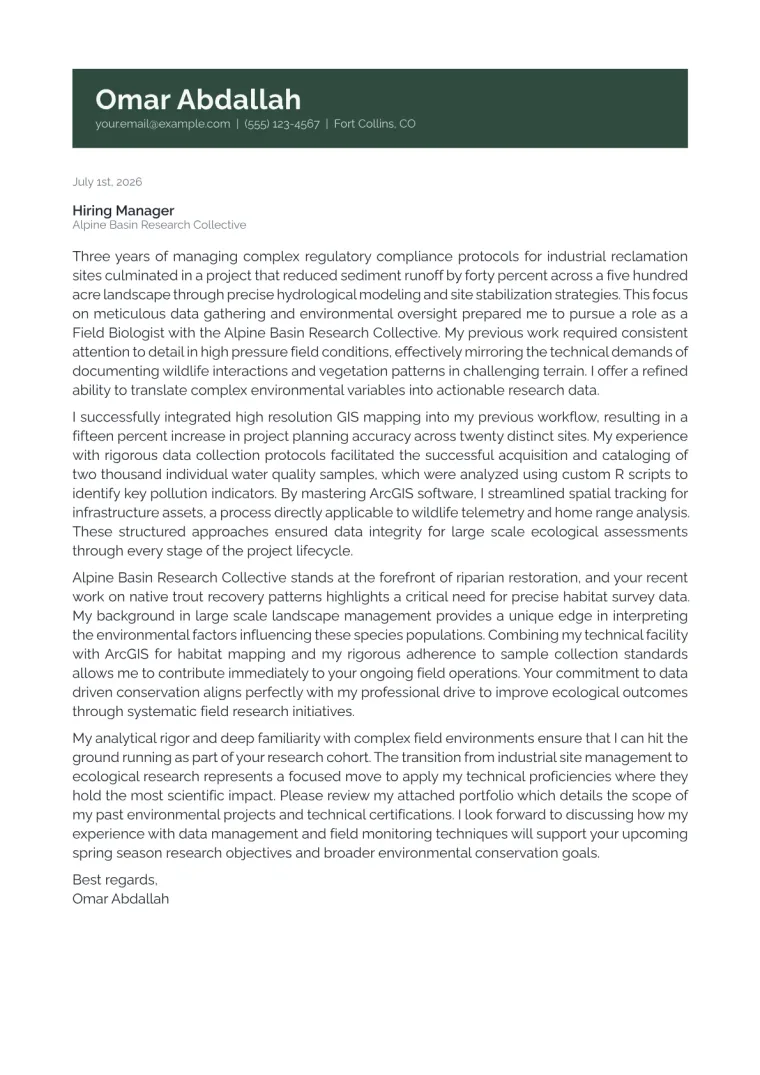
Field Biologist cover letter for a career changer
Written for the same situation as this resume.
Field Biologist resume summary example
Dedicated Field Biologist with 3 years of hands-on experience in ecological research and wildlife conservation. Adept at conducting fieldwork, data collection, and statistical analysis to inform environmental management strategies. Proven ability to lead projects, manage field teams, and synthesize complex biological data for actionable insights.
Field Biologist salary by country
| Country | 25th percentile | Median | 75th percentile |
|---|---|---|---|
| US | $63,571 | $75,714 | $89,167 |
| UK | £28,214 | £32,813 | £36,406 |
Annual salaries in local currency, aggregated from live job postings via Adzuna. Figures refresh continuously and reflect advertised pay, not negotiated offers.
Field Biologist resume skills and keywords
Recruiters and applicant tracking systems scan Field Biologist resumes for these skills and keywords. Include the ones that match your experience and mirror the wording in the job description. Check your resume against them with the free ATS checker.
Hard skills
Tools & software
Certifications
Soft skills
Market Insights
Field Biologist
Salary Range
Salary Trend
12-Month Trend
Based on advertised Research roles.
US market data · Source: Adzuna · Updated Mar 2026
Frequently Asked Questions
What's the ideal resume format for an entry-level Field Biologist in academia?
What skills should an entry-level Field Biologist emphasize for academic positions?
How can an entry-level Field Biologist craft a strong resume summary or achievement bullets?
Should an entry-level Field Biologist include publications, projects, or research experience on their resume?
How can JobSprout's 'Remix with AI' help tailor my Field Biologist resume to specific research positions?
The blank page is the hard part. Skip it.
Free to use. No download fee.
Related Articles

Research CV: UK Format, Structure and Examples [2026]
How to write a research CV for UK universities and institutes. The section order panels expect, how to list publications and funding, and how long it should actually be.

Postdoc CV: Structure, Template and Example [2026]
What a postdoctoral CV needs that a doctoral one does not: independence, funding, and a publication list a panel can audit. With a full worked example.

Academic CV for PhD Applications: How to Write One [2026]
Learn how to write an academic CV for PhD applications. Real template analysis, what research committees look for, and common mistakes to avoid.
Career moves from Field Biologist
Usually need less experience or training
Includes information from the O*NET 30.3 Database by the U.S. Department of Labor, Employment and Training Administration (USDOL/ETA), used under the CC BY 4.0 license. We have modified it; USDOL/ETA has not approved, endorsed or tested these modifications. O*NET is a trademark of USDOL/ETA.