Genetics Student Resume Examples
 Example by JobSprout
Use the Academic template
Your resume in this design, ready to edit.
Free, and no account needed to start.
How useful was this template?
Genetics Student resume samples
What makes a strong Genetics Student resume?
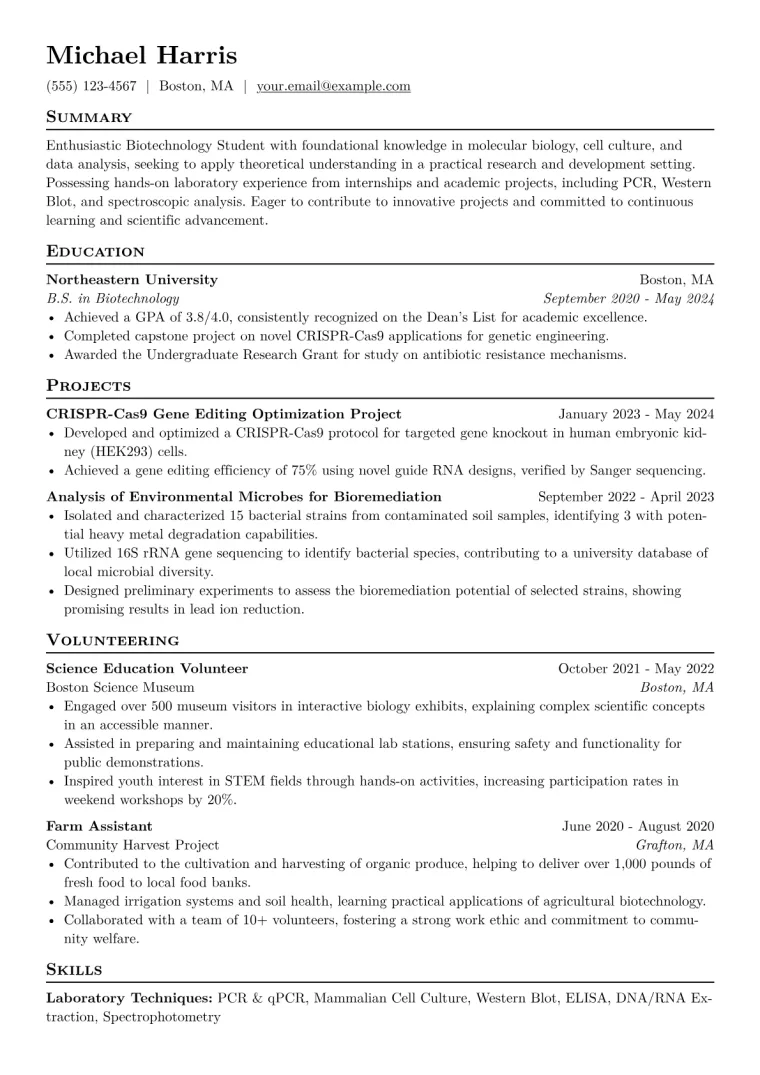
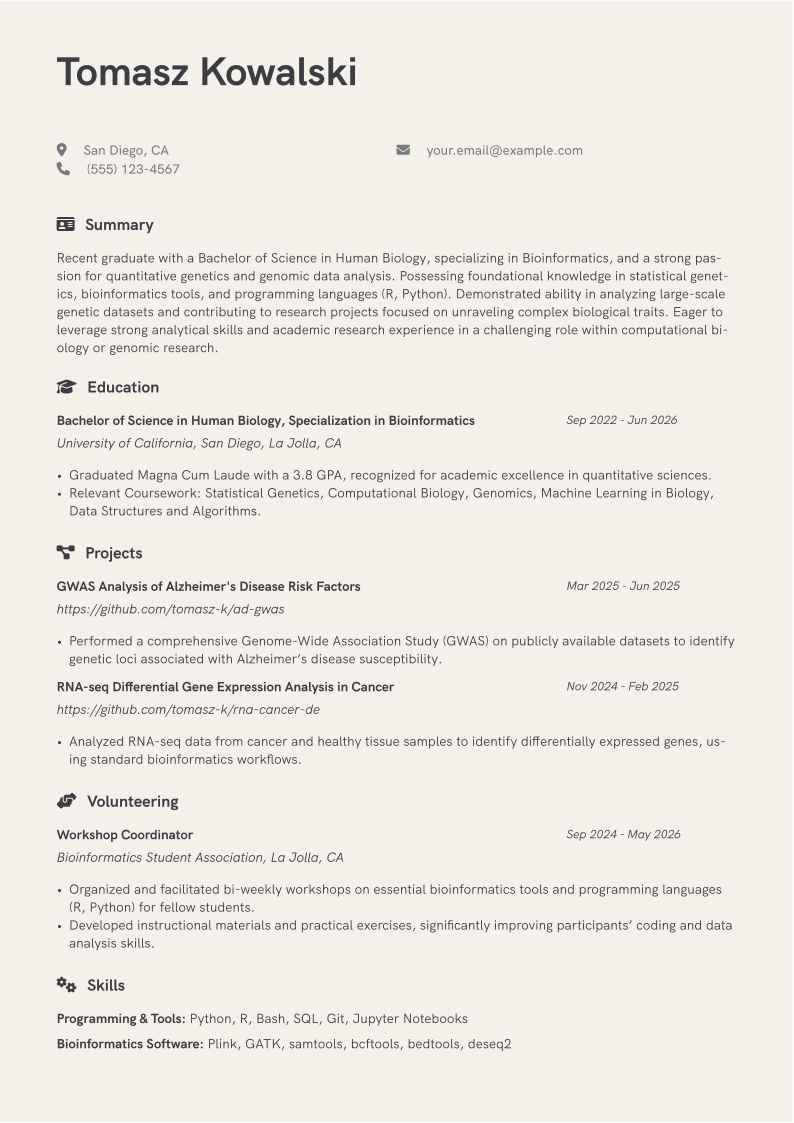
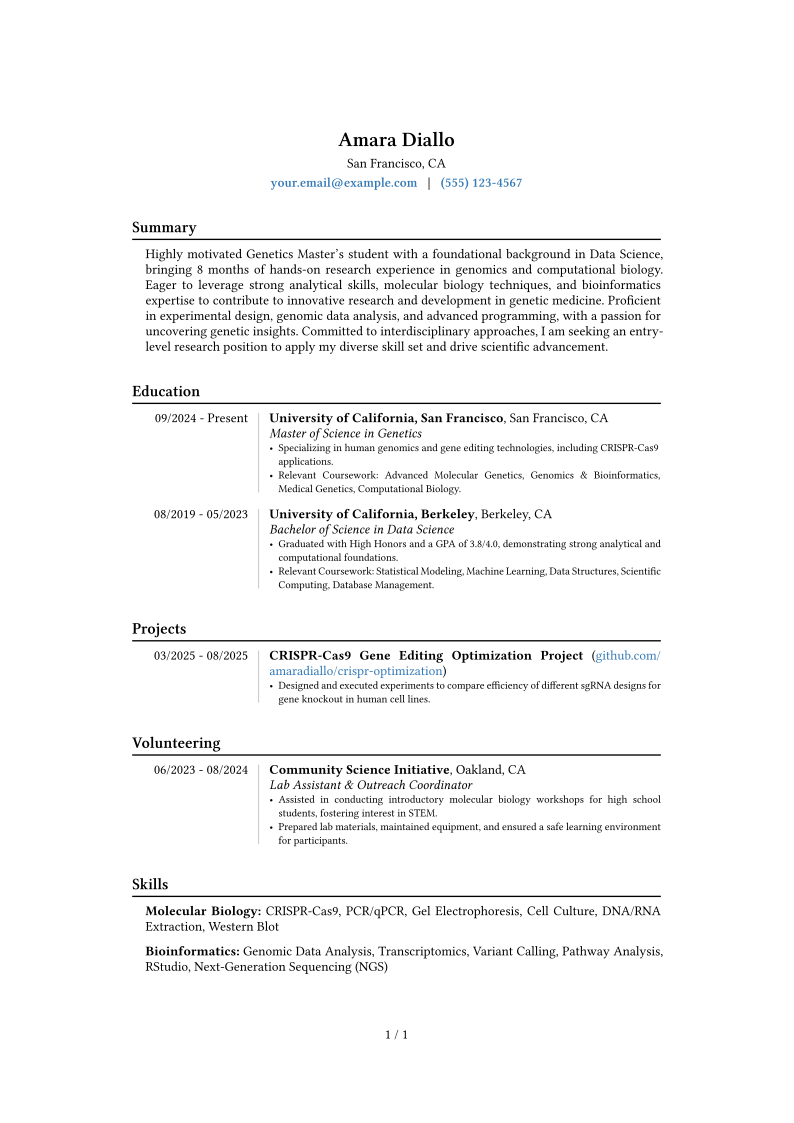
For Genetics Students eyeing roles in healthcare research, a resume must highlight practical lab proficiency and analytical acumen. Hiring managers in biotech companies and academic labs seek candidates who can immediately contribute to experimental pipelines. This includes demonstrated experience with core molecular biology techniques such as gene cloning, PCR, qPCR, and Western blot analyses. Familiarity with cell culture, genome editing tools like CRISPR-Cas9, and data analysis software like GraphPad Prism or programming languages such as Python and R are highly valued. Strong resumes will also showcase the ability to interpret complex scientific data and communicate findings effectively, often through contributions to lab meetings or progress reports. Projects demonstrating initiative, such as “CRISPR-Cas9 Mediated Gene Editing in Zebrafish Models,” further signal a candidate's research potential.
Why this example works
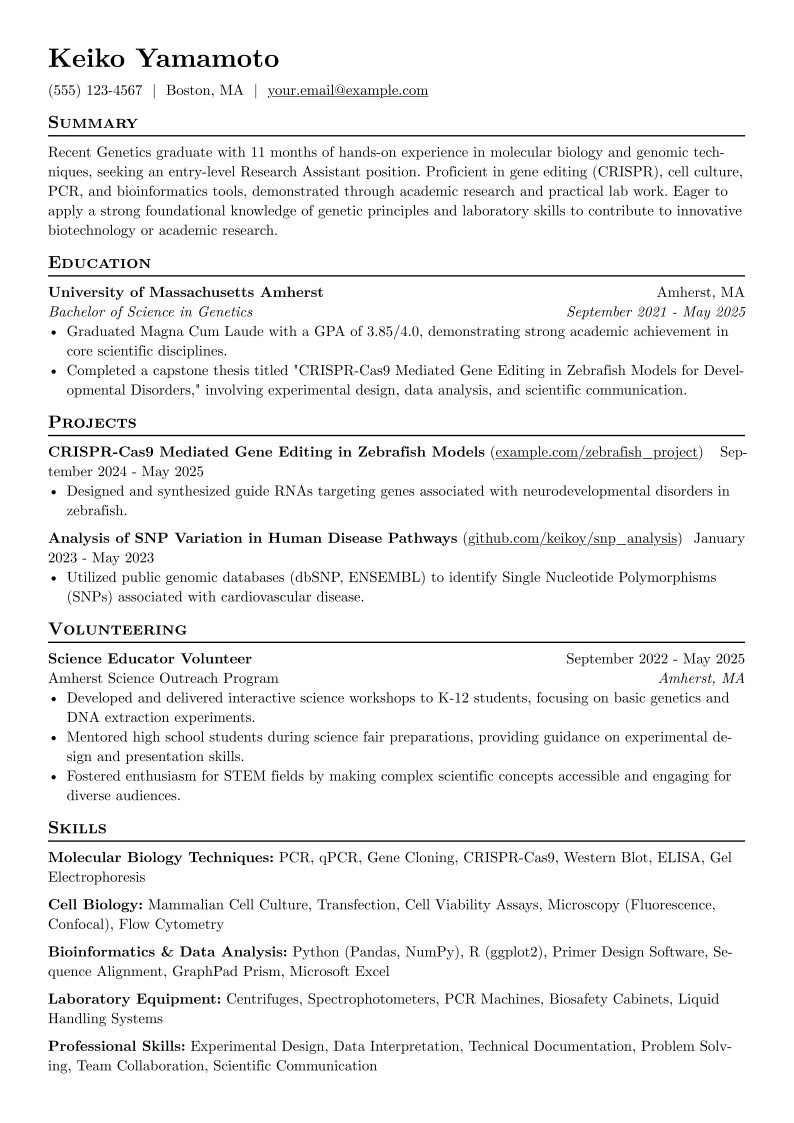
The provided “Genetics Student” example, for Keiko Yamamoto, effectively showcases these critical qualifications. The “Job” section bullet points immediately demonstrate hands-on experience, detailing specific techniques like “Performed gene cloning, PCR, qPCR, and Western blot analyses” and “Maintained mammalian cell cultures (HeLa, HEK293) and executed transfections.” Crucially, it highlights contributions to “CRISPR-Cas9 genome editing experiments” and “Analyzed experimental data using GraphPad Prism and Excel,” directly addressing key research demands. The comprehensive “Skills” section is exceptionally strong, categorizing expertise in “Molecular Biology Techniques,” “Cell Biology,” “Bioinformatics & Data Analysis,” and “Professional Skills,” listing specific software and tools like Python (Pandas, NumPy) and R (ggplot2), alongside “Experimental Design” and “Technical Documentation.”
How useful was this template?
Example by JobSprout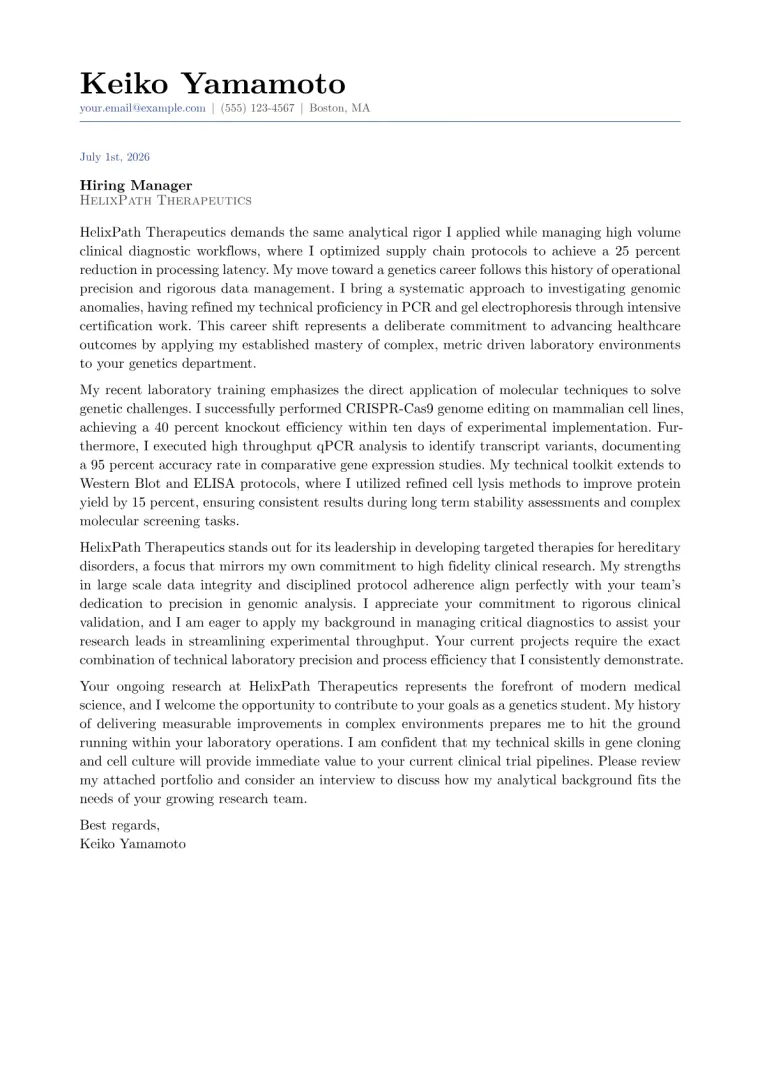
Genetics Student cover letter for a career changer
Written for the same situation as this resume.
Genetics Student resume summary example
Recent Genetics graduate with 11 months of hands-on experience in molecular biology and genomic techniques, seeking an entry-level Research Assistant position. Proficient in gene editing (CRISPR), cell culture, PCR, and bioinformatics tools, demonstrated through academic research and practical lab work. Eager to apply a strong foundational knowledge of genetic principles and laboratory skills to contribute to innovative biotechnology or academic research.
Genetics Student resume skills and keywords
Recruiters and applicant tracking systems scan Genetics Student resumes for these skills and keywords. Include the ones that match your experience and mirror the wording in the job description. Check your resume against them with the free ATS checker.
Hard skills
Tools & software
Certifications
Soft skills
Frequently Asked Questions
As a Genetics student, what's the best resume format to showcase my academic and lab experience?
What key laboratory techniques and analytical skills should a Genetics student highlight? Should I include specific software experience?
How do I write a resume summary that demonstrates my potential in genetics or healthcare with limited professional experience?
Are research projects, publications, or relevant coursework important to list as a Genetics student? What about specific lab certifications?
How does JobSprout's 'Remix with AI' assist me in adapting my Genetics student resume for different healthcare or research roles?
The blank page is the hard part. Skip it.
Free to use. No download fee.
Related Articles

Research CV: UK Format, Structure and Examples [2026]
How to write a research CV for UK universities and institutes. The section order panels expect, how to list publications and funding, and how long it should actually be.
Postdoc CV: Structure, Template and Example [2026]
What a postdoctoral CV needs that a doctoral one does not: independence, funding, and a publication list a panel can audit. With a full worked example.

Academic CV for PhD Applications: How to Write One [2026]
Learn how to write an academic CV for PhD applications. Real template analysis, what research committees look for, and common mistakes to avoid.