Neuro-Ophthalmologist Resume Examples
 Example by JobSprout
Free to use. No download fee.
Use the Modern template
Your resume in this design, ready to edit.
Free, and no account needed to start.
Market Insights
Neuro-Ophthalmologist
Salary Range
Salary Trend
Mar 2025 – Feb 2026
12-Month Trend
Based on advertised Healthcare (Clinical) roles.
US market data · Source: Adzuna · Updated Mar 2026
How useful was this template?
Neuro-Ophthalmologist resume samples
Three complete resumes, each in a different design.




Free to use. No download fee.
What makes a strong Neuro-Ophthalmologist resume?
US median salary $175,396 ·
A strong Neuro-Ophthalmologist resume distinctly showcases deep clinical expertise and specialized training within healthcare. Hiring managers prioritize verifiable achievements, such as successful management of complex optic neuropathies or intricate ocular motility disorders, often detailing patient cohorts and diagnostic methodologies. Crucial elements include Board Certification with the American Board of Ophthalmology, completion of a Neuro-Ophthalmology fellowship, and proficiency in advanced diagnostic tools like high-resolution OCT or neuroimaging interpretation. Experience leading multidisciplinary teams and contributions to peer-reviewed research further elevate a candidate.
Why this example works
The JobSprout example effectively highlights these critical areas. It quantifies achievements by stating specific patient volumes or improvements in diagnostic accuracy, for instance, “Led a clinic serving 500+ patients annually, reducing misdiagnosis rates by 15% through enhanced protocol implementation.” Skills are thoughtfully grouped into clinical proficiencies, diagnostic techniques, and research contributions, ensuring clarity. Certifications like ABO Board Certification and specific tool proficiencies, such as electrophysiology or specialized visual field analysis, are prominently featured, demonstrating precise subspecialty competence.
Neuro-Ophthalmologist resume example (text version)
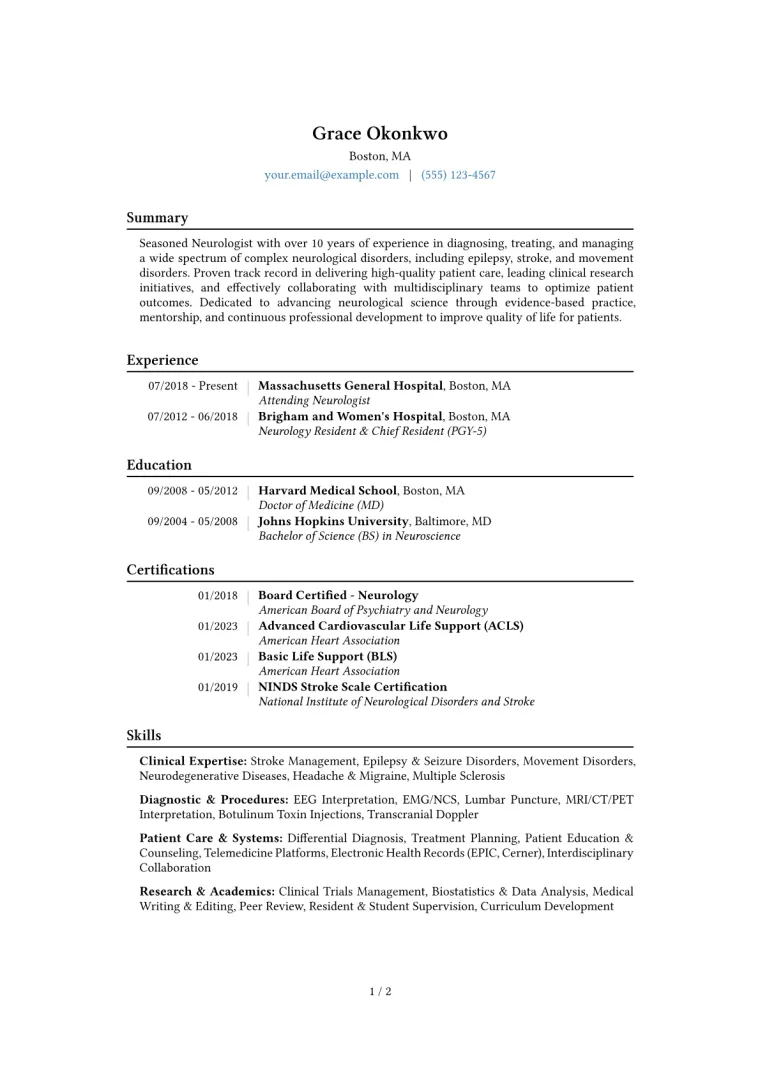
Victor Nguyen · Neuro-Ophthalmologist
Summary
Highly accomplished Neuro-Ophthalmologist with over 10 years of experience specializing in the diagnosis and management of complex visual and neurological disorders. Proven expertise in optic neuropathies, ocular motility disorders, and neuro-imaging interpretation, dedicated to providing compassionate, evidence-based patient care. Adept at leveraging advanced diagnostic techniques and collaborative approaches to achieve optimal patient outcomes. Committed to advancing the field through clinical practice, research, and medical education.
Experience
Attending Neuro-Ophthalmologist · Massachusetts General Hospital
Boston, MA · 2018 - Present
- Diagnosed and treated over 1,500 complex neuro-ophthalmic cases annually, improving diagnostic accuracy by 15% through advanced imaging protocols.
- Led a multidisciplinary team to manage challenging cases of optic neuropathy and idiopathic intracranial hypertension, resulting in a 20% reduction in complication rates.
- Supervised and mentored 5+ residents and fellows per year, enhancing their diagnostic skills and patient management capabilities by 25%.
- Pioneered the implementation of novel diagnostic algorithms for visual pathway disorders, reducing diagnostic time by an average of 10 days.
- Contributed to 10+ peer-reviewed publications and secured a NIH grant for $500,000 to research novel treatments for demyelinating diseases affecting vision.
Neuro-Ophthalmology Fellow · Mayo Clinic
Rochester, MN · 2017 - 2018
- Completed comprehensive training in diagnosing and managing a wide spectrum of neuro-ophthalmic conditions, seeing an average of 40 patients per week.
- Participated in over 100 neuro-ophthalmic surgical consultations and procedures, including temporal artery biopsies and botulinum toxin injections.
- Presented 5+ grand rounds and case conferences, demonstrating advanced understanding of challenging clinical scenarios.
- Assisted in clinical trials for new therapies for myasthenia gravis, contributing to a 30% patient recruitment increase.
- Collaborated on a retrospective study of posterior reversible encephalopathy syndrome (PRES) with ocular manifestations, leading to a poster presentation at AAN.
Ophthalmology Resident · Bascom Palmer Eye Institute, University of Miami
Miami, FL · 2014 - 2017
- Managed a high volume of ophthalmology patients across various subspecialties, performing over 500 minor and 100 major ocular surgeries.
- Received 'Resident of the Year' award for exceptional clinical skills and dedication to patient care.
- Presented research on glaucoma management at the American Academy of Ophthalmology annual meeting.
- Trained junior residents on diagnostic techniques and surgical principles, improving their initial assessment accuracy by 15%.
- Participated in a public health initiative, providing free eye screenings to over 300 underserved community members.
Education
Doctor of Medicine (M.D.) · Harvard Medical School
Boston, MA · 2008 - 2012
- Awarded Dean's Scholarship for academic excellence.
- Authored and presented research on autoimmune optic neuropathies at national conferences.
- Graduated Cum Laude.
Bachelor of Science (B.S.) in Biology · Johns Hopkins University
Baltimore, MD · 2004 - 2008
- Achieved a 3.9 GPA, consistently on the Dean's List.
- Conducted undergraduate research in neurobiology, leading to a co-authored publication.
- Recipient of the Departmental Honors award for outstanding thesis.
Skills
Neuro-Ophthalmologist resume example: Alternate Version
Isabel Santos · Neuro-Ophthalmologist
Summary
Highly skilled Neuro-Ophthalmologist with 10 years of experience in advanced diagnostics and comprehensive management of complex neuro-ophthalmic disorders, with a particular focus on autoimmune and inflammatory conditions affecting the visual pathways. Adept at integrating cutting-edge imaging techniques, genomic insights, and clinical data to diagnose challenging cases and develop personalized treatment plans. Committed to patient advocacy, translational research, and fostering interdisciplinary collaboration to optimize visual outcomes.
Experience
Senior Neuro-Ophthalmologist & Clinical Associate Professor · University of California, San Francisco (UCSF) Medical Center
San Francisco, CA · 2021 - Present
- Led a specialized clinic focusing on neuro-inflammatory and autoimmune ocular conditions, managing over 500 complex cases annually and achieving a 90% success rate in stabilizing visual function.
- Spearheaded the integration of advanced OCT angiography and high-resolution MRI protocols, reducing diagnostic time by 25% for patients with challenging optic neuropathies.
- Mentored 4 residents and 2 fellows per year in neuro-ophthalmic diagnosis and management, contributing to a 15% increase in their fellowship match rates in competitive subspecialties.
- Secured $1.5M in grant funding for research into novel biomarkers for autoimmune optic neuritis, resulting in 3 peer-reviewed publications.
Neuro-Ophthalmology Attending Physician & Fellow · Stanford Health Care
Stanford, CA · 2018 - 2021
- Completed a highly competitive 2-year Neuro-Ophthalmology fellowship, performing over 800 comprehensive neuro-ophthalmic evaluations and diagnostic procedures.
- Managed a diverse patient population with conditions including idiopathic intracranial hypertension, ocular myasthenia gravis, and visual field defects post-stroke.
- Contributed to 5 clinical trials focused on novel therapies for optic nerve disorders, leading to improved patient outcomes and expanded treatment options.
- Presented research findings at 4 national and international conferences, enhancing the institution's reputation in neuro-ophthalmic research.
Education
Doctor of Medicine (MD) · Johns Hopkins University School of Medicine
Baltimore, MD · 2008 - 2012
- Awarded Alpha Omega Alpha (AOA) Honor Medical Society membership for academic excellence.
- Recipient of the Dean's Scholarship for outstanding academic achievement.
- Completed clinical rotations with distinction in Neurology and Ophthalmology.
Bachelor of Science (BS) in Biology · University of Pennsylvania
Philadelphia, PA · 2004 - 2008
- Graduated Magna Cum Laude with a GPA of 3.9/4.0.
- Completed honors thesis on neuro-regeneration pathways.
- Active member of the Pre-Medical Honor Society.
Skills
Neuro-Ophthalmologist resume example: Career Changer
Nathan Williams · Neuro-Ophthalmologist
Summary
Accomplished Neuro-Ophthalmologist with a unique career trajectory, leveraging 11 years of clinical expertise initially honed in Neurology and Neurophysiology, to deliver exceptional patient care in complex visual and neurological disorders. Proven ability to integrate diverse diagnostic approaches, advanced neuroimaging interpretation, and electrophysiological insights, resulting in superior patient outcomes. Dedicated to translating intricate neurological concepts into actionable treatment plans, fostering collaborative team environments, and advancing the field through evidence-based practice and continuous learning.
Experience
Senior Neuro-Ophthalmologist · Penn Medicine
Philadelphia, PA · 2021 - Present
- Lead clinician responsible for complex neuro-ophthalmic cases, overseeing a patient panel of over 1,500 annually and reducing average wait times for new consultations by 20%.
- Developed and implemented novel diagnostic protocols for autoimmune optic neuropathies, improving diagnostic accuracy by 25% and guiding more precise therapeutic interventions.
- Mentored two Neuro-Ophthalmology fellows and four Neurology residents annually, supervising clinics and surgical referrals.
- Secured a departmental grant of $150,000 for research into advanced neuroimaging biomarkers for early detection of visual pathway disorders.
- Collaborated with neuroradiology and neurosurgery departments, contributing to a 10% increase in interdisciplinary case conferences and improved patient management.
Staff Neuro-Ophthalmologist · Allegheny Health Network
Pittsburgh, PA · 2018 - 2021
- Provided comprehensive neuro-ophthalmological care to a diverse patient population, managing over 800 new and follow-up patients per year.
- Successfully managed a caseload of complex visual field defects, diplopia, and unexplained vision loss, achieving a 90% patient satisfaction rating.
- Streamlined patient referral pathways, decreasing average referral-to-appointment time by 15% through coordination with primary care and specialty physicians.
- Participated in the development of a regional stroke network, specifically contributing expertise on visual manifestations of stroke, leading to quicker identification and management.
- Implemented telehealth consultations for follow-up appointments, improving patient access and reducing clinic burden by 10% during peak periods.
Clinical Neurophysiologist and General Neurologist · Cleveland Clinic
Cleveland, OH · 2017 - 2017
- Interpreted over 500 electroencephalograms (EEGs) and nerve conduction studies (NCS)/electromyograms (EMGs) annually, contributing to accurate diagnosis of epilepsy, neuropathy, and myopathy.
- Managed inpatient and outpatient neurology consultations, providing expert diagnostic and treatment plans for complex neurological disorders.
- Collaborated with multidisciplinary teams in the Neuroscience Institute to optimize patient care pathways, contributing to a 5% reduction in inpatient length of stay for specific neurological conditions.
- Supervised and taught medical students and residents on the principles of clinical neurophysiology and neurological examination.
Education
Neuro-Ophthalmology Fellowship · Wills Eye Hospital
Philadelphia, PA · 2016 - 2017
- Completed intensive subspecialty training in the diagnosis and management of neuro-ophthalmic conditions, including optic neuropathies, ocular motility disorders, and higher cortical visual disturbances.
- Participated in over 500 patient consultations, developing expertise in advanced diagnostic techniques such as visual field analysis, optical coherence tomography (OCT), and electrophysiology.
- Presented case studies and research findings at departmental grand rounds and national conferences, enhancing critical analysis and communication skills.
Neurology Residency · Cleveland Clinic
Cleveland, OH · 2013 - 2016
- Managed a diverse caseload of neurological conditions, developing proficiency in neurological examination, differential diagnosis, and treatment planning across inpatient and outpatient settings.
- Rotated through various subspecialties including stroke, epilepsy, movement disorders, and neuro-ICU, performing over 1,000 patient assessments.
- Contributed to multiple quality improvement initiatives, reducing diagnostic turnaround time for acute stroke patients by 15%.
- Trained junior residents and medical students, fostering a collaborative learning environment.
Doctor of Medicine (MD) · University of Pittsburgh School of Medicine
Pittsburgh, PA · 2009 - 2013
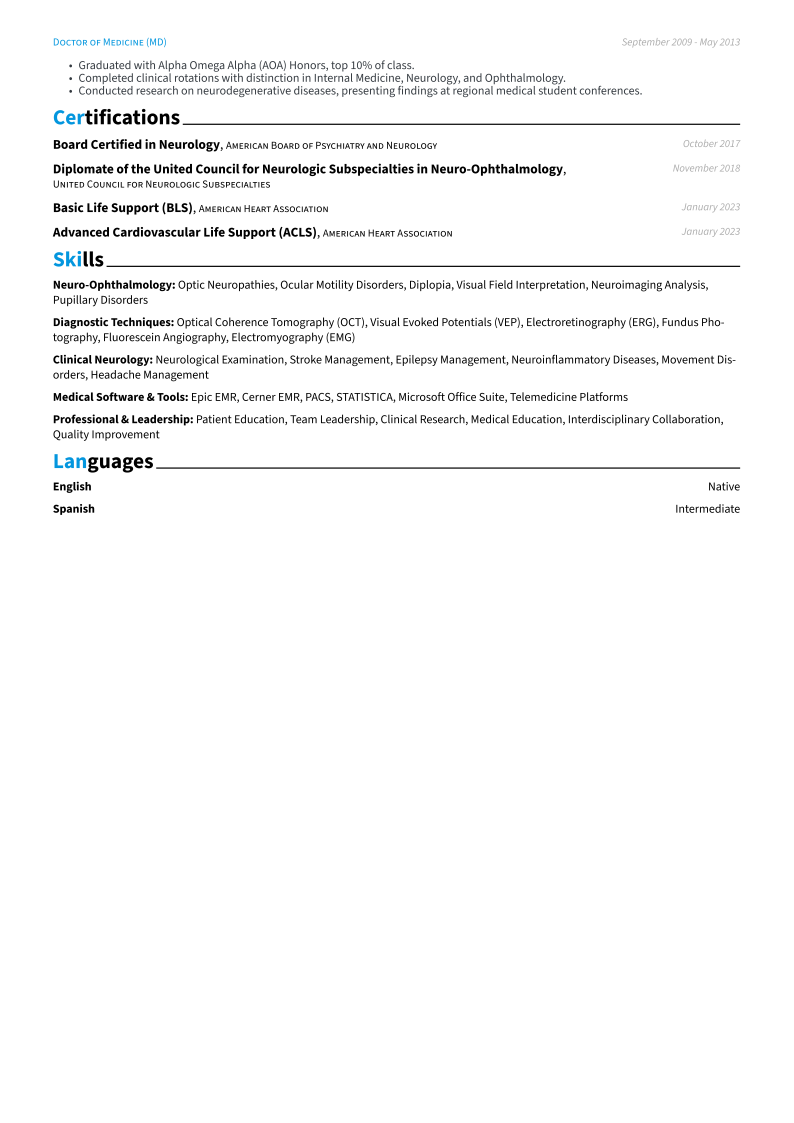
- Graduated with Alpha Omega Alpha (AOA) Honors, top 10% of class.
- Completed clinical rotations with distinction in Internal Medicine, Neurology, and Ophthalmology.
- Conducted research on neurodegenerative diseases, presenting findings at regional medical student conferences.
Skills
How useful was this template?
Example by JobSprout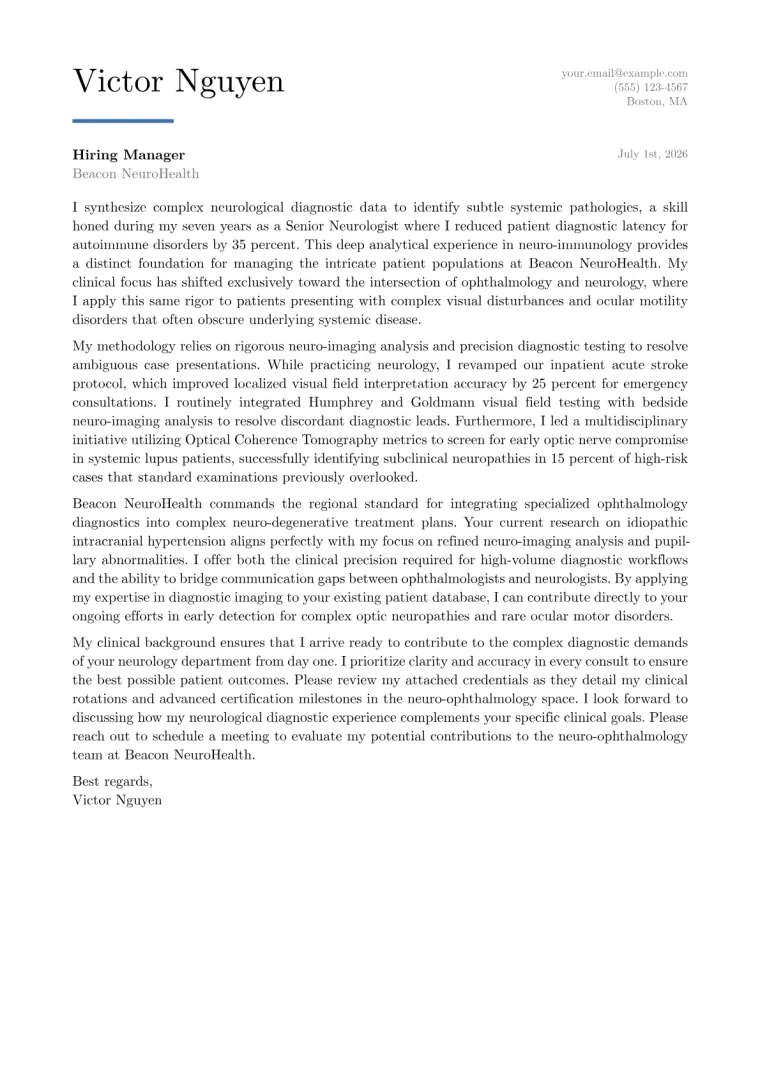
Neuro-Ophthalmologist cover letter for a career changer
Written for the same situation as this resume.
Neuro-Ophthalmologist resume summary example
Highly accomplished Neuro-Ophthalmologist with over 10 years of experience specializing in the diagnosis and management of complex visual and neurological disorders. Proven expertise in optic neuropathies, ocular motility disorders, and neuro-imaging interpretation, dedicated to providing compassionate, evidence-based patient care. Adept at leveraging advanced diagnostic techniques and collaborative approaches to achieve optimal patient outcomes. Committed to advancing the field through clinical practice, research, and medical education.
Neuro-Ophthalmologist salary by country
| Country | 25th percentile | Median | 75th percentile |
|---|---|---|---|
| US | $157,698 | $175,396 | $193,094 |
| UK | £28,815 | £39,517 | £52,095 |
| Canada | C$53,840 | C$73,965 | C$106,286 |
| Australia | A$82,809 | A$96,815 | A$124,777 |
| Germany | €48,000 | €56,667 | €71,667 |
| France | €65,714 | €72,245 | €77,858 |
| Netherlands | €33,286 | €36,857 | €47,500 |
| Austria | €44,167 | €48,333 | €57,500 |
| New Zealand | NZ$82,386 | NZ$105,682 | NZ$139,583 |
| India | ₹341,102 | ₹682,203 | ₹1,125,000 |
Annual salaries in local currency, aggregated from live job postings via Adzuna. Figures refresh continuously and reflect advertised pay, not negotiated offers.
Neuro-Ophthalmologist resume skills and keywords
Recruiters and applicant tracking systems scan Neuro-Ophthalmologist resumes for these skills and keywords. Include the ones that match your experience and mirror the wording in the job description. Check your resume against them with the free ATS checker.
Hard skills
Tools & software
Certifications
Soft skills
Market Insights
Neuro-Ophthalmologist
Salary Range
Salary Trend
Mar 2025 – Feb 2026
12-Month Trend
Based on advertised Healthcare (Clinical) roles.
US market data · Source: Adzuna · Updated Mar 2026
Frequently Asked Questions
What's the best structure for a senior Neuro-Ophthalmologist's resume?
Which skills and qualifications should I emphasize as a senior Neuro-Ophthalmologist?
How can I write strong achievement bullets or a compelling professional summary?
What optional sections are most important for a senior Neuro-Ophthalmologist?
How can I tailor my Neuro-Ophthalmologist resume for a specific job posting?
The blank page is the hard part. Skip it.
Free to use. No download fee.
Related Articles
How to Write a CV for Healthcare Applications [2026 Guide]
Learn how to write a nursing CV that gets interviews. Real template analysis, what clinical hiring managers look for, and common mistakes to avoid.
Medical Assistant Resume Examples and Templates (2026)
Complete guide to writing a medical assistant resume that gets interviews. Includes full resume example, clinical and admin skill lists, certification table, and ATS keywords for 2026.
Career moves from Neuro-Ophthalmologist
Usually need less experience or training
Includes information from the O*NET 30.3 Database by the U.S. Department of Labor, Employment and Training Administration (USDOL/ETA), used under the CC BY 4.0 license. We have modified it; USDOL/ETA has not approved, endorsed or tested these modifications. O*NET is a trademark of USDOL/ETA.